
Ascending pathway
Reading File
Ascending pathways (also called somatosensory/sensory tracts) carry sensory information from the body up the spinal cord to the brain. The two main systems are the dorsal column-medial lemniscal pathway (fine touch, proprioception, vibration) and the anterolateral system (pain, temperature, crude touch).
Searching sources...
Finding Sources
Finding Sources
Finding Sources
Finding Sources
Reading File
That result covers auditory ascending pathways. Let me search more specifically for somatosensory ascending tracts.
Finding Sources
Finding Sources
Finding Sources
Finding Sources
Good - found rich content. Let me read the key sections on ascending pathways from multiple sources simultaneously.
Reading File
Reading File
Reading File
Excellent - now let me read more on the anterolateral system (spinothalamic tract) and fetch key diagrams.
Reading File
Loading Image
Now let me get the anterolateral/spinothalamic content and another diagram.
Reading File
Reading File
Loading Image
Reading File
I now have comprehensive information. Let me also get the spinothalamic/anterolateral section content from the Neuroscience textbook.
Finding Sources
I have more than enough material for a comprehensive answer. Let me now compose it.
Ascending (Sensory) Pathways
Ascending pathways carry sensory information from peripheral receptors up through the spinal cord to the brain. There are two principal systems, each handling different sensory modalities and crossing the midline at different levels.
Overview Diagram
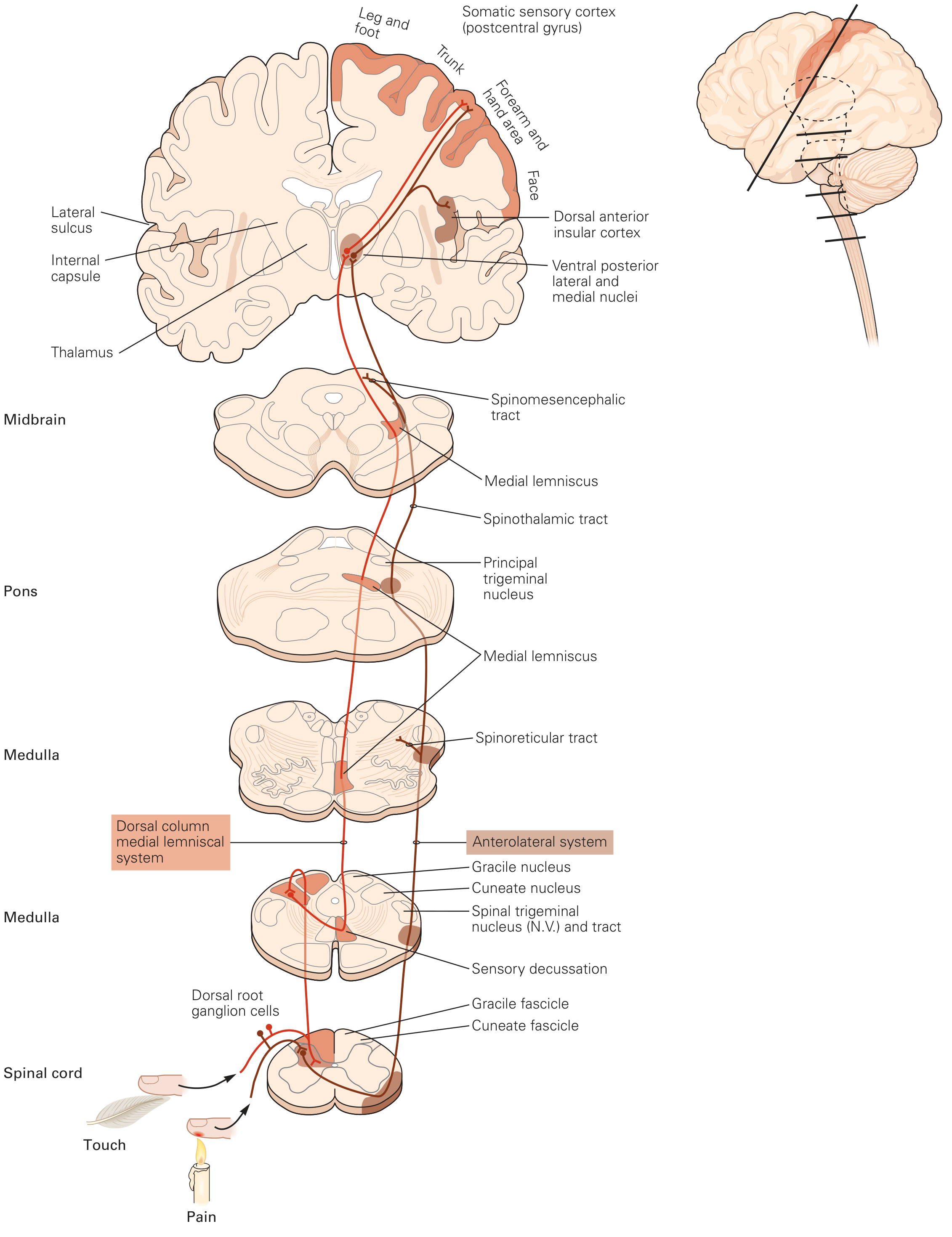
Both ascending systems shown: dorsal column-medial lemniscal (touch, proprioception) and anterolateral system (pain, temperature). - Kandel, Principles of Neural Science 6th ed.
1. Dorsal Column - Medial Lemniscal (DCML) Pathway
Modalities: Fine/discriminative touch, vibration, proprioception (conscious position sense), two-point discrimination
Fiber type: Large-diameter, heavily myelinated Aβ fibers (fast conduction)
Course (3-neuron chain):
| Neuron | Location | Key Detail |
|---|---|---|
| 1st order | Dorsal root ganglion (DRG) | Enters ipsilateral dorsal column; does NOT synapse in dorsal horn |
| 2nd order | Dorsal column nuclei (medulla) | Gracile nucleus (lower body - T6 and below); Cuneate nucleus (upper body - T6 and above) |
| 3rd order | VPL/VPM of thalamus | Projects to primary somatosensory cortex (S1, postcentral gyrus) |
Key features:
- Fibers from the lower body travel in the gracile fasciculus (medial)
- Fibers from the upper body travel in the cuneate fasciculus (lateral)
- Decussation (crossing) occurs in the medulla - second-order axons from dorsal column nuclei cross the midline to form the medial lemniscus
- Maintains strict somatotopic organization throughout
- Touch/proprioception signals are segregated: rostral dorsal column nuclei handle proprioception, caudal handle tactile input
- Thalamic relay: limb/trunk touch → VPL nucleus → area 3b of S1; face → VPM nucleus → area 3b; proprioception → VPS nucleus → area 3a
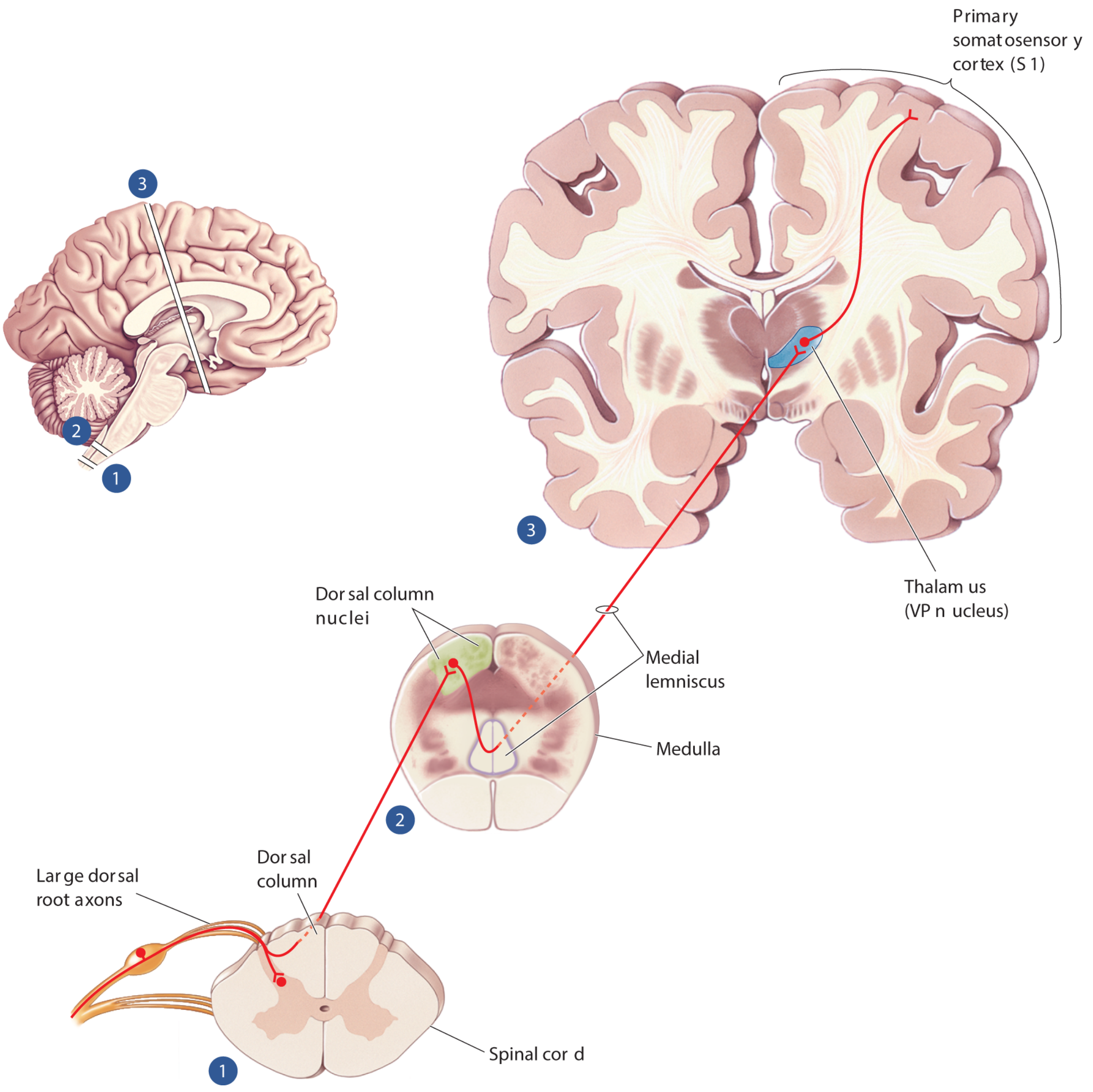
3-neuron relay of the DCML pathway. - Neuroscience: Exploring the Brain, 5th ed.
2. Anterolateral System (ALS)
Modalities: Pain, temperature, itch, crude touch, visceral sensations
Fiber type: Small-diameter myelinated (Aδ) and unmyelinated (C) fibers (slow conduction)
Course (3-neuron chain):
| Neuron | Location | Key Detail |
|---|---|---|
| 1st order | Dorsal root ganglion (DRG) | Enters and synapses in the ipsilateral dorsal horn (Rexed laminae I, II, V) |
| 2nd order | Dorsal horn (spinal cord) | Crosses midline within the spinal cord (via the anterior white commissure), then ascends contralaterally |
| 3rd order | Thalamus (VPL) | Projects to somatosensory cortex and other areas |
Sub-tracts of the ALS:
- Spinothalamic tract - the largest component; carries pain and temperature to VPL thalamus, then to S1 cortex (discriminative pain) and anterior cingulate/insula (affective component)
- Spinoreticular tract - terminates in brainstem reticular formation (mediates arousal and diffuse pain responses)
- Spinomesencephalic tract - terminates in the periaqueductal gray (PAG) and superior colliculus; involved in descending pain modulation and orienting
Key features:
- Decussation occurs in the spinal cord (within 1-2 segments of entry), contrast to DCML which crosses in the medulla
- Clinical implication: a hemisection of the spinal cord (Brown-Séquard syndrome) causes ipsilateral loss of fine touch/proprioception and contralateral loss of pain/temperature at the same level
3. Trigeminal (Face) Pathway
The face is not served by spinal dorsal roots. Instead:
- CN V (trigeminal nerve) carries fine touch, pain, and temperature from the face
- Large-diameter (touch) fibers synapse in the principal (main) sensory nucleus of CN V in the pons
- Small-diameter (pain/temperature) fibers descend to the spinal trigeminal nucleus
- Both second-order neurons cross the midline and ascend to the VPM nucleus of the thalamus, then to S1 cortex
4. Cortical Processing
All three major pathways ultimately reach the primary somatosensory cortex (S1) in the postcentral gyrus of the parietal lobe (Brodmann areas 3a, 3b, 1, 2).
S1 is organized somatotopically - the "sensory homunculus" maps body parts onto cortical surface:
- Feet/legs: superior/medial cortex
- Trunk, hand, face: progressively more lateral
- Areas with high tactile acuity (hands, lips) have disproportionately large representation
S1 is organized into vertical columns (~300-600 µm wide), each processing input from one skin area and one receptor class. Information then flows to secondary somatosensory cortex (S2) and posterior parietal cortex for higher-order integration.
Comparison Summary
| Feature | DCML Pathway | Anterolateral System |
|---|---|---|
| Modalities | Fine touch, vibration, proprioception | Pain, temperature, itch, crude touch |
| Fiber type | Large myelinated (Aβ) | Small myelinated (Aδ) and unmyelinated (C) |
| 1st synapse | Dorsal column nuclei (medulla) | Dorsal horn (spinal cord) |
| Decussation | Medulla | Spinal cord (1-2 segments above entry) |
| Ascent | Ipsilateral in cord, then contralateral medial lemniscus | Contralateral from start (in cord) |
| Thalamic nucleus | VPL (body), VPM (face), VPS (proprioception) | VPL (spinothalamic) |
| Cortical target | S1 areas 3a/3b | S1, anterior cingulate, insula |
| Brown-Séquard | Ipsilateral loss | Contralateral loss |
Sources: Kandel et al., Principles of Neural Science, 6th ed. | Neuroscience: Exploring the Brain, 5th ed.
This is a shared conversation. Sign in to Orris to start your own chat.