
Pathogenesis of carcinoma colon
colorectal cancer AND carcinogenesis
NCI colorectal cancer genetics APC KRAS TP53 mismatch repair pathogenesis
https://www.cancer.gov/types/colorectal/hp/colorectal-geneti…
Pathogenesis of carcinoma colon
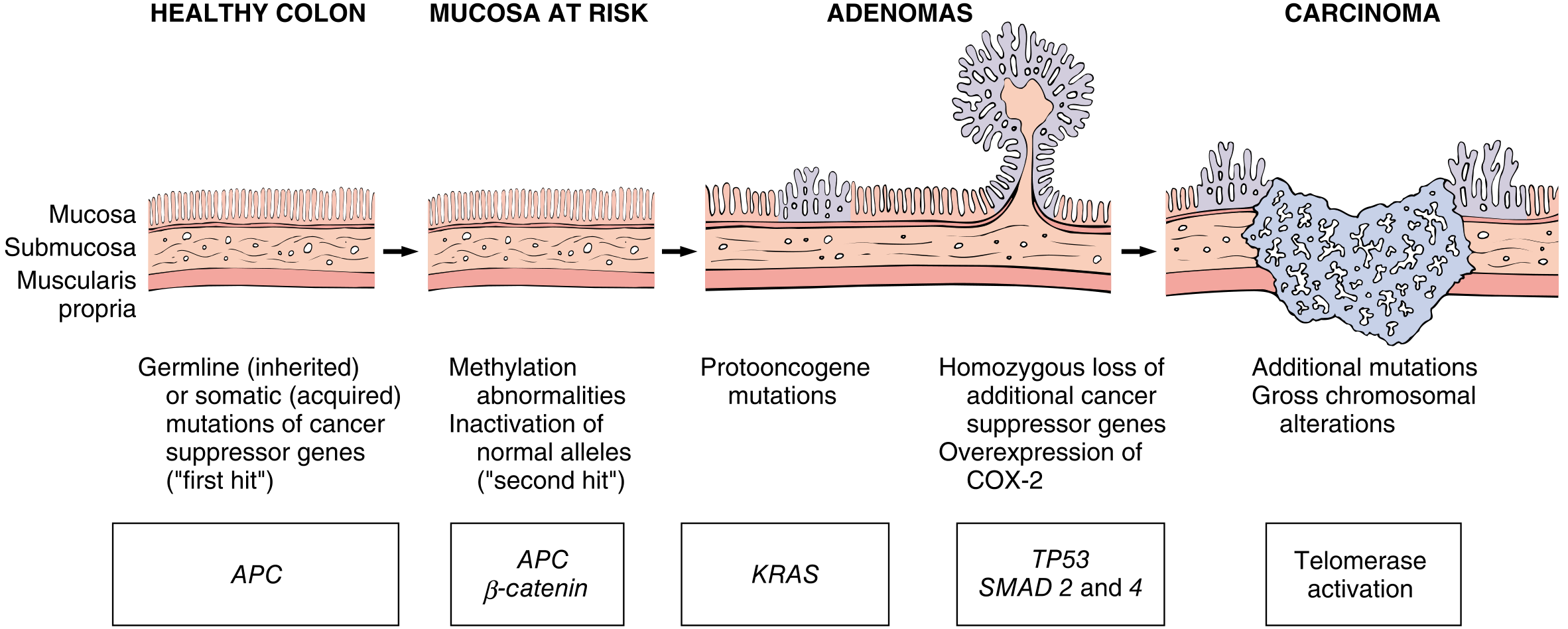
1. Conventional adenoma-carcinoma sequence: chromosomal instability pathway
| Molecular event | Main effect |
|---|---|
| APC loss on chromosome 5q, an early event | Failure to degrade β-catenin → activation of WNT signaling → increased crypt-cell proliferation and adenoma formation |
| KRAS activation | Persistent RAS-MAPK signaling → increased growth, survival and progression to larger adenoma |
| Loss of SMAD2/SMAD4 or other 18q changes | Loss of TGF-β mediated growth inhibition |
| TP53 loss on chromosome 17p, usually late | Loss of DNA-damage checkpoint and apoptosis → invasion and carcinoma |
Robbins, Cotran & Kumar Pathologic Basis of Disease, p. 758.
2. Microsatellite instability pathway: defective DNA mismatch repair
- MLH1
- MSH2
- MSH6
- PMS2
- Lynch syndrome: inherited pathogenic variant in an MMR gene, followed by somatic loss of the remaining normal allele.
- Sporadic MSI cancers commonly result from hypermethylation of the MLH1 promoter.
3. Serrated pathway: CpG-island methylator phenotype
- Activating BRAF mutation
- Widespread promoter CpG-island hypermethylation, called CIMP
- Silencing of tumor-suppressor genes, often including MLH1
- If MLH1 is silenced, the tumor becomes MSI-high
4. Role of chronic inflammation
5. Environmental and host factors promoting carcinogenesis
- Diet high in processed/red meat and fat, low fibre intake
- Obesity, insulin resistance and type 2 diabetes
- Smoking and alcohol
- Increasing age
- Family history and inherited syndromes
- Chronic inflammatory bowel disease
Robbins, Cotran & Kumar Pathologic Basis of Disease, p. 758.
Exam summary
-
CIN / adenoma-carcinoma pathway:
APC → KRAS → SMAD/DCC loss → TP53 loss -
MSI pathway:
Defective MLH1, MSH2, MSH6, PMS2 mismatch repair, classically in Lynch syndrome. -
Serrated/CIMP pathway:
BRAF mutation + CpG methylation, often causing MLH1 silencing and MSI.
Make a flowchart of the pathogensis
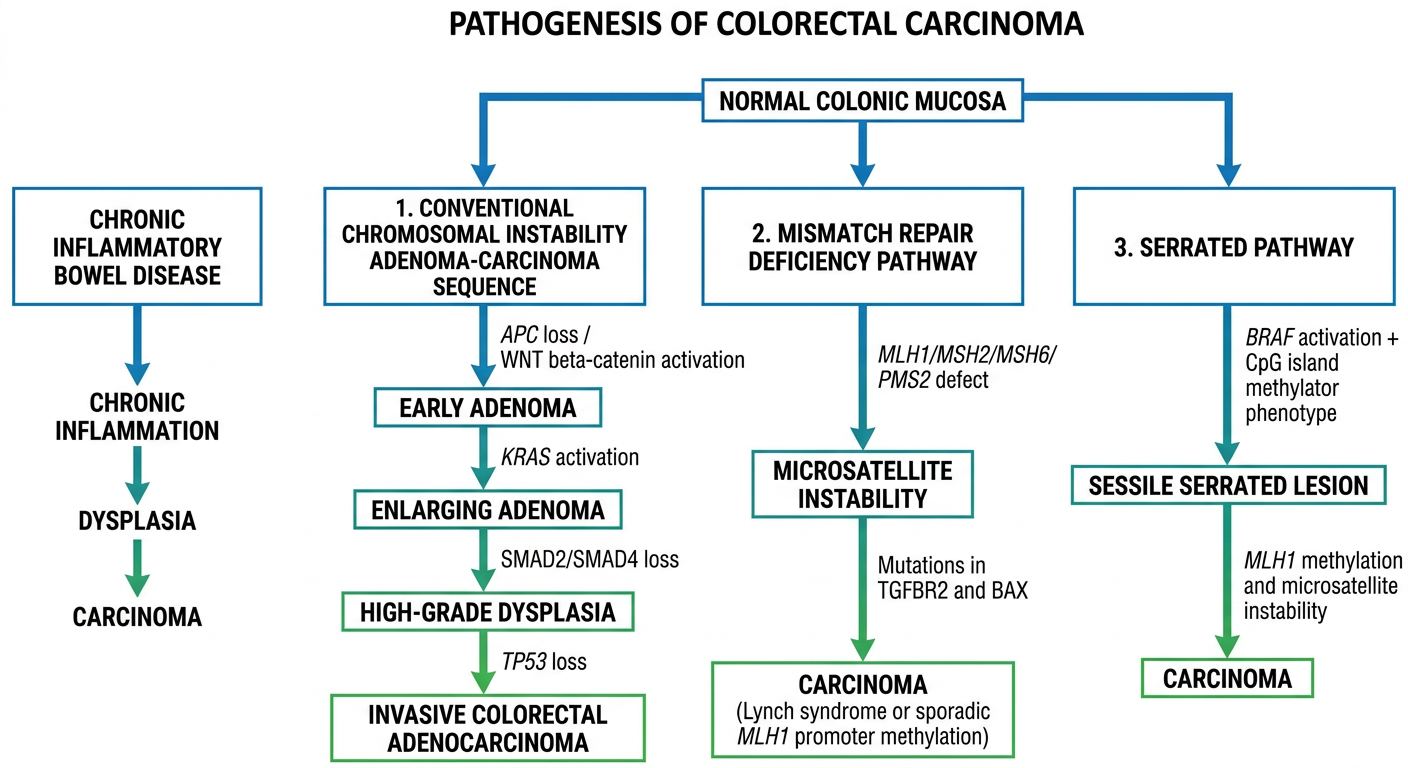
Educational medical flowchart showing the pathogenesis of colorectal carcinoma. Start with normal colonic mucosa, then split into three clear pathways: (1) conventional chromosomal instability adenoma-carcinoma sequence: APC loss/WNT beta-catenin activation to early adenoma, KRAS activation to enlarging adenoma, SMAD2/SMAD4 loss to high-grade dysplasia, TP53 loss to invasive colorectal adenocarcinoma; (2) mismatch repair deficiency pathway: MLH1/MSH2/MSH6/PMS2 defect to microsatellite instability to mutations in TGFBR2 and BAX to carcinoma, labeled Lynch syndrome or sporadic MLH1 promoter methylation; (3) serrated pathway: BRAF activation plus CpG island methylator phenotype to sessile serrated lesion, MLH1 methylation and microsatellite instability to carcinoma. Add a side branch chronic inflammatory bowel disease to chronic inflammation, dysplasia, carcinoma. Use accurate spelling, concise labels, arrows, and a clean white-background exam revision diagram.
Flowchart: Pathogenesis of carcinoma colon
↓
APC mutation / WNT-β-catenin activation
↓
Early adenoma
↓
KRAS activation
↓
Large adenoma
↓
SMAD2/SMAD4 loss, 18q deletion
↓
High-grade dysplasia
↓
TP53 loss
↓
Invasive colorectal adenocarcinoma