
Step of glucose production in process of gluconeogenesis
Gluconeogenesis synthesizes glucose from non-carbohydrate precursors (pyruvate, lactate, oxaloacetate, glycerol, glucogenic amino acids). It occurs mainly in the liver and to a lesser extent the kidneys. The pathway is essentially the reverse of glycolysis, except at three irreversible steps that require unique bypass enzymes.
Searching sources...
Reading File
Finding Sources
Searching the Web
gluconeogenesis steps glucose production pathway biochemistry
The best sources are the Lippincott Biochemistry textbook and Basic Medical Biochemistry. Let me read both in parallel.
Reading File
Reading File
Good content so far. Let me read the detailed enzymatic steps from Lippincott and also fetch the pathway diagram.
Reading File
Loading Image
Reading File
I now have comprehensive detail from Lippincott's Illustrated Reviews: Biochemistry (8th ed.). Let me compile the full answer.
Gluconeogenesis: Steps of Glucose Production
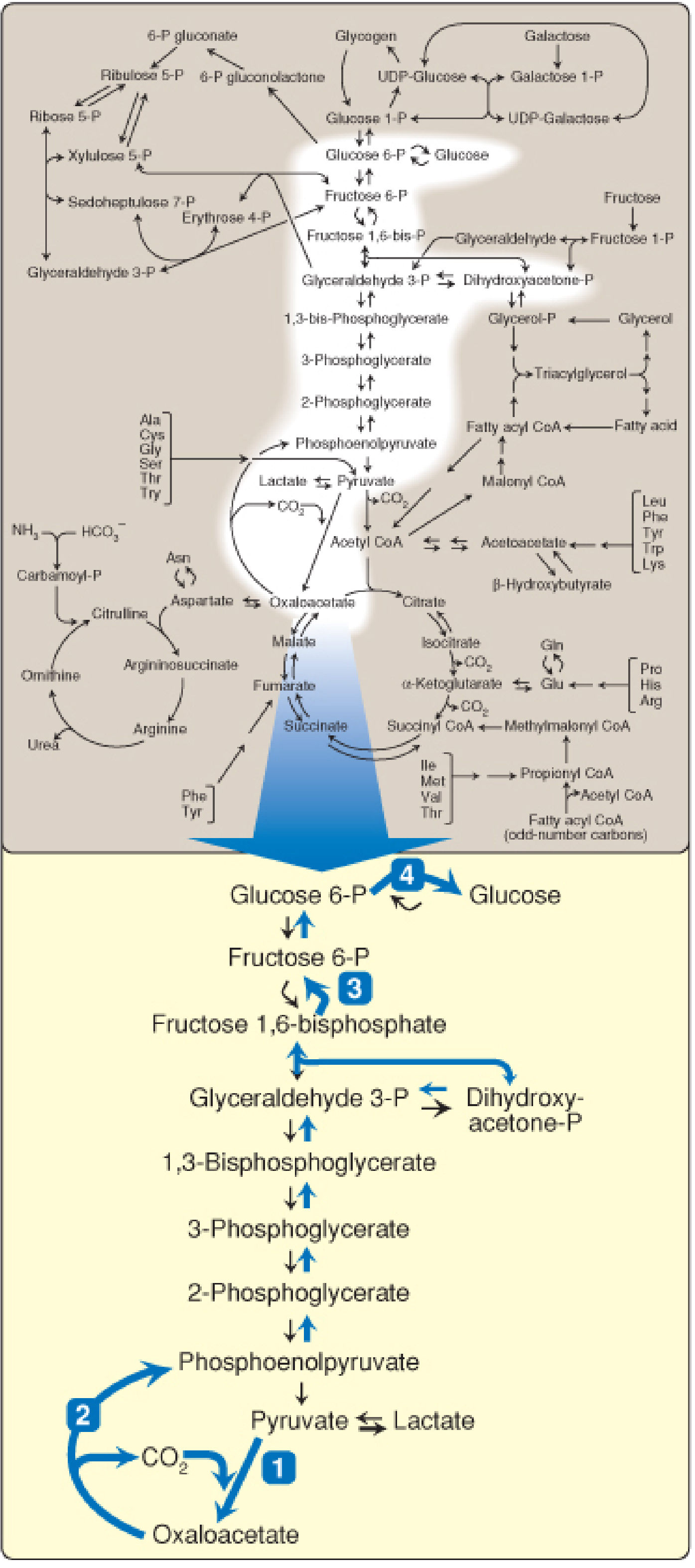
Gluconeogenesis is the synthesis of glucose from non-carbohydrate precursors. It is essentially the reverse of glycolysis, except at three irreversible glycolytic steps that are bypassed by four unique gluconeogenic reactions.
Precursors (Substrates)
| Precursor | Source | Entry Point |
|---|---|---|
| Pyruvate / Lactate | Muscle (anaerobic glycolysis), RBCs | Converted to OAA -> PEP |
| Glycerol | Adipose tissue (TAG hydrolysis) | Glycerol 3-P -> DHAP |
| Glucogenic amino acids | Muscle protein hydrolysis | Alpha-keto acids -> OAA or pyruvate |
Leucine and lysine are the only purely ketogenic amino acids - they cannot contribute to net glucose synthesis.
The 10 Steps (Starting from Pyruvate)
Seven of the ten steps are shared reversals of glycolysis. Three glycolytic reactions are irreversible and require four unique bypass reactions in gluconeogenesis.
Step 1 - Pyruvate → Oxaloacetate (OAA)
Enzyme: Pyruvate carboxylase (PC)
Location: Mitochondrial matrix
Cofactors: Biotin (covalently bound to enzyme), ATP, HCO3-
Regulation: Allosterically activated by acetyl-CoA (high fat oxidation signals glucose is needed)
Pyruvate + HCO3- + ATP → Oxaloacetate + ADP + Pi
This bypasses the irreversible pyruvate kinase reaction of glycolysis.
Step 2 - OAA → Phosphoenolpyruvate (PEP)
Enzyme: PEP carboxykinase (PEPCK)
Location: Cytosol (requires transport of OAA out of mitochondria)
Cofactors: GTP
OAA + GTP → PEP + CO2 + GDP
Since the inner mitochondrial membrane has no OAA transporter, OAA is first reduced to malate by mitochondrial malate dehydrogenase, transported to the cytosol, then reoxidized to OAA by cytosolic malate dehydrogenase (generating cytosolic NADH needed for later steps).
Steps 3-9 - PEP → Fructose 1,6-bisphosphate (Shared Reversals of Glycolysis)
These seven reactions proceed in the reverse direction of glycolysis using the same enzymes:
| Step | Reaction |
|---|---|
| 3 | PEP → 2-phosphoglycerate (enolase, reverse) |
| 4 | 2-phosphoglycerate → 3-phosphoglycerate (phosphoglycerate mutase, reverse) |
| 5 | 3-phosphoglycerate → 1,3-bisphosphoglycerate (phosphoglycerate kinase, reverse; requires ATP) |
| 6 | 1,3-bisphosphoglycerate → glyceraldehyde 3-phosphate (G3P dehydrogenase, reverse; uses NADH) |
| 7 | G3P ↔ DHAP (triose phosphate isomerase) |
| 8 | G3P + DHAP → fructose 1,6-bisphosphate (aldolase, reverse) |
Step 9 - Fructose 1,6-bisphosphate → Fructose 6-phosphate
Enzyme: Fructose 1,6-bisphosphatase (FBPase-1)
Location: Cytosol
Energy: Hydrolysis (not reversal of PFK-1)
Fructose 1,6-bisphosphate + H2O → Fructose 6-phosphate + Pi
Regulation:
- Inhibited by AMP (low-energy signal) and fructose 2,6-bisphosphate (high when insulin is dominant)
- Activated by citrate and high ATP
- This is the rate-limiting step of gluconeogenesis
Step 10 - Fructose 6-phosphate → Glucose 6-phosphate → Glucose
Fructose 6-phosphate → Glucose 6-phosphate: Phosphoglucose isomerase (same as glycolysis, reversible)
Glucose 6-phosphate → Free Glucose:
Enzyme: Glucose 6-phosphatase (G6Pase)
Location: Endoplasmic reticulum of liver and kidneys
Energy: Hydrolysis
Glucose 6-phosphate + H2O → Glucose + Pi
This final step is absent in muscle and brain cells, which is why only liver and kidneys can release free glucose into the blood.
Summary: The 4 Unique Gluconeogenic Bypass Reactions
| # | Glycolytic Irreversible Step | Gluconeogenic Bypass | Enzyme |
|---|---|---|---|
| 1 | Pyruvate kinase (PEP → Pyruvate) | Pyruvate → OAA → PEP | PC + PEPCK |
| 2 | PFK-1 (F6P → F1,6-BP) | F1,6-BP → F6P | Fructose 1,6-bisphosphatase |
| 3 | Hexokinase (Glucose → G6P) | G6P → Glucose | Glucose 6-phosphatase |
Energy Cost of Gluconeogenesis
Making 1 glucose molecule from 2 pyruvate molecules costs:
- 4 ATP + 2 GTP + 2 NADH consumed
- Compare with glycolysis, which yields 2 ATP net per glucose
The high energy cost is why gluconeogenesis is tightly regulated and only activated during fasting, prolonged exercise, or stress.
Regulation Summary
| Condition | Effect | Mediators |
|---|---|---|
| Fasting / Glucagon | Stimulates GNG | High cAMP, low fructose-2,6-BP, high acetyl-CoA |
| Fed state / Insulin | Inhibits GNG | High fructose-2,6-BP inhibits FBPase-1; PEPCK downregulated |
| Cortisol | Stimulates GNG | Upregulates PEPCK and G6Pase transcription |
| High AMP | Inhibits GNG | AMP inhibits FBPase-1 |
Sources: Lippincott Illustrated Reviews: Biochemistry, 8th ed., pp. 353-362; Basic Medical Biochemistry: A Clinical Approach, 6th ed., pp. 1007-1010
This is a shared conversation. Sign in to Orris to start your own chat.