
What are all the substance obtained from cholesterol?
Cholesterol is a precursor to several important biological molecules, including steroid hormones (cortisol, aldosterone, testosterone, estrogen, progesterone), bile acids, vitamin D, and it forms the structural backbone of cell membranes.
Searching sources...
Reading File
Finding Sources
Finding Sources
Harper's Biochemistry has a dedicated section on cholesterol derivatives. Let me read it along with relevant sections from other textbooks.
Reading File
Finding Sources
Now let me fetch the cholesterol derivatives figure and read the key biochemistry sections for comprehensive detail.
Loading Image
Finding Sources
Reading File
Now let me get more detailed information on bile acids, steroid hormones, and vitamin D synthesis from cholesterol.
Reading File
Finding Sources
Reading File
I now have comprehensive information. Let me also fetch the bile acids biosynthesis figure.
Loading Image
Finding Sources
I now have thorough information from authoritative textbooks to compose a comprehensive answer. Here is the complete overview:
Substances Obtained from Cholesterol
Cholesterol is far more than a membrane component - it is the parent molecule for an array of biologically critical substances. All share the cyclopentanoperhydrophenanthrene (steroid) nucleus.
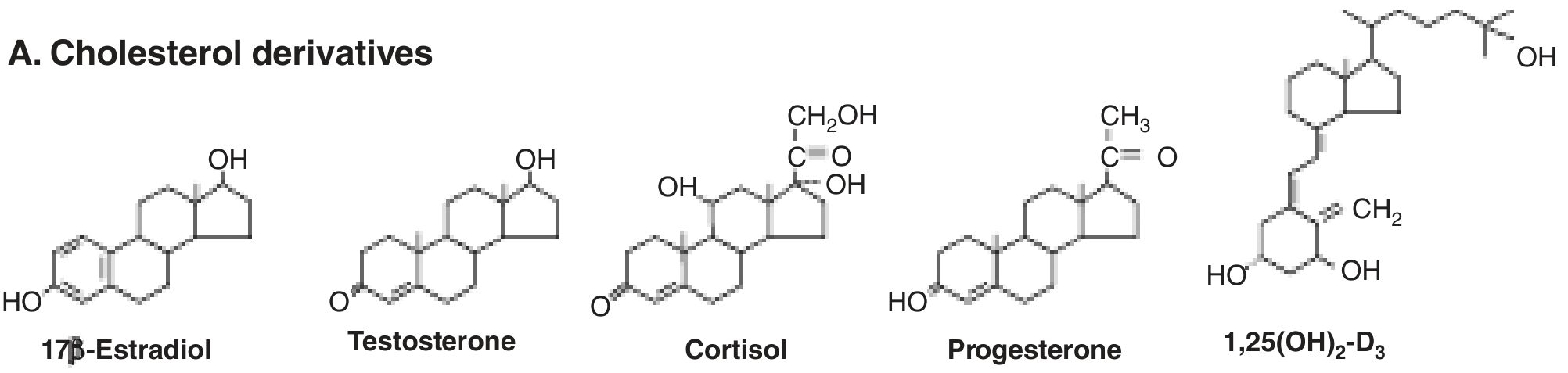
1. Steroid Hormones
All steroid hormones are derived from cholesterol. They are grouped by the gland producing them:
A. Adrenocortical Hormones (from the adrenal cortex)
| Category | Examples |
|---|---|
| Glucocorticoids | Cortisol, Corticosterone |
| Mineralocorticoids | Aldosterone |
| Adrenal androgens | Dehydroepiandrosterone (DHEA), Androstenedione |
B. Gonadal Hormones
| Category | Examples |
|---|---|
| Androgens | Testosterone, Dihydrotestosterone (DHT) |
| Estrogens | 17β-Estradiol, Estrone, Estriol |
| Progestogens | Progesterone |
C. Placental Hormones
- Human chorionic gonadotropin (hCG) steroid component
- Progesterone (produced in large amounts by the placenta during pregnancy)
The key intermediate in all steroid hormone synthesis is pregnenolone, formed from cholesterol by the side-chain cleavage enzyme (CYP11A1/P450scc) in the mitochondria.
- Biochemistry, 8th ed - Lippincott Illustrated Reviews, Overview Ch. 18
2. Bile Acids (and Bile Salts)
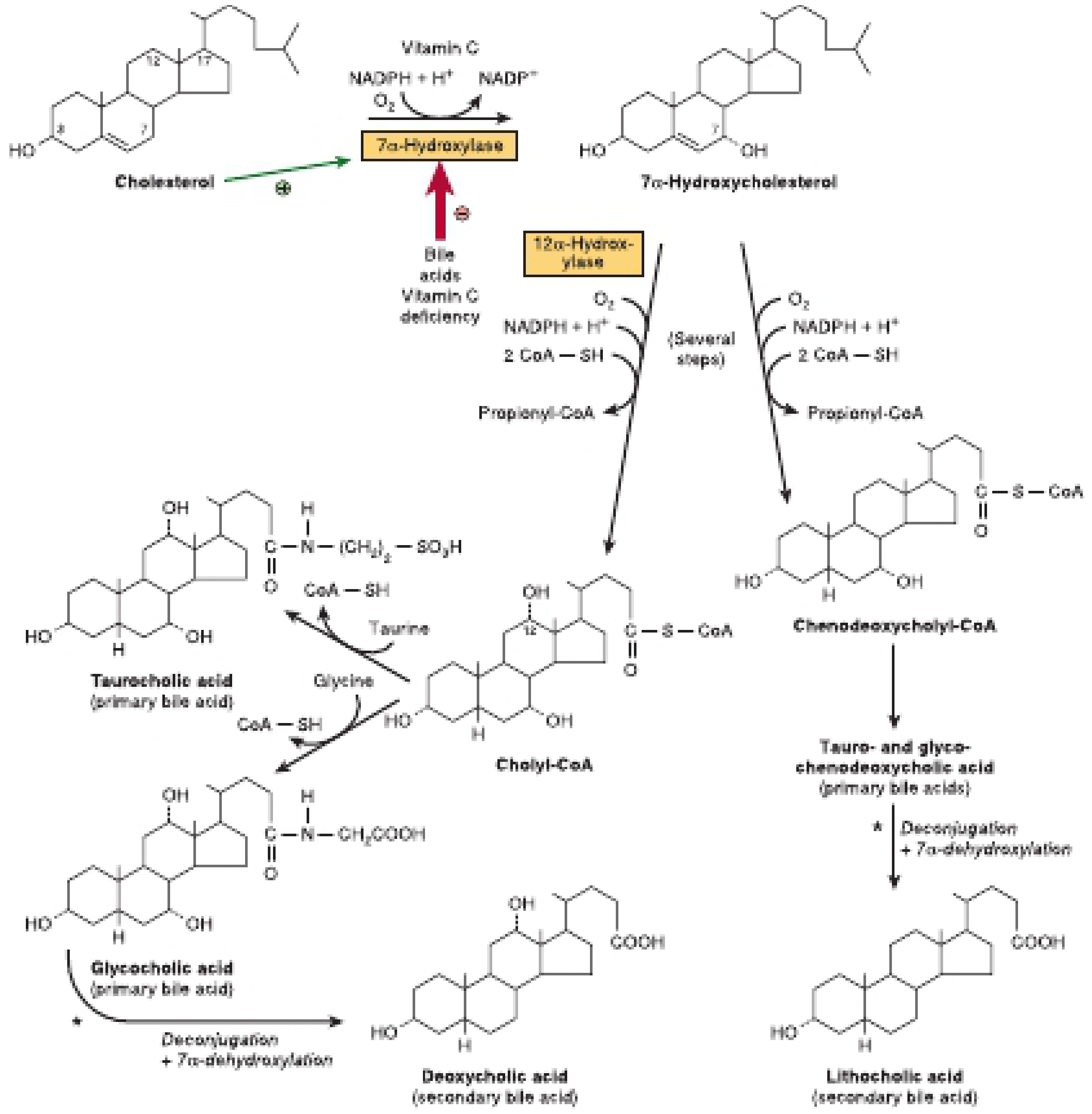
Bile acids are the major route of cholesterol excretion from the body. The first and rate-limiting step is 7α-hydroxylation of cholesterol by CYP7A1 in the liver.
Primary bile acids (synthesized in liver):
- Cholic acid
- Chenodeoxycholic acid
These are conjugated with glycine or taurine (ratio ~3:1) to form bile salts:
- Glycocholic acid, Taurocholic acid
- Glycochenodeoxycholic acid, Taurochenodeoxycholic acid
Secondary bile acids (formed by intestinal bacteria via deconjugation + 7α-dehydroxylation):
- Deoxycholic acid (from cholic acid)
- Lithocholic acid (from chenodeoxycholic acid)
Fecal product:
- Coprostanol - formed from cholesterol by colonic bacteria; the principal sterol in feces.
- Harper's Illustrated Biochemistry, 32nd Ed, Ch. 26
3. Vitamin D (Calcitriol)
Cholesterol is the starting point for vitamin D synthesis via two routes:
-
Endogenous route (skin): Cholesterol → 7-dehydrocholesterol (by removal of 2H) → exposed to UV-B radiation in the skin → Cholecalciferol (Vitamin D₃) → hydroxylated in liver to 25-hydroxyvitamin D₃ (calcidiol) → further hydroxylated in kidney to 1,25-dihydroxyvitamin D₃ (calcitriol), the active hormonal form.
-
Dietary route: Plant-derived Ergocalciferol (Vitamin D₂) comes from ergosterol (plant equivalent of cholesterol).
The active form 1,25(OH)₂-D₃ (calcitriol) regulates calcium and phosphate absorption from the gut.
- Park's Textbook of Preventive and Social Medicine; Basic Medical Biochemistry - A Clinical Approach, 6e
4. Cholesterol Esters
Cholesterol is esterified at its C-3 hydroxyl group with a fatty acid by:
- ACAT (Acyl CoA-Cholesterol Acyl Transferase) - in cells (for storage)
- LCAT (Lecithin-Cholesterol Acyl Transferase) - in plasma (HDL maturation)
Cholesterol esters are the storage/transport form of cholesterol found in the core of lipoproteins (VLDL, LDL, HDL).
5. Oxysterols
Oxysterols are oxidized derivatives of cholesterol formed either enzymatically or non-enzymatically (by free radical peroxidation). Key examples:
- 7α-Hydroxycholesterol - first intermediate in bile acid synthesis
- 25-Hydroxycholesterol
- 27-Hydroxycholesterol
They are potent regulators of cholesterol metabolism (they activate Liver X Receptors [LXR], which regulate cholesterol efflux and metabolism), and also serve as markers of oxidative stress.
- Harper's Illustrated Biochemistry, 32nd Ed (Nuclear Receptor section)
6. Cell Membrane Structural Component
While not a "derivative" per se, cholesterol itself is a critical structural molecule embedded in all mammalian cell plasma membranes, where it modulates fluidity by fitting between phospholipid fatty acid tails and prevents the membrane from becoming too fluid or too rigid.
Summary Table
| Substance | Category | Key Function |
|---|---|---|
| Cortisol, Aldosterone | Adrenocortical hormones | Stress response, salt/water balance |
| Testosterone, DHT | Androgens | Male sex characteristics |
| Estradiol, Estrone | Estrogens | Female sex characteristics |
| Progesterone | Progestogen | Pregnancy maintenance |
| Cholic acid, Chenodeoxycholic acid | Primary bile acids | Fat digestion/emulsification |
| Deoxycholic acid, Lithocholic acid | Secondary bile acids | Formed by gut bacteria |
| Calcitriol (1,25(OH)₂-D₃) | Vitamin D (active form) | Ca²⁺/PO₄ regulation, bone health |
| Cholesterol esters | Storage/transport form | Packaged in VLDL, LDL, HDL |
| Oxysterols | Oxidized metabolites | LXR activation, cholesterol regulation |
| Coprostanol | Fecal sterol | End product in gut |
| Pregnenolone | Key intermediate | "Mother steroid" - precursor to all steroid hormones |
All these molecules retain the four-ring steroid skeleton inherited from cholesterol, making cholesterol arguably the single most biologically prolific lipid precursor in the human body.
This is a shared conversation. Sign in to Orris to start your own chat.