
Tracheostomy in ICU, wound care and also a note on Percutaneous Tracheostomy
I'll start with a quick overview while I consult the medical library.
Quick Answer: Tracheostomy care in the ICU involves regular stoma site cleaning, inner cannula management, cuff pressure monitoring, and secretion management. Percutaneous dilatational tracheostomy (PDT) is the preferred bedside technique in ICU patients, offering advantages over surgical tracheostomy in terms of reduced infection rates and faster healing.
Searching sources...
Reading File
Now let me search the medical library and PubMed in parallel for comprehensive coverage.
Finding Sources
Searching PubMed
percutaneous tracheostomy ICU
Excellent sources found. Let me now read the most relevant sections in parallel - Sabiston Surgery (rich tracheostomy section), Roberts & Hedges (wound care), and search for percutaneous tracheostomy specifically.
Reading File
Reading File
Finding Sources
Good content found. Let me now read the Sabiston continuation, Current Surgical Therapy on PDT, and also the wound care section from Roberts & Hedges in parallel.
Reading File
Reading File
Reading File
Excellent content. Let me now read the stoma wound care section and the PDT comparison section in parallel.
Reading File
Reading File
Finding Sources
Now let me get the wound/stoma care specifics from the Roberts & Hedges section and the Sabiston PDT complications section:
Reading File
Reading File
Finding Sources
Now let me read the critical wound care / routine tracheostomy maintenance section:
Reading File
Reading File
I now have rich content from multiple textbooks. Let me compile the comprehensive answer.
Tracheostomy in the ICU: Wound Care & Percutaneous Tracheostomy
1. Overview and Indications
Tracheostomy is the most common surgical procedure in critically ill patients requiring prolonged mechanical ventilation. Indications fall into three broad categories:
Table: Indications vs. Contraindications (Sabiston Textbook of Surgery)
| Indications | Contraindications (mostly relative) |
|---|---|
| Upper airway obstruction (angioedema, tumors, trauma) | Recent anterior neck surgery (<7 days) |
| Prolonged mechanical ventilation | High ventilator settings (FiO2 >50%, PEEP >10 cmH2O) |
| Neurologic condition preventing safe extubation (TBI, SCI, severe delirium) | Hemodynamic instability |
| Difficult airway / significant maxillofacial trauma | Significant bleeding risk or coagulopathy |
| Elevated ICP | |
| Local infection or malignancy at proposed site |
2. Timing of Tracheostomy
The optimal timing remains debated:
- Early tracheostomy (within 4-7 days): associated with shorter ICU stay and fewer ventilator days, but no consistent mortality benefit
- The largest RCT (>900 patients across 72 UK ICUs) found no mortality difference between early (<4 days) and late (>10 days) tracheostomy at 30-day to 2-year follow-up
- Notably, over 50% of patients randomized to late tracheostomy were eventually liberated from ventilation without needing the procedure
- In COVID-19, retrospective data and meta-analysis suggest tracheostomy after 10-14 days of mechanical ventilation is associated with lower MV duration and ICU stay without increased mortality
(Sabiston Textbook of Surgery, pp. 960-961)
3. Tracheostomy Tube Components
A standard tracheostomy tube (e.g., Shiley) has three components:
- Outer cannula - the permanent portion; should not be removed routinely. Has flanges with eyelets for securing the tube to the neck
- Obturator - rounded insert used only during tube insertion to guide placement; removed immediately once tube is seated
- Inner cannula - removable lining that can be cleaned or replaced; has the 15-mm adapter for Ambu bag or ventilator connection. The inner cannula MUST be in place to ventilate the patient
Cuffed vs. uncuffed:
- Cuffed tubes: used for mechanical ventilation and aspiration risk; high-volume, low-pressure cuffs reduce mucosal injury
- Uncuffed / metal tubes: for patients with adequate ventilatory effort who are alert and low aspiration risk; can speak if air bypasses the tube
(Roberts and Hedges' Clinical Procedures in Emergency Medicine)
4. Tracheostomy Wound Care in the ICU
4.1 Stoma Site Care
- Change contaminated tube ties regularly; soiled ties harbor bacteria and promote skin maceration
- Clean tube flanges regularly with saline or chlorhexidine-soaked gauze
- Use pre-cut tracheostomy gauze dressings under the flanges - do NOT use hand-cut gauze, as loose fibers cause inflammatory reactions at the stomal site
- Clean the peri-stomal skin gently; watch for skin breakdown, granulation tissue, and early infection signs (erythema, purulent discharge, odor)
4.2 Inner Cannula Care
- The inner cannula should remain in place at all times and removed only for daily cleaning
- A clogged inner cannula is the most common cause of respiratory distress in tracheostomy patients
- Cleaning technique:
- Soak in half-strength hydrogen peroxide solution for 10-15 minutes
- Remove encrustations with a soft-bristle tracheostomy brush
- Rinse all equipment with sterile saline before reinsertion to prevent tracheal mucosal damage
- In mechanically ventilated patients, use a disposable single-use inner cannula system if available to reduce infection risk
4.3 Cuff Pressure Management
- Cuff pressure should ideally be maintained below 25 mmHg (some sources cite 20-25 cmH2O)
- Overinflation is common and dangerous - can cause:
- Tracheomalacia
- Tracheal stenosis
- Tracheoesophageal fistula
- Tracheo-innominate artery fistula (if very high pressure over innominate artery)
- Use a handheld pressure manometer to regularly check and document cuff pressure
- If an air leak persists at or above maximum recommended cuff pressure, suspect tube dislodgement and evaluate urgently
4.4 Humidification
- Adequate humidification is essential - inadequate humidification causes:
- Tube obstruction from thick secretions
- Sputum retention
- Keratinization or ulceration of tracheal mucosa
- Lung atelectasis
- Ambulatory/low-flow O2 patients: use a heat-moisture exchanger (HME) on the tracheostomy opening
- Long-term ventilated or high-flow O2 patients: require regular saline nebulizer treatments via in-line humidification system
4.5 Tracheal Suctioning
Performed when clinically indicated (coarse secretions, worsening dyspnea, desaturation) - not on a routine fixed schedule.
Technique:
- Preoxygenate with 100% FiO2 for 30-60 seconds before suctioning
- Suction catheter size (French) = 2 × (tracheostomy tube size - 2)
- Catheter diameter must be no larger than half the inner diameter of the tracheostomy tube
- Insert catheter 10-15 cm only (shallow to premeasured technique preferred)
- Apply suction while withdrawing the catheter; rotate gently
- Suction duration should not exceed 10-15 seconds per pass
- Vacuum pressure: max 150 mmHg in adults (80 mmHg in infants)
- Routine saline instillation is NOT recommended
- Use aseptic technique throughout
Closed-circuit suction system is preferred in mechanically ventilated patients - maintains ventilatory support during suctioning and prevents catheter contamination.
Complications of suctioning:
- Hypoxemia
- Dysrhythmias (vagal/sympathetic stimulation)
- Atelectasis
- Mucosal injury and tracheitis
- Raised ICP (especially in TBI patients)
For raised ICP patients: hyperventilate before suctioning, provide adequate sedation, and consider intra-tracheal lidocaine (1-1.5 mg/kg of 2% lidocaine) to blunt cough reflex.
(Roberts and Hedges' Clinical Procedures in Emergency Medicine, pp. 204-207)
5. Tube Exchange
Key steps for tracheostomy tube change:
- Have the current size and 1-2 smaller sizes ready (in case of difficult re-insertion)
- Patient in semi-recumbent position with neck slightly extended - do NOT flex the neck
- Check cuff integrity before insertion
- Apply water-based lubricant to the replacement tube
- Continuous pulse oximetry and cardiac monitoring throughout
- First tube change after surgical tracheostomy: wait 4-5 days for tract maturity; PDT tracts may take slightly longer (7+ days)
6. Percutaneous Dilatational Tracheostomy (PDT)
6.1 Background and Adoption
- PDT was first described by Ciaglia et al. in 1985 and has since become the standard bedside technique in many ICUs
- It is widely used for elective tracheostomy in critically ill adults
- Can be safely performed in patients of higher obesity classes
- Periprocedural mortality in randomized studies: <0.2%; major complication rate in large series: 0.15%
6.2 Pre-procedure Evaluation
- Review history, respiratory status, neck anatomy
- Palpate thyroid cartilage, cricoid cartilage, and 1st-3rd tracheal rings
- Ultrasound assessment of the neck - strongly recommended to:
- Identify vessels in the cannulation pathway
- Detect enlarged thyroid lobes
- Reduce the number of needle passes (especially in obese patients)
- Review existing CT imaging for vascular anatomy (high-riding innominate artery, aberrant vessels)
- Lab work: platelet count, PT, PTT, BUN
- Ideal: PT/PTT <1.5 times control, platelets >50,000/mm³
- Uremic patients: pre-treat with DDAVP
6.3 Staffing Requirements
- Anesthesiologist or airway-trained physician at the head of the bed: manages ETT, performs bronchoscopy, administers anesthesia
- Sedation + analgesia + short-acting paralysis preferred to minimize coughing and optimize first-attempt success
- Nurse familiar with the procedure for monitoring and supply management
6.4 Step-by-Step Technique (Ciaglia Single-Dilator Method)
- Positioning: shoulder roll placed, neck slightly extended
- Prep: sterile field, FiO2 increased to 100%
- Landmarks: identify entry point between 1st/2nd or 2nd/3rd tracheal rings (cricothyroid membrane involvement risks tracheal stenosis; too inferior risks tracheo-innominate fistula)
- Infiltrate: up to 10 cc of 1.5% lidocaine with epinephrine (primarily for vasoconstrictive effect)
- Incision: 1-1.5 cm horizontal or vertical skin incision through skin and subcutaneous fascia; bluntly dissect to palpate tracheal rings
- Bronchoscope positioning: scope advanced to distal ETT end to transilluminate through anterior neck; ETT cuff deflated and withdrawn under bronchoscopic vision
- Needle insertion: 14-gauge needle inserted under direct bronchoscopic visualization in the midline, avoiding posterior tracheal membrane; air aspiration confirms tracheal lumen entry
- Guidewire: J-tipped guidewire advanced toward carina using Seldinger technique
- Dilation: short 14-French dilating catheter first, then single tapered dilator over the wire
- Tube insertion: tracheostomy tube loaded over obturator, passed over wire into trachea; cuff inflated once confirmed in lumen
- Confirmation: bronchoscopy through ETT to confirm position; ETT removed once tracheostomy tube confirmed
(Current Surgical Therapy 14e; Sabiston Textbook of Surgery)
6.5 PDT vs. Surgical Tracheostomy - Comparison
| Feature | PDT | Surgical (OR) |
|---|---|---|
| Setting | Bedside ICU | Operating room |
| Speed | Faster (no OR scheduling) | Slower |
| Cost | More cost-effective | Higher (OR time, staff) |
| Wound infection | Lower | Higher |
| Perioperative bleeding | Lower in most studies | Higher in most studies |
| Posterior tracheal wall injury | Slightly higher | Lower |
| Serious perioperative complications | Comparable (some older meta-analyses favor surgical) | Comparable |
| Late complications (stenosis, fistula) | Similar | Similar |
| Preferred when | Ideal anatomy, ICU bedside | Difficult anatomy, coagulopathy, high-risk |
- A meta-analysis of 17 RCTs (1,212 patients) showed PDT was associated with fewer infections and less bleeding vs. surgical tracheostomy
- An earlier meta-analysis of 65 trials showed posterior tracheal wall injury was slightly more common with PDT (50 vs. 6 per 10,000), but the absolute rates are very small
- Evidence-based guidelines do not recommend one technique over the other for reducing mortality or overall complications
(Current Surgical Therapy 14e; Sabiston Textbook of Surgery)
6.6 Role of Bronchoscopic and Ultrasound Guidance
- Bronchoscopic guidance: ensures midline needle entry, prevents posterior membrane injury, reduces accidental paratracheal placement
- Ultrasound guidance: increasingly preferred for preprocedural anatomy mapping; 2025 meta-analysis (PMID 40281422) and 2026 systematic review (PMID 41987801) confirm US-guided PDT reduces complications vs. landmark-only techniques, particularly vascular injury
6.7 Special Populations
- Obesity: PDT can be performed safely; ultrasound pre-assessment is especially helpful; dedicated bedside series of >3,000 cases confirmed safety across higher BMI classes
- ECMO patients: tracheostomy can be safely performed at bedside with meticulous hemostatic technique; overall complication rates are higher (mainly bleeding), but PDT and open techniques have similar complication rates in this group
- COVID-19: aerosol-generating procedure requiring full airborne + droplet PPE; timing after 10-14 days recommended
7. Complications of Tracheostomy
Early (<7 days)
- Hemorrhage (anterior jugular veins, thyroid isthmus)
- False passage / paratracheal placement
- Subcutaneous emphysema
- Pneumothorax / pneumomediastinum
- Accidental decannulation
- Tube obstruction
- Hypoxia during procedure
Late (weeks to months)
- Tracheal stenosis: most important long-term complication; symptomatic stenosis in ~6% of PDT patients; subclinical stenosis in up to 40% - usually subglottic
- Tracheo-innominate artery fistula: life-threatening; caused by tube placed too inferiorly or high-riding innominate artery
- Tracheoesophageal fistula: from cuff overinflation or posterior wall erosion
- Tracheomalacia
- Stomal infection
- Granulation tissue formation
- Difficult decannulation
Summary
Tracheostomy wound care in the ICU is a nursing-intensive, multidisciplinary responsibility that centers on keeping the stoma clean, maintaining a patent inner cannula, monitoring cuff pressures (<25 mmHg), providing adequate humidification, and performing suctioning using correct technique and aseptic precautions. PDT is the preferred bedside ICU technique - faster, cheaper, and with equivalent or lower infectious and bleeding complications compared to surgical tracheostomy, especially when guided by bronchoscopy and/or ultrasound. Dedicated multidisciplinary tracheostomy teams have been shown to reduce time to decannulation, ICU length of stay, and adverse events.
Sources:
- Sabiston Textbook of Surgery, pp. 960-961
- Roberts and Hedges' Clinical Procedures in Emergency Medicine, pp. 203-207
- Current Surgical Therapy 14e, pp. 1594-1596
- Wen D et al. (2025). Ultrasound vs. landmark-guided PDT meta-analysis - BMC Anesthesiol (PMID 40281422)
- Ren B et al. (2026). US-guided vs. bronchoscopy-guided PDT RCT meta-analysis - Front Med (PMID 41987801)
Bronchopulmonary segments, anatomy, from grey's anatomy and anaesthetic and surgical importance. Along with viva questions for md anaesthesia
I'll consult Gray's Anatomy and pulmonary textbooks in parallel for comprehensive coverage.
Searching sources...
Reading File
Finding Sources
Finding Sources
Gray's Anatomy for Students found. Let me read all the key sources in parallel.
Reading File
Reading File
Reading File
Excellent content from Gray's and Fischer's. Let me now read the Gray's anatomy detailed segment listing, Fischer's continuation for surgical importance, and search for anaesthetic significance in parallel.
Reading File
Reading File
Finding Sources
Now let me get the Gray's Anatomy bronchial tree image and search for anaesthetic/surgical relevance of segments:
Loading Image
Loading Image
Finding Sources
Finding Sources
Excellent - beautiful diagrams from Gray's! Now let me get the DLT/anaesthetic content from Barash and Miller's, and also the Gray's anatomy image of segmental bronchi:
Reading File
Finding Sources
Loading Image
Excellent images retrieved! Now let me get more anaesthetic content on one-lung ventilation, postural drainage and aspiration pneumonia segments, and the Gray's anatomy segment listing image:
Reading File
Finding Sources
Finding Sources
I now have comprehensive content from Gray's Anatomy, Color Atlas, Fischer's Mastery of Surgery, and Barash's Clinical Anaesthesia. I have beautiful diagrams too. Let me now compile the full answer.
Bronchopulmonary Segments: Anatomy, Anaesthetic & Surgical Importance
1. Definition (Gray's Anatomy for Students)
"A bronchopulmonary segment is the area of lung supplied by a segmental bronchus and its accompanying pulmonary artery branch."
"A bronchopulmonary segment is the smallest functionally independent region of a lung and the smallest area of lung that can be isolated and removed without affecting adjacent regions."
Each segment is shaped like an irregular cone (or pyramid), with the apex directed toward the hilum and the base projected peripherally onto the lung surface.
Key vascular rule:
- Segmental bronchus + pulmonary artery branch = intrasegmental (run together in the centre of the segment)
- Pulmonary vein tributaries = intersegmental (run in the connective tissue planes between segments and demarcate segment boundaries)
This vascular arrangement is what makes surgical segmentectomy possible.
(Gray's Anatomy for Students, pp. 208-210)
2. The Bronchial Tree - Overview
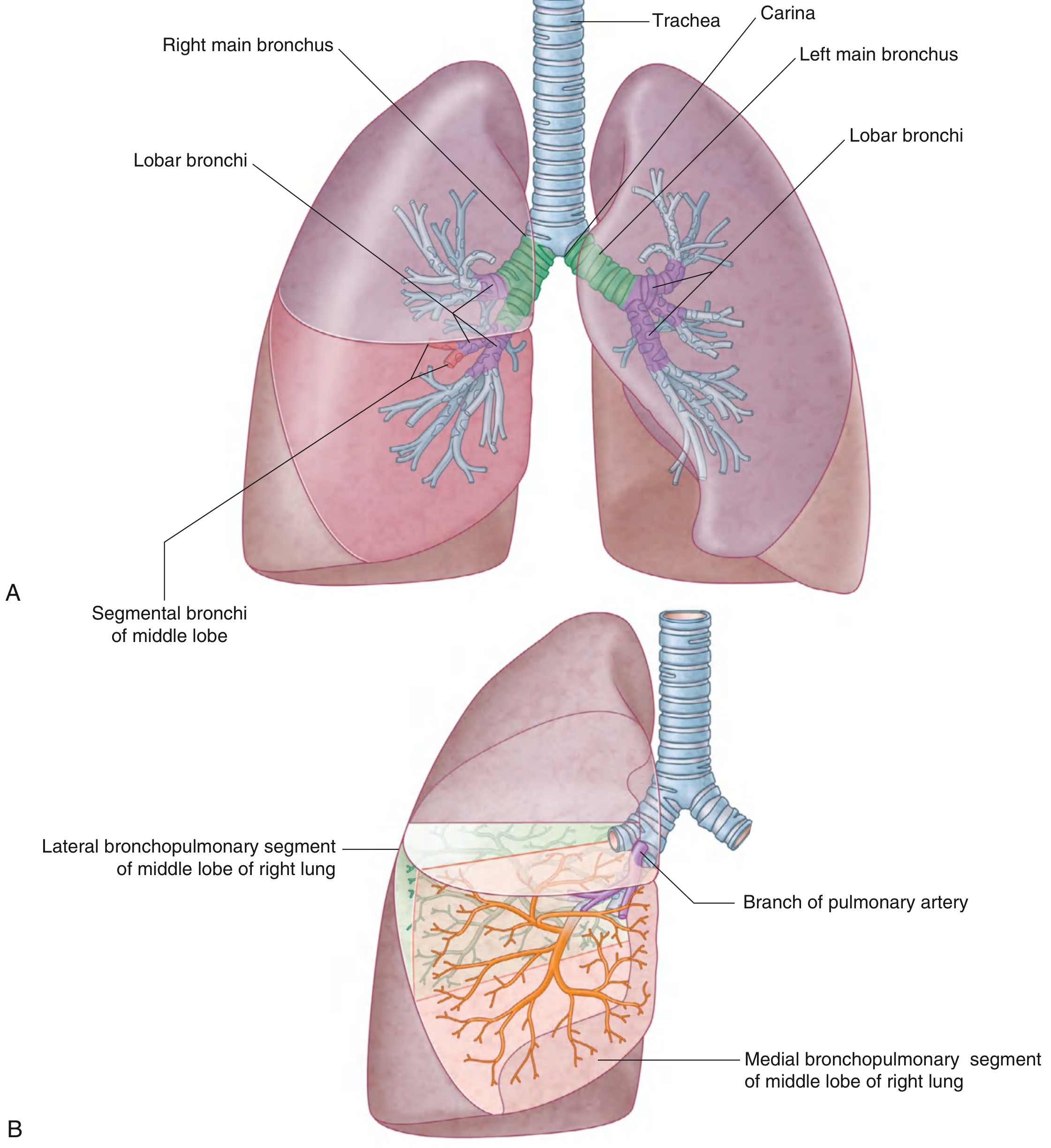
Fig. 3.48 - Bronchial tree (A) and bronchopulmonary segments (B). Note the lobar bronchi and segmental bronchi of the middle lobe of the right lung. (Gray's Anatomy for Students)
- Right main bronchus: wider, shorter, and more vertical (~25° from midline) - hence more direct continuation of the trachea
- Left main bronchus: narrower, longer (~5 cm before division), and more horizontal (~45° from midline)
- Lobar bronchi divide into segmental (third-order) bronchi - one per bronchopulmonary segment
3. Number of Bronchopulmonary Segments
| Lung | Lobes | Segments |
|---|---|---|
| Right | 3 (upper, middle, lower) | 10 |
| Left | 2 (upper, lower) | 8 (American nomenclature) or 10 (British nomenclature) |
On the left, segments 1+2 fuse into the apicoposterior segment, and segments 7+8 may fuse into the anteromedial basal segment, giving 8 segments.
(Color Atlas of Human Anatomy Vol. 2; Fischer's Mastery of Surgery 8th ed.)
4. Complete Segment Listing
RIGHT LUNG (10 segments)
RIGHT UPPER LOBE (Superior Lobe)
| No. | Name | Bronchus |
|---|---|---|
| S1 | Apical | B1 |
| S2 | Posterior | B2 |
| S3 | Anterior | B3 |
RIGHT MIDDLE LOBE
| No. | Name | Bronchus |
|---|---|---|
| S4 | Lateral | B4 |
| S5 | Medial | B5 |
RIGHT LOWER LOBE (Inferior Lobe)
| No. | Name | Bronchus |
|---|---|---|
| S6 | Superior (apical of lower lobe) | B6 |
| S7 | Medial basal (cardiac segment) | B7 |
| S8 | Anterior basal | B8 |
| S9 | Lateral basal | B9 |
| S10 | Posterior basal | B10 |
LEFT LUNG (8 segments, American; 10 British)
LEFT UPPER LOBE (Superior Lobe)
Upper division:
| No. | Name | Bronchus |
|---|---|---|
| S1+2 | Apicoposterior | B1+2 (fused) |
| S3 | Anterior | B3 |
Lingular division (equivalent to right middle lobe):
| No. | Name | Bronchus |
|---|---|---|
| S4 | Superior lingular | B4 |
| S5 | Inferior lingular | B5 |
LEFT LOWER LOBE (Inferior Lobe)
| No. | Name | Bronchus |
|---|---|---|
| S6 | Superior (apical of lower lobe) | B6 |
| S7+8 | Anteromedial basal (fused) | B7+8 |
| S9 | Lateral basal | B9 |
| S10 | Posterior basal | B10 |
5. Diagrams
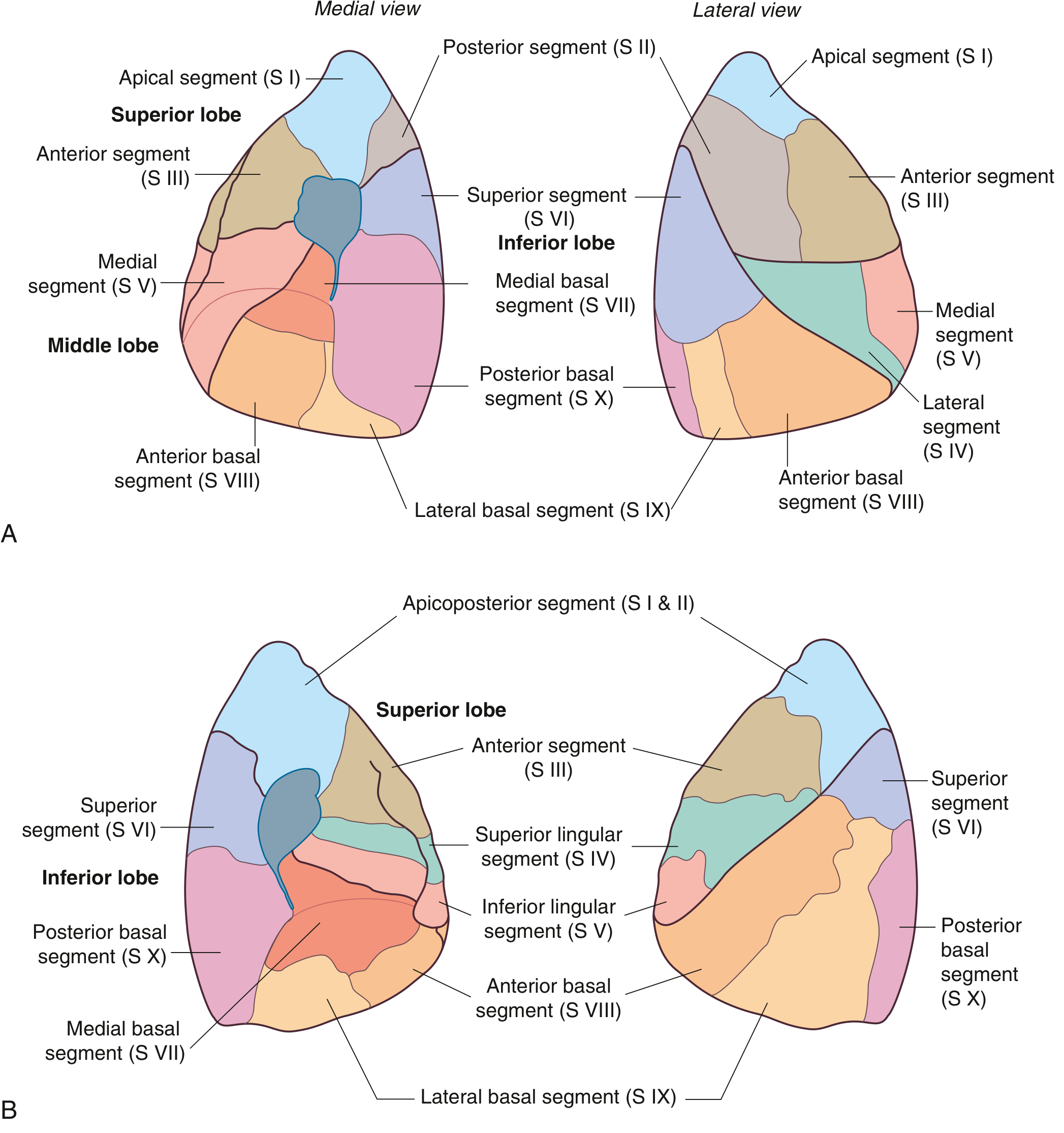
Fig. 3.49 - Bronchopulmonary segments of the right lung (A, top) and left lung (B, bottom) - medial and lateral views. (Gray's Anatomy for Students, p. 210)
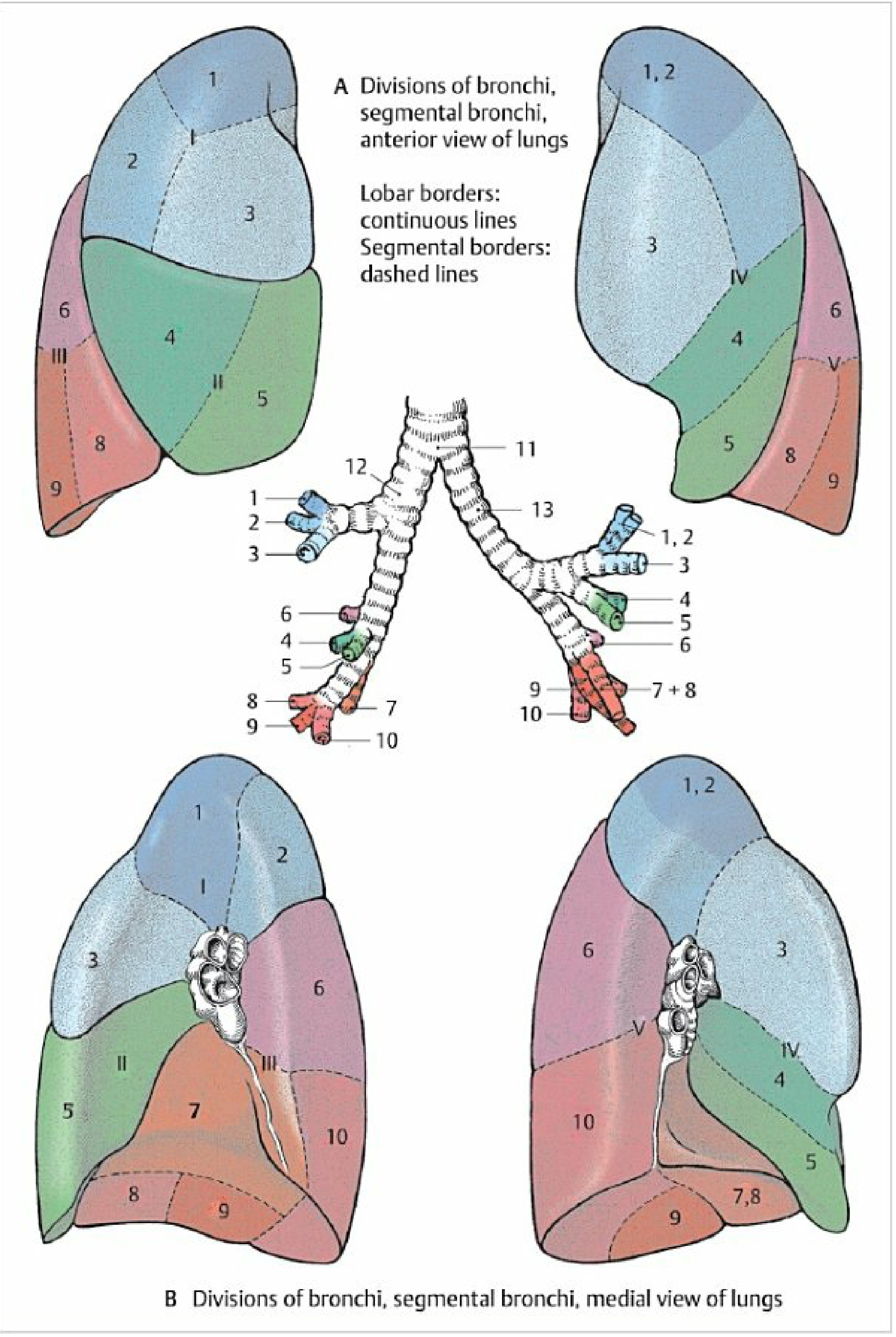
Bronchial divisions and bronchopulmonary segments - anterior view (A) and medial view (B). Right: 10 segments; Left: 9 segments (European). (Color Atlas of Human Anatomy Vol. 2, p. 215)
6. Segmental Bronchoscopic Landmarks (Clock-face positions)
(Fischer's Mastery of Surgery 8th Edition - as seen endoscopically)
Right lung:
- Upper lobe: Apical (B1) at 4 o'clock | Anterior (B2) at 12 o'clock | Posterior (B3) at 8 o'clock
- Middle lobe: Lateral (B4) at 3-6 o'clock | Medial (B5) at 9-12 o'clock
- Lower lobe: Superior (B6) at 5 o'clock (just past middle lobe orifice) | Medial basal (B7) at 9 o'clock | Anterior basal (B8) at 1 o'clock | Lateral basal (B9) at 3 o'clock | Posterior basal (B10) at 6 o'clock
Left lung:
- Upper division orifice at 8 o'clock → apicoposterior (B1+3) and anterior (B2)
- Lingular orifice at 2 o'clock → superior lingular (B4) at 10 o'clock | inferior lingular (B5) at 2 o'clock
- Lower lobe: Superior (B6) at 6 o'clock | Anteromedial basal (B8+7) at 12 o'clock | Lateral basal (B9) at 9 o'clock | Posterior basal (B10) at 5 o'clock
7. Anaesthetic Importance
7.1 Right vs. Left Main Bronchus - Critical Differences
| Feature | Right Main Bronchus | Left Main Bronchus |
|---|---|---|
| Length | ~2.5 cm | ~5 cm |
| Angle from trachea | ~25° (more vertical) | ~45° (more horizontal) |
| Width | Wider | Narrower |
| Consequence | Foreign bodies, ETT tip, and secretions preferentially enter the right | Left DLT preferred for most thoracic procedures |
The right upper lobe bronchus arises only ~1-2.5 cm from the carina - this makes right-sided endobronchial intubation risky (RUL obstruction). This is why a left-sided DLT is preferred for most procedures (including right-sided thoracic surgery).
7.2 Unintentional Endobronchial Intubation
- ETT advancing too far → right main bronchus intubation preferentially (because of its steeper angle)
- Right upper lobe collapse is the classic consequence (right upper lobe bronchus is occluded by ETT tip)
- Monitor: unilateral breath sounds, SpO2 fall, increased peak airway pressure
7.3 One-Lung Ventilation (OLV) and DLT
- Anatomical knowledge of segmental bronchi is essential for fiberoptic bronchoscopy confirmation of DLT position
- After DLT insertion, fiberoptic bronchoscope is passed through:
- Tracheal lumen → should see carina, blue bronchial cuff just below, and open right or left bronchus
- Bronchial lumen → should see segmental orifices of the respective lobe
DLT size selection (Barash Clinical Anaesthesia 9th ed.):
| Patient | DLT Size |
|---|---|
| Women <1.6 m | 35 Fr |
| Women >1.6 m | 37 Fr |
| Men <1.7 m | 39 Fr |
| Men >1.7 m | 41 Fr |
- Right-sided DLT: the bronchial cuff has a special slot/doughnut design to avoid occluding the right upper lobe bronchus (which arises 1-2.5 cm from carina)
- Left-sided DLT is used for ~99% of thoracic cases including right-sided surgery
7.4 Aspiration Pneumonia and Dependent Segments
Position determines which segment gets aspirated material:
| Patient Position | Most Dependent (at-risk) Segments |
|---|---|
| Supine | Posterior segments of upper lobes (S2) + Superior segments of lower lobes (S6) |
| Right lateral decubitus | Right posterior basal (S10), right lateral basal (S9) |
| Left lateral decubitus | Left posterior basal (S10), left lateral basal (S9) |
| Upright | Basal segments (S8-S10) bilaterally |
- The right lower lobe posterior basal (S10) and right upper lobe posterior (S2) are classically the most common sites of aspiration pneumonia in supine patients
- Knowledge critical for: aspiration risk in anaesthesia, ICU positioning, bronchoscopic lavage targeting
7.5 Postural Drainage - Physiotherapy in ICU
Each segment is drained by a specific patient position:
| Segment | Drainage Position |
|---|---|
| Upper lobe apical (S1) | Sitting upright/leaning back 30° |
| Upper lobe posterior (S2) | Head down, leaning forward over pillow (30°) |
| Upper lobe anterior (S3) | Lying flat/supine |
| Middle lobe (S4, S5) / Lingula (S4, S5) | Head-down 15°, right/left lateral |
| Lower lobe superior (S6) | Lying prone, flat |
| Lower lobe basal (S8-S10) | Head-down (Trendelenburg), prone or lateral |
7.6 Foreign Body Aspiration
- Adults (upright): foreign bodies typically lodge in right lower lobe bronchi (especially posterior basal, S10) - due to the more vertical right main bronchus
- Children (supine): right and left sides equally affected in some series
- Rigid bronchoscopy is the treatment - knowledge of segment anatomy guides retrieval
7.7 Lung Abscess
- Most common in dependent segments
- Supine: superior segments of lower lobes (S6) and posterior segments of upper lobes (S2) - especially the right side
- Right side predominance - due to wider, more vertical right main bronchus
7.8 Segmentectomy and Surgical Resection
- A bronchopulmonary segment is the smallest surgically resectable unit of lung tissue
- Segmentectomy (vs. lobectomy) is used for:
- Small peripheral tumours (<2 cm, stage IA)
- Poor pulmonary reserve (FEV1 <40% predicted)
- Metastasectomy
- Pulmonary veins being intersegmental means they must be ligated carefully during segmentectomy to avoid injuring adjacent segments
- The right middle lobe (lingula on the left) has a long, narrow bronchus making it susceptible to middle lobe syndrome (recurrent collapse/atelectasis)
7.9 Bronchoscopy and Targeted BAL
- Each segment's bronchial orifice is identifiable bronchoscopically by clock-face position (see Section 6 above)
- Targeted bronchoalveolar lavage (BAL), bronchial washing, or endobronchial biopsy can be directed to specific segments
- Critical in ICU for ventilator-associated pneumonia (VAP) diagnosis - mini-BAL or protected specimen brushing directed at consolidating segment
7.10 Selective Lobar Blockade
- Bronchial blockers (e.g., Arndt, Cohen, EZ-Blocker) can be guided into specific segmental bronchi under FOB to achieve selective lobar or segmental collapse while ventilating other lobes
- Particularly useful in patients with pre-existing contralateral lung disease or in pediatric thoracic cases where DLT is not feasible
8. Surgical Importance Summary
| Clinical Scenario | Relevant Anatomy |
|---|---|
| Pneumonectomy | Entire lung resection; main bronchus divided at carina |
| Lobectomy | Lobar bronchus + lobar PA + intersegmental pulmonary veins |
| Segmentectomy | Segmental bronchus + segmental PA + intersegmental veins |
| Bronchiectasis surgery | Usually lower lobe basal segments |
| Carcinoid / early NSCLC | Segmentectomy sparing adjacent segments |
| Sleeve resection | Segmental bronchial anatomy at anastomosis |
| Middle lobe syndrome | Long, narrow middle lobe bronchus (S4, S5) |
9. Viva Questions for MD Anaesthesia
Q1. What is a bronchopulmonary segment? What defines its boundaries?
A: The smallest functionally independent unit of lung, supplied by one segmental bronchus and one pulmonary artery branch (both intrasegmental). Boundaries are demarcated by intersegmental pulmonary vein tributaries and connective tissue septa.
Q2. How many bronchopulmonary segments are there in each lung, and why does the left have fewer?
A: Right lung - 10. Left lung - 8 (American) or 10 (British). On the left, segments 1 and 2 fuse to form the apicoposterior segment (S1+2), and segments 7 and 8 fuse to form the anteromedial basal segment (S7+8), due to space constraints from the heart.
Q3. Why is a left-sided DLT preferred for most thoracic surgery, even right-sided procedures?
A: The right upper lobe bronchus arises only 1-2.5 cm from the carina. A right-sided DLT's bronchial cuff, if inflated, can easily obstruct the right upper lobe. A left-sided DLT in the long left main bronchus (5 cm) gives a safe margin for cuff inflation without obstructing any segmental orifice.
Q4. Which segments are most commonly affected in aspiration pneumonia? Why?
A: In the supine patient - posterior segment of right upper lobe (S2) and superior segment of right lower lobe (S6). In the erect patient - basal segments (S8-S10), especially right sided. The right main bronchus is wider, shorter, and more vertical (25°), making it the preferential route for aspirated material.
Q5. What is the clock-face position of the right upper lobe orifice at bronchoscopy?
A: The right upper lobe bronchus orifice is at 4 o'clock on bronchoscopic view. The anterior segment (B2) is at 12 o'clock and posterior (B3) at 8 o'clock.
Q6. What is the significance of pulmonary veins being intersegmental?
A: Pulmonary veins run between segments in the intersegemental connective tissue planes. This means they cannot be used as a guide to the segmental artery or bronchus during surgery. During segmentectomy, intersegmental veins must be carefully identified and preserved (or ligated at their point of entry into the resected segment) to avoid inadvertent devascularisation of adjacent segments.
Q7. How do you confirm DLT position after insertion?
A: Clinically: differential clamping with auscultation. Definitively: fiberoptic bronchoscopy - through the tracheal lumen you should visualise the carina, the blue bronchial cuff just visible below in the intended bronchus, and the opposite bronchus open. Through the bronchial lumen, you should identify the segmental orifices of the appropriate lobe.
Q8. What is one-lung ventilation (OLV)? What are the physiological consequences?
A: OLV means ventilating one lung while the other is collapsed (for surgical access). Consequences: (a) obligatory shunt through the collapsed non-ventilated lung → hypoxaemia; (b) increased pulmonary vascular resistance in ventilated lung; (c) hypoxic pulmonary vasoconstriction (HPV) in collapsed lung partially compensates. FiO2 often increased to 1.0; recruitment manoeuvres, CPAP to non-ventilated lung, or PEEP to ventilated lung used for refractory hypoxaemia.
Q9. What is the role of the lingula and why is it clinically important?
A: The lingula (S4 + S5 of left upper lobe) is the anatomical equivalent of the right middle lobe. It has a long, narrow bronchus prone to secretion retention and atelectasis. It is important in left upper lobectomy (the lingular division must be separately identified), and in lung transplant sizing when only the lingula is resected as a living-donor procedure.
Q10. How do bronchopulmonary segments guide postural drainage in the ICU?
A: Each segment is gravity-drained by a specific patient position. ICU patients are positioned to make the affected segment dependent so secretions drain toward larger airways for suctioning. E.g., lower lobe basal segments require head-down (Trendelenburg) position; upper lobe apical segments require sitting upright. This is particularly important in mechanically ventilated patients, bronchiectasis, and cystic fibrosis.
Q11. What is the "cardiac segment" of the lung?
A: The medial basal segment (S7) of the right lower lobe is called the cardiac segment because it is adjacent to the heart's right border. It is the smallest and least often involved in aspiration but can be the site of right lower lobe atelectasis in post-cardiac surgery patients.
Q12. Describe the anatomical reason why foreign body aspiration is more common on the right.
A: The right main bronchus is wider (~1.4 cm vs ~1.2 cm), shorter (2.5 cm vs 5 cm), and branches off the trachea at a less acute angle (25° vs 45°) - making it the more direct continuation of the trachea. Foreign bodies aspirated with the body upright tend to fall into the right bronchial tree, most commonly into the right lower lobe (posterior basal or lateral basal segment).
Sources:
- Gray's Anatomy for Students, pp. 208-210 (Figs 3.47, 3.48, 3.49)
- Color Atlas of Human Anatomy Vol. 2 - Internal Organs, pp. 214-216 (Fig. 3.16)
- Fischer's Mastery of Surgery 8th Edition, pp. 2058-2059
- Barash, Cullen & Stoelting's Clinical Anaesthesia 9th Edition, pp. 3177-3182
This is a shared conversation. Sign in to Orris to start your own chat.