
Atrial fibrilation
Reading File
Finding Sources
Searching PubMed
"atrial fibrillation"[MeSH Terms] AND "management"[MeSH Terms]
Braunwald's block 13 has the most comprehensive AF content. Let me read the key sections in parallel.
Reading File
Reading File
Now let me read the dedicated AF chapter from Braunwald's (block 3, the main AF chapter):
Reading File
Finding Sources
Finding Sources
Finding Sources
Finding Sources
Finding Sources
Let me read the main AF section from Braunwald's block 7, which appears to be the dedicated Chapter 66:
Reading File
Searching Images
atrial fibrillation ECG rhythm strip
Now let me read the actual Chapter 66 content from Braunwald's:
Reading File
Excellent — I now have very rich content from Braunwald's Chapter 66. Let me read one more section covering management:
Reading File
I now have comprehensive content to provide a thorough overview of atrial fibrillation. Let me compose the answer.
Atrial Fibrillation (AF)
Definition & ECG Features
AF is a supraventricular arrhythmia characterized by:
- Low-amplitude baseline oscillations (fibrillatory / f-waves) from chaotically firing atria at 300–600 beats/min, variable in amplitude, shape, and timing
- Irregularly irregular ventricular rhythm — the hallmark clinical sign
- Absent discrete P waves
- Ventricular rate during untreated AF is typically 100–160 beats/min
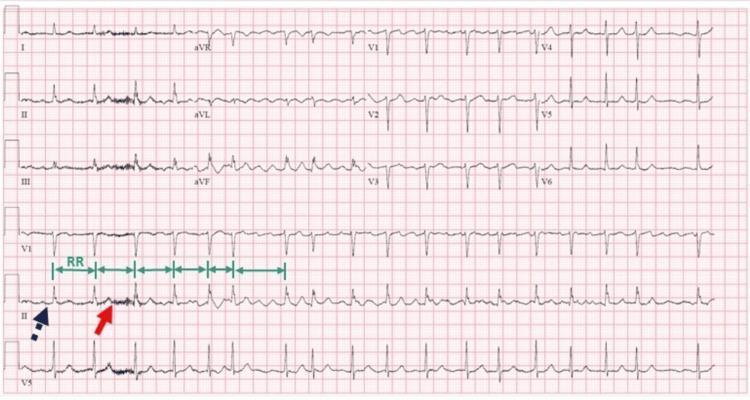
Classic 12-lead ECG of AF: absent P waves (red arrow), fibrillatory baseline, and irregularly irregular R-R intervals (green arrows).
Classification
| Type | Definition |
|---|---|
| Paroxysmal | Terminates spontaneously within 7 days |
| Persistent | Continuously present >7 days |
| Long-standing persistent | Present >1 year |
| Permanent | Patient and clinician decide to accept AF and abandon rhythm control; this is a therapeutic attitude, not a pathophysiological category |
| Vagotonic (paroxysmal subtype) | ~25% of paroxysmal AF; triggered by high vagal tone (evening, sleep); worsened by digoxin |
| Adrenergic (paroxysmal subtype) | Triggered by exercise or emotional stress; β-blockers preferred |
— Braunwald's Heart Disease, Chapter 66
Epidemiology
- Affects ~12% of adults ≥75 years and 18% of those ≥85 years
- About one-third of all AF patients are ≥80 years (2019 AHA/ACC/HRS guideline estimate)
- Common comorbidities: hypertension, coronary heart disease, obesity, sleep apnea, hyperlipidemia, heart failure
Mechanisms
AF is maintained by multiple wavelet re-entry and/or focal triggers (most commonly from pulmonary vein ostia). The key elements are:
- Trigger: Ectopic impulses, often from the pulmonary veins, initiate AF
- Substrate: Atrial fibrosis, conduction abnormalities, and stretch provide a favorable re-entrant environment
- Remodeling: AF itself causes electrical and structural remodeling ("AF begets AF") — progressive shortening of the atrial refractory period and loss of rate adaptation
- Autonomic influences: Vagal or adrenergic tone can both precipitate and maintain AF depending on the subtype
Causes / Risk Factors
- Hypertension (most common)
- Ischemic / structural heart disease
- Valvular disease (especially mitral stenosis — MS + AF carries near-prosthetic-valve stroke risk; warfarin, not DOACs, required in rheumatic MS)
- Thyrotoxicosis
- Heart failure (both cause and consequence)
- Obesity, sleep apnea
- Alcohol ("holiday heart")
- Post-cardiac surgery
- Genetic factors (familial AF, mutations in ion channel and gap junction genes)
Clinical Features
Symptoms:
- Palpitations, fatigue, reduced exercise tolerance
- Dyspnea, lightheadedness, chest discomfort
- Acute pulmonary edema (loss of atrial kick in a stiff LV)
- Syncope, fall, or stroke as initial presentation (especially in elderly)
- Frequently asymptomatic — subclinical AF detected on implanted devices in up to 50% of pacemaker/ICD patients
Complications:
- Stroke / thromboembolism: Nonvalvular AF → 5-fold increase in stroke risk; strokes tend to be severe
- Heart failure (rate-related cardiomyopathy)
- Cognitive impairment, reduced physical performance, increased mortality
Diagnostic Evaluation
- ECG — gold standard; 12-lead or rhythm strip
- Holter / event monitor — for paroxysmal AF
- Implantable loop recorder — high yield for cryptogenic stroke workup
- Echocardiography — assess structural disease, LA size, LV function, thrombus (especially transesophageal echo before cardioversion)
- TFTs, CMP, CBC — exclude reversible causes
- CHA₂DS₂-VASc score — stroke risk stratification
- HAS-BLED score — bleeding risk assessment
Stroke Prevention (Anticoagulation)
CHA₂DS₂-VASc Score
| Factor | Points |
|---|---|
| Congestive heart failure | 1 |
| Hypertension | 1 |
| Age ≥75 years | 2 |
| Diabetes mellitus | 1 |
| Stroke / TIA / thromboembolism (prior) | 2 |
| Vascular disease (prior MI, PAD, aortic plaque) | 1 |
| Age 65–74 years | 1 |
| Sex category (female) | 1 |
2019 AHA/ACC/HRS Guidelines (Class I):
- Men with CHA₂DS₂-VASc ≥ 2 → anticoagulate
- Women with CHA₂DS₂-VASc ≥ 3 → anticoagulate
- All patients ≥75 years (score ≥ 2 by definition) → anticoagulate regardless of AF type
Key points:
- DOACs (dabigatran, rivaroxaban, apixaban, edoxaban) preferred over warfarin for nonvalvular AF — no dietary restrictions, no INR monitoring, similar or better efficacy with less bleeding in elderly
- Warfarin (target INR 2–3) remains first choice in rheumatic mitral stenosis and mechanical valves (DOACs are contraindicated in these)
- Aspirin is NOT effective for stroke prevention in AF; no longer recommended for this purpose
- In elderly, typical warfarin maintenance dose is 2–5 mg/day, often started without a loading dose
Acute Management
Hemodynamically Unstable AF
- Immediate direct-current cardioversion (DCCV) — biphasic shock, typically starting at 200 J
Hemodynamically Stable AF
Rate control (first-line in most):
- IV β-blocker (metoprolol, esmolol) or non-dihydropyridine CCB (diltiazem, verapamil)
- Digoxin — slower onset, useful in HF with reduced EF
- Amiodarone — when other agents fail or in hemodynamically compromised patients
Rhythm control / Cardioversion:
- If AF onset ≤48 hours, cardioversion can proceed after anticoagulation with heparin
- If AF onset >48 hours or unknown duration: anticoagulate for ≥3 weeks before cardioversion OR perform transesophageal echo (TEE) to rule out LA thrombus, then cardiovert with adequate anticoagulation
- Anticoagulation must continue for ≥4 weeks after successful cardioversion regardless of CHA₂DS₂-VASc score (due to atrial stunning)
Long-Term Management: Rate vs. Rhythm Control
| Strategy | Approach | Agents / Methods |
|---|---|---|
| Rate control | Control ventricular rate; accept AF | β-blockers, CCBs (diltiazem, verapamil), digoxin |
| Rhythm control | Restore and maintain sinus rhythm | Antiarrhythmics (flecainide, propafenone, sotalol, amiodarone, dofetilide); cardioversion; catheter ablation |
Key principle: Rate control is recommended as first-line for asymptomatic or mildly symptomatic patients — it is safer and as effective as pharmacologic rhythm control (AFFIRM, RACE trials). Rhythm control is preferred for:
- Symptomatic patients despite rate control
- First-episode or young patients
- AF contributing to HF or tachycardia-induced cardiomyopathy
Target heart rate: Generally ≤110 bpm at rest ("lenient" rate control per RACE II trial) is acceptable; stricter control (<80 bpm rest, <110 bpm with exertion) for symptomatic patients.
Antiarrhythmic Drug (AAD) Selection
| Drug | Best for | Cautions |
|---|---|---|
| Flecainide / Propafenone | No structural heart disease | Contraindicated in CAD, HF, significant LVH |
| Sotalol | CAD, mild LVH | QTc monitoring; avoid in CrCl <40 |
| Amiodarone | HF, complex structural disease | Thyroid, pulmonary, hepatic toxicity; multiple drug interactions |
| Dofetilide | HF, CAD | In-hospital initiation; QTc monitoring |
| Dronedarone | Paroxysmal AF, no HF | Contraindicated in permanent AF with HF (increased mortality) |
Nonpharmacologic Management
Catheter Ablation (Pulmonary Vein Isolation, PVI)
- First-line rhythm control option in symptomatic paroxysmal AF refractory to or intolerant of AADs (Class I)
- Superior to AADs for maintaining sinus rhythm in paroxysmal AF
- Growing evidence supports early ablation, even as first-line, in selected patients
- In HF with reduced EF + AF, ablation significantly reduces mortality and hospitalization vs. rate control (CASTLE-AF trial)
Left Atrial Appendage (LAA) Occlusion
- Watchman device (percutaneous LAA closure) — for patients with nonvalvular AF who have contraindications to long-term anticoagulation
- Surgical LAA excision/ligation during concomitant cardiac surgery
Upstream Risk Factor Modification
- Weight loss, treatment of sleep apnea, blood pressure control, and exercise can reduce AF burden
- Addresses the AF substrate directly
Special Situations
| Situation | Key Consideration |
|---|---|
| WPW + AF | Risk of ventricular fibrillation via accessory pathway conduction (rates >250 bpm); avoid AV nodal blockers (digoxin, CCBs, adenosine); treat with DCCV or procainamide/ibutilide; refer for ablation |
| AF + Mitral Stenosis | Use warfarin (not DOACs); oral anticoagulants regardless of CHA₂DS₂-VASc; restore sinus rhythm after balloon mitral valvuloplasty (BMV) for better durability |
| AF + HFrEF | Catheter ablation preferred; amiodarone or dofetilide for AAD; avoid flecainide/propafenone/sotalol; DOACs preferred |
| AF in Pregnancy | β-blockers (metoprolol) preferred for rate control; electrical cardioversion safe at any trimester; heparin preferred over warfarin in first trimester |
| Elderly (≥75 years) | All have CHA₂DS₂-VASc ≥2; anticoagulate unless bleeding risk overwhelming; DOACs preferred; lower warfarin doses needed |
| Subclinical AF (device-detected) | Anticoagulation advised for episodes ≥5 hours with elevated stroke risk profile |
Sources: Braunwald's Heart Disease: A Textbook of Cardiovascular Medicine, Chapter 66 (Atrial Fibrillation); Chapter 54 (Heart Failure with Preserved/Mid-range EF); Chapter 77 (Cardiovascular Disease in the Elderly); Chapter 75 (Valvular Heart Disease).
This is a shared conversation. Sign in to Orris to start your own chat.