
Propofol role in anesthesia
Reading File
Now let me search the medical library for propofol content in parallel with a web search.
Finding Sources
Finding Sources
Searching PubMed
propofol anesthesia mechanism pharmacology
Miller's Anesthesia and Katzung's pharmacology are the best sources. Let me read the key sections now in parallel.
Reading File
Reading File
Reading File
Excellent content from Miller's Anesthesia. Let me now read the detailed pharmacodynamics, clinical uses, and adverse effects sections.
Reading File
Reading File
I now have rich content on propofol. Let me read the cardiovascular effects and clinical use sections from Miller's, plus the adverse effects from Katzung.
Reading File
Reading File
I now have comprehensive content from two authoritative sources. Let me fetch the propofol structure image and compile the full answer.
Loading Image
I now have everything needed for a thorough, well-cited answer. Here it is:
Propofol in Anesthesia
Overview
Propofol (2,6-diisopropylphenol) is today the most commonly used intravenous hypnotic worldwide. It has largely replaced barbiturates for anesthesia induction and is widely used for maintenance of anesthesia, procedural sedation, and ICU sedation. Its dominance stems from a rapid onset, predictable offset, and favorable recovery profile.
- Miller's Anesthesia, 10e, p. 2458
Structure and Formulation
Propofol is an alkylphenol - highly lipid soluble and insoluble in water. The standard commercial preparation is a 1% oil-in-water emulsion containing:
- 10% soybean oil
- 1.2% purified egg phospholipid (emulsifier)
- 2.25% glycerol (tonicity agent)
- EDTA (bacteriostatic)
This accounts for the characteristic milky white appearance and pH of ~7. The lipid vehicle also contributes ~1.1 kcal/mL, which matters in prolonged ICU infusions. A water-soluble prodrug, fospropofol (Lusedra), was FDA-approved in 2008 for monitored anesthesia care; it avoids injection pain but causes perineal paresthesias.
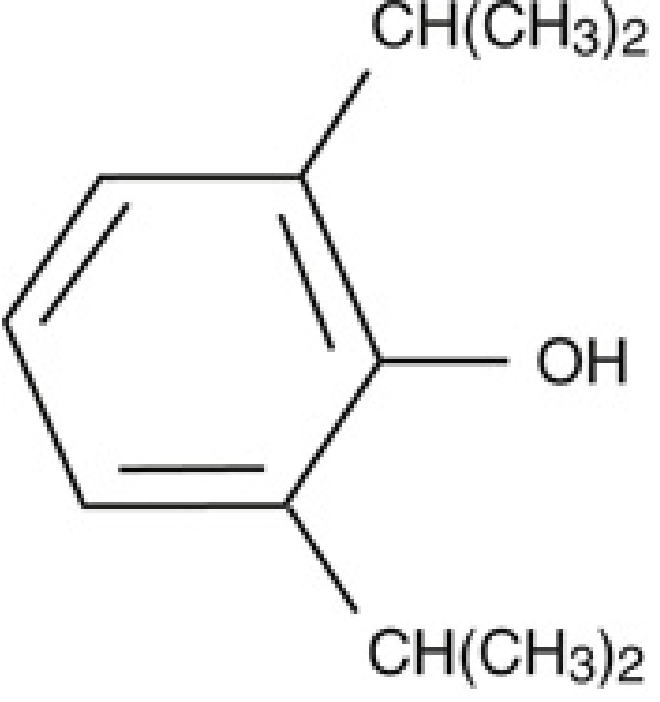
Structure of propofol (2,6-diisopropylphenol) - Miller's Anesthesia, 10e
Mechanism of Action
Propofol potentiates chloride current mediated through the GABA-A receptor complex, enhancing inhibitory neurotransmission. This is the same fundamental mechanism shared by benzodiazepines and barbiturates, though propofol binds at different subunit sites. It has no analgesic properties - it is purely hypnotic.
- Katzung's Basic and Clinical Pharmacology, 16e, p. 707
- Miller's Anesthesia, 10e, p. 2462
Pharmacokinetics
| Parameter | Value |
|---|---|
| Induction dose | 1-2.5 mg/kg IV |
| Duration after single dose | 3-8 min |
| Protein binding | 97% |
| Clearance | 20-30 mL/kg/min (exceeds hepatic blood flow) |
| Volume of distribution (steady state) | 150-700 L |
| Elimination half-life | 4-23 hours |
| Context-sensitive half-time (up to 8h infusion) | < 40 min |
Key points:
-
Three-compartment model: Initial distribution half-life is 2-8 min; termination of effect after a bolus is mainly from redistribution (brain to muscle/fat), not metabolism.
-
Extrahepatic metabolism: Clearance exceeds hepatic blood flow. The kidney accounts for up to 30% of clearance; the lungs handle 20-30% of a bolus dose. This was confirmed during liver transplant anhepatic phases.
-
Metabolites (propofol-glucuronide, quinol conjugates) are renally excreted and considered inactive.
-
Propofol is a CYP3A4 inhibitor - at 3 mcg/mL it reduces CYP3A4 activity by ~37%, relevant when co-administered with midazolam or other CYP3A4 substrates.
-
The brief context-sensitive half-time is what makes it practical for TIVA (total intravenous anesthesia) - recovery remains rapid even after prolonged infusions.
-
Miller's Anesthesia, 10e, p. 2460-2461
Clinical Uses
1. Induction of General Anesthesia
The standard adult induction dose is 1-2.5 mg/kg IV (titrated over 20-30 seconds). Onset is within one arm-brain circulation time (~30 seconds). Elderly patients require lower doses (often 1-1.5 mg/kg) due to smaller central compartments and reduced cardiac output.
2. Maintenance of Anesthesia (TIVA)
Propofol can be run as a variable-rate infusion (typically 50-150 mcg/kg/min, adjusted to response) to maintain anesthesia. Recovery after propofol maintenance is not significantly faster than volatile agents, but it produces less postoperative nausea and vomiting (PONV) - a major practical advantage. Target-controlled infusion (TCI) systems use validated three-compartment pharmacokinetic models (Marsh, Schnider) to automate dosing.
3. Monitored Anesthesia Care (MAC) / Sedation
Propofol's easy titratability and smooth recovery profile make it popular for procedural sedation (endoscopy, minor procedures). Sub-hypnotic doses (25-75 mcg/kg/min) provide sedation with patients remaining responsive.
4. ICU Sedation
Propofol infusions are widely used for short-term ICU sedation (typically ventilated patients). The lipid vehicle imposes a caloric load, and Propofol Infusion Syndrome (PRIS) is a rare but potentially fatal complication with prolonged high-dose infusions (see below).
5. Antiemetic Effect
Sub-hypnotic doses of propofol (10-20 mg IV bolus) have an antiemetic effect and are used to treat PONV - likely via dopaminergic antagonism and action in the chemoreceptor trigger zone.
6. Antipruritic
Low-dose propofol has been used to treat cholestatic pruritus and opioid-induced itch, though the mechanism is not fully established.
Organ System Effects
CNS
-
Dose-dependent suppression: sedation → hypnosis → burst suppression on EEG
-
Decreases cerebral blood flow (CBF) by 53-79% and cerebral metabolic rate (CMRO2) by 48-58%, thereby reducing ICP and intraocular pressure
-
Autoregulation and CO2 reactivity are preserved even at burst-suppression doses - a key advantage over volatile agents in neuroanaesthesia
-
Anticonvulsant properties; safe in epilepsy patients
-
Occasional excitatory phenomena (twitching, spontaneous movement) during induction - not true seizures
-
Miller's Anesthesia, 10e, p. 2208; Katzung 16e, p. 707-708
Cardiovascular
Propofol causes the most pronounced blood pressure drop of all IV induction agents, via:
- Arterial and venous vasodilation (reducing preload and afterload)
- Impaired baroreflex response (blunted compensatory tachycardia)
- Direct negative inotropic effect at higher concentrations
The result: systolic BP can fall 20-40% after induction. Risk is amplified by hypovolemia, old age, and rapid injection. Profound bradycardia and even asystole have been reported in otherwise healthy adults. Caution is required in patients with compromised cardiac function.
Respiratory
- Apnea in 25-30% of patients after an induction dose (higher with opioid premedication)
- Maintenance infusion: 40% decrease in tidal volume, 20% increase in respiratory rate
- Depresses ventilatory response to both hypoxia and hypercapnia
- Bronchodilator in COPD patients - attenuates vagal and methacholine-induced bronchoconstriction (this effect is abolished by the metabisulfite preservative used in some formulations)
- Reduces upper airway reflexes more than thiopental - making it well-suited for laryngeal mask airway (LMA) insertion without neuromuscular blockade
Antiemetic / Antipruritic
Sub-anesthetic plasma concentrations (as low as 100-200 ng/mL) have antiemetic effects. This is why TIVA with propofol is preferred when PONV prevention is a priority.
Adverse Effects and Complications
| Effect | Details |
|---|---|
| Pain on injection | Common (up to 70%); minimized by injecting into a large antecubital vein, using lidocaine pretreatment, or using lipid formulations with EDTA |
| Hypotension/apnea | Most clinically significant hemodynamic and respiratory effects (see above) |
| Propofol Infusion Syndrome (PRIS) | Rare but fatal: metabolic acidosis, rhabdomyolysis, cardiac failure, renal failure. Occurs with high-dose (>4-5 mg/kg/h) prolonged (>48h) infusions, especially in children |
| Hyperlipidemia | Relevant in prolonged ICU infusions; monitor triglycerides |
| Infection risk | Lipid emulsion supports microbial growth; strict aseptic technique required; discard unused drug within 6-12 hours of vial opening |
| Allergy | Rare; history of egg or soy allergy may warrant caution (though most reactions are not IgE-mediated) |
| Green urine | Benign discoloration from phenol metabolites |
Special Populations
- Elderly: Reduce dose by 30-50%; smaller central volume + reduced cardiac output leads to higher peak plasma concentrations.
- Children: Higher dose requirements (mg/kg) for induction; PRIS risk with long ICU infusions. Propofol is not approved for ICU sedation in pediatric patients in the US.
- Obstetrics: Crosses the placenta; neonatal CNS/respiratory depression possible.
- Hepatic impairment: Extrahepatic metabolism maintains overall clearance; pharmacokinetics not dramatically altered.
Propofol vs. Volatile Anesthetics
| Feature | Propofol (TIVA) | Volatile agents |
|---|---|---|
| PONV | Lower | Higher |
| Cancer recurrence | No proven benefit | No proven difference |
| Airway pollution | None | Yes (OR contamination) |
| Titratability | High | Moderate |
| Cost | Higher | Lower |
| ICP control | Excellent | Variable |
A large prospective study found propofol-based anesthesia does not reduce cancer recurrence compared with volatile anesthesia - earlier observational data suggesting a benefit have not been confirmed.
- Miller's Anesthesia, 10e, p. 1250
Key takeaway: Propofol's rapid onset, brief context-sensitive half-time, antiemetic properties, and preservation of cerebrovascular autoregulation have made it the default IV anesthetic for induction and increasingly for maintenance via TIVA, despite its cardiovascular depressant effects and the risk of PRIS in prolonged high-dose use.
Sources: Miller's Anesthesia, 2-Volume Set, 10e; Katzung's Basic and Clinical Pharmacology, 16e; Barash Clinical Anesthesia, 9e
This is a shared conversation. Sign in to Orris to start your own chat.