
Hair pull test
Reading File
Finding Sources
Finding Sources
Searching PubMed
hair pull test alopecia diagnosis
Reading File
Reading File
Loading Image
Reading File
Hair Pull Test (Sabouraud Maneuver)
Technique
The test is performed in a patient who has not shampooed for more than 24 hours prior to examination. The examiner grasps approximately 40-60 hairs between the thumb, index, and middle fingers from the base near the scalp and pulls firmly - but not forcefully - along the hair shafts. The process is repeated in at least 3 scalp areas: frontal, occipital, and temporal regions.
- Fitzpatrick's Dermatology, Vol. 1-2
Interpretation
| Finding | Interpretation |
|---|---|
| >10% of grasped hairs extracted (strict criterion) | Positive - active shedding |
| >5-6 hairs consistently from 2+ areas (clinical criterion) | Positive - probable effluvium |
| Diffusely positive across all regions | Telogen effluvium |
| Positive in frontal region, negative in occipital | Androgenetic alopecia (AGA) |
| Strongly positive | Alopecia areata incognita |
| Negative | Does NOT exclude telogen effluvium |
Root Morphology of Extracted Hairs (Critical Step)
After collecting hairs, examine root morphology - this distinguishes the cause:
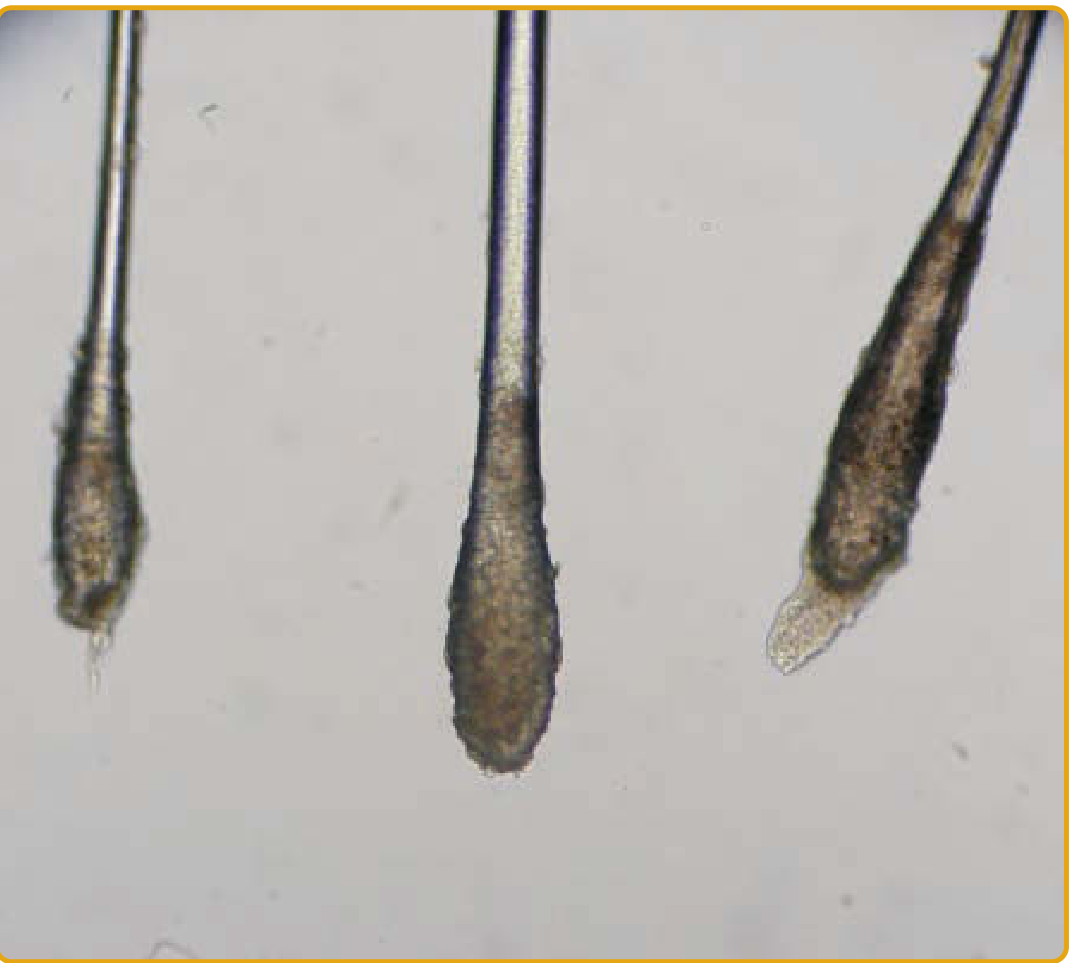
- Club-shaped (telogen) roots - blunt, white, pigment-free bulbs with an intact root sheath. Seen in telogen effluvium. (See figure below)
- Tapered "pencil point" roots (dystrophic anagen) - strongly suggests alopecia areata
- Anagen roots - soft, pigmented, irregularly shaped bulbs with a root sheath; pulled in anagen effluvium (e.g., chemotherapy)
Clinical Correlations by Diagnosis
| Diagnosis | Hair Pull Test Result |
|---|---|
| Telogen effluvium (TE) | Diffusely positive; telogen club hairs extracted |
| Alopecia areata | Positive at margins of patch; tapered anagen hairs |
| Alopecia areata incognita | Strongly positive (diffuse, no visible patches) |
| AGA (androgenetic alopecia) | May be positive frontally; negative occipitally |
| Female pattern hair loss | Usually not valuable for distinction from chronic TE |
| Protein-energy malnutrition | Positive gentle hair pull |
Comparison with Trichogram
The trichogram is the more formal, semi-invasive version of the hair pull test - forceps are used to pluck 50-100 hairs, which are then examined microscopically for the telogen:anagen ratio. Acute TE is suggested if the telogen rate exceeds 25% (normal telogen rate ~13%). The hair pull test is a simpler bedside screen, but the trichogram gives quantitative cycle data.
Key Limitations
- A negative test does not exclude telogen effluvium
- The "normal" daily hair loss count is not firmly standardized (range 40-180 hairs/day in studies; >100/day is widely used as a threshold for abnormal)
- The test can be positive in multiple conditions, so root morphology examination is essential to differentiate them
- Fitzpatrick's Dermatology, Vol. 1-2 (Chapter 86)
Corn vs callus
Finding Sources
Finding Sources
Finding Sources
Reading File
Reading File
Reading File
Reading File
Corn vs. Callus
Both are forms of hyperkeratosis caused by repeated mechanical pressure or friction, but they differ structurally, anatomically, and clinically.
Comparison Table
| Feature | Callus (Tyloma) | Corn (Clavus) |
|---|---|---|
| Latin name | Callus / Tyloma | Clavus |
| Shape | Diffuse, broad, flat thickening | Circumscribed, conical |
| Central core | Absent | Present - hard, horny core pointing inward |
| Pain | Usually painless (unless severe) | Painful - core presses on sensory nerves (dull/boring or sharp/lancinating) |
| Location | Palms, soles, bony prominences, weight-bearing areas | Dorsa of toes (hard corn), interdigital spaces (soft corn), soles |
| Surface | Diffuse yellowish thickening | Shiny, polished surface; core visible on paring |
| Disappears with pressure removal | Yes | Yes |
| Bony abnormality underneath | Uncommon | Common (exostosis or bony spur, especially in longstanding cases) |
- Andrews' Diseases of the Skin, p. 52
Callus
A callus is a non-penetrating, circumscribed hyperkeratosis - it has no central core and represents a more diffuse skin thickening. It arises wherever repetitive pressure is applied: palms, soles, bony joint prominences. It tends to disappear spontaneously when the causative pressure is removed.
Notable occupational/activity calluses include: boxer's knuckle pads, surfer's nodules, tennis toe, rower's rump, violinist's neck callosity, and Russell sign (calluses on the dorsum of the hand over the MCP/IP joints - a clue to bulimia nervosa).
Corn (Clavus)
Corns are circumscribed horny conical thickenings with the base on the surface and the apex pointing inward, pressing on underlying sensory nerves. There are two types:
Hard Corn (Heloma Durum)
- Located on the dorsa of toes or subungually/soles
- Shiny, polished surface
- Paring reveals a clear, hard central core
- Pain is dull/boring or sharp/lancinating from core pressure on nerves
Soft Corn (Heloma Molle)
- Located in interdigital spaces (most commonly the 4th web space)
- Softened and macerated by sweat - appears white and soggy
- Caused by bony pressure between adjacent toes (e.g., medial flare of the 5th toe's distal phalanx pressing on the 4th toe's IP joint)
- Can ulcerate and become infected
Corn vs. Plantar Wart (Important Differential)
| Maneuver | Corn | Plantar Wart |
|---|---|---|
| Lateral squeeze | Painless | Painful |
| Perpendicular pressure | Painful | Less painful |
| On paring | Clear horny core | Elongated dermal papillae with punctate bleeding vessels |
Treatment
Callus:
- Padding to relieve pressure
- Paring/pumice stone
- Keratolytics: 40% salicylic acid plasters, 12% ammonium lactate lotion, urea-containing cream
- Corrective footwear
Corn:
- Pressure relief (ring of soft felt wadding, corrective footwear)
- Soaking + paring the surface, especially removing the central core
- 40% salicylic acid plaster (reapply every 48 hours after paring)
- Er:YAG laser ablation
- Punch excision
- If underlying bony exostosis: surgical removal is often necessary for definitive cure; simple surface treatments will fail without addressing the bony cause
- Andrews' Diseases of the Skin, p. 52; Campbell's Operative Orthopaedics 15th Ed 2026
This is a shared conversation. Sign in to Orris to start your own chat.