
If a patient has BP - 170/100 mmhg On multiple readings, the average is 160/90 mmhg , no comorbidities Not DM or any other diseases Then how to start treatment to the patient and which tablet is best suitable for the patient and how to decide the correct medication for this patient
Reading File
Now let me search the medical library for hypertension management content in parallel.
Finding Sources
Finding Sources
Searching PubMed
"hypertension" AND "antihypertensive" AND "treatment guidelines"
Good. Let me now read the key sections from Lippincott Pharmacology and Goldman-Cecil Medicine on hypertension management.
Reading File
Finding Sources
Finding Sources
Reading File
Finding Sources
Reading File
Finding Sources
Reading File
Reading File
Now let me fetch the flowchart image and get info on ACE inhibitors/ARBs from the same textbook:
Loading Image
Reading File
I now have comprehensive information to give a thorough, evidence-based answer. Let me compile this now.
Hypertension Management: BP 160/90 mmHg (Average), No Comorbidities
Step 1 - Classify the Hypertension
Based on the readings provided:
| Reading | Value |
|---|---|
| Presenting BP | 170/100 mmHg |
| Average on multiple readings | 160/90 mmHg |
Using ACC/AHA 2017 guidelines, this patient has Stage 2 Hypertension (SBP ≥140 OR DBP ≥90 mmHg). The BP is also significantly above the treatment goal of <130/80 mmHg - the systolic is 30 mmHg above goal and the diastolic is 10 mmHg above goal.
Key decision point: Per Lippincott Pharmacology, "Patients with systolic blood pressure greater than 20 mm Hg above goal or diastolic blood pressure more than 10 mm Hg above goal should be started on two antihypertensives simultaneously." - Lippincott Illustrated Reviews: Pharmacology, p. 293
Step 2 - Start Both Lifestyle + Medication Together
Unlike Stage 1 HTN (where you can trial lifestyle for a few months), Stage 2 HTN at 160/90 requires immediate dual approach:
Lifestyle Modifications (always first/concurrent)
| Modification | Recommendation | Expected SBP Drop |
|---|---|---|
| Weight reduction | Maintain BMI 18.5-24.9 | 5-20 mmHg per 10 kg lost |
| DASH diet | High fruits, vegetables, low-fat dairy, low saturated fat | 8-14 mmHg |
| Sodium restriction | <2300 mg/day (100 mmol/day) | 2-8 mmHg |
| Aerobic exercise | Brisk walking 30 min/day, most days | 5-8 mmHg |
| Alcohol restriction | Max 2 drinks/day men, 1 drink/day women | 2-4 mmHg |
| Stop smoking | For overall CV risk reduction | - |
(Source: National Kidney Foundation Primer on Kidney Diseases, 8e, Table 64.9)
Step 3 - Drug Selection
For a patient with no comorbidities, the four first-line drug classes are:
- Thiazide/Thiazide-like diuretics (e.g., hydrochlorothiazide, chlorthalidone)
- ACE Inhibitors (e.g., enalapril, lisinopril, ramipril)
- Angiotensin Receptor Blockers / ARBs (e.g., losartan, telmisartan)
- Calcium Channel Blockers / CCBs (e.g., amlodipine)
Since this patient's BP is 30 mmHg above systolic goal, start COMBINATION therapy from day 1.
Best Recommended Starting Combination:
Amlodipine (CCB) + either ACE inhibitor or ARB
This is the most widely recommended combination per ESH/ESC 2018 guidelines - specifically:
ACE or ARB + CCB or ACE or ARB + thiazide diuretic
Practical starting doses:
| Drug | Starting Dose | Max Dose |
|---|---|---|
| Amlodipine | 2.5-5 mg once daily | 10 mg/day |
| Ramipril (ACE-I) | 2.5-5 mg once daily | 10 mg/day |
| OR Telmisartan (ARB) | 40 mg once daily | 80 mg/day |
| Losartan (ARB) | 50 mg once daily | 100 mg/day |
Step 4 - How to Decide Which Drug to Use (ACE-I vs ARB vs CCB vs Diuretic)
The choice is guided by patient-specific factors:
| Factor | Preferred Drug |
|---|---|
| Young patient (<55 yrs), non-black | ACE inhibitor or ARB |
| Black patient or age ≥55 yrs | CCB or Thiazide (first choice; ACE-I less effective as monotherapy) |
| Dry cough develops on ACE-I | Switch to ARB |
| History of angioedema | Avoid ACE-I; use ARB |
| High heart rate, anxiety, palpitations | Beta-blocker can be added |
| Edema, heart failure features present | Thiazide diuretic preferred |
(Source: NICE 2019 guidelines, ACC/AHA 2017)
Step 5 - Target BP and Follow-Up
- Treatment target: <130/80 mmHg (ACC/AHA 2017) for most non-elderly adults
- NICE 2019 target for age <80: <140/90 mmHg (more conservative)
- Review at: 4 weeks after starting medication
- If BP still not at goal: uptitrate doses or add a 3rd drug (the "AB+C+D" stepwise approach)
Summary Decision Algorithm for This Patient
BP 160/90 (no DM, no comorbidities)
         |
         ▼
Stage 2 HTN → Start lifestyle + 2-drug therapy simultaneously
         |
         ▼
Preferred: Amlodipine 5mg + Ramipril 5mg (or Telmisartan 40mg)
         |
         ▼
Review in 4 weeks → If BP <130/80: continue
                  → If not: uptitrate or add chlorthalidone
Drug classes to avoid in a healthy patient without indication: Beta-blockers are NOT first-line here (no heart disease, no tachycardia, no anxiety). Alpha-blockers are 3rd/4th line. Avoid dual RAAS blockade (ACE-I + ARB together - increased risk of renal failure and hyperkalaemia).
Quick Reference: Drug Class Comparison
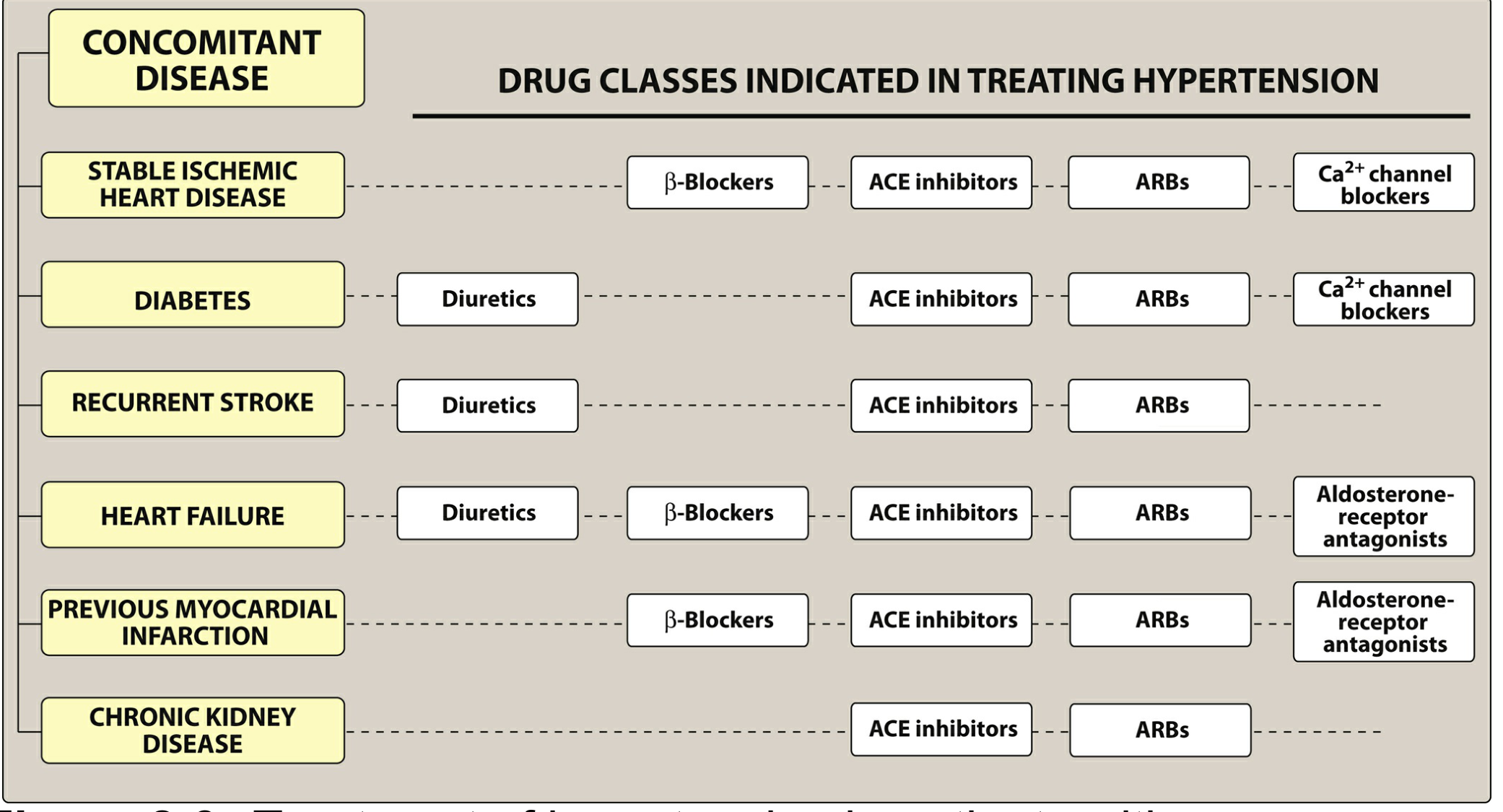
Source: Lippincott Illustrated Reviews: Pharmacology - Figure 8.6, Treatment of hypertension in patients with concomitant diseases
Sources:
- Lippincott Illustrated Reviews: Pharmacology, pp. 293-295 - ACC/AHA 2017, ESH/ESC 2018, NICE 2019 guideline comparison table and drug selection
- National Kidney Foundation Primer on Kidney Diseases, 8e - Lifestyle modification table (Table 64.9)
- ACC/AHA 2017 Hypertension Guidelines (treatment target <130/80, 4 first-line drug classes)
Is Tab telma h(40/12.5mg ) tablet is best for above hypertension
Quick answer: Tab Telma-H (Telmisartan 40mg + Hydrochlorothiazide 12.5mg) is a reasonable combination for this patient - it combines an ARB with a thiazide diuretic, both of which are first-line drugs for hypertension. However, the preferred combination per most guidelines for a treatment-naive Stage 2 HTN patient is ARB/ACE-I + CCB (amlodipine) rather than ARB + diuretic. Let me pull the detailed evidence.
Searching sources...
Finding Sources
Finding Sources
Searching PubMed
"telmisartan" AND "hydrochlorothiazide" AND "hypertension"
Finding Sources
Finding Sources
Reading Article
PMID: 37432701
Reading File
Finding Sources
Finding Sources
Finding Sources
Reading File
Now I have everything needed for a thorough, evidence-based answer.
Tab Telma-H (Telmisartan 40mg + HCTZ 12.5mg): Is It the Best Choice?
Short Answer
Telma-H is a good, acceptable combination - but not the preferred first-line choice for this specific patient based on current guidelines. Here's a full breakdown:
What Is Telma-H?
| Component | Drug | Class | Dose |
|---|---|---|---|
| Telmisartan | ARB (Angiotensin Receptor Blocker) | RAAS blocker | 40 mg |
| Hydrochlorothiazide (HCTZ) | Thiazide diuretic | Volume-reducing | 12.5 mg |
Both drugs individually are first-line for hypertension. Combining them as a single-pill makes sense for compliance. However, the choice between ARB + Diuretic vs ARB + CCB matters clinically.
What the Evidence Says: ARB + CCB vs ARB + Diuretic
A 2023 systematic review and network meta-analysis published in Clinical Cardiology (PMID: 37432701) directly compared single-pill combinations in 16,273 patients with uncontrolled essential hypertension and found:
ARB/CCB combination had better advantages than ARB/HCTZ in terms of systolic BP reduction, diastolic BP reduction, BP control rates, and diastolic response rate.
Specifically, Telmisartan + Amlodipine (not Telmisartan + HCTZ) ranked #1 in blood pressure control rates (SUCRA: 83.5%).
This matches guideline recommendations:
- ESH/ESC 2018: Preferred first-line dual therapy = ARB/ACE-I + CCB OR ARB/ACE-I + thiazide
- Katzung's Basic & Clinical Pharmacology: Triple therapy mentioned = Telmisartan 20mg + Amlodipine 2.5mg + Chlorthalidone 12.5mg - showing CCB is the preferred backbone
Why Telma-H May Still Be Used
It is not wrong, and is used widely. Here's when it makes sense:
| Situation | Telma-H Suitable? |
|---|---|
| Patient has pedal edema or tendency for fluid retention | YES - HCTZ helps |
| Patient cannot tolerate amlodipine (ankle swelling, flushing) | YES |
| Cost is a concern (Telma-H is cheap and widely available) | YES |
| Adequate BP control achieved | YES, continue |
| Patient has high sodium diet | YES - HCTZ offsets sodium load |
| Patient is young, no edema, treatment-naive Stage 2 HTN | Prefer Telma-AM (Telmisartan + Amlodipine) instead |
Why Telma-H Has Limitations for This Patient
The HCTZ 12.5mg component carries metabolic risks that matter in a young, otherwise healthy patient:
- Hypokalemia (low potassium) - requires monitoring
- Hyperuricemia (elevated uric acid) - can precipitate gout
- Hyperglycemia (slightly raises blood sugar) - relevant if patient has pre-diabetic tendency
- Dyslipidemia (mild effect on lipids with long-term use)
"Thiazide diuretics can induce hypokalemia, hyperuricemia, and, to a lesser extent, hyperglycemia in some patients."
- Lippincott Illustrated Reviews: Pharmacology, p. 296
Also, note that Chlorthalidone (a thiazide-like diuretic) is superior to Hydrochlorothiazide for cardiovascular outcomes - meaning even if a thiazide combination is chosen, Tab Telma + Chlorthalidone would be pharmacologically stronger than Telma-H (which contains HCTZ).
Head-to-Head: Telma-H vs Telma-AM
| Feature | Telma-H (ARB + HCTZ) | Telma-AM (ARB + Amlodipine) |
|---|---|---|
| Guideline preference (ESH/ESC) | Second option | First option |
| BP control (network meta-analysis) | Good | Superior |
| Metabolic side effects | Hypokalemia, hyperuricemia, glucose rise | Ankle edema, flushing |
| Cardioprotection | Moderate | Good |
| Suitable if patient develops edema | Not ideal | Can cause more edema |
| Once daily dosing | Yes | Yes |
| Cost (India) | Very affordable | Slightly more |
Bottom Line Recommendation
| Scenario | Best Tablet |
|---|---|
| First-line, treatment-naive, no edema, young patient | Tab Telma-AM (Telmisartan 40mg + Amlodipine 5mg) |
| Patient has ankle swelling or amlodipine intolerance | Tab Telma-H (Telmisartan 40mg + HCTZ 12.5mg) |
| BP very high (>160/100) needing stronger control | Triple combo: Telmisartan + Amlodipine + low-dose HCTZ |
| If using Telma-H | Monitor serum potassium, uric acid, fasting glucose at 3 months |
Telma-H is acceptable but Telma-AM is the preferred first-line combination for this patient based on current evidence and major guidelines (ESH/ESC 2018 and 2023 meta-analysis data).
Sources:
- Lippincott Illustrated Reviews: Pharmacology, pp. 293-296 (thiazide adverse effects, ARB/CCB guidelines)
- Katzung's Basic and Clinical Pharmacology, 16th Ed., p. 291 (telmisartan triple combination evidence)
- Xie M et al. (2023) - Network meta-analysis of 16,273 patients: ARB/CCB > ARB/HCTZ for BP control, Clinical Cardiology [PMID: 37432701]
- ESH/ESC 2018 Hypertension Guidelines (ARB + CCB as preferred first-line dual therapy)
This is a shared conversation. Sign in to Orris to start your own chat.