
25. Three drugs used to treat arrhythmias for 3 Marks final year Allied Health Sciences exam Advance paper 3 Rajiv Gandhi University
Quick Answer: Three drugs used to treat arrhythmias are Lidocaine (Class Ib), Amiodarone (Class III), and Adenosine. These act by different mechanisms - blocking sodium channels, potassium channels, or purinergic receptors respectively to restore normal cardiac rhythm.
Searching sources...
Reading File
Finding Sources
Finding Sources
Reading File
Reading File
Reading File
I now have excellent textbook content. Let me fetch the classification diagram to include visually.
Loading Image
I now have all the content needed for a complete, exam-ready answer. Here is the full response:
Three Drugs Used to Treat Arrhythmias
For 3 Marks - Allied Health Sciences Final Year, Rajiv Gandhi University
Antiarrhythmic drugs are classified by the Vaughan-Williams classification (Classes I-IV) based on their mechanism of action on the cardiac action potential. Below are three commonly tested drugs:
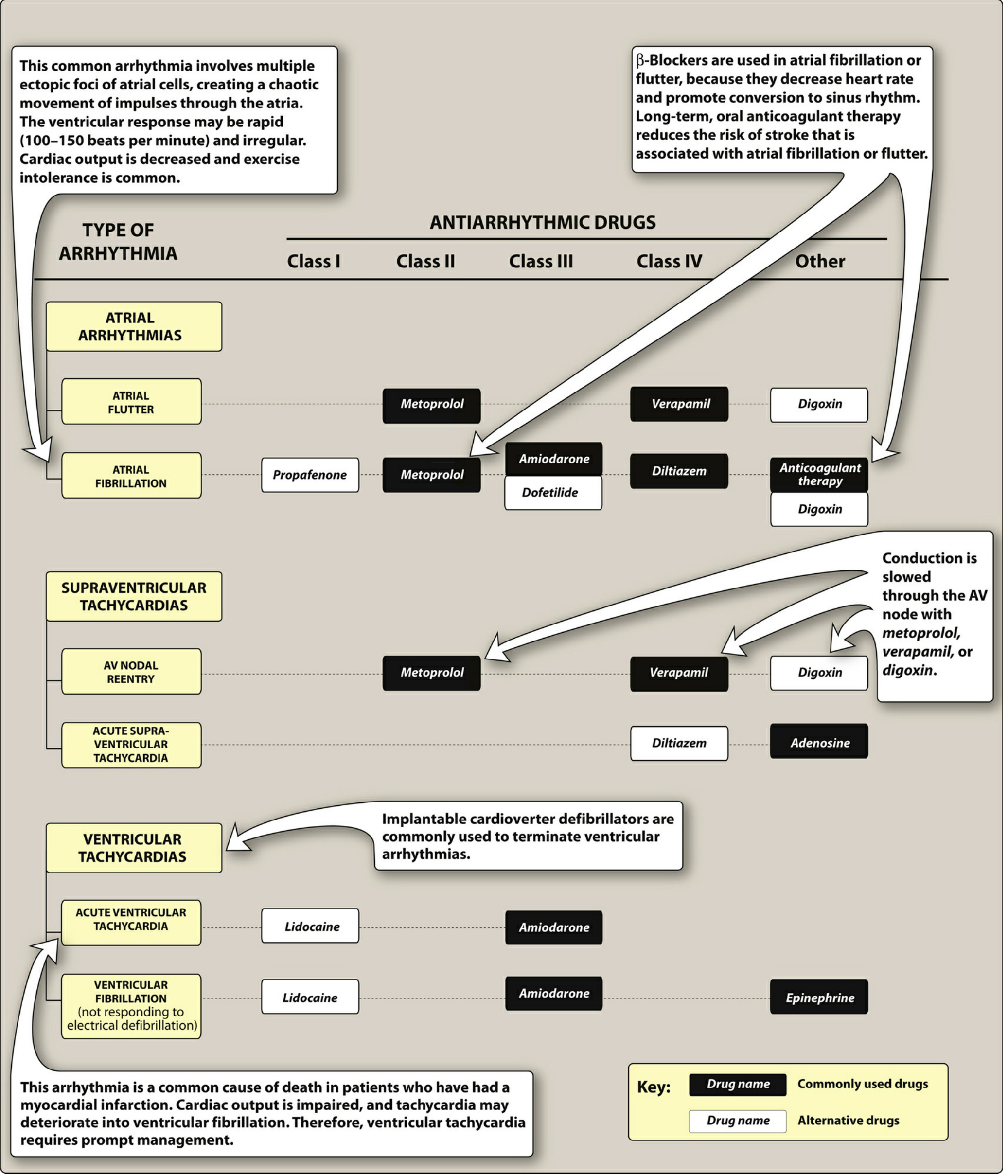
1. Lidocaine (Class IB - Na⁺ Channel Blocker)
| Feature | Detail |
|---|---|
| Class | IB - Sodium channel blocker |
| Mechanism | Blocks voltage-gated Na⁺ channels; shortens Phase 3 repolarization in cardiac myocytes. Preferentially acts on depolarized (ischemic) tissue |
| Uses | Acute ventricular tachycardia (VT), ventricular fibrillation (VF) - especially post-myocardial infarction |
| Route | IV only (extensive first-pass metabolism) |
| Adverse Effects | CNS toxicity (tremor, confusion, seizures), worsening ventricular arrhythmias, dizziness, paresthesia |
Key Point: Lidocaine is the drug of choice for acute ventricular arrhythmias in emergency settings. It has no effect on atrial arrhythmias because atrial tissue has shorter action potentials.
2. Amiodarone (Class III - K⁺ Channel Blocker)
| Feature | Detail |
|---|---|
| Class | III - Potassium channel blocker (also has Class I, II, and IV properties) |
| Mechanism | Blocks K⁺ channels, prolonging Phase 3 repolarization and increasing the effective refractory period (ERP). Also blocks Na⁺ and Ca²⁺ channels and has beta-blocking activity |
| Uses | Atrial fibrillation, atrial flutter, ventricular tachycardia, ventricular fibrillation (broad-spectrum antiarrhythmic) |
| Route | Oral and IV |
| Adverse Effects | Pulmonary toxicity (most serious), thyroid dysfunction (hypo/hyperthyroidism - contains iodine), photosensitivity, corneal microdeposits, hepatotoxicity, QT prolongation |
Key Point: Amiodarone is the most widely used antiarrhythmic drug with the broadest spectrum of action, effective for both atrial and ventricular arrhythmias.
3. Adenosine (Miscellaneous/Other Class)
| Feature | Detail |
|---|---|
| Class | Miscellaneous - Purinergic agonist |
| Mechanism | Activates A1 purinergic receptors in the AV node → increases K⁺ conductance → hyperpolarizes AV nodal cells → transiently blocks AV conduction |
| Uses | Drug of choice for acute supraventricular tachycardia (SVT), especially AV nodal re-entry tachycardia (AVNRT) |
| Route | IV rapid bolus only (half-life < 10 seconds) |
| Adverse Effects | Transient flushing, dyspnea, chest tightness, transient asystole (expected and brief), bronchospasm (contraindicated in asthma) |
Key Point: Adenosine has an extremely short half-life (~10 seconds), making it both safe and rapidly reversible for diagnosing and terminating SVT.
Quick Summary Table
| Drug | Class | Mechanism | Main Use |
|---|---|---|---|
| Lidocaine | IB | Na⁺ channel block (shortens repolarization) | Ventricular arrhythmias (acute VT/VF) |
| Amiodarone | III | K⁺ channel block (prolongs repolarization) | Broad-spectrum (AF, VT, VF) |
| Adenosine | Other | K⁺ ↑ → AV node block | Acute SVT termination |
Sources: Lippincott Illustrated Reviews: Pharmacology, p. 383-390; Goodman & Gilman's The Pharmacological Basis of Therapeutics, p. 2693-2715
This is a shared conversation. Sign in to Orris to start your own chat.