
Rapido and sand filter from spm standard textbook for university exams
Reading File
The user is asking about "Rapid sand filter" from an SPM (Social and Preventive Medicine) textbook for university exams. Let me search the medical library for this topic.
Finding Sources
Finding Sources
Finding Sources
Finding Sources
Found it in Park's Textbook. Let me read the full section on rapid sand filter.
Reading File
I can see there's a lot of content. Let me read a bit more to get the rapid sand filter section and the comparison table.
Reading File
Reading File
Reading File
Now I have all the content I need. Let me also fetch the diagram images.
Loading Image
I now have all the content needed for a complete answer. Here is the comprehensive notes on Rapid Sand Filter from Park's Textbook of Preventive and Social Medicine:
Rapid Sand Filter (Mechanical Filter)
Source: Park's Textbook of Preventive and Social Medicine, pp. 813-815
Introduction
In 1885, the first rapid sand filters were installed in the USA. Since then, they have gained considerable popularity especially in highly industrialized countries.
Rapid sand filters are of two types:
- Gravity type - e.g., Paterson's filter
- Pressure type - e.g., Candy's filter
Steps of Purification
The following steps are involved in purification of water by rapid sand filters:
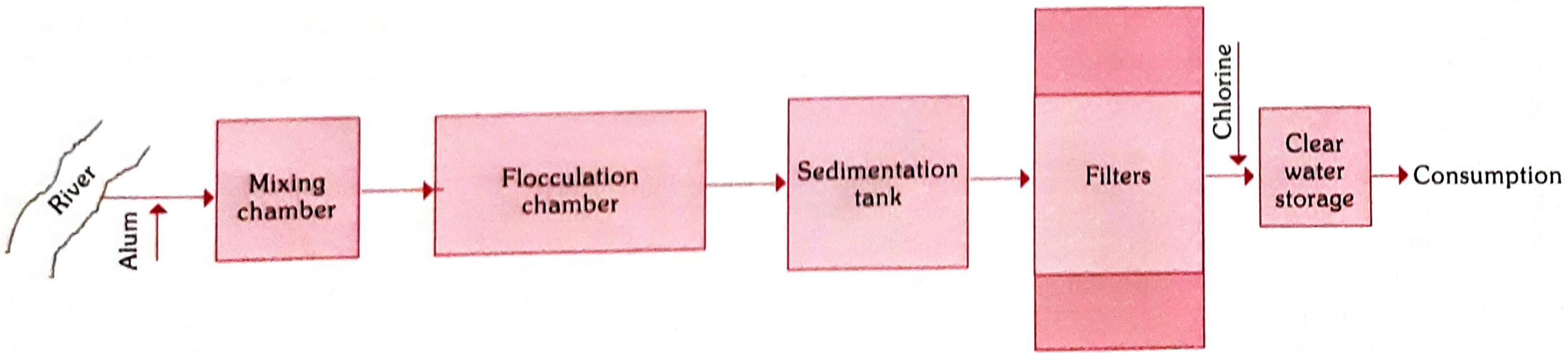
Fig. 6 - Flow diagram of a rapid sand filtration plant (Park's SPM, p. 814)
1. Coagulation
- Raw water is treated with a chemical coagulant - alum (aluminium sulphate)
- Dose: 5 to 40 mg/L or more, depending on turbidity, colour, temperature, and pH of the water
2. Rapid Mixing
- Treated water is subjected to violent agitation in a "mixing chamber" for a few minutes
- Ensures quick and thorough dissemination of alum throughout the bulk of water
3. Flocculation
- Water undergoes slow and gentle stirring in a "flocculation chamber" for about 30 minutes
- Mechanical flocculator (most widely used) consists of paddles rotating at 2 to 4 rpm, driven by motors
- This produces a thick, copious, white flocculant precipitate of aluminium hydroxide
- Thicker the precipitate/flock diameter = greater the settling velocity
4. Sedimentation
- Coagulated water is led into sedimentation tanks where it is detained for 2 to 6 hours
- Flocculent precipitate along with impurities and bacteria settle down
- At least 95% of the flocculant precipitate must be removed before water enters rapid sand filters
- Sludge is removed periodically without disturbing operation
5. Filtration
- Partly clarified water is subjected to rapid sand filtration
Filter Beds
| Parameter | Details |
|---|---|
| Surface area per unit | ~80 to 90 m² (~900 sq. feet) |
| Filtering medium | Sand |
| Effective size of sand particles | 0.4 to 0.7 mm |
| Depth of sand bed | ~1 metre (2½ to 3 feet) |
| Gravel layer below sand | 30 to 40 cm (1 to 1½ feet) |
| Depth of water on top of sand bed | 1.0 to 1.5 m (5 to 6 feet) |
| Rate of filtration | 200 million gallons per acre per day (m.g.a.d.) |
The gravel layer supports the sand bed and permits filtered water to move freely to the under-drains.
Filtration Process
- The "alum-floc" not removed by sedimentation is held back on the sand bed
- It forms a slimy layer comparable to the zoogleal layer in slow sand filters
- It adsorbs bacteria and effects purification; oxidation of ammonia also takes place
- As filtration proceeds, suspended impurities and bacteria clog the filters
- When "loss of head" approaches 7 to 8 feet, filtration is stopped and backwashing begins
Backwashing
- Rapid sand filters need frequent washing - daily or weekly, depending on loss of head
- Washing is accomplished by reversing the flow of water through the sand bed
- Backwashing dislodges impurities and cleans the sand bed
- Washing is stopped when clear sand is visible and wash water is clear
- Whole process takes about 15 minutes
- In some rapid sand filters, compressed air is also used as part of backwashing
Advantages of Rapid Sand Filter over Slow Sand Filter
- Can deal with raw water directly - no preliminary storage needed
- Filter beds occupy less space
- Filtration is rapid - 40 to 50 times that of a slow sand filter
- Washing of the filter is easy (backwashing)
- There is more flexibility in operation
Comparison of Rapid Sand Filter vs. Slow Sand Filter (TABLE 3)
| Feature | Rapid Sand Filter | Slow Sand Filter |
|---|---|---|
| 1. Space | Occupies very little space | Occupies large area |
| 2. Rate of filtration | 200 m.g.a.d. | 2-3 m.g.a.d. |
| 3. Effective size of sand | 0.4-0.7 mm | 0.2-0.3 mm |
| 4. Preliminary treatment | Chemical coagulation and sedimentation | Plain sedimentation |
| 5. Washing | By back-washing | By scraping the sand bed |
| 6. Operation | Highly skilled | Less skilled |
| 7. Loss of head allowed | 6-8 feet (2-2.5 m) | 4 feet (1.5 m) |
| 8. Removal of turbidity | Good | Good |
| 9. Removal of colour | Good | Fair |
| 10. Removal of bacteria | 98-99% | 99.9-99.99% |
Key exam point: Slow sand filter is superior to rapid sand filter in removal of bacteria (99.9-99.99% vs 98-99%). However, rapid sand filter is better for removal of colour and is much faster in rate.
Key Numbers to Remember for Exams
| Parameter | Value |
|---|---|
| Alum dose | 5-40 mg/L |
| Flocculation time | 30 minutes |
| Sedimentation time | 2-6 hours |
| % flock removed before filtration | ≥ 95% |
| Sand size | 0.4-0.7 mm |
| Sand depth | 1 metre |
| Rate of filtration | 200 m.g.a.d. |
| Backwash time | 15 minutes |
| Loss of head to stop filtration | 7-8 feet |
| Bacterial removal | 98-99% |
(Park's Textbook of Preventive and Social Medicine, pp. 813-815)
This is a shared conversation. Sign in to Orris to start your own chat.