
How should I manage a patient of subconjunctival hemorrhage?
Reading File
Subconjunctival hemorrhage (SCH) is usually a benign, self-limiting condition caused by rupture of small conjunctival vessels. In most cases, no treatment is needed - it resolves spontaneously in 1-2 weeks. Key management steps include identifying any underlying cause (trauma, hypertension, anticoagulation, Valsalva) and reassuring the patient.
Searching sources...
Finding Sources
Searching PubMed
subconjunctival hemorrhage management treatment
Good results from four textbooks. Let me read the most clinically relevant sections in parallel.
Reading File
Reading File
Reading File
I now have excellent content from the Wills Eye Manual, Tintinalli's, and Rosen's. Let me also read the Wills Eye treatment section which was cut off, and the Roberts and Hedges procedure text.
Reading File
Reading File
Reading File
Excellent - I now have thorough, well-sourced content from four authoritative textbooks. Let me fetch the clinical image and compose the full answer.
Loading Image
Here is a comprehensive, evidence-based management guide for subconjunctival hemorrhage (SCH):
Subconjunctival Hemorrhage - Management
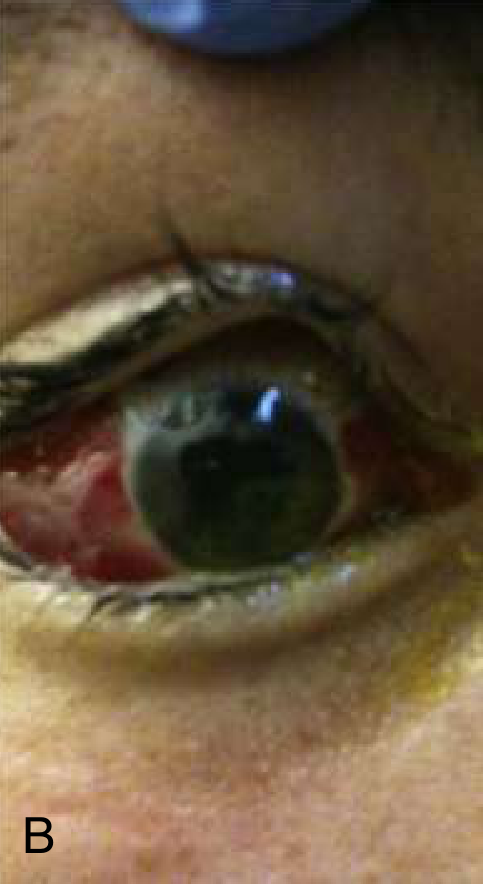
Subconjunctival hemorrhage: blood smoothly elevating the overlying conjunctiva with no vessels visible behind it. (Rosen's Emergency Medicine, Fig. 57.3)
1. Recognition and Clinical Features
- Bright red blood beneath the conjunctiva; vessels are NOT visible through the blood (this distinguishes it from conjunctivitis)
- Often found incidentally (patient notices it in the mirror on waking)
- Vision is not affected
- Symptoms, if any: mild diffuse foreign body sensation; usually asymptomatic
- May be associated with chemosis in larger bleeds
2. Etiology - Always Identify the Cause
| Category | Examples |
|---|---|
| Valsalva | Coughing, sneezing, vomiting, straining at stool, heavy lifting |
| Trauma | Direct blunt/penetrating injury; eye rubbing |
| Systemic | Hypertension, diabetes, bleeding disorders |
| Medications | Aspirin, clopidogrel, warfarin, ticagrelor, dabigatran, rivaroxaban, apixaban, edoxaban, topical steroids |
| Idiopathic | Very common; no cause found |
3. History and Examination (Workup)
History to take:
- Any bleeding or clotting problems?
- Current medications (especially anticoagulants/antiplatelets)?
- Trauma, eye rubbing, heavy lifting, or Valsalva?
- Is this a recurrent episode?
- Acute or chronic cough?
Examination:
- Check blood pressure - hypertension is a common precipitant
- Visual acuity - should be normal; any reduction warrants urgent evaluation
- Ocular examination:
- Check extraocular motility
- IOP (if large/traumatic bleed)
- Look for signs of globe rupture: abnormally deep or shallow anterior chamber, hyphema, vitreous hemorrhage, uveal prolapse, severe bullous SCH
- 360-degree hemorrhage with chemosis, pain, or reduced vision = evaluate for globe perforation
- Slit lamp + fluorescein: mandatory in trauma to rule out corneal abrasions, globe perforation (Seidel's test), and retained foreign bodies; evert eyelids to check fornices
When to do Seidel's test: If fluorescein dye on the conjunctival surface is focally displaced by leaking aqueous fluid (positive test), or brownish-black uveal tissue is visible in a scleral wound, globe perforation is present - manage accordingly.
4. Treatment
For simple, non-traumatic SCH:
- No specific treatment is required - this is the most important point
- Cool compresses may be applied for comfort; there is no evidence they hasten resolution
- Artificial tears (q.i.d.) may be given if the patient has mild ocular irritation or foreign body sensation
- Advise the patient the blood will gradually resolve over 10 to 14 days (up to 2-4 weeks), changing colours as it does (from bright red → orange/yellow → resolution)
- No patching, no antibiotic drops, no steroids needed
Medications:
- Elective use of aspirin and NSAIDs should be discouraged unless required for coexisting medical conditions
- Do NOT stop anticoagulants or antiplatelets without clearance from the patient's primary physician - the risk of stopping these (e.g. stroke, MI) usually far outweighs the benefit
5. Investigations - When Are They Needed?
Routine investigations are NOT warranted in a first, simple, spontaneous SCH.
Order coagulation studies (PT, aPTT, CBC with differential, LFTs, Protein C and S) if:
- Recurrent subconjunctival hemorrhages
- History of bleeding problems or bruising elsewhere
- Patient on anticoagulants (consider checking INR/drug levels)
- No identifiable cause in a child (consider non-accidental injury)
Imaging (CT/MRI orbits with and without contrast):
- If orbital signs are present in a non-traumatic case: proptosis, restricted extraocular motility, elevated IOP - investigate for orbital mass (e.g., neuroblastoma in children, lymphangioma in adults)
- In traumatic cases: image as guided by mechanism and clinical findings
6. Red Flags Requiring Urgent Ophthalmology Referral
- Reduced visual acuity
- 360-degree hemorrhage
- Significant chemosis
- Restricted eye movements or proptosis
- Elevated IOP
- Evidence of globe perforation on Seidel's test
- Hyphema or uveal prolapse visible
- Traumatic SCH with high-velocity mechanism (compressed air tool, hammer strike deflection) - suspect occult penetrating injury
7. Differential Diagnosis to Consider
- Kaposi sarcoma: red/purple, slightly elevated subconjunctival lesion - test for HIV
- Conjunctival lymphoma or amyloid with secondary hemorrhage
- Scleritis/episcleritis: vessels visible through injection; pain; does not have the smooth, flat blood-pool appearance
- Conjunctival abrasion or laceration
8. Follow-Up and Referral
- No routine follow-up is needed for simple SCH
- Advise patient to return if blood does not fully resolve or if a recurrence occurs
- Recurrent SCH or one that fails to resolve: refer to ophthalmologist to rule out conjunctival lesion (e.g., early Kaposi, amyloid, lymphoma)
- Refer to internist/family physician if hypertension or bleeding diathesis is suspected or identified
Sources:
- The Wills Eye Manual, 8e - section 5.5
- Rosen's Emergency Medicine, 10e - Chapter 57
- Tintinalli's Emergency Medicine, 9e - Chapter 241
- Roberts and Hedges' Clinical Procedures in Emergency Medicine, 7e - Chapter 62
This is a shared conversation. Sign in to Orris to start your own chat.