
Gastric hormones
Reading File
Searching sources...
Finding Sources
Finding Sources
Reading File
Reading File
Reading File
Reading File
Finding Sources
Reading File
Loading Image
Finding Sources
Now I have comprehensive information from the textbooks. Let me compile a thorough answer.
Gastric and Gastrointestinal Hormones
What Qualifies as a GI Hormone?
For a substance to be an "official" gastrointestinal hormone, it must:
- Be secreted in response to a physiologic stimulus and carried in the bloodstream to act at a distant site
- Function independently of neural activity
- Have been isolated, purified, chemically identified, and synthesized
Only four substances meet all criteria: Gastrin, CCK, Secretin, and GIP. Others like motilin, somatostatin, ghrelin, GLP-1, PYY, and neurotensin are "candidate hormones" that meet some but not all criteria.
- Costanzo Physiology 7th Edition, p. 349
The Four Official GI Hormones
1. Gastrin
| Feature | Detail |
|---|---|
| Structure | 17-AA (G17 = "little", postprandial) or 34-AA (G34 = "big", interdigestive) |
| Secreted by | G cells of the gastric antrum |
| Stimuli | Products of protein digestion (small peptides, amino acids), gastric distension, vagal stimulation |
| Minimal active fragment | C-terminal tetrapeptide (Trp-Met-Asp-Phe-NH₂) |
| Inhibited by | Low luminal pH (<3), somatostatin |
Actions of Gastrin:
- Stimulates H⁺ secretion by gastric parietal cells (primary action)
- Trophic effect on the gastric mucosa (promotes growth)
- Stimulates enterochromaffin-like (ECL) cell histamine release
Zollinger-Ellison Syndrome - a gastrinoma (usually in non-β cell pancreas) causes excess gastrin, leading to: massive H⁺ secretion, gastric mucosal hypertrophy, refractory duodenal ulcers, and steatorrhea (from lipase inactivation by excess acid).
Synthetic gastrin = pentagastrin (terminal 4 AA + alanine) - retains all physiologic properties.
- Costanzo Physiology, p. 350; Guyton & Hall, p. 804
2. Cholecystokinin (CCK)
| Feature | Detail |
|---|---|
| Structure | 33-AA peptide; C-terminal 5 AA identical to gastrin; member of gastrin-CCK family |
| Secreted by | I cells of duodenal and jejunal mucosa |
| Stimuli | Monoglycerides + fatty acids; small peptides + amino acids (signals fat + protein in meal) |
| Minimal active fragment | C-terminal heptapeptide (CCK-7) |
| Receptors | CCKA (CCK-selective); CCKB (equally sensitive to CCK and gastrin) |
Five Major Actions of CCK (all aimed at fat/protein digestion):
- Gallbladder contraction + sphincter of Oddi relaxation → ejects bile for lipid emulsification
- Pancreatic enzyme secretion (lipases, amylase, proteases)
- Pancreatic bicarbonate secretion (synergistic with secretin)
- Reduces gastric emptying (allows time for digestion)
- Satiety signal (acts on hypothalamus to reduce appetite)
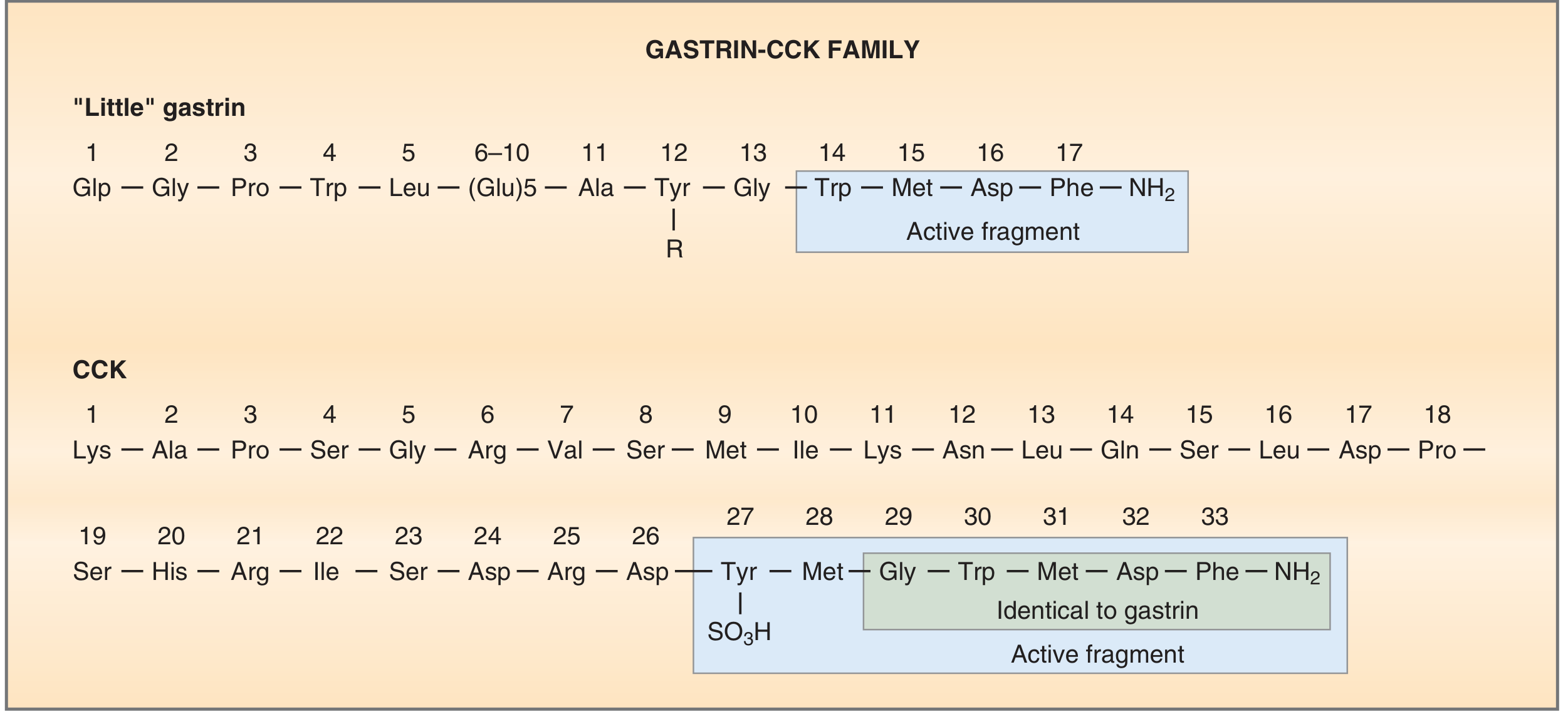
Structures of gastrin and CCK showing the shared C-terminal active fragment and their amino acid sequences - Costanzo Physiology, Fig. 8.5
3. Secretin
| Feature | Detail |
|---|---|
| Structure | 27-AA peptide; ALL amino acids essential for activity; member of secretin-glucagon family |
| Secreted by | S cells of the small intestine (duodenum) |
| Stimuli | Acid (low pH) in the duodenum; fatty acids |
Actions of Secretin:
-
Stimulates pancreatic HCO₃⁻ secretion (to neutralize duodenal acid)
-
Inhibits gastric acid secretion by:
- Inhibiting antral gastrin release
- Stimulating somatostatin release
- Direct downregulation of parietal cell H⁺ secretion
-
Inhibits gastric emptying
-
Medical Physiology, p. 888-889
4. GIP (Glucose-dependent Insulinotropic Polypeptide / Gastric Inhibitory Peptide)
| Feature | Detail |
|---|---|
| Secreted by | K cells of the duodenum and jejunum |
| Stimuli | Luminal fatty acids, glucose |
Actions of GIP:
- Incretin effect: stimulates insulin secretion from pancreatic β cells in response to duodenal glucose and fatty acids
- Inhibits gastric acid secretion (directly inhibits parietal cells; indirectly inhibits antral gastrin release)
- Inhibits gastric motility
Candidate (Unofficial) Hormones
| Hormone | Source | Key Action |
|---|---|---|
| Motilin | Upper duodenum (fasting) | Initiates migrating myoelectric complexes (MMC) every 90 min; promotes GI motility |
| Somatostatin | D cells of gastric/intestinal mucosa; pancreatic δ cells | Inhibits all other GI hormones; inhibits gastric H⁺ secretion; released by low pH |
| GLP-1 | L cells of small intestine | Incretin (stimulates insulin); inhibits glucagon; slows gastric emptying; increases satiety; basis for GLP-1 agonists in T2DM |
| GLP-2 | L cells of small intestine | Promotes intestinal mucosal growth |
| Enteroglucagon | Intestinal cells | Increases glycogenolysis/gluconeogenesis when blood glucose is low |
| Pancreatic Polypeptide | Pancreas | Inhibits pancreatic HCO₃⁻ and enzyme secretion |
| Peptide YY (PYY) | Endocrine cells of ileum/colon | Inhibits gastric acid secretion; satiety signal |
| Neurotensin | Endocrine cells of ileum | Inhibits gastric acid secretion |
| Ghrelin | Stomach (oxyntic mucosa) | "Hunger hormone" - stimulates appetite, promotes gastric emptying |
| 5-HT (Serotonin) | Enterochromaffin cells | Regulates GI motility; released by mucosal distension |
| Histamine | ECL cells of stomach | Stimulates parietal cell H⁺ secretion (key paracrine mediator) |
Hormones That Inhibit Gastric Acid (Enterogastrones)
When fat, acid, or hyperosmolar solutions reach the duodenum, a feedback loop inhibits gastric acid via:
| Hormone | Source |
|---|---|
| CCK | I cells (duodenum/jejunum) |
| Secretin | S cells (small intestine) |
| GIP | K cells (duodenum/jejunum) |
| VIP | ENS neurons |
| Somatostatin | D cells (stomach/duodenum) |
| Neurotensin | Ileal endocrine cells |
| Peptide YY | Ileal/colonic endocrine cells |
Lipids are the most potent inhibitors; acid is also significant. None has been established as the sole "enterogastrone."
- Medical Physiology, p. 644-660
Three Phases of Gastric Acid Secretion
- Cephalic phase (~30% of total): anticipation/sight/smell/taste of food; mediated by vagal (ACh) stimulation of G cells and parietal cells
- Gastric phase (~60%): food in stomach; gastric distension + protein products stimulate G cells → gastrin → H⁺
- Intestinal phase (~10%): chyme enters intestine; initially a small stimulatory component, then dominant inhibitory feedback (enterogastrones)
Paracrines vs. Hormones vs. Neurocrines
| Type | Route | Examples |
|---|---|---|
| Hormones (endocrines) | Bloodstream to distant target | Gastrin, CCK, Secretin, GIP |
| Paracrines | Local diffusion to nearby cells | Somatostatin, Histamine |
| Neurocrines | Across synapse from GI neurons | ACh, Norepinephrine, VIP, GRP, enkephalins, Neuropeptide Y, Substance P |
- Costanzo Physiology 7th Edition, pp. 349-352
This is a shared conversation. Sign in to Orris to start your own chat.