
What is General Physiology ?
General physiology is the branch of biology and medicine that studies how living organisms and their parts function - covering cellular processes, homeostasis, membrane transport, electrical signaling, and the basic mechanisms shared across all body systems. It forms the foundation for understanding organ-specific physiology.
Searching sources...
Reading File
Finding Sources
Searching the Web
general physiology definition scope topics overview
Finding Sources
Finding Sources
Finding Sources
Finding Sources
Reading File
Reading File
Reading File
Here is a thorough overview of General Physiology, drawn from the Guyton and Hall Textbook of Medical Physiology (one of the most authoritative references in the field):
General Physiology
Definition
Physiology (from Ancient Greek physis - "nature" and logia - "study of") is the branch of biology that seeks to explain the function of living organisms and their parts, including the physical and chemical mechanisms responsible for the origin, development, and progression of life.
General Physiology specifically focuses on the fundamental principles and mechanisms common to all cells and tissues - the building blocks underlying how every organ system works. It is the "core" layer of physiology before you get into organ-specific chapters.
Key Topics in General Physiology
1. The Cell - The Basic Living Unit
- The human body contains approximately 35 to 40 trillion cells
- Every cell, regardless of type, shares core characteristics: energy metabolism, chemical reactions, and the ability to reproduce
- The body also harbors trillions of microorganisms (microbiota) living in symbiosis - in the gut alone, 400 to 1000 microbial species are present
- Guyton and Hall, p. 20
2. Homeostasis - The Central Principle
- Coined by American physiologist Walter Cannon in 1929
- Homeostasis is the maintenance of a stable internal environment - it is a dynamic, not static, process that constantly adjusts body functions
- Operates at every level: molecular, genetic, cellular, organ, and whole-body
- Key examples:
- Blood hydrogen ion concentration varies less than 5 nanomoles/L (extremely tight regulation)
- Blood sodium is also tightly regulated despite variable dietary intake
- Disease is often a state of disrupted homeostasis - but even in disease, compensatory mechanisms continue to operate
- Guyton and Hall, p. 22
3. The Extracellular Environment ("Internal Environment")
- Claude Bernard (19th century) first described the concept of the "milieu intérieur" (internal environment)
- The extracellular fluid (ECF) surrounds all cells and provides them with nutrients, oxygen, and removes waste products
- The ECF has two main compartments: plasma (in blood vessels) and interstitial fluid (between cells)
- Regulation of the ECF composition is the central task of most organ systems
4. Cell Membrane Structure
- The cell membrane is a lipid bilayer 7.5 to 10 nanometers thick
- Composition: ~55% proteins, 25% phospholipids, 13% cholesterol, 4% other lipids, 3% carbohydrates
- Phospholipids are amphipathic: hydrophilic phosphate heads face the watery environment; hydrophobic fatty acid tails face inward
- Cholesterol regulates membrane fluidity and permeability
- Sphingolipids (especially in nerve cells) help with protection, signal transmission, and adhesion
- Guyton and Hall, p. 31
5. Membrane Proteins
- Integral proteins: span the full thickness of the membrane; form ion channels, carrier proteins, and receptors
- Peripheral proteins: attached to surface; often function as enzymes or structural anchors
- Membrane proteins enable selective transport of specific ions (Na+, K+, Ca2+, Cl-) and molecules
- Guyton and Hall, p. 31
6. Transport Across Cell Membranes
- Diffusion (passive): movement down a concentration gradient - no energy needed
- Fat-soluble substances (O2, CO2, alcohol) pass freely through the lipid bilayer
- Water-soluble substances (ions, glucose) require protein channels or carriers
- Active transport: requires ATP; moves substances against their concentration gradient (e.g., Na+/K+ ATPase pump)
- Osmosis: diffusion of water across a semipermeable membrane
- Endocytosis/Exocytosis: bulk movement of large molecules into or out of cells via membrane vesicles
7. Control Systems and Feedback Loops
- The body uses negative feedback to maintain homeostasis - a deviation from normal triggers a corrective response that brings it back
- Example: a rise in blood pressure triggers reflexes that lower it
- Positive feedback amplifies a change (e.g., childbirth contractions, blood clotting)
- Feedback systems involve: a sensor (detector), a control center (integrator), and an effector
8. Energy Metabolism at the Cellular Level
- All cells extract energy by oxidizing carbohydrates, fats, and proteins
- The fundamental energy currency is ATP (adenosine triphosphate)
- Cellular respiration occurs primarily in mitochondria
- The basic chemical mechanisms for energy transformation are essentially the same in all cell types
Scope and Subdivisions
| Subdivision | Focus |
|---|---|
| Cell physiology | Function of individual cells and organelles |
| Neurophysiology | Electrical signaling, action potentials, synapses |
| Cardiovascular physiology | Heart and blood vessel function |
| Renal physiology | Kidney function, fluid & electrolyte balance |
| Respiratory physiology | Gas exchange, lung mechanics |
| Endocrine physiology | Hormonal regulation |
| Gastrointestinal physiology | Digestion and absorption |
| Reproductive physiology | Reproductive mechanisms |
Why General Physiology Matters
- It is the foundation for clinical medicine - understanding disease (pathophysiology) requires knowing normal function first
- It connects basic sciences (biochemistry, molecular biology, anatomy) to clinical practice
- It explains why drugs, procedures, and treatments work the way they do
Source: Guyton and Hall Textbook of Medical Physiology, 14th Edition, pp. 20-31 (Chapter 1: Functional Organization of the Human Body and Control of the Internal Environment; Chapter 2: The Cell and Its Functions)
What is Biophysics in Human Physiology ?
Biophysics in human physiology applies the principles of physics to understand biological processes - covering membrane potentials, osmosis, fluid dynamics, diffusion, electrical signaling in nerves and muscles, and mechanical forces in tissues. It bridges physics and medicine to explain how the body works at a fundamental level.
Searching sources...
Finding Sources
Searching the Web
biophysics human physiology definition topics membrane potential action potential
Finding Sources
Finding Sources
Finding Sources
Reading File
Reading File
Reading File
Finding Sources
Reading File
Finding Sources
Reading File
Give me results quickly
Biophysics in Human Physiology
Biophysics applies physical principles to explain how the human body functions at the cellular and molecular level. Here are the core topics:
1. Membrane Biophysics
Cell Membrane Structure
- A lipid bilayer (7.5-10 nm thick): 55% proteins, 25% phospholipids, 13% cholesterol
- Hydrophobic core blocks water-soluble ions; fat-soluble gases (O₂, CO₂) cross freely
Diffusion
- Simple diffusion: movement down a concentration gradient, no energy needed
- Facilitated diffusion: via protein channels (e.g., aquaporins for water, ion channels for Na⁺/K⁺)
- Rate depends on: concentration gradient, membrane surface area, temperature, molecular size
Osmosis
- Net movement of water across a semipermeable membrane from low solute → high solute side
- Osmotic pressure: the pressure needed to stop osmosis
- Drives cell swelling or shrinking depending on tonicity of surrounding fluid
2. Bioelectricity - Membrane Potentials
Resting Membrane Potential (-70 to -80 mV)
- Inside of the cell is negative relative to outside
- Maintained by:
- High K⁺ permeability at rest (K⁺ leaks out)
- Low Na⁺ permeability at rest
- Na⁺/K⁺ ATPase pump: pumps 3 Na⁺ out and 2 K⁺ in (electrogenic)
- Ion concentrations at rest (nerve fiber):
| Ion | Outside | Inside |
|---|---|---|
| Na⁺ | 142 mEq/L | 14 mEq/L |
| K⁺ | 4 mEq/L | 140 mEq/L |
- Described mathematically by the Nernst equation and Goldman equation
Action Potential (the nerve impulse)
- A rapid depolarization and repolarization of the membrane
- Phases:
- Resting (-70 mV): Na⁺ channels closed
- Depolarization: stimulus opens voltage-gated Na⁺ channels → Na⁺ rushes in → membrane goes to +35 mV
- Repolarization: Na⁺ channels inactivate; K⁺ channels open → K⁺ flows out
- Hyperpolarization: brief overshoot below resting potential
- Restoration: Na⁺/K⁺ pump restores ion gradients
- All-or-nothing law: once threshold (~-55 mV) is reached, a full action potential fires
3. Active Transport (Biophysics of Pumps)
- Primary active transport: uses ATP directly (e.g., Na⁺/K⁺ ATPase, Ca²⁺ pump)
- Secondary active transport: uses the Na⁺ gradient created by the pump to co-transport other substances (e.g., glucose-Na⁺ cotransport in the gut)
4. Fluid & Pressure Physics (Hemodynamics)
- Blood flow follows Poiseuille's Law: flow ∝ pressure difference × radius⁴ / vessel length
- Capillary exchange governed by Starling forces: hydrostatic pressure vs. osmotic (oncotic) pressure
- Laplace's Law: wall tension = pressure × radius (explains why large aneurysms rupture more easily)
5. Mechanics of Breathing
- Boyle's Law: pressure × volume = constant; lung expansion lowers pressure → air flows in
- Surface tension in alveoli reduced by surfactant (prevents alveolar collapse)
- Compliance: the ease of lung stretching (ΔVolume / ΔPressure)
6. Optics & Sound in Physiology
- Eye: acts as a biophysical lens system; light refraction by cornea + lens focuses image on retina
- Ear: sound waves (mechanical pressure waves) converted to electrical nerve signals via hair cells in the cochlea
Summary Table
| Biophysical Principle | Physiological Application |
|---|---|
| Diffusion / Osmosis | Nutrient/gas exchange across membranes |
| Electrochemical gradients | Nerve and muscle signaling |
| Action potential | Neural communication, muscle contraction |
| Na⁺/K⁺ pump | Maintaining resting membrane potential |
| Poiseuille's Law | Blood flow regulation |
| Starling forces | Fluid balance between blood and tissues |
| Boyle's Law | Mechanics of breathing |
| Laplace's Law | Vessel wall tension, alveolar stability |
Sources: Guyton and Hall Textbook of Medical Physiology, 14th Ed. (Chapters 4 & 5); Costanzo Physiology, 7th Ed. (Chapter 1)
How do action potentials propagate along axons?
Action potentials propagate by local current flow - a depolarized segment excites the adjacent resting membrane, causing a wave of depolarization to travel along the axon. In myelinated fibers this jumps between nodes (saltatory conduction), making it much faster.
Searching sources...
Finding Sources
Finding Sources
Finding Sources
Finding Sources
Finding Sources
Reading File
Reading File
Reading File
Loading Image
Loading Image
Here is a complete, textbook-sourced explanation with diagrams:
How Action Potentials Propagate Along Axons
1. The Core Mechanism - Local Current Flow
When an action potential fires at one point on an axon, that spot becomes depolarized (inside becomes positive, ~+35 mV). The adjacent membrane is still at resting potential (-70 mV). This voltage difference drives local currents:
- Positive charges (Na⁺ ions) flow inward through the depolarized membrane
- These positive charges then travel along the inside of the axon in both directions
- On the outside, current flows back toward the depolarized zone
- This local current raises the voltage in adjacent resting membrane segments to threshold (-55 mV)
- Voltage-gated Na⁺ channels in those adjacent segments open → new action potential fires
- The cycle repeats, moving the wave of depolarization along the entire fiber
This is illustrated in the diagram below:
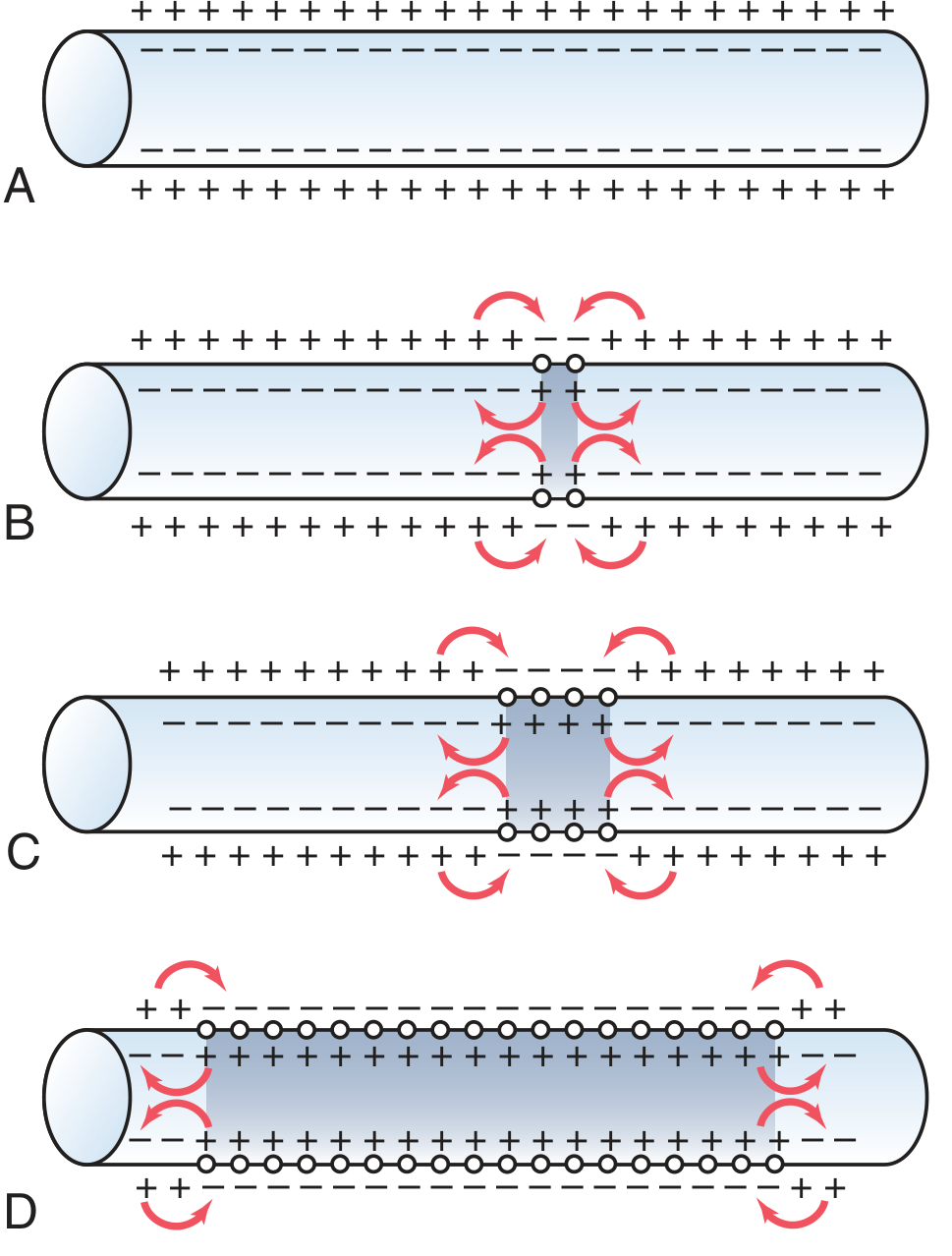
- A: Resting fiber (positive outside, negative inside)
- B: Depolarization at midpoint - local currents spread in both directions
- C & D: Adjacent segments reach threshold and fire; the wave expands outward
2. Why It Only Goes Forward (Unidirectional)
The area just behind the advancing wave is in the refractory period - Na⁺ channels are inactivated and cannot reopen immediately. This prevents the signal from going backwards and ensures one-way conduction from cell body toward the axon terminal.
3. Unmyelinated vs. Myelinated Fibers
Unmyelinated Fibers (Continuous Conduction)
- Local current spreads continuously along the entire membrane surface
- Every patch of membrane depolarizes in sequence
- Slow - conduction velocity ~0.5 to 2 m/s
- More energy costly (whole membrane must be re-polarized)
Myelinated Fibers - Saltatory Conduction
The myelin sheath (made by Schwann cells in PNS, oligodendrocytes in CNS) wraps the axon in multiple lipid layers - reducing ion flow across the membrane ~5000-fold. The only exposed membrane is at the nodes of Ranvier (2-3 µm gaps between Schwann cells).
As a result:
- Action potentials can only fire at nodes of Ranvier
- Electrical current jumps through the axoplasm and extracellular fluid from node to node
- The impulse "jumps" along the fiber - this is saltatory conduction (from Latin saltare = to jump)
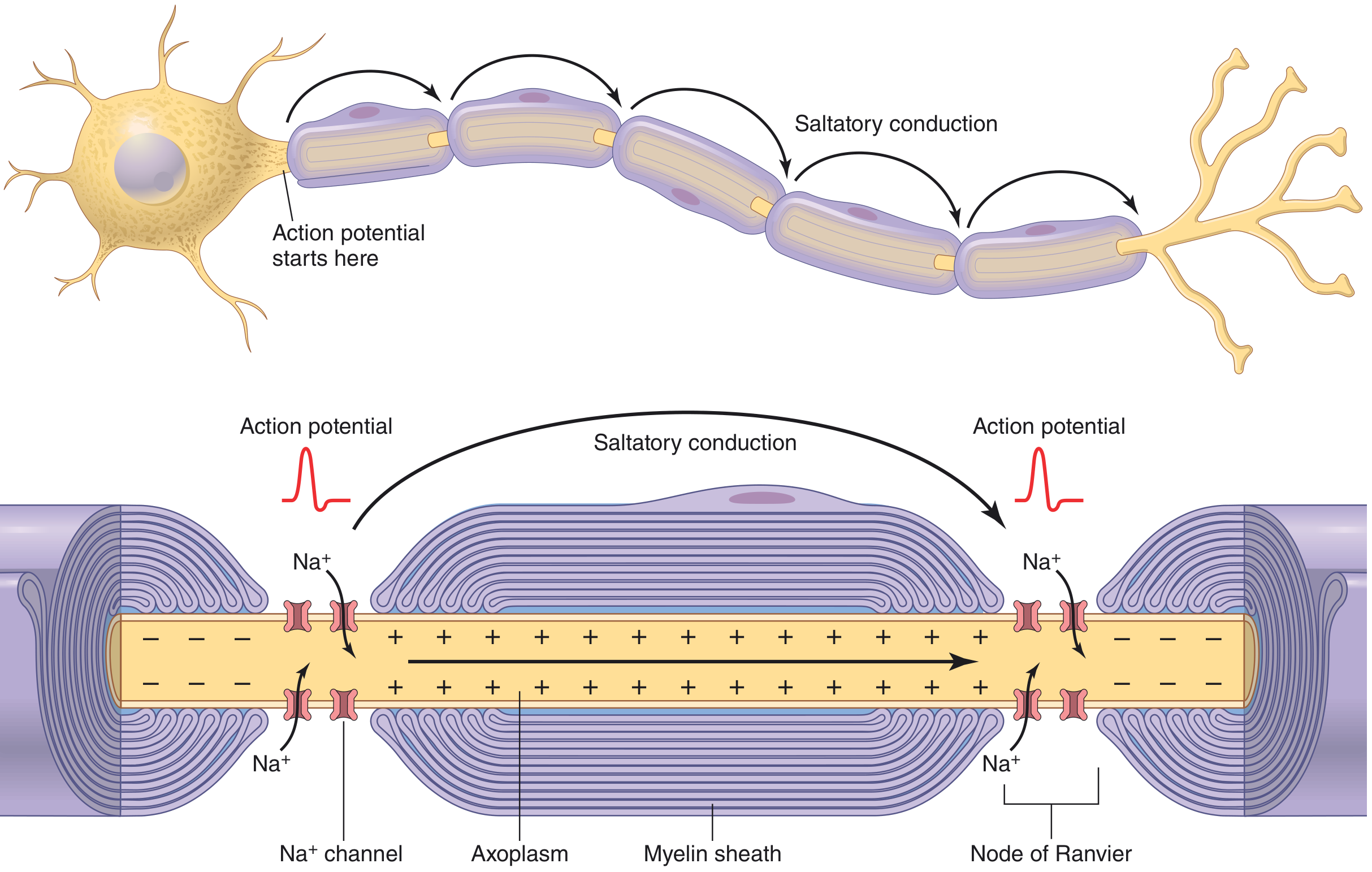
Two major advantages of saltatory conduction:
- Speed: 5- to 50-fold faster than unmyelinated fibers (up to 120 m/s in large myelinated fibers)
- Energy efficiency: Only nodes depolarize → ~100x less ion movement → far less ATP needed to restore ion gradients via Na⁺/K⁺ pump
4. Conduction Velocity - What Determines It?
| Factor | Effect on Velocity |
|---|---|
| Larger axon diameter | Faster (less internal resistance) |
| Myelination | Much faster (saltatory conduction) |
| Temperature | Higher temp = faster (up to a limit) |
Examples of conduction velocities:
- Large myelinated (Aα fibers): 70-120 m/s (motor neurons, proprioception)
- Small myelinated (Aδ fibers): 5-30 m/s (fast pain, cold)
- Unmyelinated (C fibers): 0.5-2 m/s (slow/burning pain, warmth)
5. Clinical Relevance
- Demyelinating diseases (e.g., Multiple Sclerosis, Guillain-Barré): destroy myelin → saltatory conduction fails → slowed or blocked nerve signals → weakness, numbness, paralysis
- Local anesthetics (e.g., lidocaine): block voltage-gated Na⁺ channels → prevent propagation → no pain signal reaches the brain
- Nerve conduction velocity (NCV) studies: measure propagation speed to diagnose neuropathies
Source: Guyton and Hall Textbook of Medical Physiology, 14th Ed., Chapter 5 (pp. 84-88) - Propagation of the Action Potential & Saltatory Conduction
Explain in details: Blood and Body Fluids in Human Physiology.
This is a shared conversation. Sign in to Orris to start your own chat.