
Make a detailed Notes of isolflurane pharmacology and mechanism from standard Anesthesia book and Pharma books
Reading File
Searching the medical library for isoflurane pharmacology content...
Searching sources...
Finding Sources
Finding Sources
Excellent - I have isoflurane sections in Miller's Anesthesia, Morgan & Mikhail, Goodman & Gilman, Barash Clinical Anesthesia, and Lippincott Pharmacology. Let me read all key sections in parallel.
Reading File
Reading File
Reading File
Reading File
Good data from Goodman & Gilman, Morgan & Mikhail, and Lippincott. Now let me get the Barash content and deeper sections from Goodman & Gilman and Miller's on mechanism of action, pharmacokinetics, and organ effects.
Reading File
Reading File
Finding Sources
Finding Sources
Now let me get the detailed mechanism of action content from the main anesthesia textbooks, plus the physical/pharmacokinetic data, and search for the relevant image:
Finding Sources
Reading File
Reading File
Excellent data from Barash and Miller's. Now let me get the molecular mechanism of action content from Miller's and Goodman & Gilman, plus a relevant image search:
Finding Sources
Reading File
Searching Images
isoflurane chemical structure volatile anesthetic
Now I have comprehensive data. Let me also fetch the molecular mechanism section from Goodman & Gilman and get the isoflurane-specific organ effects in more detail from Barash:
Reading File
Reading File
I now have comprehensive, detailed content from multiple standard textbooks. Let me fetch the key images that were found and compile the full notes:
Loading Image
Loading Image
I now have all the content needed. Let me compile the comprehensive, detailed notes on Isoflurane pharmacology.
ISOFLURANE - Detailed Pharmacology Notes
Sources: Miller's Anesthesia 10e, Morgan & Mikhail's Clinical Anesthesiology 7e, Barash Clinical Anesthesia 9e, Goodman & Gilman's Pharmacological Basis of Therapeutics, Lippincott Illustrated Reviews: Pharmacology
1. CHEMISTRY AND PHYSICAL PROPERTIES
Chemical Identity
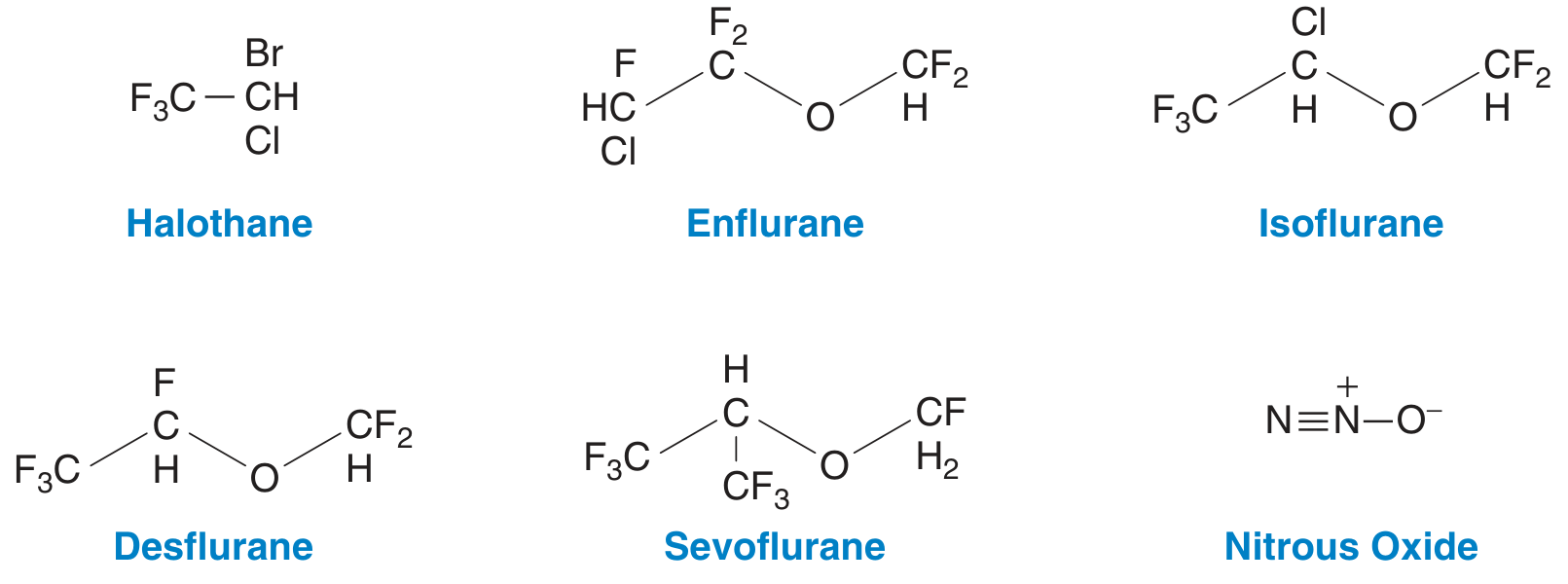
- Isoflurane is a halogenated methyl ethyl ether - a structural isomer of enflurane
- Chemical formula: CHF₂-O-CHClCF₃ (1-chloro-2,2,2-trifluoroethyl difluoromethyl ether)
- It is the most potent of the volatile anesthetics currently in clinical use
Physical Characteristics
| Property | Isoflurane | Notes |
|---|---|---|
| Physical state at room temp | Clear, colorless liquid | Volatile; requires vaporizer |
| Odor | Pungent, ethereal | Limits use for mask induction |
| Flammability | Non-flammable | Safe in clinical use |
| Boiling point | 49°C | |
| Molecular weight | 184 g/mol | |
| Vapor pressure (20°C) | 238 mmHg | Conventional vaporizer sufficient |
| Stability | Excellent - up to 5 years | Does not require light protection |
| Preservative | None needed | High degree of physical stability |
Partition Coefficients (at 37°C)
| Partition Coefficient | Value | Clinical Implication |
|---|---|---|
| Blood : Gas | 1.43-1.46 | Intermediate solubility; moderately slower induction than sevoflurane/desflurane |
| Brain : Blood | 2.2-2.6 | Rapid CNS equilibration once in blood |
| Fat : Blood | 45 (Fat:Gas = 91) | High fat solubility; prolonged context-sensitive half-life with long cases |
| Oil : Gas | 91 | High lipid solubility correlates with potency |
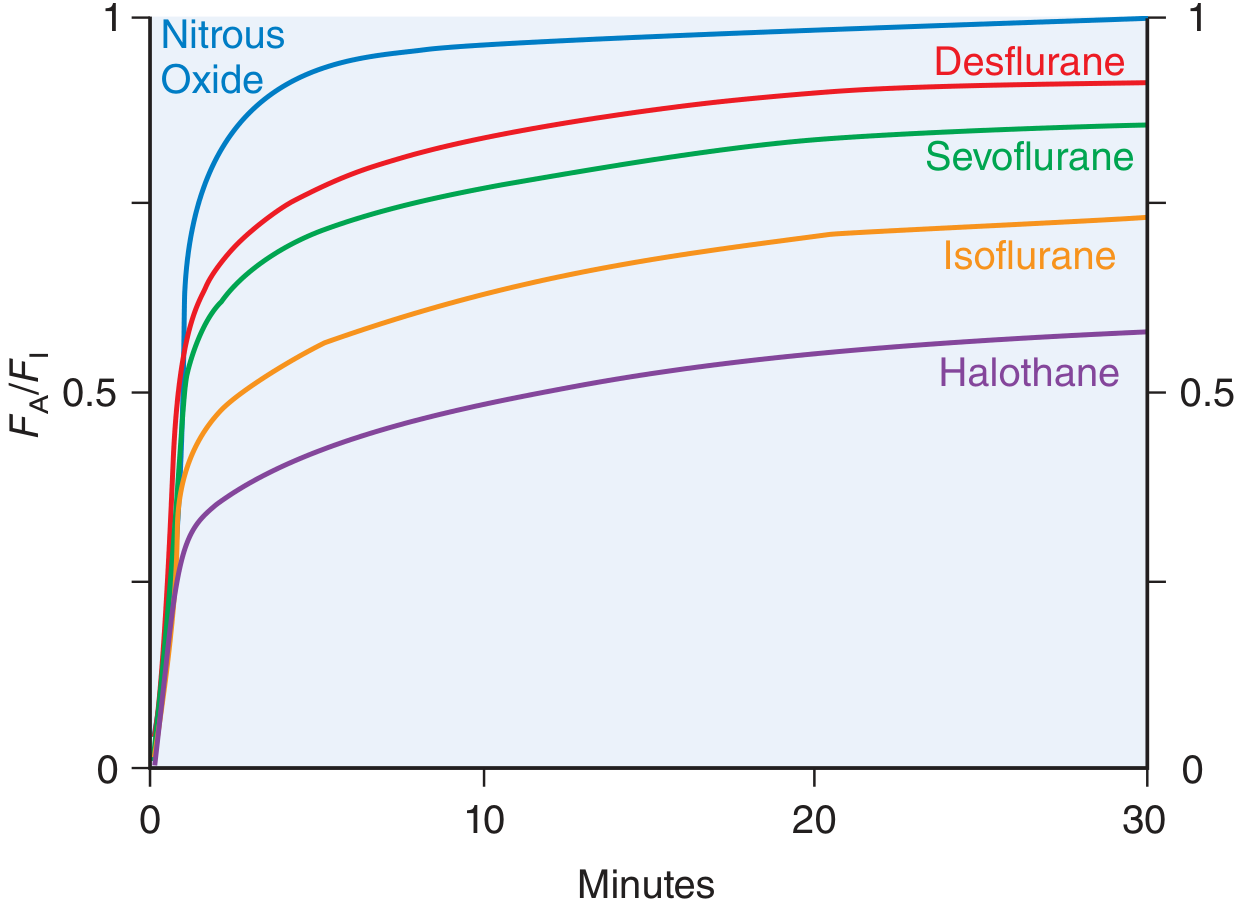
Blood:gas solubility intermediate between halothane (2.5) and sevoflurane (0.65). This means induction and recovery are faster than halothane but slower than sevoflurane or desflurane. - Barash Clinical Anesthesia 9e
2. PHARMACOKINETICS
A. Uptake (FA/FI Ratio)
The speed of induction depends on how rapidly the alveolar concentration (FA) rises toward the inspired concentration (FI). Isoflurane's blood:gas coefficient of 1.46 means blood acts as a large "sink," slowing this rise compared to low-solubility agents.
Factors determining uptake rate:
- Inspired concentration - higher concentration speeds FA/FI rise (concentration effect)
- Alveolar ventilation - higher minute ventilation speeds delivery; important for isoflurane
- Blood:gas partition coefficient - isoflurane (1.46) has intermediate uptake into blood
- Cardiac output - high CO increases blood uptake, slowing FA rise
- Alveolar-venous partial pressure difference - greatest at induction
Induction Protocol (Goodman & Gilman):
- Inhalational induction: 1.5-3% in O₂ for <10 minutes
- Maintenance: 1-2% (approximately 1-2 MAC)
- Adjuncts (opioids, N₂O) reduce the required isoflurane concentration
B. Distribution
- At equilibrium: P(CNS) = P(blood) = P(alveolar)
- Brain:blood coefficient = 2.2-2.6 → at equilibrium, brain contains ~2.2x the quantity of isoflurane as the same volume of blood
- High fat solubility (fat:blood = 45) leads to significant accumulation in adipose tissue over long procedures
C. Metabolism and Elimination
- >99% eliminated unchanged via the lungs - primary route of clearance
- Only 0.17% is recovered as metabolites (among the lowest of all potent volatile anesthetics)
- Minor hepatic metabolism via CYP2E1 produces trifluoroacetic acid (TFA)
- Small amounts of inorganic fluoride are generated, but serum fluoride levels are clinically insignificant
- No nephrotoxicity - unlike methoxyflurane or enflurane
- No hepatotoxicity - TFA production is minimal; immune-mediated hepatitis is extremely rare
- Not a mutagen, teratogen, or carcinogen
Because isoflurane undergoes little metabolism, it is considered nontoxic to the liver and kidney. - Lippincott Pharmacology
3. MECHANISM OF ACTION
Isoflurane, like all volatile anesthetics, acts via multiple molecular targets rather than a single receptor. The unitary "lipid theory" of anesthesia has been replaced by understanding that anesthetics bind directly to specific hydrophobic/amphiphilic pockets within proteins.
A. CNS Depression Mechanisms
1. GABA-A Receptor Potentiation (Primary mechanism)
- Isoflurane potentiates GABA-A receptor (ligand-gated Cl⁻ channel) function
- Binds to hydrophobic pockets within the receptor's transmembrane domains
- Increases frequency and duration of Cl⁻ channel opening → hyperpolarization → neuronal inhibition
- This is the major mechanism of unconsciousness and sedation
2. NMDA Receptor Inhibition
- Isoflurane inhibits NMDA (N-methyl-D-aspartate) glutamate receptors
- Reduces excitatory glutamatergic neurotransmission
- Contributes to immobility, analgesia, and amnesia
3. Two-Pore Domain Potassium (K₂P) Channel Activation
- Activates TREK-1 and TASK background K⁺ channels
- Increased K⁺ conductance hyperpolarizes neurons
- Contributes to CNS depression
4. Hyperpolarization-Activated Cyclic Nucleotide-Gated (HCN) Channel Inhibition
- Inhibits HCN1 channels (the molecular basis of Ih current in neurons)
- Reduces the pacemaker current that normally keeps neurons in a state of readiness
5. Voltage-Gated Na⁺ and Ca²⁺ Channel Inhibition
- Reduces Na⁺ channel activity, decreasing action potential generation and propagation
- Inhibits voltage-gated Ca²⁺ channels in nerve terminals, reducing neurotransmitter release
Key Principle - Immobility vs. Unconsciousness:
- Immobility (MAC) is mediated predominantly at the spinal cord level (suppression of reflex arcs)
- Unconsciousness and amnesia are mediated at cortical and subcortical brain levels
- Different molecular targets may dominate at each anatomic site
B. The Lipid Solubility Correlation
The Meyer-Overton rule states that anesthetic potency correlates with lipid solubility (oil:gas partition coefficient). Isoflurane's oil:gas coefficient of 91 places it among the more potent modern volatile agents (compare: desflurane = 19, sevoflurane = 47). This relationship supports hydrophobic protein binding sites as the molecular target.
4. MINIMUM ALVEOLAR CONCENTRATION (MAC)
MAC = the alveolar concentration (vol%) that prevents movement in 50% of subjects in response to a standard surgical stimulus (skin incision). It is the key measure of potency for inhalational anesthetics.
| MAC Endpoint | Value |
|---|---|
| MAC-immobility (standard MAC) | 1.05-1.28% (age ~40 years) |
| MAC-awake (consciousness lost in 50%) | ~0.4% |
| EC₅ for memory suppression | 0.24% |
Factors that DECREASE MAC of isoflurane:
- Increasing age (MAC declines by ~6%/decade after 40 years)
- Hypothermia
- Hypotension, anemia, hypoxia
- Other CNS depressants (opioids, benzodiazepines, propofol, N₂O)
- Pregnancy
- Hypothyroidism, metabolic acidosis
Factors that INCREASE MAC:
- Hyperthermia
- Chronic alcohol use, CNS stimulant use
- Hyperthyroidism
- Children (MAC peaks in infancy, then declines)
MAC in pediatric patients:
- MAC is lower in neonates, peaks in infancy, then declines with age
- More potent than sevoflurane but pungent odor makes inhalational induction unacceptable for children
- Miller's Anesthesia 10e
MAC-reducing effect of N₂O: Adding nitrous oxide reduces isoflurane MAC (additive effect), allowing lower doses and faster recovery.
5. EFFECTS ON ORGAN SYSTEMS
A. Cardiovascular System
- Hypotension: Concentration-dependent decrease in arterial blood pressure - the primary dose-limiting effect
- Mechanism of hypotension: Predominantly decreased systemic vascular resistance (vasodilation in skin and muscle); cardiac output is relatively well maintained
- Heart rate: Mildly elevated heart rate as baroreceptor-mediated compensation for hypotension; rapid increases in concentration cause transient tachycardia and hypertension due to sympathetic stimulation
- Cardiac output: Maintained (unlike halothane which directly depresses the myocardium); only minimal left ventricular depression in vivo
- Baroreceptor function: Significantly attenuated but partial preservation of carotid baroreflexes (better than halothane)
- Coronary vasodilation: Isoflurane is a potent coronary vasodilator - simultaneously increases coronary blood flow AND decreases myocardial O₂ consumption (favorable balance)
- Coronary steal controversy: Dilation of normal coronary arteries could theoretically divert blood away from territories supplied by stenotic vessels (coronary steal). In clinical practice, this has proven to be a rare occurrence - Barash 9e, Goodman & Gilman
- Hypotension can be treated with a direct-acting vasoconstrictor such as phenylephrine
B. Respiratory System
- Dose-dependent respiratory depression - decreases tidal volume; tachypnea is less pronounced compared to other volatile agents, so net minute ventilation falls more
- Hypercapnia develops at concentrations >1 MAC (elevated PaCO₂)
- Hypoxic and hypercapnic drive blunted - even at 0.1 MAC, isoflurane blunts the normal ventilatory response to hypoxia and hypercapnia
- Airway irritation: Pungent odor stimulates upper airway reflexes → breath-holding, coughing, laryngospasm, salivation (prevents use for mask induction)
- Bronchodilation: Isoflurane is a bronchodilator (clinically useful in asthmatic patients), though perhaps not as potent as halothane
C. Central Nervous System (CNS)
- Cerebral metabolic rate (CMRO₂): Reduced - isoflurane decreases cerebral oxygen requirements
- EEG: Progressive slowing; at 2 MAC, produces an electrically silent EEG (burst suppression), reducing CMRO₂ by ~50%
- Cerebral blood flow (CBF): Dilates cerebral vasculature → increases CBF at >1 MAC
- Intracranial pressure (ICP): May increase in patients with poor intracranial compliance; these effects are less pronounced than halothane
- Hyperventilation: The vasoconstricting response to hypocapnia is preserved during isoflurane anesthesia; ICP increases can be prevented by hyperventilation. Unlike halothane, hyperventilation does NOT need to be instituted before isoflurane is started - Morgan & Mikhail 7e
- Neuroprotection: Some evidence of anesthetic preconditioning; the EEG silence at 2 MAC is used therapeutically in status epilepticus
D. Neuromuscular System
- Skeletal muscle relaxation - direct effect
- Potentiates both non-depolarizing and depolarizing neuromuscular blocking agents
- Allows dose reduction of neuromuscular blockers during general anesthesia
E. Renal System
- Decreases renal blood flow, glomerular filtration rate (GFR), and urinary output
- However, no clinically significant nephrotoxicity - minimal metabolism means minimal fluoride generation
F. Hepatic System
- Reduces total hepatic blood flow (hepatic arterial + portal venous)
- However, hepatic oxygen supply is better maintained than with halothane, because hepatic arterial perfusion is preserved
- Liver function tests usually unaffected - Morgan & Mikhail 7e
- Immune-mediated hepatitis (analogous to halothane hepatitis) is extremely rare due to minimal TFA production
G. Uterus
- Produces dose-dependent uterine relaxation (tocolysis)
- At ≥1 MAC may impair uterine contraction and increase blood loss during obstetric procedures
6. CLINICAL USE
Indications
- Maintenance of anesthesia (primary role) - after induction with IV agents (propofol, thiopentone)
- Preferred for longer surgical procedures due to low cost (more economical than sevoflurane or desflurane)
- Status epilepticus refractory to other treatments (produces EEG burst suppression at 2 MAC)
- Useful in asthmatic patients (bronchodilator property)
Why NOT used for Inhalational Induction
- Pungent, ethereal odor causes breath-holding, coughing, laryngospasm, and excessive secretions
- Sevoflurane (sweet-smelling, non-pungent) is preferred for mask induction, especially in children
Advantages over Halothane
- Greater cardiovascular stability (maintains cardiac output via SVR reduction vs. direct myocardial depression with halothane)
- Much less hepatotoxic (0.17% vs ~20% metabolism; no reliable immune hepatitis)
- Better maintenance of hepatic arterial perfusion
- "Gold standard" volatile anesthetic since introduced in the 1970s - Barash Clinical Anesthesia 9e
Position Among Volatile Agents (Comparison Summary)
| Feature | Isoflurane | Sevoflurane | Desflurane |
|---|---|---|---|
| Blood:gas coeff | 1.46 | 0.65 | 0.42 |
| MAC (%) | 1.15 | 2.0 | 6-7 |
| Odor | Pungent | Sweet | Very pungent |
| Inhalational induction | No | Yes | No |
| Metabolism | 0.17% | 3-5% | <0.02% |
| Cost | Lowest | Moderate | Higher |
| Recovery speed | Intermediate | Fast | Fastest |
7. BIOTRANSFORMATION AND TOXICITY
Metabolic Pathway:
- Hepatic CYP2E1 oxidation → Trifluoroacetic acid (TFA) + small quantities of inorganic fluoride
- Only 0.17% of absorbed isoflurane undergoes hepatic biotransformation
-
99% exhaled unchanged
Hepatotoxicity:
- TFA production is minimal compared to halothane; immune-mediated hepatic necrosis is extremely rare
- Not clinically significant in routine use
Nephrotoxicity:
- Serum fluoride levels may rise slightly but are far below nephrotoxic thresholds
- Nephrotoxicity is extremely unlikely - Morgan & Mikhail 7e
No mutagenicity, teratogenicity, or carcinogenicity has been demonstrated - Goodman & Gilman
Carbon monoxide production:
- Like other halogenated agents, isoflurane can produce CO if passed through desiccated CO₂ absorbent in the anesthesia circuit (though far less than desflurane)
- Prevented by using well-hydrated, fresh CO₂ absorbent
8. SPECIAL CONSIDERATIONS
Pediatric Patients
- MAC declines from peak in infancy through childhood
- Not suitable for inhalational induction due to pungent odor
- Blood solubility is intermediate; less ideal than sevoflurane for pediatric maintenance in non-intubated patients
Elderly Patients
- MAC decreases ~6%/decade after age 40
- Reduced doses required; cardiovascular effects (hypotension) are magnified
Cardiac Patients
- Historically controversial due to coronary steal concern - now largely dismissed clinically
- Useful because cardiac output is preserved (SVR reduction mechanism)
Neuroanaesthesia
- Can be used at low concentrations (<1 MAC) with hyperventilation to maintain ICP
- The EEG burst suppression at 2 MAC is used for cerebral protection in specific scenarios
Obstetrics
- Produces uterine relaxation; use with caution for obstetric procedures to avoid excessive uterine atony and hemorrhage
9. STORAGE AND HANDLING
- Stable liquid at room temperature; does not require amber bottle or preservatives
- Non-flammable, non-explosive
- Delivered via a conventional vaporizer (unlike desflurane which requires a specialized heated, pressurized vaporizer)
- Physically stable for up to 5 years; no deterioration on sunlight exposure
KEY MNEMONICS
"ISOFLURANE is the GOLD standard"
- Intermediate blood:gas (1.46)
- SVR reduction = mechanism of hypotension
- Output (cardiac) maintained
- Flurane - fluorinated methyl ethyl ether
- Liver: minimal toxicity (0.17% metabolism)
- Use: maintenance (not induction - too pungent)
- Renal: decreased GFR (no true nephrotoxicity)
- Alveolar concentration needed: 1.15% MAC
- Neuromuscular: relaxation + potentiates NMBDs
- EEG silence at 2 MAC (burst suppression)
Sources:
- Miller's Anesthesia, 10e - Chapters 18, 72
- Morgan & Mikhail's Clinical Anesthesiology, 7e - Chapter on Inhalational Anesthetics
- Goodman & Gilman's Pharmacological Basis of Therapeutics - Chapter 24
- Barash, Cullen & Stoelting's Clinical Anesthesia, 9e - Chapter 18
- Lippincott Illustrated Reviews: Pharmacology - Chapter 20
This is a shared conversation. Sign in to Orris to start your own chat.