
Teach me Nerve Action Potential Physiology and all for neet PG
Reading File
Now let me search the medical library for nerve action potential physiology in parallel.
Finding Sources
Finding Sources
Excellent! Now let me read the core sections from Guyton, Costanzo, and Ganong in parallel - the best NEET PG sources.
Reading File
Reading File
Finding Sources
Now let me read the key content from Guyton (action potential steps) and Costanzo (ionic basis + refractory periods), and also search for conduction velocity / myelination topics.
Reading File
Reading File
Finding Sources
Now let me fetch the key images and read a few more sections (refractory periods, saltatory conduction, nerve fiber types) in parallel.
Loading Image
Loading Image
Reading File
Reading File
Excellent! Now let me get the nerve fiber classification table from Costanzo and fetch the saltatory conduction image and Na+-K+ pump image in parallel.
Reading File
Loading Image
Loading Image
I now have all the content needed for a comprehensive NEET PG-level answer. Let me compose it.
Nerve Action Potential Physiology - Complete NEET PG Guide
Sources: Guyton & Hall (14e), Costanzo Physiology (7e), Ganong's Review (26e)
1. Resting Membrane Potential (RMP)
Definition
The RMP is the potential difference across the membrane of excitable cells between action potentials, expressed as intracellular relative to extracellular potential.
- Value: -70 mV (nerve) to -90 mV (skeletal muscle)
Why is the inside negative?
Two key mechanisms:
A. Na⁺-K⁺ ATPase Pump (Electrogenic)
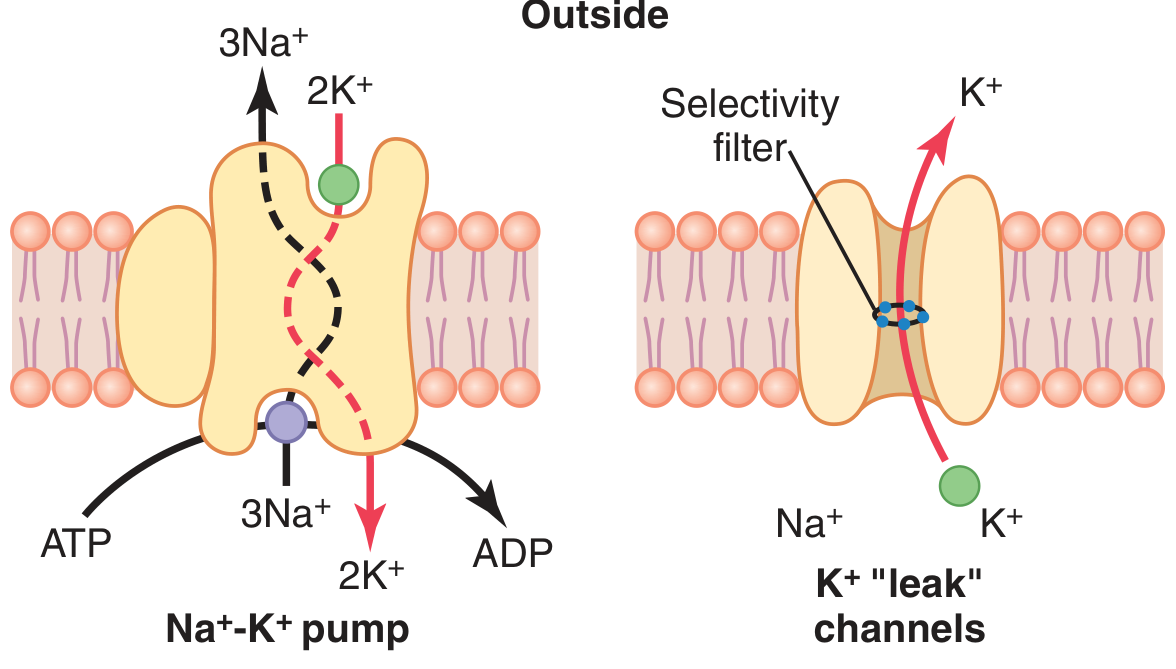
- Pumps 3 Na⁺ OUT and 2 K⁺ IN per cycle (uses ATP)
- Net effect: 1 positive charge leaves per cycle → creates a net negative charge inside
- This is an electrogenic pump (contributes ~-4 mV directly)
- Creates ionic concentration gradients:
| Ion | Outside | Inside |
|---|---|---|
| Na⁺ | 142 mEq/L | 14 mEq/L |
| K⁺ | 4 mEq/L | 140 mEq/L |
B. K⁺ Leak Channels
- At rest, membrane is highly permeable to K⁺ (K⁺ leak channels are open)
- K⁺ diffuses OUT down its concentration gradient, taking positive charge with it
- This dominates RMP calculation
- Na⁺ permeability at rest is very low
Nernst Equation (for a single ion):
E = (61/z) × log [ion]out/[ion]in
Goldman Equation (for multiple ions - gives RMP):
Em = weighted by relative permeabilities of K⁺, Na⁺, Cl⁻
Key Rule for NEET PG:
RMP is determined mainly by K⁺ because K⁺ permeability is highest at rest. If K⁺ equilibrium potential = -94 mV and Na⁺ equilibrium potential = +61 mV, the RMP (-70 mV) sits close to K⁺.
- Costanzo Physiology 7e, p. 26
2. Action Potential - Step by Step
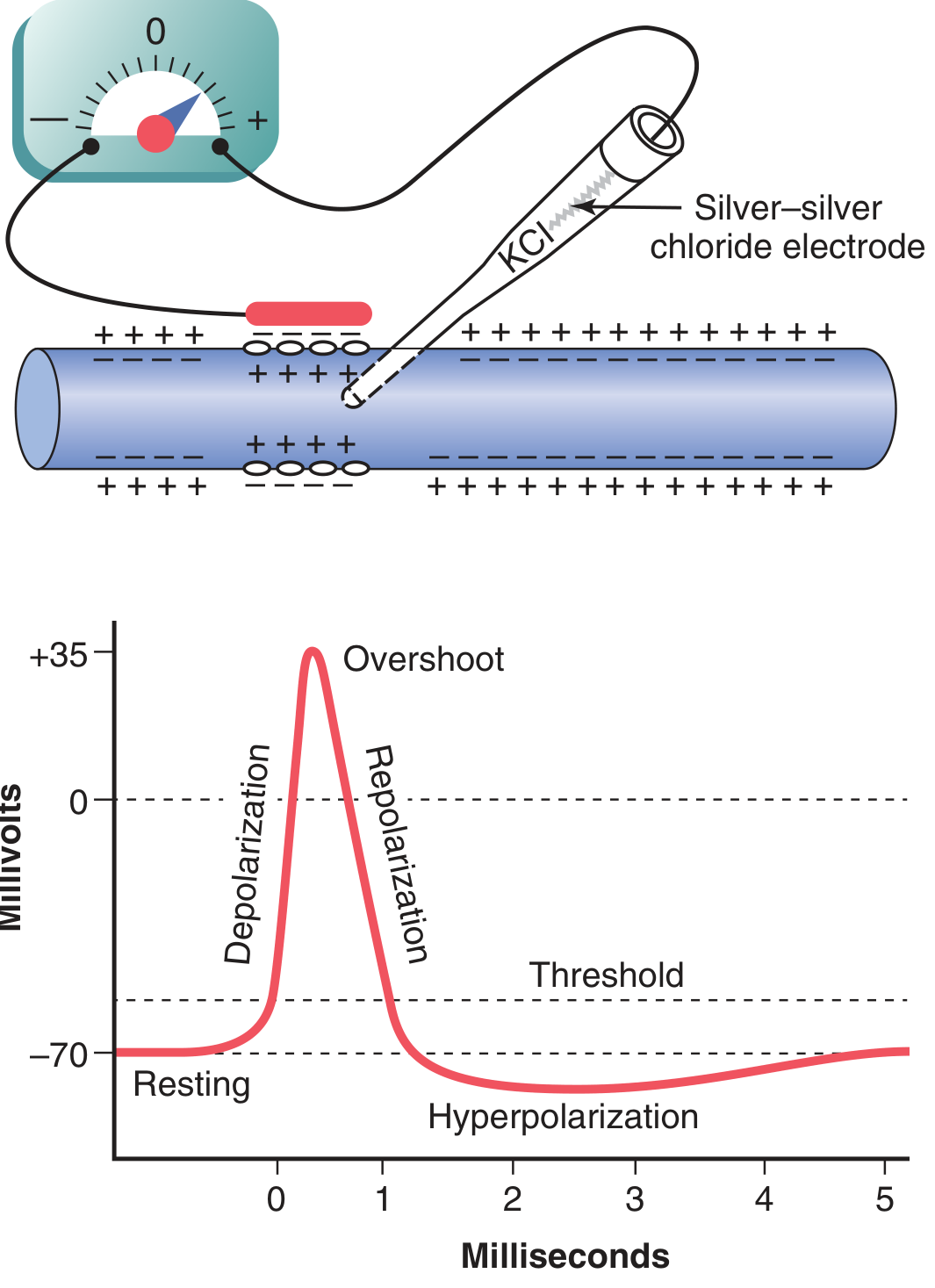
Stages (Guyton & Hall)
| Stage | Membrane Potential | What Happens |
|---|---|---|
| Resting | -70 mV | Polarized state; membrane at rest |
| Threshold | -55 mV | Stimulus depolarizes to this point; Na⁺ channels open explosively |
| Depolarization (Upstroke) | -70 → +35 mV | Rapid Na⁺ influx; membrane becomes positive inside |
| Overshoot | +35 mV | Potential overshoots zero; approaches Na⁺ equilibrium (+61 mV) |
| Repolarization | +35 → -70 mV | Na⁺ channels inactivate; K⁺ channels open → K⁺ efflux |
| Hyperpolarization (Undershoot) | -70 → -80 mV | K⁺ channels remain open longer; membrane transiently more negative |
| Return to RMP | Back to -70 mV | K⁺ channels close; Na⁺-K⁺ pump restores gradients |
- Guyton & Hall, p. 80
3. Ionic Basis of the Action Potential
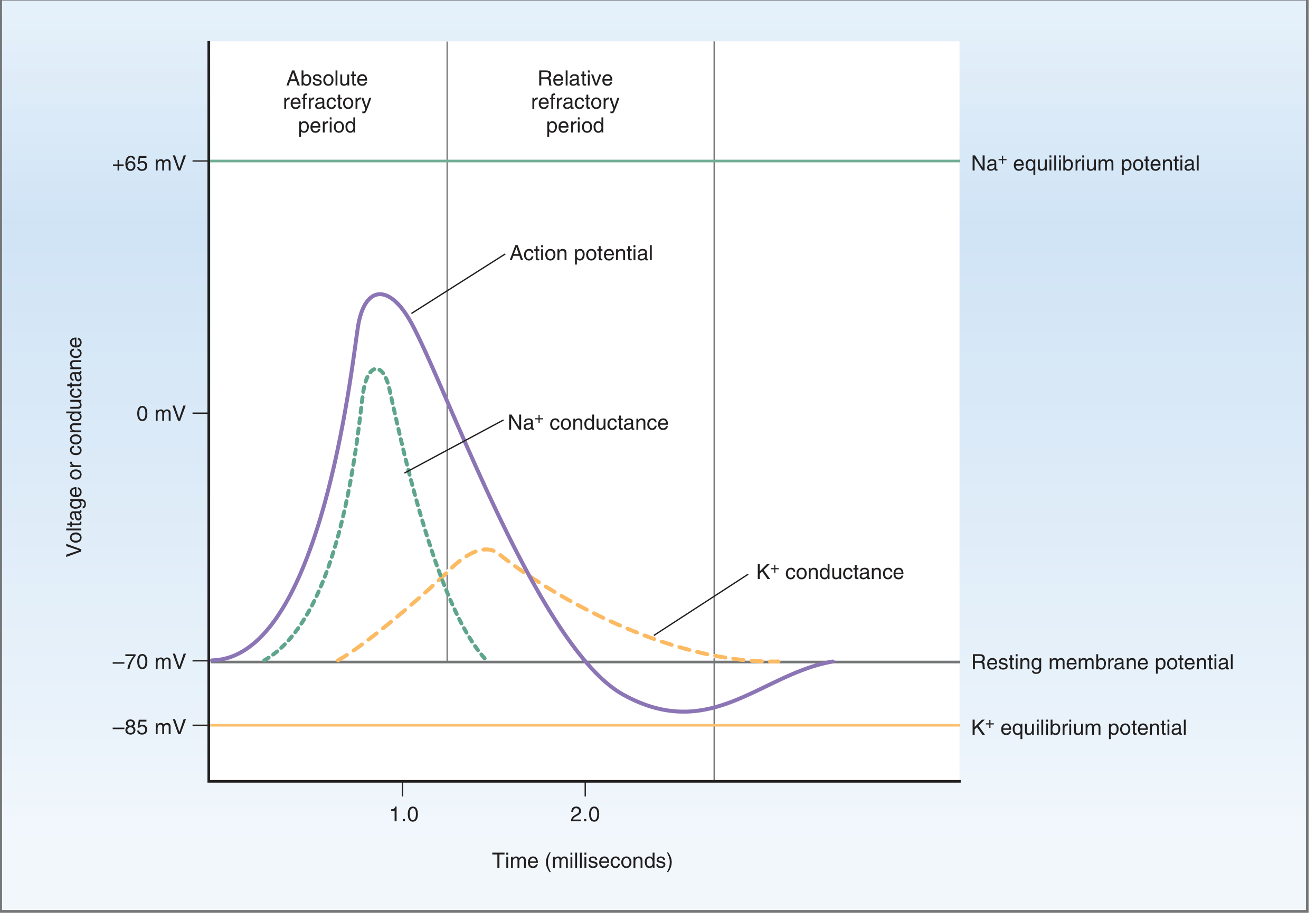
Voltage-Gated Na⁺ Channel (VGNC) - "M-gate / H-gate"
The Na⁺ channel has 2 gates:
- Activation gate (M-gate): Opens rapidly on depolarization → triggers upstroke
- Inactivation gate (H-gate): Closes slowly on depolarization → ends upstroke
| Channel State | Activation Gate | Inactivation Gate | Ion Flow |
|---|---|---|---|
| Closed (resting) | Closed | Open | None |
| Open | Open | Open (briefly) | Na⁺ IN |
| Inactivated | Open | Closed | None |
Recovery: Only when the cell repolarizes back toward RMP do inactivation gates re-open → channels return to "closed but available" state.
Voltage-Gated K⁺ Channel
- Opens slowly after depolarization
- Stays open during repolarization and into hyperpolarization
- Causes K⁺ efflux → repolarization and undershoot
Key Drugs Blocking Na⁺ Channels (NEET PG High-Yield):
-
Tetrodotoxin (TTX) - from puffer fish - blocks from outside
-
Local anesthetics (lidocaine) - block from inside, use-dependent
-
Both block the voltage-sensitive Na⁺ channels and prevent action potentials
-
Costanzo Physiology 7e, p. 28-30
4. Characteristics of the Action Potential
Three fundamental properties:
- All-or-None Law: AP either fires completely or not at all - no partial AP (once threshold is reached, the full response occurs)
- Stereotypical size and shape: Every normal AP for a given cell type looks identical
- Non-decremental propagation: AP does not decrease in amplitude as it travels along the nerve fiber
5. Refractory Periods
Absolute Refractory Period (ARP)
- Lasts from threshold until ~1/3 of repolarization
- No AP possible no matter how strong the stimulus
- Basis: Na⁺ inactivation gates are CLOSED (Na⁺ channels in inactivated state)
- Cannot fire again until membrane repolarizes and inactivation gates reset
Relative Refractory Period (RRP)
- Begins at end of ARP, overlaps with hyperpolarization
- AP CAN be elicited but only with a supramaximal stimulus
- Basis: K⁺ conductance is still higher than at rest → membrane hyperpolarized → needs more inward current to reach threshold
| Property | Absolute Refractory | Relative Refractory |
|---|---|---|
| AP possible? | NO | YES (with larger stimulus) |
| Basis | Na⁺ inactivation gates closed | Elevated K⁺ conductance |
| Timing | ~1 ms (during AP) | ~5-10 ms (during hyperpolarization) |
Clinical Significance: ARP prevents backward conduction (ensures unidirectional propagation) and limits maximum firing frequency.
- Ganong's Review, p. (Refractory Periods section)
6. Accommodation
- When a nerve is depolarized slowly, it may fail to fire an AP even though threshold voltage is crossed
- Reason: Slow depolarization gives time for Na⁺ inactivation gates to close progressively → insufficient Na⁺ channels available to generate upstroke
- Clinical example: Hyperkalemia → chronic depolarization → Na⁺ channels inactivated → muscle weakness despite depolarized membrane
7. Propagation of the Action Potential
Unmyelinated Fibers
- AP propagates by local current circuits - each depolarized area depolarizes the adjacent area
- Continuous, slow conduction
Myelinated Fibers - Saltatory Conduction
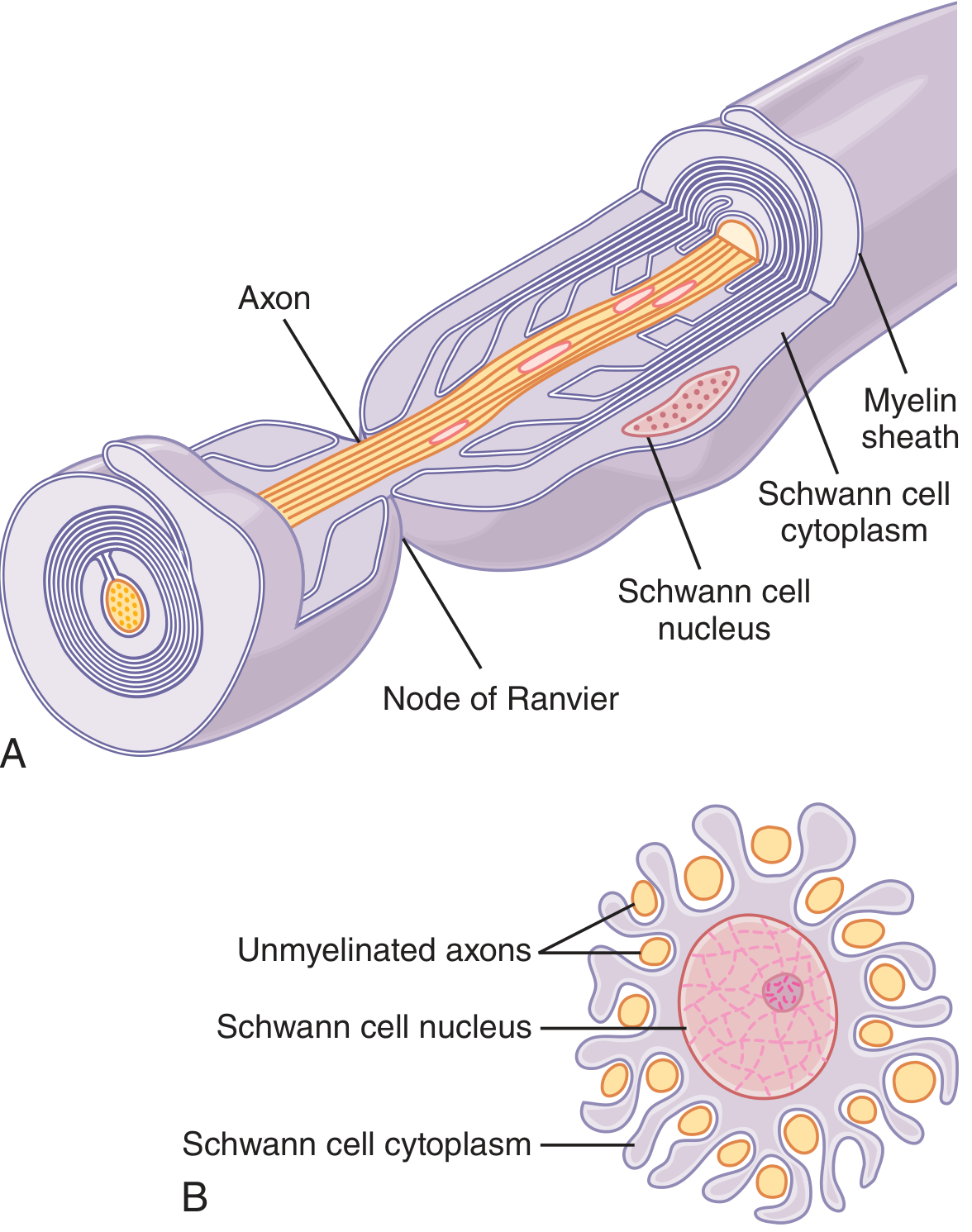
- Myelin is formed by Schwann cells (PNS) wrapping around axon
- Node of Ranvier = uninsulated gap every 1-3 mm
- AP jumps from node to node (saltatory = "to jump" in Latin)
- Only nodes have high Na⁺ channel density; internodal membrane has very few
- Myelin reduces ion flow through internodal membrane ~5000-fold
Advantages of Saltatory Conduction:
- Conduction velocity increased 5-50x compared to unmyelinated fibers
- Energy-efficient - ion exchange only at nodes, so less Na⁺-K⁺ pump activity needed
Conduction velocity (CV) determinants:
-
Larger diameter → faster CV
-
Myelination → much faster CV
-
Unmyelinated: CV ∝ √(diameter)
-
Myelinated: CV ∝ diameter (linear relationship)
-
Fastest: Aα = 70-120 m/s; Slowest: C fibers = 0.5-2 m/s
-
Guyton & Hall, p. (Saltatory conduction section)
8. Classification of Nerve Fibers (NEET PG Must-Know)
Erlanger-Gasser Classification (Motor + Sensory)
| Fiber | Diameter | CV (m/s) | Myelin | Function |
|---|---|---|---|---|
| Aα | Largest | 70-120 | Yes | α-motoneurons, proprioception (Ia, Ib) |
| Aβ | Medium | 30-70 | Yes | Touch, pressure |
| Aγ | Medium | 15-30 | Yes | γ-motoneurons to muscle spindles |
| Aδ | Small | 5-30 | Yes | Fast pain, temperature, touch |
| B | Small | 3-15 | Thin | Preganglionic autonomic |
| C | Smallest | 0.5-2 | No | Slow pain, temp, postganglionic autonomic |
Lloyd-Hunt Classification (Sensory Only)
| Class | Equivalent | Source | Function |
|---|---|---|---|
| Ia | Aα | Muscle spindle primary afferent | Stretch (dynamic) |
| Ib | Aα | Golgi tendon organ | Tension sensing |
| II | Aβ | Muscle spindle secondary, skin | Touch, pressure |
| III | Aδ | Skin | Fast pain, temperature |
| IV | C | Skin | Slow pain, temperature |
NEET PG Mnemonics:
-
"ABCD of pain": A-delta = fast/first pain (sharp), C fibers = slow/second pain (burning/aching)
-
C fibers are unmyelinated - only fiber class with no myelin
-
B fibers = preganglionic autonomic (lightly myelinated)
-
Costanzo Physiology 7e, Table 3.1
9. High-Yield NEET PG Points Summary
| Topic | Key Fact |
|---|---|
| RMP value (nerve) | -70 mV |
| Threshold potential | -55 mV |
| Na⁺ equilibrium potential | +61 mV |
| K⁺ equilibrium potential | -94 mV |
| Na⁺-K⁺ pump ratio | 3 Na⁺ out : 2 K⁺ in |
| Dominant ion at rest | K⁺ (high permeability) |
| Upstroke ion | Na⁺ (rapid influx) |
| Repolarization ion | K⁺ (efflux) |
| Hyperpolarization cause | K⁺ channels remain open |
| ARP basis | Na⁺ inactivation gates closed |
| RRP basis | Elevated K⁺ conductance |
| Saltatory conduction jumps | Node to Node (of Ranvier) |
| Fastest fiber | Aα (70-120 m/s) |
| Slowest fiber | C (0.5-2 m/s); unmyelinated |
| TTX blocks | Voltage-gated Na⁺ channels |
| Accommodation | Slow depolarization → Na⁺ inactivation → no AP |
| All-or-none law | AP is complete or absent |
10. Clinically Relevant NEET PG Scenarios
| Condition | Physiology |
|---|---|
| Hyperkalemia → muscle weakness | Chronic depolarization → Na⁺ channel inactivation → accommodation → no AP |
| Hypokalemia → weakness | Hyperpolarizes membrane → harder to reach threshold |
| Local anesthetics | Block voltage-gated Na⁺ channels → no AP in sensory/pain fibers |
| Multiple sclerosis | Demyelination → loss of saltatory conduction → slowed/blocked CV |
| Tetrodotoxin poisoning | Blocks Na⁺ channels from outside → paralysis |
| Hypocalcemia → tetany | Ca²⁺ normally stabilizes Na⁺ channels; low Ca²⁺ → increased excitability → spontaneous AP |
Quick Recap for Exam Day:
- RMP = -70 mV, maintained by K⁺ leak + Na⁺-K⁺ pump
- AP: Resting → Threshold (-55) → Depolarization (Na⁺ in) → Overshoot (+35) → Repolarization (K⁺ out) → Hyperpolarization → Back to -70
- ARP = Na⁺ channels inactivated; RRP = K⁺ channels still open (hyperpolarized)
- Saltatory conduction = node-to-node jumping; 5-50x faster; energy efficient
- Fastest = Aα, Slowest = C (unmyelinated); Fast pain = Aδ, Slow pain = C
This is a shared conversation. Sign in to Orris to start your own chat.