
Can u explain extrinsic pathway of apoptosis
Your credits are exhausted. Your daily credits reset tomorrow, or you can purchase a top-up for more.
What is immunity
Reading File
Finding Sources
Searching the Web
immunity innate adaptive immune system overview
Reading File
Finding Sources
Reading File
Reading File
Reading File
Reading File
Reading File
Loading Image
Here is a comprehensive explanation of Immunity, drawn from authoritative medical textbooks.
Immunity
Immunity refers to protection against infections. It is the capacity of the body to defend itself against pathogens, foreign substances, and abnormal cells. The immune system is the collection of cells and molecules responsible for this defense.
"Immunity refers to protection against infections. The immune system is the collection of cells and molecules that are responsible for defending the body against the countless pathogens that individuals encounter." — Robbins & Kumar Basic Pathology
Two Broad Arms of Immunity
Defense against pathogens consists of two coordinated but distinct systems:
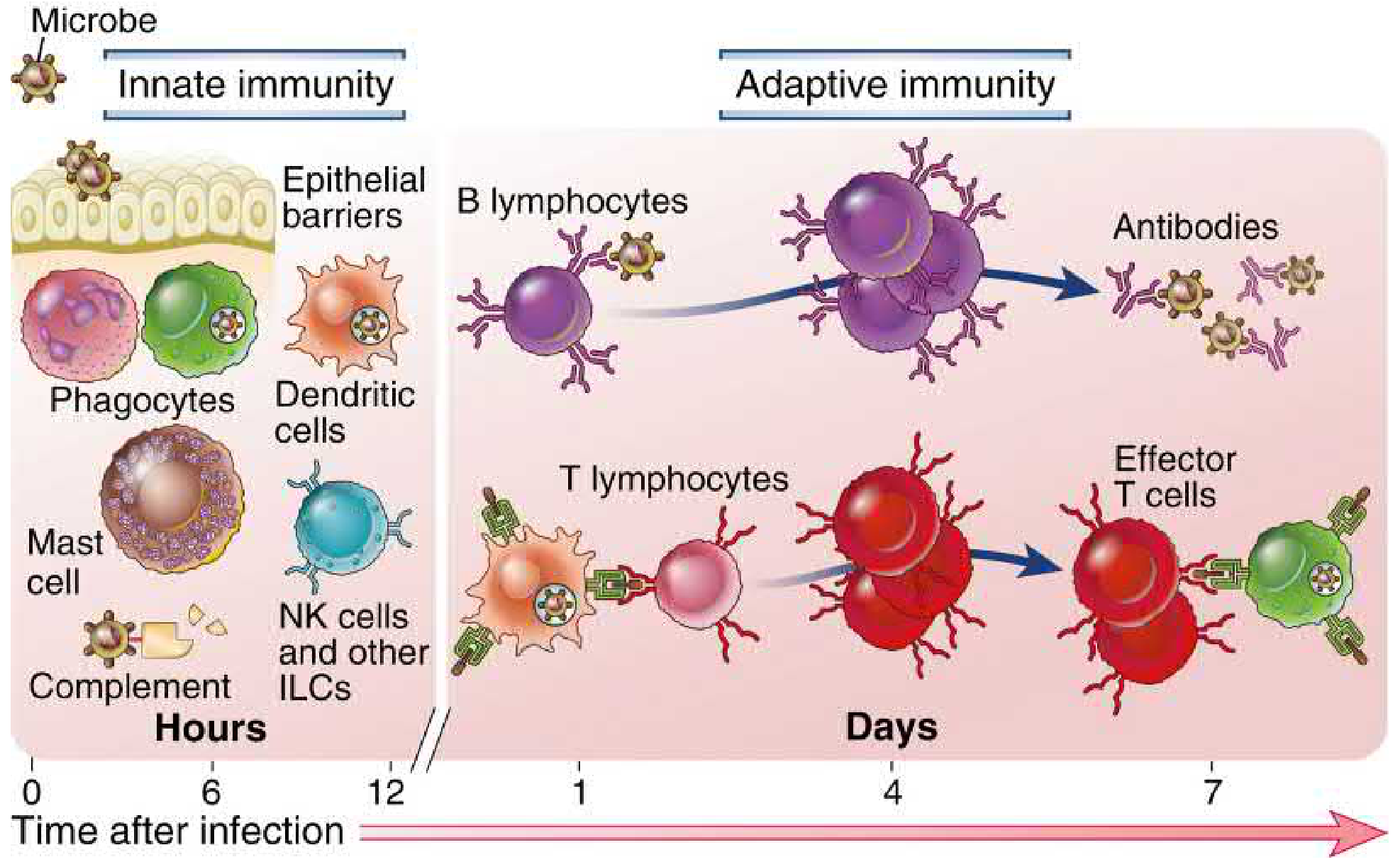
1. Innate Immunity (Natural/Native Immunity)
Innate immunity is the first line of defense — always present and ready to respond within minutes to hours of infection.
Key Features:
| Feature | Detail |
|---|---|
| Speed | Immediate response (hours) |
| Specificity | Recognizes broad patterns shared by groups of microbes |
| Memory | Limited or none |
| Diversity | Low — encoded by inherited germline genes |
Components:
- Physical & chemical barriers — Skin, mucosal epithelia, antimicrobial molecules
- Phagocytic cells — Neutrophils, macrophages (engulf and destroy microbes)
- Dendritic cells — Sentinels in tissues; link innate to adaptive immunity
- Natural Killer (NK) cells — Kill virus-infected and tumor cells
- Mast cells & Innate lymphoid cells (ILCs)
- Plasma proteins — Complement system, lectins
How it recognizes pathogens:
- Innate immune cells express Pattern Recognition Receptors (PRRs) that detect:
- PAMPs (Pathogen-Associated Molecular Patterns) — conserved microbial structures (e.g., LPS on bacteria)
- DAMPs (Damage-Associated Molecular Patterns) — molecules released from injured/dead cells (e.g., uric acid, ATP)
- Key PRRs include Toll-Like Receptors (TLRs), NOD-Like Receptors (NLRs), RIG-like receptors, and C-type lectins
Mechanisms of defense:
- Inflammation — recruits phagocytes and leukocytes to sites of infection
- Antiviral responses — blocks viral replication; NK cells kill infected cells
2. Adaptive Immunity (Acquired/Specific Immunity)
Adaptive immunity is a highly specialized, antigen-specific response that develops over days to weeks after exposure. It adapts to the specific pathogen and improves with repeated encounters.
Key Features:
| Feature | Detail |
|---|---|
| Speed | Slower (days) |
| Specificity | Highly specific for individual antigens (epitopes) |
| Memory | Yes — faster and stronger on re-exposure |
| Diversity | Enormous — 10⁷–10⁹ distinct antigens recognized |
Components:
- B Lymphocytes → produce antibodies (humoral immunity)
- T Lymphocytes → cell-mediated immunity
- CD4⁺ Helper T cells — coordinate immune responses
- CD8⁺ Cytotoxic T cells — kill infected/tumor cells
Cardinal Features:
- Specificity — Each lymphocyte clone recognizes a unique antigen epitope (clonal selection, described by Burnet in 1957)
- Diversity — Generated by somatic recombination of gene segments in lymphocytes
- Memory — Secondary immune responses are faster, larger, and qualitatively better than primary responses
- Self-tolerance — Does not normally attack the host's own tissues
Two types of adaptive immune response:
- Humoral immunity — B cells activated → differentiate into plasma cells → secrete antibodies → neutralize and eliminate extracellular pathogens
- Cell-mediated immunity — T cells activated → eliminate intracellular pathogens and infected cells
Innate vs. Adaptive: Quick Comparison
| Innate Immunity | Adaptive Immunity | |
|---|---|---|
| Timing | Immediate (hours) | Delayed (days) |
| Specificity | Broad (microbial patterns) | Highly specific (individual antigens) |
| Receptors | Germline-encoded PRRs | Somatically generated (BCR, TCR) |
| Memory | Limited | Yes (immunologic memory) |
| Key cells | Macrophages, neutrophils, NK cells, DCs | B cells, T cells |
| Secreted proteins | Complement, cytokines | Antibodies |
Why Both Are Needed
The innate immune response provides early danger signals that stimulate adaptive immune responses. Conversely, adaptive immune responses work by enhancing innate immunity, making it more capable of combating pathogens. Many pathogens have evolved to resist innate immunity — this is why the more powerful adaptive arm is essential.
Sources: Cellular and Molecular Immunology (Abbas et al.) | Robbins & Kumar Basic Pathology
This is a shared conversation. Sign in to Orris to start your own chat.