
extrinsic pathway
The extrinsic pathway initiates blood coagulation when tissue factor (TF/Factor III) is exposed after vascular injury and binds circulating Factor VII, forming the TF-VIIa complex. This complex activates Factor X (and Factor IX), ultimately leading to thrombin generation and fibrin clot formation. It is the primary initiator of coagulation in vivo.
Searching sources...
Reading File
Finding Sources
Finding Sources
Good. I have strong hits from Miller's Anesthesia, Lippincott Biochemistry, Guyton & Hall, and Ganong's. Let me read the most relevant sections in parallel.
Reading File
Reading File
Reading File
Excellent. I now have rich content from multiple authoritative textbooks. Let me also fetch the coagulation diagram image from Miller's Anesthesia and read the Lippincott section on TFPI and the common pathway to complete the picture.
Loading Image
Reading File
I now have comprehensive content from multiple textbooks. Let me compile the full answer.
The Extrinsic Pathway of Coagulation
Overview
The extrinsic pathway is the primary initiator of plasma-mediated hemostasis in vivo. It is triggered by vascular injury that exposes tissue factor (TF, Factor III) - a transmembrane glycoprotein normally sequestered in the subendothelium - to circulating blood. The name "extrinsic" comes from TF being a protein extrinsic (outside) to the blood.
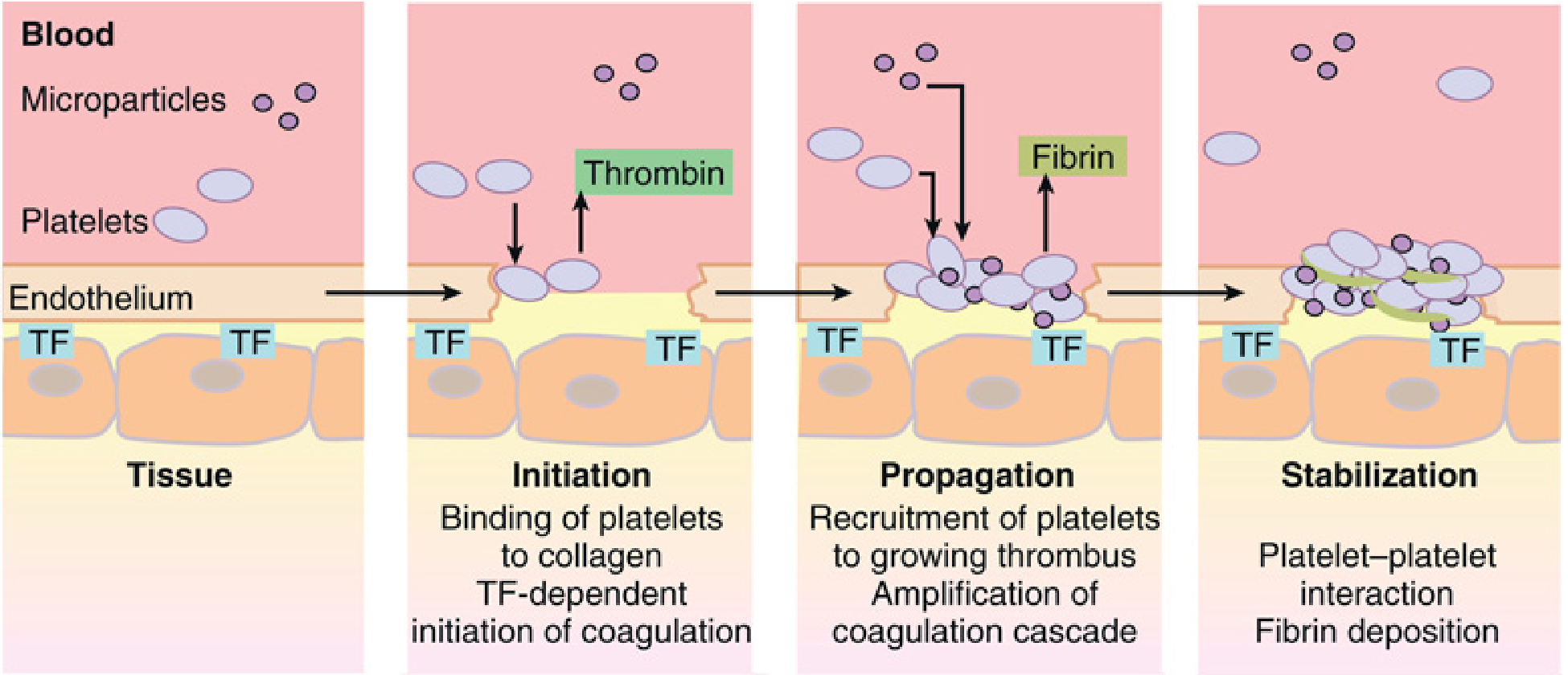
Step-by-Step Mechanism
1. Trigger: Tissue Factor Exposure
- Under normal conditions, the vascular endothelium prevents contact between TF (abundant in subendothelial tissues) and circulating coagulation factors.
- Vascular injury disrupts this barrier, exposing TF to blood within seconds.
2. TF-FVIIa Complex Formation
- A small amount of Factor VII circulates constitutively in plasma in its active form (FVIIa).
- Exposed TF rapidly binds FVIIa, forming the TF-FVIIa complex (also called the "extrinsic tenase").
- This complex is anchored to the phospholipid cell membrane and requires Ca2+ for full activity.
- FVII can also be activated proteolytically by thrombin or other serine proteases, and FVIIa-TF can be activated via cross-talk with FXIIa.
3. Activation of Factor X (and Factor IX)
- The TF-FVIIa complex activates Factor X → FXa by proteolysis (this is the key step feeding into the common pathway).
- Critically, the TF-FVIIa complex also activates Factor IX of the intrinsic pathway - demonstrating that the extrinsic pathway does not work in complete isolation.
4. Entry into the Common Pathway
- FXa combines with FVa (a cofactor), Ca2+, and phospholipids to form the prothrombinase complex.
- Prothrombinase cleaves prothrombin (FII) → thrombin (FIIa) - a massive, explosive amplification step.
- Thrombin cleaves fibrinopeptides A and B from fibrinogen → fibrin monomers, which polymerize into a soft clot.
- Factor XIIIa (activated by thrombin) cross-links fibrin strands via isopeptide bonds (Gln-Lys linkage), creating an insoluble, hard fibrin clot.
Regulation: Tissue Factor Pathway Inhibitor (TFPI)
The extrinsic pathway is rapidly self-limiting. TFPI shuts it down via a two-step mechanism:
- TFPI binds FXa first (FXa-dependent activation of TFPI).
- The TFPI-FXa complex then binds and inhibits TF-FVIIa, forming a quaternary inhibitory complex (TF-FVIIa-FXa-TFPI).
This means the extrinsic pathway provides only the initial "spark" of FXa and thrombin. The small amount of thrombin generated then activates Factor XI and the intrinsic pathway, which amplifies and sustains clot formation after TFPI extinguishes the extrinsic pathway.
"The extrinsic pathway initiates clotting by the generation of FXa, and the intrinsic pathway amplifies and sustains clotting after the extrinsic pathway has been inhibited by TFPI." - Lippincott Illustrated Reviews: Biochemistry, 8e
Speed and Clinical Significance
- The extrinsic pathway is explosive in speed: with severe tissue trauma, clotting can occur in as little as 15 seconds.
- The intrinsic pathway, by contrast, requires 1-6 minutes.
- Speed is limited only by the amount of TF released and the available quantities of Factors X, VII, and V.
Lab Test: Prothrombin Time (PT / INR)
- PT measures the extrinsic + common pathway function (using thromboplastin to activate TF).
- Prolonged PT indicates deficiency in Factors VII, X, V, II (prothrombin), or fibrinogen.
- PT is the test monitored for warfarin therapy (warfarin inhibits vitamin K-dependent γ-carboxylation of Factors VII, IX, X, and II).
Thrombin's Central Amplifying Role
Once generated, thrombin acts as a master amplifier with positive feedback on:
- Common pathway: Activates FV, fibrinogen (FI), FXIII
- Intrinsic pathway: Activates FXI, FVIII
- Extrinsic pathway: Activates FVII
This cross-talk ensures robust and sustained clot formation from an initial small TF-driven signal.
Summary Table
| Step | Factor(s) Involved | Result |
|---|---|---|
| Vascular injury | TF exposed | Trigger |
| TF + FVIIa + Ca2+ + PL | Extrinsic tenase complex | Forms |
| Extrinsic tenase acts on FX | FX → FXa | Primary output |
| Extrinsic tenase also activates FIX | FIX → FIXa | Feeds intrinsic |
| FXa + FVa + Ca2+ + PL | Prothrombinase complex | Forms |
| Prothrombinase acts on FII | FII → Thrombin | Amplification |
| Thrombin cleaves fibrinogen | Fibrin monomers → polymer | Soft clot |
| FXIIIa (from thrombin) | Cross-links fibrin | Hard, insoluble clot |
| TFPI binds FXa, then TF-FVIIa | Quaternary inhibitory complex | Pathway OFF |
Sources:
- Miller's Anesthesia, 10e, Chapter 46
- Lippincott Illustrated Reviews: Biochemistry, 8e, Chapter 35
- Guyton and Hall Textbook of Medical Physiology (Guyton & Hall), Chapter 37
This is a shared conversation. Sign in to Orris to start your own chat.