

5afc36d4-76f5-4242-bdae-383fa44ff088.jpeg
Explain it
This is a biochemistry MCQ about mitochondrial respiration inhibitors. The correct answer is Oligomycin (C), not Antimycin A (B) which you selected.
Searching sources...
Reading File
Finding Sources
Finding Sources
Finding Sources
Finding Sources
Reading File
Reading File
Reading File
Loading Image
Here is a full explanation of the question and why Oligomycin is the correct answer.
The Question, Broken Down
The experiment involves three substrates - malate, pyruvate, and succinate - all feeding electrons into the electron transport chain (ETC) at different points:
- Malate & Pyruvate - generate NADH → feed electrons into Complex I
- Succinate - generates FADH₂ → feeds electrons into Complex II
All three together cover entry points at Complexes I and II. Respiration is running normally. Then a mystery substance is added and respiration is completely blocked at ALL points simultaneously.
The Key Logic
The ETC and ATP synthesis are tightly coupled (respiratory control). The only way to block ALL electron entry points simultaneously is to block something downstream that all electrons must pass through - specifically, the final step of ATP synthesis.
Here is the ETC diagram from Lippincott's Biochemistry:
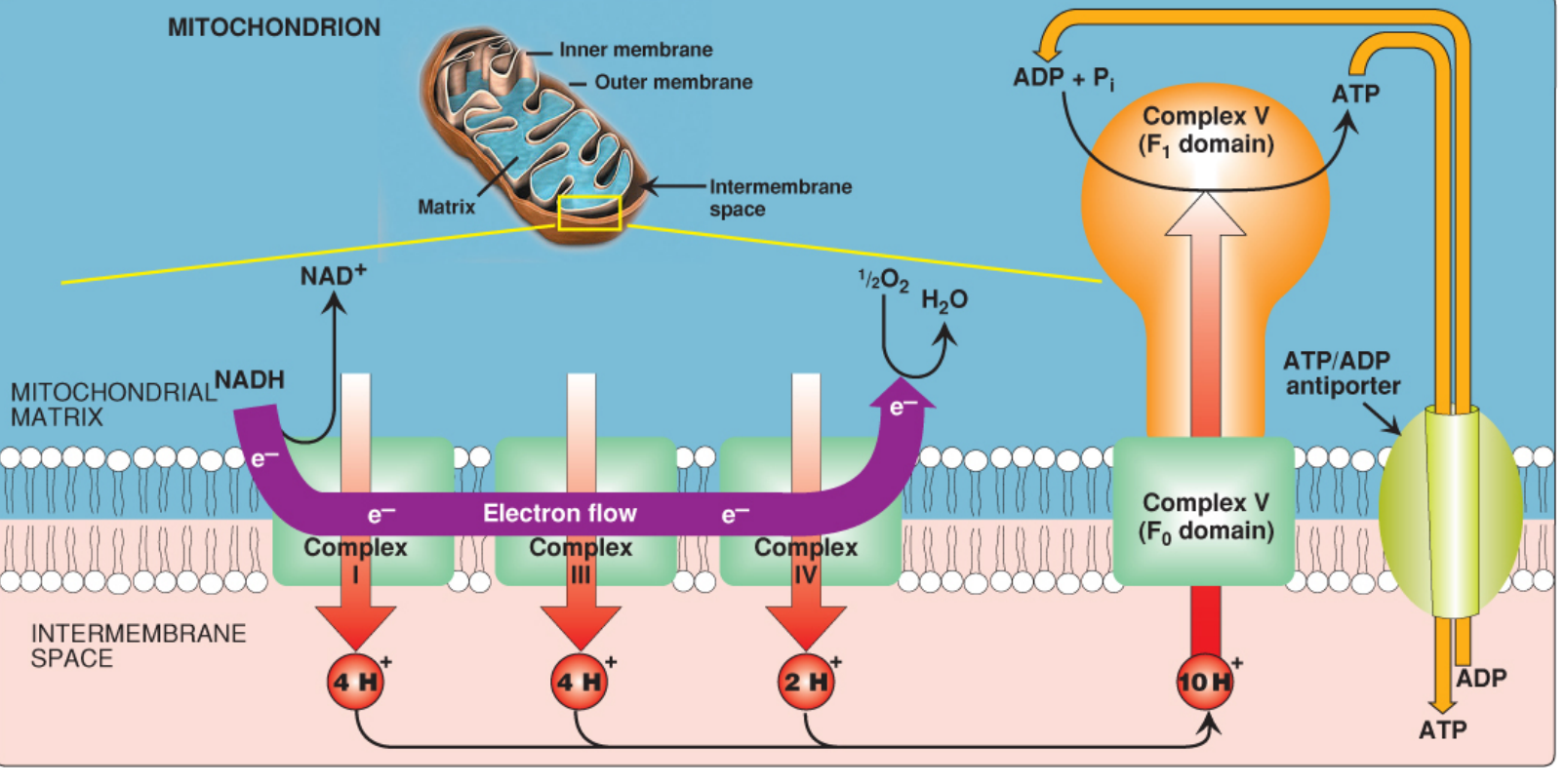
Notice that all electrons from Complexes I, II, III, and IV ultimately drive proton pumping, and those protons MUST re-enter the matrix through Complex V (ATP synthase) to complete the cycle.
Why Each Option is Right or Wrong
| Drug | Target | Effect | Does it block ALL substrates? |
|---|---|---|---|
| Rotenone (A) | Complex I | Blocks NADH (malate/pyruvate) entry | ❌ No - succinate still works via Complex II |
| Antimycin A (B) | Complex III | Blocks electron transfer to cytochrome c | ❌ Partially - but read below |
| Oligomycin (C) | ATP synthase (F₀ subunit) | Blocks H⁺ re-entry, stops ATP production | ✅ YES - blocks ALL substrates |
Why NOT Antimycin A?
Antimycin A blocks Complex III (cytochrome bc1 complex). This does block electron flow from both Complex I and Complex II substrates... so why is it wrong?
The answer lies in the experimental setup: the question says that adding pyruvate + malate + succinate keeps respiration normal. The question then asks what drug would block all of it. Antimycin A would indeed block electron flow at Complex III, but:
- The question is specifically testing the concept of respiratory control - the coupling between ATP synthesis (phosphorylation) and electron transport.
- Oligomycin blocks the F₀ domain of ATP synthase, which collapses the H⁺ gradient. Because the proton gradient can no longer be dissipated, H⁺ cannot be pumped out by any of the complexes (I, III, IV) - they all back up and stop. This directly demonstrates the tight coupling between electron transport and phosphorylation.
As stated in Lippincott's Illustrated Biochemistry (8th ed.):
"Oligomycin binds to the F₀ domain of ATP synthase, closing the H⁺ channel and preventing reentry of H⁺ into the matrix, thereby inhibiting phosphorylation of ADP to ATP. Because the pH and electrical gradients cannot be dissipated... electron transport stops because of the difficulty of pumping any more H⁺ against the steep concentration gradient."
And from Basic Medical Biochemistry (6th ed.) - Table of inhibitors:
| Inhibitor | Site |
|---|---|
| Rotenone | Complex I → CoQ |
| Antimycin A | Complex III → cytochrome c |
| Cyanide/CO | Complex IV → O₂ |
| Oligomycin | Proton flow through F₀ of ATP synthase |
Summary - Why Oligomycin is Correct
- The substrates provided (malate, pyruvate, succinate) feed into both Complex I and Complex II, bypassing any single ETC complex block
- Only a block at ATP synthase (the common final step) will halt all electron flow simultaneously
- Oligomycin does exactly this - it plugs the H⁺ channel in the F₀ unit, the proton gradient builds up, and the entire ETC stalls
- This is the classic principle of "respiratory control" - ETC and oxidative phosphorylation are inseparably coupled
Memory tip: The name Oligomycin contains the letter "o" - it inhibits the F₀ (F-zero, "o" for oligomycin) subunit of ATP synthase.
- Biochemistry, 8th ed., Lippincott Illustrated Reviews, p. 241
- Basic Medical Biochemistry, 6th ed., Table 24.1
This is a shared conversation. Sign in to Orris to start your own chat.