
Messles note
Reading File
Now let me search the medical library for measles content in parallel.
Finding Sources
Finding Sources
Good sources found. Let me read the most comprehensive ones in parallel - Goldman-Cecil Medicine (main reference), Andrews' Dermatology (for rash/skin), and Park's Preventive Medicine (epidemiology).
Reading File
Reading File
Reading File
Let me read the Goldman-Cecil continuation for pathogenesis, clinical features, diagnosis, treatment, and complications, plus the Park's text for more epidemiology/prevention.
Reading File
Reading File
I have enough material. Let me also grab the images for Koplik spots and the measles rash, and get pathogenesis/treatment from the Goldman-Cecil block.
Reading File
Loading Image
I now have comprehensive material for a complete measles note. Let me also grab the rash image and check the pathogenesis section.
Loading Image
Reading File
I now have all the information needed for a comprehensive measles note. Let me compile it.
Measles (Rubeola) - Clinical Notes
Definition
Measles (rubeola, morbillii) is an extremely contagious, prolonged respiratory and systemic viral illness caused by the measles virus - a single-stranded RNA virus of the family Paramyxoviridae, genus Morbillivirus. It is characterized by high fever, erythematous maculopapular rash, cough, coryza, and conjunctivitis. At least 24 distinct genotypes exist, but only one serotype - meaning natural infection or adequate immunization confers broad protection against all types.
- Goldman-Cecil Medicine, Ch. 338
Epidemiology
| Feature | Detail |
|---|---|
| Reservoir | Humans only (no animal reservoir) |
| R0 | 12-18 (highest of any known pathogen) |
| Transmission | Respiratory droplets and aerosolized small droplets (can remain suspended in air for hours) |
| Incubation period | 9-12 days (range 7-18 days) |
| Period of communicability | From 4 days before to 4 days after rash onset |
| Herd immunity threshold | ~95% vaccination coverage needed |
Measles is the fourth leading worldwide cause of death from infectious disease, after TB, HIV/AIDS, and malaria.
- Goldman-Cecil Medicine; Park's Preventive & Social Medicine
Pathobiology
The virus is spread by large respiratory droplets or fine aerosols. Key steps:
- Initial infection - Virus infects cells in the respiratory tract or conjunctiva
- Lymphoid spread - Migrates to regional lymph nodes, infects CD150/SLAM1-expressing T and B cells
- Systemic spread - Infected mononuclear cells travel to spleen, tonsils, lymph nodes; viremia allows infection of GI system, kidney, liver, and skin
- Epithelial damage - Virus infects respiratory epithelium via the Nectin-4 receptor, spreads cell-to-cell, causes sloughing, and is expelled by coughing
Immune evasion: The virus inhibits type 1 interferons early on, allowing extensive viral replication before clinical disease.
Rash mechanism: Koplik spots and the exanthem result from infection of capillary endothelium, syncytial cell formation, and local production of nitrous oxide and TNF-alpha.
Immune suppression ("immune amnesia"): Measles concurrently depletes subsets of both T and B cells, erasing immune memory against other pathogens - this explains the prolonged increase in all-cause mortality lasting months to years after measles infection.
- Goldman-Cecil Medicine, Ch. 338
Clinical Features
Stage 1 - Prodromal Stage (Days 10-14 post-infection, lasting 2-4 days)
- High fever (may reach 40°C / 104°F)
- The "3 Cs": Cough, Coryza (nasal congestion, sneezing), Conjunctivitis (red eyes, photophobia)
- Malaise, anorexia, vomiting, or diarrhea may occur
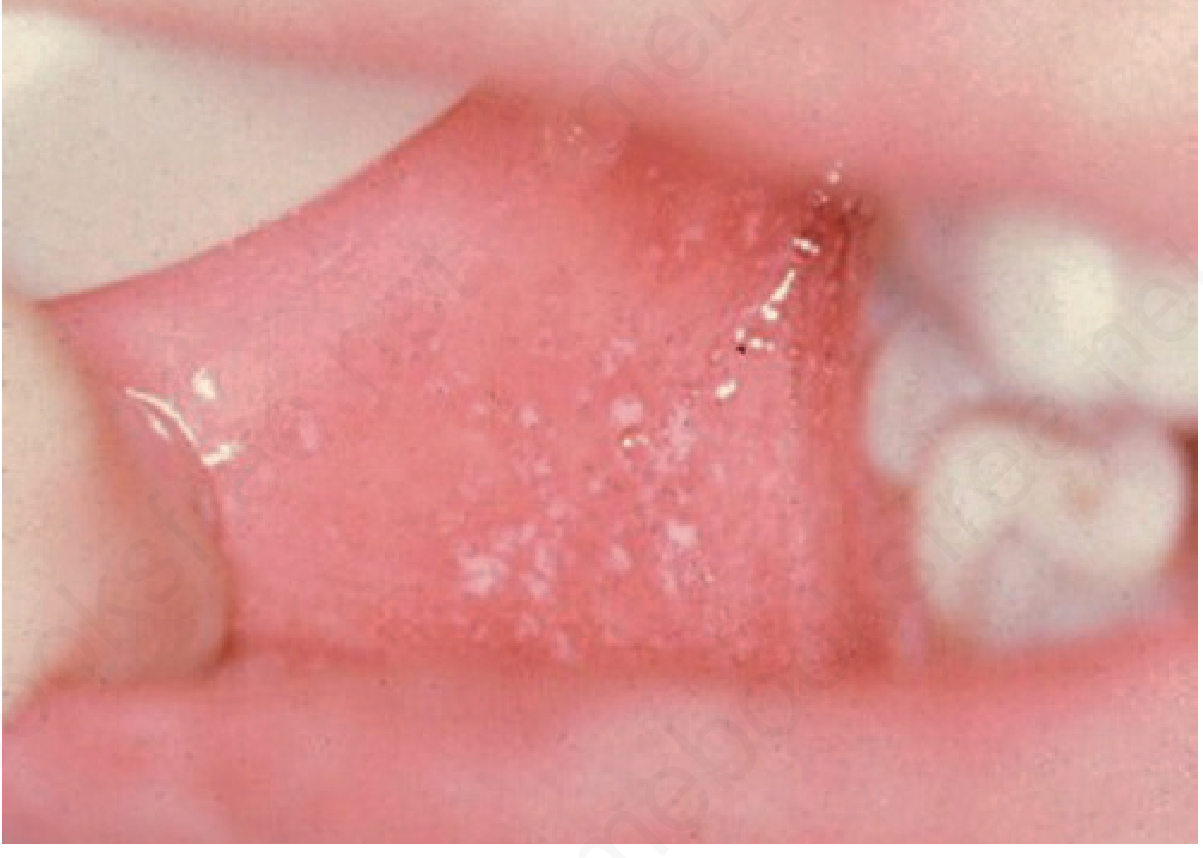
- Koplik spots (pathognomonic): Small bluish-white spots on a red base, like grains of salt, appearing on the buccal mucosa opposite the lower molars - appear 1-2 days before the rash
Koplik spots (Andrews' Dermatology):
Stage 2 - Eruptive Phase (Days 14-17, lasting 6-7 days)
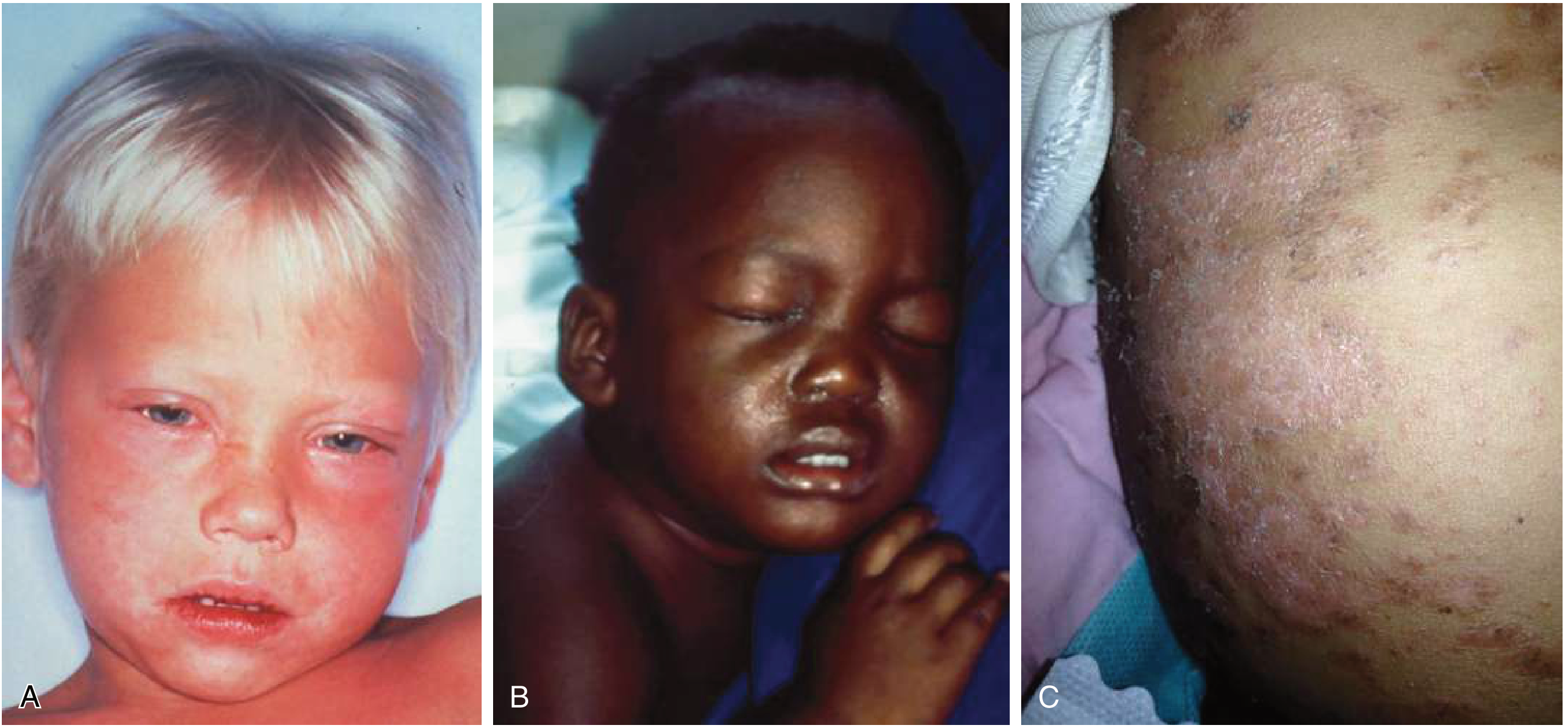
- Dusky-red, macular or maculopapular rash begins at the hairline/behind ears, then spreads:
- Day 1: face and neck
- Day 2-3: trunk
- Day 3: lower extremities
- Lesions coalesce and become confluent, most prominent in areas first involved
- Fever remains high during rash, then falls as rash begins to clear
- Rash fades in the same craniocaudal order, leaving brownish hyperpigmentation that may persist for 2 months
Variable rash of measles (Goldman-Cecil Medicine):
Clinical tip: In any febrile exanthem where red eyes and cough are absent, measles is unlikely.
Stage 3 - Post-Measles Stage
- Child remains weak, underweight
- Increased susceptibility to bacterial and viral superinfections
- Risk of growth retardation, diarrhea, cancrum oris, reactivation of latent TB
Complications
Complications occur in approximately 30% of reported cases.
| Complication | Frequency / Notes |
|---|---|
| Otitis media | 7-9% in developed countries; most common complication |
| Diarrhea | ~8% |
| Pneumonia | 1-6%; can be primary viral or secondary bacterial |
| Laryngotracheobronchitis (croup) | Relatively common |
| Encephalitis (acute post-infectious) | 1-4 per 1000-2000 cases; can be fatal; mild lymphocytic pleocytosis in CSF |
| Measles inclusion body encephalitis | In immunocompromised; diagnosed by brain biopsy |
| Subacute sclerosing panencephalitis (SSPE) | Rare, devastating; occurs years after acute infection; confirmed by periodic sharp-slow wave complexes on EEG + high measles IgM/IgG in CSF and serum. Risk highest if infected before age 2. |
| Thrombocytopenic purpura | Uncommon |
| "Black measles" | Rare DIC-like complication |
| Fetal death | In pregnant patients |
High-risk groups for severe/fatal measles:
- Children under 5 years
- Malnourished children (especially vitamin A deficiency)
- Immunocompromised (HIV, T-cell deficiency) - rash may be less prominent
- Overcrowded living conditions
Diagnosis
| Method | Details |
|---|---|
| Clinical | Classic triad (3 Cs) + Koplik spots + craniocaudal maculopapular rash |
| RT-PCR | Gold standard; nasopharyngeal/oropharyngeal swab, conjunctival swab, or urine; also allows genotyping for outbreak investigation |
| Serology (IgM) | Elevated measles-specific IgM as early as day 1 of rash in unvaccinated; also 4-fold rise in IgG between acute and convalescent samples |
| CBC | Marked leukopenia and lymphopenia |
Treatment
Treatment is supportive:
- Fever control
- Hydration and nutrition
- Monitoring for complications (pneumonia, encephalitis)
Vitamin A supplementation: Recommended by WHO to reduce overall mortality and risk of xerophthalmia - especially in malnourished children and those with vitamin A deficiency.
- 2 doses of 200,000 IU (age >1 yr); 100,000 IU (age 6-12 months); 50,000 IU (age <6 months)
Note on hospitalization: Must be weighed against the challenge of infection control, as measles is extremely contagious.
- Goldman-Cecil Medicine, Ch. 338
Prevention & Vaccination
| Feature | Detail |
|---|---|
| Vaccine type | Live-attenuated; given as MMR (Measles-Mumps-Rubella) |
| Schedule | 2 doses required; first dose at 9-12 months, second at 15-18 months (schedules vary by country) |
| Efficacy | Two doses highly protective (~97% efficacy) |
| Herd immunity threshold | ~95% population coverage needed |
| Post-exposure prophylaxis | MMR vaccine within 72 hours of exposure; or human immunoglobulin within 6 days (for immunocompromised, infants <12 months, pregnant women) |
WHO/UNICEF Global Strategy (2 doses of measles-containing vaccine, MCV1 + MCV2): Estimated measles deaths declined 73% and cases by 76% from 2000 to 2018, though coverage gaps remain in 10 high-burden countries (Nigeria, India, DRC, Ethiopia, Indonesia, Pakistan, Philippines, Angola, Brazil, Tanzania).
- Park's Preventive & Social Medicine; Goldman-Cecil Medicine; Andrews' Dermatology
Differential Diagnosis
- Rubella (German measles) - milder prodrome, less prominent 3 Cs, rash spreads faster
- Roseola infantum (HHV-6)
- Scarlet fever
- Drug eruptions (morbilliform drug rash)
- Enterovirus infections
- Secondary syphilis
- RMSF (Rocky Mountain spotted fever)
- Kawasaki disease / MIS-C (in children, post-COVID)
- Infectious mononucleosis
Memory Aids
3 Cs of measles prodrome: Cough, Coryza, Conjunctivitis
Koplik spots: "Salt grains on a red mucosa" - appear before rash, are pathognomonic
Rash spread: Top-down (cephalocaudal) over 3 days - starts behind ears, ends at feet
Complications: "OPES" - Otitis media, Pneumonia, Encephalitis, SSPE
Sources: Goldman-Cecil Medicine (Ch. 338); Andrews' Diseases of the Skin; Park's Textbook of Preventive and Social Medicine
This is a shared conversation. Sign in to Orris to start your own chat.