

4dbda586-6aa3-4589-a26e-62f487042818.jpeg
Can u explain me shortly
This is a diagnostic algorithm for jaundice from a hepatobiliary textbook. Here's a quick breakdown:
Starting Point
Any jaundiced patient gets: history, physical exam, and basic labs (bilirubin with fractionation, ALT, AST, alkaline phosphatase, PT, albumin).
Two Main Branches
1. Isolated Bilirubin Elevation (all other liver tests normal)
- Direct hyperbilirubinemia (direct >15%) - think inherited disorders: Dubin-Johnson or Rotor syndrome
- Indirect hyperbilirubinemia (direct <15%) - think:
- Drugs (Rifampicin, Probenecid)
- Inherited: Gilbert's or Crigler-Najjar syndrome
- Hemolytic disorders / ineffective erythropoiesis
2. Bilirubin + Other Liver Tests Elevated
Split into two patterns:
| Hepatocellular pattern | Cholestatic pattern |
|---|---|
| ALT/AST elevated out of proportion to ALP | ALP elevated out of proportion to ALT/AST |
| Test: viral serologies (Hep A/B/C), toxicology, ceruloplasmin, ANA/SMA/SPEP | Test: Ultrasound first |
| If negative → more virologic tests (CMV, EBV, Hep D/E) | Dilated ducts → extrahepatic cholestasis → CT/MRCP/ERCP |
| Still negative → Liver biopsy | Non-dilated ducts → intrahepatic cholestasis → serologic testing (AMA, hepatitis) |
Bottom of Page: AST:ALT Ratio
- AST:ALT >1 = chronic viral hepatitis or NAFLD
- (The handwritten note shows AST↑ and ALT↓, flagging this ratio concept)
The key clinical logic: Fractionate the bilirubin first, then determine if it's hepatocellular vs. cholestatic, and work down each pathway systematically.
Explain what fractionated bilirubin (direct vs indirect) means
This is a medical question, so let me check the medical library first.
Searching sources...
Reading File
Finding Sources
Finding Sources
Reading File
Reading File
Loading Image
Here's a clear explanation of fractionated bilirubin:
What is Bilirubin Fractionation?
When you order a "fractionated bilirubin" (also called bilirubin with fractionation), the lab separates total bilirubin into two fractions:
| Indirect (Unconjugated) | Direct (Conjugated) | |
|---|---|---|
| What it is | Bilirubin NOT yet processed by the liver | Bilirubin that HAS been processed by the liver |
| Solubility | Fat-soluble, insoluble in water | Water-soluble |
| Bound to? | Bound to albumin in the blood | Free in blood/bile |
| In urine? | No - too big, can't pass through kidney | Yes - water-soluble, so it passes into urine |
| Normal value | Makes up ~70-80% of total bilirubin | Makes up ~20-30% of total bilirubin |
The Journey of Bilirubin (Why Two Forms Exist)
Here's the step-by-step process:
- RBCs break down → heme is released
- Heme → biliverdin → unconjugated (indirect) bilirubin
- Unconjugated bilirubin travels in blood, bound to albumin, to the liver
- In the liver, the enzyme glucuronyl transferase attaches glucuronic acid → now it becomes conjugated (direct) bilirubin
- Conjugated bilirubin is secreted into bile → enters gut → excreted as stercobilin (makes stool brown) or urobilinogen (excreted in urine)
Why Does It Matter Clinically?
Elevated INDIRECT (unconjugated) = problem BEFORE the liver
- Overproduction: hemolysis, ineffective erythropoiesis
- Impaired uptake/conjugation: Gilbert's syndrome (low glucuronyl transferase), Crigler-Najjar syndrome, drugs (rifampicin, probenecid)
- No bilirubin in urine (can't filter through kidneys)
Elevated DIRECT (conjugated) = problem AT or AFTER the liver
- Liver can't excrete it: Dubin-Johnson syndrome, Rotor syndrome
- Bile duct obstruction: stones, pancreatic cancer (cholestasis)
- Hepatocellular disease: hepatitis, cirrhosis
- Bilirubin appears in urine ("dark/tea-colored urine") - since it's water-soluble
The Diagnostic Shortcut
The diagram from the textbook says it well:
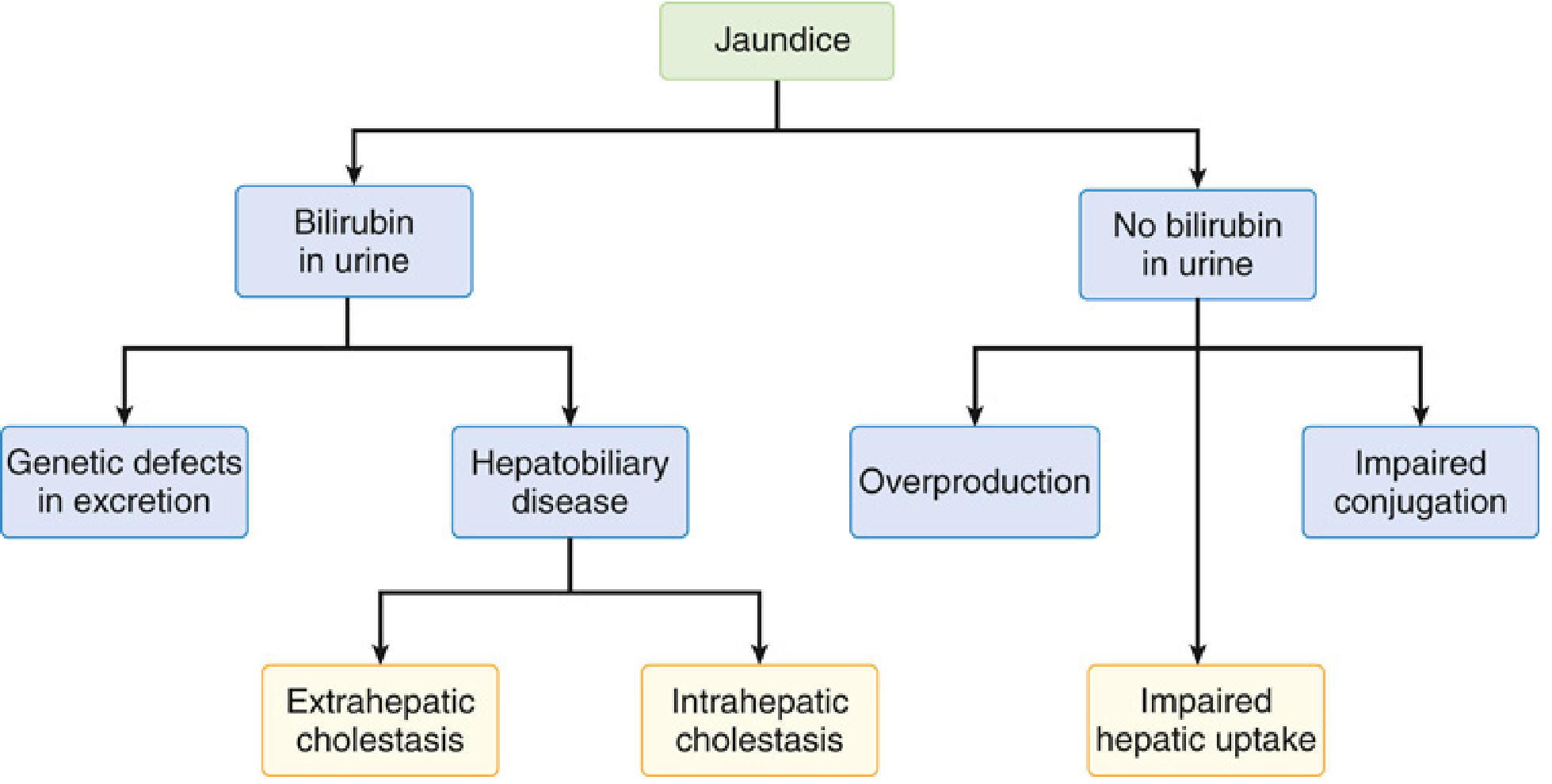
- Bilirubin in urine = direct hyperbilirubinemia = hepatobiliary disease or genetic excretion defect
- No bilirubin in urine = indirect hyperbilirubinemia = overproduction, impaired uptake, or impaired conjugation
One Important Lab Note
Direct bilirubin and conjugated bilirubin are correlated but not identical - the indirect test slightly underestimates true unconjugated bilirubin. But clinically, the terms are used interchangeably.
- Miller's Anesthesia, 10e - Serum Bilirubin section
- Rosen's Emergency Medicine - Normal Bilirubin Metabolism
This is a shared conversation. Sign in to Orris to start your own chat.