
Enumerate the dna damaging agents and indicate the types of damages made by them. 7 marks
Reading File
Now let me search the medical library for DNA damaging agents.
Finding Sources
Finding Sources
Reading File
Reading File
Finding Sources
Finding Sources
Harper's Biochemistry has a dedicated section. Let me read it along with Jawetz Microbiology.
Reading File
Reading File
There's a key diagram in Harper's. Let me fetch it, and also read more from Harper's for the detailed table on DNA damaging agents.
Loading Image
Finding Sources
I now have everything I need. The Harper's diagram is a perfect visual summary. Let me compile the full answer.
DNA Damaging Agents and Their Types of Damage
(Harper's Illustrated Biochemistry, 32nd Ed.; Jawetz Melnick & Adelberg's Medical Microbiology 28th Ed.; Robbins Pathologic Basis of Disease)
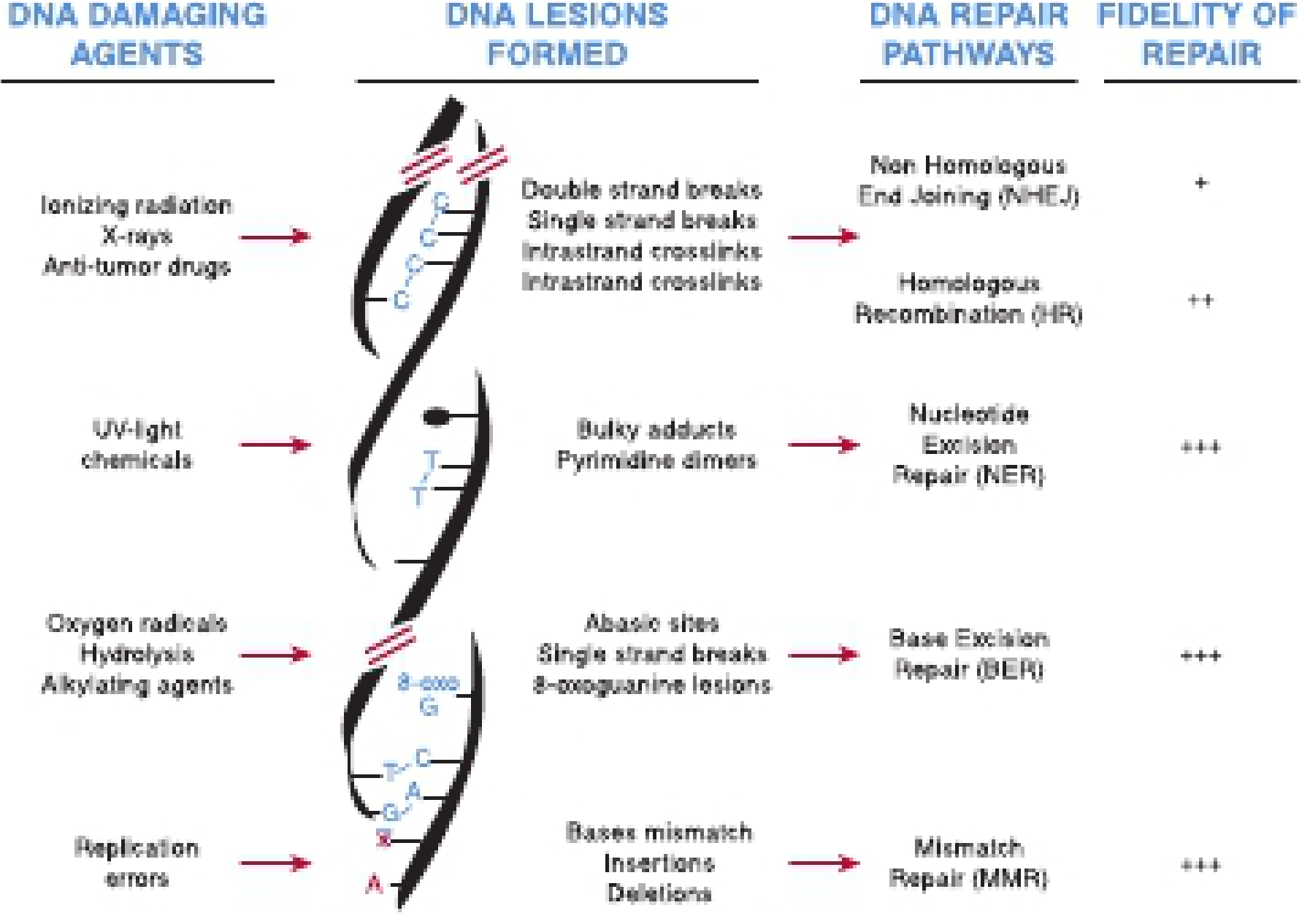
1. Ionizing Radiation (X-rays, Gamma rays, anti-tumor drugs)
Ionizing radiation deposits energy in biological tissue, generating reactive oxygen species (ROS) and directly breaking chemical bonds in DNA.
Types of damage:
- Double-strand breaks (DSBs) - the most lethal lesion; both strands are cut simultaneously
- Single-strand breaks (SSBs) - one strand nicked
- Interstrand cross-links - covalent links between bases on opposite strands
- Intrastrand cross-links - covalent links between adjacent bases on the same strand
- DNA backbone sugar damage
Repair pathway: Non-Homologous End Joining (NHEJ) and Homologous Recombination (HR)
2. Ultraviolet (UV) Radiation
UV light (especially UVB, 280-320 nm) is directly absorbed by DNA (absorption max at 260 nm), causing photochemical reactions between adjacent pyrimidine bases (thymine and cytosine).
Types of damage:
- Cyclobutane pyrimidine dimers (CPDs) - the major lesion; covalent bonding of adjacent pyrimidines (T-T, T-C, C-T, or C-C)
- 6,4-Pyrimidine-pyrimidone photoproducts (6-4 PPs) - second major lesion
- Bulky adducts - distortions in the DNA helix
- These lead to UV-signature mutations: C→T and CC→TT transitions at dipyrimidine sites
Repair pathway: Nucleotide Excision Repair (NER)
3. Chemical Agents
a. Alkylating Agents
(e.g., nitrogen mustards, cyclophosphamide, busulfan, nitrosamines)
These agents add alkyl groups to bases, most commonly to the N7 and O6 positions of guanine.
Types of damage:
- DNA adducts (alkyl groups covalently attached to bases)
- Interstrand cross-links - linking the two strands together and blocking replication
- Intrastrand cross-links
- Depurination - loss of the alkylated base, creating an abasic (apurinic) site
- Mispairing: O6-methylguanine pairs with thymine instead of cytosine → G:C to A:T transversion mutations
b. Polycyclic Aromatic Hydrocarbons (PAHs)
(e.g., benzo[a]pyrene found in tobacco smoke, combustion products)
Types of damage:
- Bulky covalent DNA adducts - large hydrophobic molecules inserted between base pairs
- Strand distortion blocking replication
c. Intercalating Agents
(e.g., acridine dyes, ethidium bromide, anthracyclines like doxorubicin)
Types of damage:
- Intercalation between base pairs, causing frameshift mutations (insertions or deletions)
- Some also generate strand breaks via topoisomerase II poisoning
d. Base Analogues
(e.g., 5-fluorouracil, 6-mercaptopurine, 5-bromouracil)
Types of damage:
- Incorporated into DNA in place of normal bases, causing mispairing and point mutations
- 5-bromouracil can pair with guanine instead of adenine
e. Deaminating Agents
(e.g., nitrous acid, sodium bisulfite)
Types of damage:
- Deamination of cytosine → uracil (C→U), causing C:G → T:A transitions
- Deamination of adenine → hypoxanthine
- Also occurs spontaneously (aging): ~100-500 C→U events per cell per day
4. Reactive Oxygen Species (ROS) / Oxidative Agents
(Generated endogenously by mitochondrial respiration, inflammation; exogenously by radiation and chemicals)
Types of damage:
- 8-oxoguanine (8-oxoG) lesions - the most common oxidative base lesion; 8-oxoG mispairs with adenine → G:C to T:A transversions
- Abasic (AP) sites - loss of oxidized bases
- Single-strand breaks
- Strand cross-links
- Sugar-phosphate backbone oxidation
Repair pathway: Base Excision Repair (BER)
5. Hydrolysis (Spontaneous)
Water spontaneously attacks the N-glycosidic bond between deoxyribose and purine bases.
Types of damage:
- Depurination - loss of adenine or guanine, creating apurinic (AP) sites (~10,000 events/cell/day)
- Deamination of cytosine to uracil
Repair pathway: Base Excision Repair (BER)
6. Replication Errors
DNA polymerase makes errors during normal replication (~1 per 10^5 nucleotides before proofreading).
Types of damage:
- Base mismatches (wrong base incorporated)
- Insertions and deletions (slippage at repetitive sequences)
Repair pathway: Mismatch Repair (MMR)
Summary Table
| DNA Damaging Agent | DNA Lesion / Type of Damage |
|---|---|
| Ionizing radiation, X-rays, anti-tumor drugs | Double-strand breaks, single-strand breaks, interstrand/intrastrand cross-links |
| UV light (UVB) | Cyclobutane pyrimidine dimers (CPDs), 6-4 photoproducts, bulky adducts |
| Alkylating agents | DNA adducts, interstrand cross-links, abasic sites, mispairing |
| Polycyclic aromatic hydrocarbons | Bulky covalent adducts, strand distortion |
| Intercalating agents | Frameshift mutations (insertions/deletions), strand breaks |
| Base analogues | Mispairing, point mutations |
| Deaminating agents | C→U conversions, base mismatches |
| Oxygen radicals / ROS | 8-oxoguanine lesions, abasic sites, single-strand breaks |
| Hydrolysis (spontaneous) | Depurination (AP sites), deamination |
| Replication errors | Base mismatches, insertions, deletions |
Key principle: Radiation-induced and chemically-induced DNA lesions kill cells mainly by interfering with DNA replication. If repair mechanisms fail, p53 triggers apoptosis rather than allowing survival with mutagenic DNA. (Robbins Pathologic Basis of Disease)
This is a shared conversation. Sign in to Orris to start your own chat.