
Hemlock poison Signs nd symptoms Postmortem finding Circumstances of poisoning
hemlock poisoning signs symptoms postmortem findings forensic toxicology
Hemlock Poisoning (Conium maculatum - Poison Hemlock)
The Poison
- Coniine - the primary alkaloid, a volatile piperidine alkaloid
- gamma-Coniceine - more toxic than coniine
- Methyl coniine and other related piperidine alkaloids
Mechanism of Action
- Initial overstimulation of nicotinic cholinergic receptors at autonomic ganglia and neuromuscular junctions
- Followed by blockade/paralysis of motor nerve terminals in muscles
- Gradual spread to motor cells of the spinal cord and brain
Signs and Symptoms
Early (Stimulatory) Phase
- Burning pain in mouth and throat
- Unpleasant mousy/musty odor on breath
- Nausea and vomiting
- Excessive salivation, diarrhea, abdominal pain
- Nervousness, tremor, restlessness
- Ataxia (vertigo and loss of coordination - Greeks called hemlock "koneion" meaning "to whirl about")
- Headache, dizziness
- Hypertension and tachycardia (sympathetic stimulation)
- Muscle fasciculations
- Miosis, visual disturbances
- Diaphoresis, tachypnea
Progressive/Paralytic Phase (Ascending Paralysis)
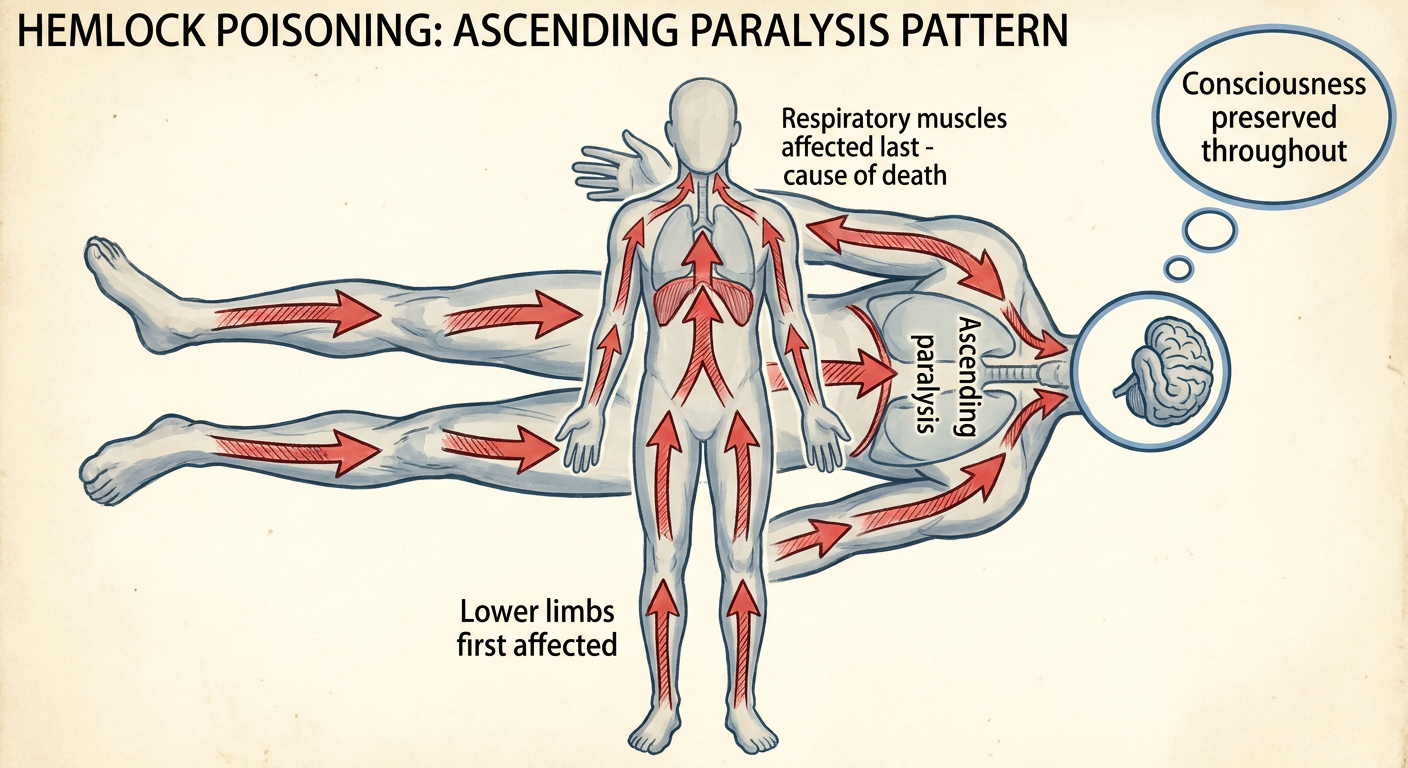
- Muscular weakness beginning in the lower limbs, ascending upward
- Progressive paralysis of the legs - then trunk - then upper limbs
- Blurred vision, blindness
- Slurred speech, difficulty swallowing
- Confusion, delirium, convulsions, coma may supervene
- Bradycardia, hypotension (as muscle paralysis deepens)
- Respiratory muscles affected last - dyspnea, respiratory depression
- Death from respiratory paralysis/asphyxia
Key clinical feature: The mind remains clear almost until the end - consciousness is preserved while paralysis ascends. The patient is fully aware but unable to breathe. This was classically described in Plato's account of Socrates' death.
Postmortem Findings
| Finding | Detail |
|---|---|
| External | Signs of asphyxia: cyanosis of lips/fingernails, petechiae on face and conjunctivae |
| Internal | Congestion of viscera (brain, lungs, kidneys) |
| Lungs | Pulmonary edema, congestion |
| Brain | Cerebral congestion, possibly petechial hemorrhages |
| Stomach | Remains of plant parts (roots, leaves, seeds) may be visible; preserved for analysis |
| Odor | Characteristic mousy odor may be detectable in stomach contents |
| Rhabdomyolysis | Muscle breakdown may be present (acute tubular necrosis in kidneys in severe cases) |
| Toxicology | Coniine and gamma-coniceine detectable in blood, urine, gastric contents, liver |
The gastric contents and plant remains should always be preserved for laboratory analysis. Toxicological confirmation is by chromatography (GC-MS or HPLC).
Circumstances of Poisoning
1. Accidental Poisoning (Most Common)
- Plant misidentification is the most frequent cause - poison hemlock closely resembles:
- Wild carrot / Queen Anne's lace (Daucus carota)
- Parsley (Petroselinum crispum)
- Parsnip (Pastinaca sativa) roots
- Anise (Pimpinella anisum)
- Ingestion while foraging for wild edible plants
- Children are especially vulnerable - may chew leaves or stems
- One historic case recorded of a child who died from blowing whistles made from conium twigs (coniine is volatile and can be inhaled)
- Inhalation toxicity is possible because coniine is a volatile alkaloid
2. Homicidal Poisoning
- Historically significant - used as a state poison by the ancient Greeks; Socrates was executed with hemlock in 399 BC
- Relatively uncommon today but possible
- Administration can be oral, injectable, or by inhalation
3. Suicidal Poisoning
- Case reports of intentional ingestion for self-harm
- Also reported in individuals seeking an "opioid-like" effect
4. Routes of Exposure
- Ingestion - most common
- Inhalation - possible as coniine is volatile; risk during plant crushing or burning
- Skin absorption - possible in some cases, though less common
- Injection - parenteral method is possible (homicide)
Quick Reference Table
| Feature | Detail |
|---|---|
| Botanical name | Conium maculatum |
| Active toxin | Coniine, gamma-coniceine |
| Mechanism | Nicotinic receptor agonist then antagonist; ascending motor paralysis |
| Onset | 15 min - 2 hours |
| Fatal dose | ~60 mg coniine |
| Distinguishing feature | Ascending paralysis with clear sensorium |
| Cause of death | Respiratory paralysis/asphyxia |
| PM finding | Asphyxia picture + plant material in stomach |
| Most common circumstance | Accidental - plant misidentification |
It's for my seminar can u give some images
Conium maculatum poison hemlock plant identification images stem spots flowers
coniine nicotinic receptor mechanism ascending paralysis hemlock diagram
poison hemlock purple spotted stem identification forensic medicine
Medical diagram showing ascending paralysis pattern in hemlock poisoning: human body outline with arrows showing paralysis starting from lower limbs, progressing upward through legs, abdomen, chest, arms, and finally respiratory muscles. Labels showing: "Lower limbs first affected", "Ascending paralysis", "Respiratory muscles affected last - cause of death". Include a brain icon showing "Consciousness preserved throughout". Clinical forensic medicine educational diagram style.
Seminar Images - Hemlock Poisoning
1. The Plant - Flowers (White Umbel/Umbrella-shaped inflorescence)
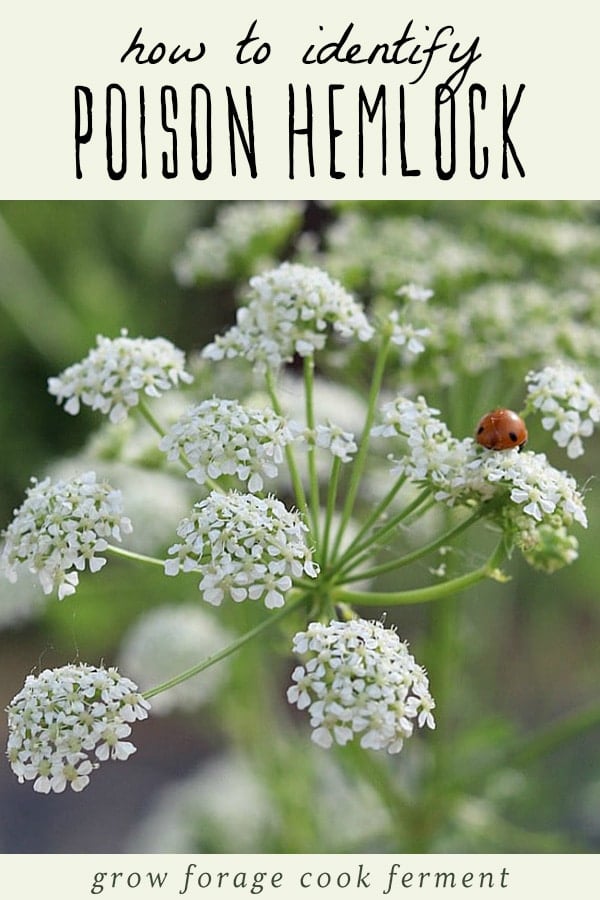
2. The Plant - Full Appearance (with purple-red stem)

3. Diagnostic Feature - Purple Spotted Stem (Close-up)
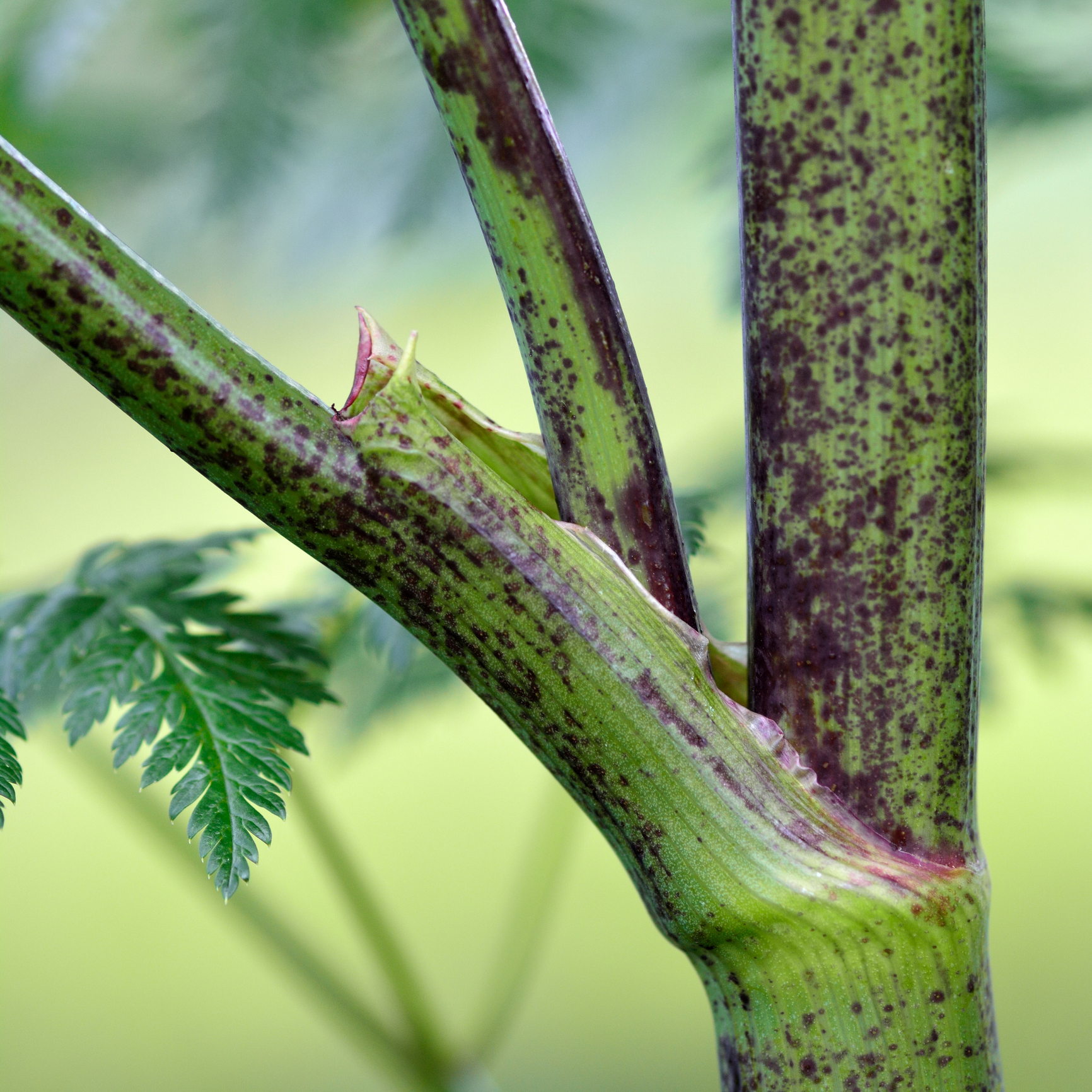
4. Stem Spots & Fern-like Leaves

5. Mechanism & Clinical Pattern - Ascending Paralysis Diagram
Quick Image Summary for Your Slides
| Slide Topic | Image to Use |
|---|---|
| Plant identification | Images 1, 2 |
| Diagnostic stem feature | Images 3, 4 |
| Mechanism / Clinical features | Image 5 |
| Misidentification risk | Images 1 & 2 (resembles parsley/carrot) |
Tip for your seminar: Emphasize Image 3 (purple spotted stem) as the key differentiating feature from parsley/wild carrot, since accidental misidentification is the most common cause of poisoning.
Create a PowerPoint presentation on hemlock poisoning for your seminar
mkdir -p /home/daytona/workspace/hemlock-ppt && ls /home/daytona/workspace/hemlock-ppt
node /home/daytona/skills/shared/scripts/fetch_images.js "https://www.growforagecookferment.com/wp-content/uploads/2018/06/poison-hemlock.jpg" "https://extension.psu.edu/media/catalog/product/7/a/7aca81e80146cf34973d3521eb7e7be2.jpeg" "https://news.delaware.gov/files/2021/07/Poison-Hemlock-purple-spots.jpg" "https://crops.extension.iastate.edu/files/article/image006_21.jpg" "https://cdn.orris.care/image-gen/7af65ddb70894b89ba20b8ae8da29446.png" 2>/dev/null | node -e "const d=require('fs');const j=JSON.parse(require('fs').readFileSync('/dev/stdin','utf8'));j.forEach((img,i)=>{if(img.base64){const ext=img.base64.split(';')[0].split('/')[1];d.writeFileSync('/home/daytona/workspace/hemlock-ppt/img'+i+'.'+ext,img.base64.split(',')[1],'base64');console.log('saved img'+i+'.'+ext);}else{console.log('failed: '+img.url+' err:'+img.error);}});"
node /home/daytona/skills/shared/scripts/fetch_images.js "https://www.growforagecookferment.com/wp-content/uploads/2018/06/poison-hemlock.jpg" "https://news.delaware.gov/files/2021/07/Poison-Hemlock-purple-spots.jpg" "https://cdn.orris.care/image-gen/7af65ddb70894b89ba20b8ae8da29446.png" 2>/dev/null | head -c 500
cd /home/daytona/workspace/hemlock-ppt && curl -sL --max-time 15 "https://www.growforagecookferment.com/wp-content/uploads/2018/06/poison-hemlock.jpg" -o flowers.jpg && echo "flowers ok" && curl -sL --max-time 15 "https://news.delaware.gov/files/2021/07/Poison-Hemlock-purple-spots.jpg" -o spots.jpg && echo "spots ok"
cd /home/daytona/workspace/hemlock-ppt && curl -sL --max-time 15 "https://cdn.orris.care/image-gen/7af65ddb70894b89ba20b8ae8da29446.png" -o paralysis_diagram.png && echo "diagram ok" && curl -sL --max-time 15 "https://crops.extension.iastate.edu/files/article/image006_21.jpg" -o stem_fern.jpg && echo "stem ok" && curl -sL --max-time 15 "https://extension.psu.edu/media/catalog/product/7/a/7aca81e80146cf34973d3521eb7e7be2.jpeg" -o full_plant.jpeg && echo "plant ok"
~/hemlock-ppt/create_pptx.js
const pptxgen = require("pptxgenjs");
const path = require("path");

const pres = new pptxgen();
pres.layout = "LAYOUT_16x9";
pres.author = "Forensic Medicine Seminar";
pres.title = "Hemlock Poisoning";

// ─── COLOR PALETTE ───────────────────────────────────────────────────────────
// Dark forest green theme (toxic plant aesthetic)
const C = {
  darkBg:    "0D1F0E",   // Deep forest dark for title/end slides
  midGreen:  "1A3A1C",   // Dark green for content bg
  leafGreen: "2D6A2F",   // Accent green
  acidGreen: "5DBB63",   // Bright highlight
  offWhite:  "F0F4F0",   // Body text
  white:     "FFFFFF",
  gold:      "E8C84A",   // Warning/callout
  danger:    "C0392B",   // Red for danger/death
  lightCard: "EAF4EB",   // Light card bg
  cardBorder:"2D6A2F",
  subtext:   "A8C4A9",
};

const IMGS = {
  flowers:   path.resolve(__dirname, "flowers.jpg"),
  spots:     path.resolve(__dirname, "spots.jpg"),
  diagram:   path.resolve(__dirname, "paralysis_diagram.png"),
  stemFern:  path.resolve(__dirname, "stem_fern.jpg"),
  fullPlant: path.resolve(__dirname, "full_plant.jpeg"),
};

// ─── HELPER: slide with dark background ──────────────────────────────────────
function darkSlide() {
  const s = pres.addSlide();
  s.addShape(pres.shapes.RECTANGLE, { x:0, y:0, w:10, h:5.625, fill:{ color: C.darkBg }, line:{ type:"none" } });
  return s;
}

// ─── HELPER: slide with medium-green background ───────────────────────────────
function greenSlide() {
  const s = pres.addSlide();
  s.addShape(pres.shapes.RECTANGLE, { x:0, y:0, w:10, h:5.625, fill:{ color: C.midGreen }, line:{ type:"none" } });
  return s;
}

// ─── HELPER: left accent bar ──────────────────────────────────────────────────
function accentBar(slide, color) {
  slide.addShape(pres.shapes.RECTANGLE, {
    x:0, y:0, w:0.18, h:5.625, fill:{ color: color || C.acidGreen }, line:{ type:"none" }
  });
}

// ─── HELPER: section header band ─────────────────────────────────────────────
function sectionBand(slide, title, bgColor) {
  slide.addShape(pres.shapes.RECTANGLE, {
    x:0, y:0, w:10, h:0.85, fill:{ color: bgColor || C.leafGreen }, line:{ type:"none" }
  });
  slide.addText(title, {
    x:0.3, y:0, w:9.4, h:0.85, fontSize:22, bold:true, color:C.white,
    valign:"middle", margin:0
  });
}

// ─── HELPER: card ─────────────────────────────────────────────────────────────
function card(slide, x, y, w, h, fillColor, borderColor) {
  slide.addShape(pres.shapes.ROUNDED_RECTANGLE, {
    x, y, w, h,
    fill:{ color: fillColor || "1E3D20" },
    line:{ color: borderColor || C.acidGreen, width:1.5 },
    rectRadius: 0.08,
    shadow:{ type:"outer", color:"000000", blur:6, offset:2, angle:135, opacity:0.2 }
  });
}

// ══════════════════════════════════════════════════════════════════════════════
// SLIDE 1 — TITLE SLIDE
// ══════════════════════════════════════════════════════════════════════════════
{
  const s = darkSlide();

  // Green leaf-streak decoration top
  s.addShape(pres.shapes.RECTANGLE, { x:0, y:0, w:10, h:0.12, fill:{ color: C.acidGreen }, line:{ type:"none" } });
  s.addShape(pres.shapes.RECTANGLE, { x:0, y:0.12, w:10, h:0.05, fill:{ color: C.leafGreen }, line:{ type:"none" } });

  // Plant image on right side
  s.addImage({ path: IMGS.flowers, x:5.8, y:0.5, w:4.0, h:4.7, transparency:15 });
  // Dark overlay to blend image into background
  s.addShape(pres.shapes.RECTANGLE, {
    x:5.5, y:0, w:4.5, h:5.625,
    fill:{ color: C.darkBg, transparency:30 }, line:{ type:"none" }
  });
  // Left-side dark gradient strip
  s.addShape(pres.shapes.RECTANGLE, {
    x:0, y:0, w:6.2, h:5.625,
    fill:{ color: C.darkBg }, line:{ type:"none" }
  });

  // Poison symbol
  s.addText("☠", { x:0.4, y:0.45, w:1, h:1, fontSize:52, color: C.gold });

  // Title
  s.addText("HEMLOCK", {
    x:0.3, y:1.2, w:5.8, h:1.0, fontSize:56, bold:true, color:C.acidGreen,
    charSpacing:8, valign:"middle", margin:0
  });
  s.addText("POISONING", {
    x:0.3, y:2.1, w:5.8, h:0.85, fontSize:48, bold:true, color:C.white,
    charSpacing:4, valign:"middle", margin:0
  });

  // Subtitle band
  s.addShape(pres.shapes.RECTANGLE, { x:0.3, y:3.05, w:5.4, h:0.04, fill:{ color: C.acidGreen }, line:{ type:"none" } });

  s.addText("Conium maculatum — Forensic Medicine & Toxicology", {
    x:0.3, y:3.15, w:5.6, h:0.4, fontSize:13, italic:true, color:C.subtext,
    valign:"top", margin:0
  });

  // Bottom tags
  s.addText([
    { text: "Signs & Symptoms", options:{ color: C.acidGreen, bold:true } },
    { text: "  |  " },
    { text: "Postmortem Findings", options:{ color: C.gold, bold:true } },
    { text: "  |  " },
    { text: "Medicolegal Aspects", options:{ color: C.subtext } }
  ], { x:0.3, y:4.5, w:9, h:0.45, fontSize:11, color:C.subtext, valign:"middle", margin:0 });

  // Bottom bar
  s.addShape(pres.shapes.RECTANGLE, { x:0, y:5.45, w:10, h:0.175, fill:{ color: C.leafGreen }, line:{ type:"none" } });
  s.addShape(pres.shapes.RECTANGLE, { x:0, y:5.5, w:10, h:0.125, fill:{ color: C.acidGreen }, line:{ type:"none" } });
}

// ══════════════════════════════════════════════════════════════════════════════
// SLIDE 2 — INTRODUCTION & THE PLANT
// ══════════════════════════════════════════════════════════════════════════════
{
  const s = greenSlide();
  accentBar(s);
  sectionBand(s, "Introduction — The Plant");

  // Left: plant image
  s.addImage({ path: IMGS.fullPlant, x:0.3, y:1.0, w:3.5, h:4.2 });
  // Caption
  s.addText("Conium maculatum\nTall biennial, 8–10 ft\nWaste places & roadsides", {
    x:0.3, y:4.8, w:3.5, h:0.7, fontSize:9.5, italic:true, color:C.subtext,
    align:"center"
  });

  // Right: info cards
  const facts = [
    ["Also Known As", "Spotted Hemlock, Spotted Cowbane, Parsley Hemlock"],
    ["Family", "Apiaceae (Carrot/Parsley family)"],
    ["Toxic Parts", "ALL parts — leaves, stem, root, seeds, flowers"],
    ["Active Toxins", "Coniine & gamma-Coniceine (piperidine alkaloids)"],
    ["Key Odor", "Strong mousy/musty smell when crushed"],
    ["Fatal Dose", "~60 mg of coniine"],
  ];

  facts.forEach(([label, val], i) => {
    const row = Math.floor(i / 1);
    card(s, 4.1, 1.0 + row * 0.72, 5.6, 0.65, "1A3A1C", C.acidGreen);
    s.addText(label + ": ", {
      x:4.3, y:1.04 + row * 0.72, w:1.5, h:0.55, fontSize:10.5, bold:true,
      color:C.acidGreen, valign:"middle", margin:0
    });
    s.addText(val, {
      x:5.6, y:1.04 + row * 0.72, w:3.9, h:0.55, fontSize:10.5,
      color:C.offWhite, valign:"middle", margin:0
    });
  });
}

// ══════════════════════════════════════════════════════════════════════════════
// SLIDE 3 — PLANT IDENTIFICATION (Images)
// ══════════════════════════════════════════════════════════════════════════════
{
  const s = greenSlide();
  accentBar(s);
  sectionBand(s, "Plant Identification — Key Features");

  // Image 1: flowers
  s.addImage({ path: IMGS.flowers, x:0.3, y:1.0, w:4.6, h:3.5 });
  card(s, 0.3, 4.55, 4.6, 0.75, "152A16", C.acidGreen);
  s.addText("White umbrella-shaped UMBEL flowers\nResembles parsley, wild carrot — a key misidentification risk", {
    x:0.45, y:4.6, w:4.3, h:0.65, fontSize:9.5, color:C.offWhite, align:"center"
  });

  // Image 2: spots
  s.addImage({ path: IMGS.spots, x:5.2, y:1.0, w:4.5, h:3.5 });
  card(s, 5.2, 4.55, 4.5, 0.75, "152A16", C.gold);
  s.addText([
    { text: "DIAGNOSTIC: ", options:{ bold:true, color:C.gold } },
    { text: "Purple/violet spots on hollow stem\n\"Blood of Socrates\" — hallmark identification", options:{ color:C.offWhite } }
  ], { x:5.35, y:4.6, w:4.2, h:0.65, fontSize:9.5, align:"center" });
}

// ══════════════════════════════════════════════════════════════════════════════
// SLIDE 4 — MECHANISM OF ACTION
// ══════════════════════════════════════════════════════════════════════════════
{
  const s = greenSlide();
  accentBar(s);
  sectionBand(s, "Mechanism of Action");

  // Central title
  s.addText("Coniine — Nicotinic Acetylcholine Receptor (nAChR) Agonist/Antagonist", {
    x:0.3, y:0.95, w:9.4, h:0.52, fontSize:13, bold:true, color:C.gold,
    align:"center", valign:"middle", margin:0
  });

  // Flow boxes: step-by-step mechanism
  const steps = [
    { num:"1", title:"Ingestion", body:"Coniine absorbed rapidly from GI tract\n(also absorbed via skin & inhalation — volatile alkaloid)" },
    { num:"2", title:"Initial Stimulation", body:"Overstimulates nicotinic receptors at\nautonomic ganglia & neuromuscular junction" },
    { num:"3", title:"Receptor Blockade", body:"Sustained stimulation → depolarization block\nFlaccid paralysis of skeletal muscle" },
    { num:"4", title:"Ascending Spread", body:"Motor nerve terminals → spinal cord\n→ brainstem motor cells" },
    { num:"5", title:"Respiratory Failure", body:"Paralysis of intercostals & diaphragm\n→ Asphyxia → Death" },
  ];

  const stepW = 1.78;
  steps.forEach((st, i) => {
    const x = 0.25 + i * (stepW + 0.05);
    // Number circle
    s.addShape(pres.shapes.OVAL, {
      x: x + 0.55, y: 1.6, w:0.62, h:0.62,
      fill:{ color: C.acidGreen }, line:{ type:"none" }
    });
    s.addText(st.num, { x: x + 0.55, y:1.6, w:0.62, h:0.62, fontSize:14, bold:true, color:C.darkBg, align:"center", valign:"middle", margin:0 });

    // Arrow between (except last)
    if (i < steps.length - 1) {
      s.addText("→", { x: x + stepW - 0.1, y:2.15, w:0.3, h:0.4, fontSize:16, color:C.acidGreen, align:"center", valign:"middle", margin:0 });
    }

    // Card
    card(s, x, 2.3, stepW, 2.85, "162C18", i === 4 ? C.danger : C.leafGreen);
    s.addText(st.title, {
      x: x+0.08, y:2.32, w:stepW-0.16, h:0.45, fontSize:11, bold:true,
      color: i === 4 ? "#FF6B6B" : C.acidGreen,
      align:"center", valign:"middle", margin:0
    });
    s.addShape(pres.shapes.RECTANGLE, {
      x: x+0.1, y:2.75, w:stepW-0.2, h:0.03, fill:{ color: i === 4 ? C.danger : C.acidGreen }, line:{ type:"none" }
    });
    s.addText(st.body, {
      x: x+0.1, y:2.82, w:stepW-0.2, h:2.2, fontSize:9.5, color:C.offWhite,
      align:"center", valign:"top"
    });
  });

  // Key note
  s.addShape(pres.shapes.RECTANGLE, { x:0.25, y:5.22, w:9.5, h:0.32, fill:{ color:"152A16" }, line:{ color:C.gold, width:1 } });
  s.addText("⚠  Structurally & functionally analogous to NICOTINE — similar toxidrome", {
    x:0.35, y:5.22, w:9.3, h:0.32, fontSize:10.5, color:C.gold, bold:true, valign:"middle", margin:0
  });
}

// ══════════════════════════════════════════════════════════════════════════════
// SLIDE 5 — SIGNS & SYMPTOMS
// ══════════════════════════════════════════════════════════════════════════════
{
  const s = greenSlide();
  accentBar(s);
  sectionBand(s, "Signs & Symptoms — Biphasic Pattern");

  // Phase 1 — Early
  card(s, 0.3, 0.95, 4.55, 4.5, "152A16", C.acidGreen);
  s.addText("PHASE 1 — Early (Stimulatory)", {
    x:0.45, y:1.0, w:4.2, h:0.48, fontSize:13, bold:true, color:C.acidGreen,
    align:"center", valign:"middle", margin:0
  });
  s.addShape(pres.shapes.RECTANGLE, { x:0.5, y:1.47, w:4.0, h:0.03, fill:{ color: C.acidGreen }, line:{ type:"none" } });

  const phase1 = [
    "🤢  Nausea, vomiting, abdominal pain",
    "💧  Excessive salivation, diarrhea",
    "😵  Ataxia, dizziness, tremor",
    "❤️  Tachycardia, hypertension",
    "💪  Muscle fasciculations",
    "👁️  Miosis, visual disturbances",
    "😓  Diaphoresis, tachypnea",
    "🔥  Burning pain in mouth/throat",
    "🐭  Mousy odor on breath",
  ];
  phase1.forEach((txt, i) => {
    s.addText(txt, {
      x:0.5, y:1.55 + i * 0.37, w:4.2, h:0.35, fontSize:10.5, color:C.offWhite, valign:"middle"
    });
  });

  // Phase 2 — Progressive
  card(s, 5.1, 0.95, 4.55, 4.5, "2A1515", C.danger);
  s.addText("PHASE 2 — Progressive (Paralytic)", {
    x:5.25, y:1.0, w:4.2, h:0.48, fontSize:13, bold:true, color:"FF6B6B",
    align:"center", valign:"middle", margin:0
  });
  s.addShape(pres.shapes.RECTANGLE, { x:5.3, y:1.47, w:4.0, h:0.03, fill:{ color: C.danger }, line:{ type:"none" } });

  const phase2 = [
    "🦵  Lower limbs paralysed FIRST",
    "⬆️  Ascending paralysis — legs → trunk → arms",
    "👁️  Blindness, blurred vision",
    "🗣️  Slurred speech, dysphagia",
    "😕  Confusion, delirium, seizures",
    "🫁  Respiratory muscle paralysis",
    "💀  Death from ASPHYXIA",
    "",
    "🧠  KEY: Consciousness preserved until end!",
  ];
  phase2.forEach((txt, i) => {
    const isKey = txt.includes("KEY");
    s.addText(txt, {
      x:5.3, y:1.55 + i * 0.37, w:4.2, h:0.35, fontSize:10.5,
      color: isKey ? C.gold : C.offWhite,
      bold: isKey, valign:"middle"
    });
  });
}

// ══════════════════════════════════════════════════════════════════════════════
// SLIDE 6 — ASCENDING PARALYSIS DIAGRAM
// ══════════════════════════════════════════════════════════════════════════════
{
  const s = greenSlide();
  accentBar(s);
  sectionBand(s, "The Hallmark: Ascending Paralysis");

  // Diagram image
  s.addImage({ path: IMGS.diagram, x:0.4, y:0.95, w:5.4, h:4.4 });

  // Right side — key clinical points
  const pts = [
    { icon:"1", color:C.acidGreen, text:"Paralysis starts in lower limbs — patient notes weakness of legs first" },
    { icon:"2", color:C.acidGreen, text:"Gradually ascends — trunk, then upper limbs affected" },
    { icon:"3", color:C.gold, text:"Intercostal muscles and diaphragm affected last → respiratory failure" },
    { icon:"⭐", color:C.gold, text:"HALLMARK: Mind remains CLEAR — patient is conscious while paralysed and asphyxiating" },
    { icon:"💀", color:"FF6B6B", text:"Death by respiratory asphyxia — classical description from Plato's account of Socrates" },
  ];

  pts.forEach((pt, i) => {
    card(s, 6.0, 1.0 + i * 0.92, 3.7, 0.85, "162C18", pt.color);
    s.addShape(pres.shapes.OVAL, {
      x:6.08, y:1.07 + i * 0.92, w:0.38, h:0.38,
      fill:{ color:pt.color }, line:{ type:"none" }
    });
    s.addText(pt.icon, {
      x:6.08, y:1.07 + i * 0.92, w:0.38, h:0.38, fontSize:10, bold:true,
      color:C.darkBg, align:"center", valign:"middle", margin:0
    });
    s.addText(pt.text, {
      x:6.55, y:1.05 + i * 0.92, w:3.05, h:0.75, fontSize:9.5,
      color:C.offWhite, valign:"middle"
    });
  });
}

// ══════════════════════════════════════════════════════════════════════════════
// SLIDE 7 — POSTMORTEM FINDINGS
// ══════════════════════════════════════════════════════════════════════════════
{
  const s = greenSlide();
  accentBar(s);
  sectionBand(s, "Postmortem Findings");

  s.addText("All findings are those of MECHANICAL ASPHYXIA", {
    x:0.3, y:0.9, w:9.4, h:0.42, fontSize:13, bold:true, color:C.gold,
    align:"center", valign:"middle", margin:0
  });

  // Grid of PM finding cards — 2 columns × 4 rows + 1 special
  const findings = [
    { title:"External", body:"Cyanosis of lips, fingernails, face\nPetechial hemorrhages — face & conjunctivae\nSigns of asphyxia", color: C.danger },
    { title:"Lungs", body:"Pulmonary oedema\nCongestion & engorgement\nPetechiae on pleura", color: C.danger },
    { title:"Brain", body:"Cerebral congestion\nPetechial haemorrhages\nSigns of hypoxic-ischaemic injury", color:"8B6914" },
    { title:"Viscera", body:"Generalised venous congestion\nKidney: Acute tubular necrosis\n(rhabdomyolysis-related)", color:"8B6914" },
    { title:"Stomach / GI", body:"Plant remains visible: leaves, roots, seeds\nCharacteristic MOUSY ODOUR in contents\nPreserve for toxicology!", color: C.leafGreen },
    { title:"Muscle", body:"Rhabdomyolysis changes\nMyoglobinuria (dark urine)\nIn cases with prolonged course", color: C.leafGreen },
    { title:"Toxicology", body:"Blood, urine, gastric contents, liver\nGC-MS / HPLC for coniine &\ngamma-coniceine confirmation", color: C.acidGreen },
    { title:"Special Note", body:"No specific pathognomonic internal lesion.\nDiagnosis requires: clinical Hx + plant ID\n+ toxicological analysis", color: C.gold },
  ];

  findings.forEach((f, i) => {
    const col = i % 2;
    const row = Math.floor(i / 2);
    const x = 0.3 + col * 4.85;
    const y = 1.42 + row * 1.04;
    card(s, x, y, 4.65, 0.98, "162C18", f.color);
    s.addText(f.title, {
      x:x+0.12, y:y+0.04, w:4.4, h:0.3, fontSize:11, bold:true,
      color:f.color, valign:"middle", margin:0
    });
    s.addText(f.body, {
      x:x+0.12, y:y+0.32, w:4.4, h:0.62, fontSize:9,
      color:C.offWhite, valign:"top"
    });
  });
}

// ══════════════════════════════════════════════════════════════════════════════
// SLIDE 8 — CIRCUMSTANCES OF POISONING
// ══════════════════════════════════════════════════════════════════════════════
{
  const s = greenSlide();
  accentBar(s);
  sectionBand(s, "Circumstances of Poisoning");

  const circumstances = [
    {
      icon:"🌿", title:"Accidental (Most Common)",
      color: C.acidGreen,
      points:[
        "Plant misidentification — mimics parsley, wild carrot, parsnip, anise",
        "Foraging for wild edible plants",
        "Children chewing leaves/stems",
        "Child died blowing whistles from conium twigs (volatile coniine inhaled)",
        "Inhalation possible — coniine is a volatile alkaloid",
      ]
    },
    {
      icon:"⚔️", title:"Homicidal",
      color: C.gold,
      points:[
        "Historically significant — used as state poison in ancient Greece",
        "Socrates executed in 399 BC with hemlock potion",
        "Oral, injectable (parenteral), or inhalation routes possible",
        "Modern cases rare but documented",
      ]
    },
    {
      icon:"💊", title:"Suicidal / Intentional",
      color: C.danger,
      points:[
        "Intentional self-harm ingestion (case reports)",
        "Misuse seeking opioid-like effect",
        "Online misinformation has led to intentional use",
      ]
    },
    {
      icon:"🧪", title:"Routes of Exposure",
      color: C.subtext,
      points:[
        "Ingestion — most common",
        "Inhalation — volatile coniine (crushing/burning plant)",
        "Transdermal — possible skin absorption",
        "Parenteral — possible for homicide",
      ]
    },
  ];

  circumstances.forEach((c, i) => {
    const col = i % 2;
    const row = Math.floor(i / 2);
    const x = 0.25 + col * 4.88;
    const y = 0.97 + row * 2.32;
    card(s, x, y, 4.65, 2.2, "152A16", c.color);
    s.addText(c.icon + "  " + c.title, {
      x:x+0.15, y:y+0.06, w:4.3, h:0.4, fontSize:13, bold:true,
      color:c.color, valign:"middle", margin:0
    });
    s.addShape(pres.shapes.RECTANGLE, {
      x:x+0.15, y:y+0.48, w:4.3, h:0.03,
      fill:{ color:c.color }, line:{ type:"none" }
    });
    c.points.forEach((pt, pi) => {
      s.addText("• " + pt, {
        x:x+0.2, y:y+0.55 + pi * 0.32, w:4.2, h:0.3, fontSize:9.5,
        color:C.offWhite, valign:"middle"
      });
    });
  });
}

// ══════════════════════════════════════════════════════════════════════════════
// SLIDE 9 — MEDICOLEGAL ASPECTS & FATAL DOSE
// ══════════════════════════════════════════════════════════════════════════════
{
  const s = greenSlide();
  accentBar(s);
  sectionBand(s, "Medicolegal Aspects & Fatal Dose");

  // Fatal dose box
  s.addShape(pres.shapes.ROUNDED_RECTANGLE, {
    x:0.3, y:1.0, w:3.0, h:2.4,
    fill:{ color:"2A1515" }, line:{ color:C.danger, width:2.5 }, rectRadius:0.1
  });
  s.addText("FATAL\nDOSE", {
    x:0.3, y:1.05, w:3.0, h:0.8, fontSize:18, bold:true, color:"FF6B6B",
    align:"center", valign:"middle", margin:0, charSpacing:4
  });
  s.addText("~60 mg", {
    x:0.3, y:1.8, w:3.0, h:0.7, fontSize:32, bold:true, color:C.gold,
    align:"center", valign:"middle", margin:0
  });
  s.addText("of Coniine", {
    x:0.3, y:2.45, w:3.0, h:0.3, fontSize:12, color:C.offWhite,
    align:"center", margin:0
  });
  s.addText("Fatal Period:\nFew hours\n(1–2 hrs large dose)", {
    x:0.3, y:2.75, w:3.0, h:0.6, fontSize:10, color:C.subtext,
    align:"center"
  });

  // Historical box
  s.addShape(pres.shapes.ROUNDED_RECTANGLE, {
    x:0.3, y:3.5, w:3.0, h:1.85,
    fill:{ color:"1A1A2A" }, line:{ color:"9B8FCC", width:1.5 }, rectRadius:0.1
  });
  s.addText("📜  Historical Significance", {
    x:0.4, y:3.55, w:2.8, h:0.4, fontSize:11, bold:true, color:"B8AFEF", valign:"middle"
  });
  s.addText("Socrates (399 BC) executed with hemlock by Athenian court.\n\nPlato's Phaedo describes ascending paralysis with preserved consciousness — the earliest clinical description of hemlock poisoning.", {
    x:0.4, y:3.95, w:2.8, h:1.35, fontSize:9, color:C.offWhite, italic:true
  });

  // Right: medicolegal points
  const mlPoints = [
    { hd:"Route of Poisoning", bd:"Any route: oral (most common), inhalation, injection, transdermal", c:C.acidGreen },
    { hd:"Manner of Death Classification", bd:"Accidental > Suicidal > Homicidal. Accidental from plant misidentification most common.", c:C.acidGreen },
    { hd:"Investigation Essentials", bd:"Plant remains in stomach\nToxicology: GC-MS/HPLC for coniine\nBotanical identification of plant material", c:C.gold },
    { hd:"Confirmatory Tests", bd:"Coniine & gamma-coniceine in blood, urine, gastric wash, liver", c:C.gold },
    { hd:"Differential Diagnosis", bd:"Nicotine poisoning, organophosphates, curare, botulism (ascending paralysis)", c:C.subtext },
  ];

  mlPoints.forEach((m, i) => {
    card(s, 3.55, 1.0 + i * 0.92, 6.1, 0.86, "162C18", m.c);
    s.addText(m.hd, {
      x:3.7, y:1.04 + i * 0.92, w:5.8, h:0.32, fontSize:11, bold:true,
      color:m.c, valign:"middle", margin:0
    });
    s.addText(m.bd, {
      x:3.7, y:1.34 + i * 0.92, w:5.8, h:0.5, fontSize:9.5,
      color:C.offWhite, valign:"top"
    });
  });
}

// ══════════════════════════════════════════════════════════════════════════════
// SLIDE 10 — TREATMENT & MANAGEMENT
// ══════════════════════════════════════════════════════════════════════════════
{
  const s = greenSlide();
  accentBar(s);
  sectionBand(s, "Treatment & Management");

  s.addText("No specific antidote — Supportive Care is the cornerstone", {
    x:0.3, y:0.92, w:9.4, h:0.38, fontSize:12.5, bold:true, color:C.gold,
    align:"center", valign:"middle", margin:0
  });

  const tx = [
    { step:"A", label:"Airway & Breathing", color:C.danger, items:[
      "Secure airway immediately",
      "Mechanical ventilation if respiratory paralysis",
      "Supplemental oxygen",
    ]},
    { step:"B", label:"GI Decontamination", color:C.gold, items:[
      "Activated charcoal (if early, airway protected)",
      "Gastric lavage with dilute tannic acid solution",
      "Do NOT induce emesis (aspiration risk)",
    ]},
    { step:"C", label:"Pharmacological", color:C.acidGreen, items:[
      "Antidysrhythmics (for arrhythmias)",
      "Anticonvulsants (benzodiazepines for seizures)",
      "AChE inhibitors: Physostigmine IV",
      "Aminopyridine (experimental)",
    ]},
    { step:"D", label:"Supportive", color:C.subtext, items:[
      "IV fluid resuscitation",
      "Monitor renal function (rhabdomyolysis risk)",
      "Urinary alkalinisation if myoglobinuria",
      "Monitor cardiac rhythm continuously",
    ]},
  ];

  tx.forEach((t, i) => {
    const x = 0.25 + (i % 2) * 4.85;
    const y = 1.42 + Math.floor(i / 2) * 2.05;
    card(s, x, y, 4.65, 1.95, "152A16", t.color);
    s.addShape(pres.shapes.OVAL, {
      x:x+0.12, y:y+0.1, w:0.42, h:0.42,
      fill:{ color:t.color }, line:{ type:"none" }
    });
    s.addText(t.step, {
      x:x+0.12, y:y+0.1, w:0.42, h:0.42, fontSize:14, bold:true,
      color:C.darkBg, align:"center", valign:"middle", margin:0
    });
    s.addText(t.label, {
      x:x+0.62, y:y+0.1, w:3.9, h:0.42, fontSize:13, bold:true,
      color:t.color, valign:"middle", margin:0
    });
    s.addShape(pres.shapes.RECTANGLE, {
      x:x+0.15, y:y+0.55, w:4.3, h:0.03, fill:{ color:t.color }, line:{ type:"none" }
    });
    t.items.forEach((item, ii) => {
      s.addText("• " + item, {
        x:x+0.2, y:y+0.62 + ii * 0.35, w:4.3, h:0.32, fontSize:10,
        color:C.offWhite, valign:"middle"
      });
    });
  });
}

// ══════════════════════════════════════════════════════════════════════════════
// SLIDE 11 — SUMMARY TABLE
// ══════════════════════════════════════════════════════════════════════════════
{
  const s = greenSlide();
  accentBar(s);
  sectionBand(s, "Quick Reference Summary");

  const rows = [
    ["Botanical Name", "Conium maculatum", C.offWhite],
    ["Active Toxins", "Coniine, gamma-Coniceine (piperidine alkaloids)", C.offWhite],
    ["Mechanism", "Nicotinic receptor agonist → depolarization block → flaccid paralysis", C.offWhite],
    ["Onset of Symptoms", "15 minutes to 2 hours after ingestion", C.offWhite],
    ["Fatal Dose", "~60 mg coniine", C.gold],
    ["Fatal Period", "Few hours (1–2 hrs with large dose)", C.gold],
    ["Hallmark Feature", "Ascending paralysis with CLEAR consciousness", C.acidGreen],
    ["Cause of Death", "Respiratory paralysis → Asphyxia", "#FF6B6B"],
    ["PM Findings", "Asphyxia picture + plant material in stomach", C.offWhite],
    ["Most Common Mode", "Accidental — plant misidentification", C.offWhite],
    ["Diagnosis", "Hx + plant ID + GC-MS/HPLC toxicology", C.offWhite],
  ];

  rows.forEach(([label, val, textColor], i) => {
    const y = 0.97 + i * 0.42;
    const rowBg = i % 2 === 0 ? "152A16" : "1A3A1C";
    s.addShape(pres.shapes.RECTANGLE, {
      x:0.25, y, w:9.5, h:0.4, fill:{ color:rowBg }, line:{ type:"none" }
    });
    // Left accent for key rows
    if (["Fatal Dose", "Hallmark Feature", "Cause of Death"].includes(label)) {
      s.addShape(pres.shapes.RECTANGLE, {
        x:0.25, y, w:0.06, h:0.4, fill:{ color:textColor }, line:{ type:"none" }
      });
    }
    s.addText(label, {
      x:0.4, y:y+0.02, w:2.6, h:0.36, fontSize:10.5, bold:true,
      color:C.acidGreen, valign:"middle", margin:0
    });
    s.addShape(pres.shapes.RECTANGLE, {
      x:3.0, y:y+0.05, w:0.03, h:0.3, fill:{ color:C.leafGreen }, line:{ type:"none" }
    });
    s.addText(val, {
      x:3.1, y:y+0.02, w:6.5, h:0.36, fontSize:10.5,
      color:textColor, valign:"middle", margin:0
    });
  });
}

// ══════════════════════════════════════════════════════════════════════════════
// SLIDE 12 — CLOSING SLIDE
// ══════════════════════════════════════════════════════════════════════════════
{
  const s = darkSlide();
  // Bottom green bar
  s.addShape(pres.shapes.RECTANGLE, { x:0, y:5.45, w:10, h:0.175, fill:{ color:C.leafGreen }, line:{ type:"none" } });
  s.addShape(pres.shapes.RECTANGLE, { x:0, y:5.5, w:10, h:0.125, fill:{ color:C.acidGreen }, line:{ type:"none" } });

  // Faded plant image on right
  s.addImage({ path: IMGS.spots, x:5.5, y:0, w:4.5, h:5.625, transparency:60 });

  s.addText("☠", { x:1.5, y:0.55, w:1.2, h:1.2, fontSize:68, color:C.acidGreen });
  s.addText("Thank You", {
    x:0.5, y:1.5, w:7, h:1.0, fontSize:52, bold:true, color:C.white,
    valign:"middle", margin:0
  });
  s.addShape(pres.shapes.RECTANGLE, { x:0.5, y:2.55, w:4.5, h:0.05, fill:{ color:C.acidGreen }, line:{ type:"none" } });

  s.addText("Hemlock Poisoning — Forensic Medicine Seminar", {
    x:0.5, y:2.7, w:8, h:0.5, fontSize:16, color:C.subtext, italic:true
  });

  s.addText([
    { text: "Key Takeaway: ", options:{ bold:true, color:C.gold } },
    { text: "Ascending paralysis with preserved consciousness is the\nhallmark of hemlock (coniine) poisoning. Death results from\nrespiratory asphyxia. Accidental misidentification is the most\ncommon circumstance.", options:{ color:C.offWhite } }
  ], { x:0.5, y:3.3, w:5.5, h:1.9, fontSize:12 });

  s.addText("Sources: Parikh's Medical Jurisprudence & Toxicology\nEssentials of Forensic Medicine 36e (2026)\nTintinalli's Emergency Medicine", {
    x:0.5, y:5.0, w:9, h:0.4, fontSize:9, color:C.subtext, italic:true
  });
}

// ─── WRITE FILE ───────────────────────────────────────────────────────────────
pres.writeFile({ fileName: "/home/daytona/workspace/hemlock-ppt/Hemlock_Poisoning_Seminar.pptx" })
  .then(() => console.log("✅ Presentation saved!"))
  .catch(err => { console.error("❌ Error:", err); process.exit(1); });
cd /home/daytona/workspace/hemlock-ppt && node create_pptx.js
ls -lh /home/daytona/workspace/hemlock-ppt/Hemlock_Poisoning_Seminar.pptx
Hemlock Poisoning Seminar
Presentation · PPTX
| Slide | Content |
|---|---|
| 1 | Title slide with plant image |
| 2 | Introduction & plant facts (all key details in cards) |
| 3 | Plant identification photos (flowers + purple spots) |
| 4 | Mechanism of action (5-step flow diagram) |
| 5 | Signs & symptoms - biphasic pattern (Phase 1 vs Phase 2) |
| 6 | Ascending paralysis diagram with clinical annotations |
| 7 | Postmortem findings (8 category cards) |
| 8 | Circumstances of poisoning (accidental/homicidal/suicidal/routes) |
| 9 | Medicolegal aspects & fatal dose |
| 10 | Treatment & management |
| 11 | Quick reference summary table |
| 12 | Closing slide with key takeaway |
Where is ppt
Hemlock Poisoning Seminar
Presentation · PPTX
Now give me 3 mcqs
- A) Strychnine
- B) Curare
- C) Conium maculatum (Hemlock)
- D) Aconitine
✅ Answer: C — Conium maculatum Explanation: The hallmark of hemlock poisoning is ascending flaccid paralysis beginning in the lower limbs, with the mind remaining clear almost until death. Death occurs from respiratory muscle paralysis (asphyxia). Strychnine causes convulsions; curare causes paralysis but is used parenterally; aconitine primarily causes cardiac toxicity.
- A) GABA receptors
- B) Muscarinic acetylcholine receptors
- C) Nicotinic acetylcholine receptors
- D) Alpha-adrenergic receptors
✅ Answer: C — Nicotinic acetylcholine receptors Explanation: Coniine and gamma-coniceine are structurally and functionally analogous to nicotine. They initially overstimulate then block nicotinic receptors at the neuromuscular junction and autonomic ganglia, leading to depolarization block and flaccid paralysis.
- A) Deadly nightshade (Atropa belladonna)
- B) Parsley, wild carrot, or parsnip
- C) Tobacco (Nicotiana tabacum)
- D) Foxglove (Digitalis purpurea)
✅ Answer: B — Parsley, wild carrot, or parsnip Explanation: Conium maculatum closely mimics edible Apiaceae family plants - parsley, wild carrot (Queen Anne's lace), parsnip, and anise - leading to fatal accidental ingestion during foraging. The distinguishing feature is the purple-spotted hollow stem and mousy odor of hemlock.
Give me reference
References
Forensic Medicine & Toxicology Textbooks
Emergency Medicine Textbooks
Neurology Textbook
Peer-Reviewed Journal Articles
Classic Historical Reference
Note: All textbook content was retrieved from the medical library database (ISBN-verified editions). Journal articles are indexed on PubMed and verifiable by the DOIs listed above.
Make image for Postmortem findings
Medical forensic diagram showing postmortem findings of hemlock poisoning (Conium maculatum). Dark clinical infographic style with a human body outline in the center. Labeled arrows pointing to different body regions showing: EXTERNAL - cyanosis of lips and fingernails, petechial hemorrhages on face and conjunctivae; LUNGS - pulmonary edema and congestion, petechiae on pleura; BRAIN - cerebral congestion, petechial hemorrhages; VISCERA - generalized venous congestion, acute tubular necrosis in kidneys; STOMACH - plant remains visible (leaves, roots, seeds), characteristic mousy odor; MUSCLES - rhabdomyolysis changes, myoglobinuria. At the bottom: "All findings consistent with MECHANICAL ASPHYXIA". Include a note: "Toxicology: GC-MS/HPLC for Coniine confirmation". Professional medical education diagram suitable for forensic medicine seminar.
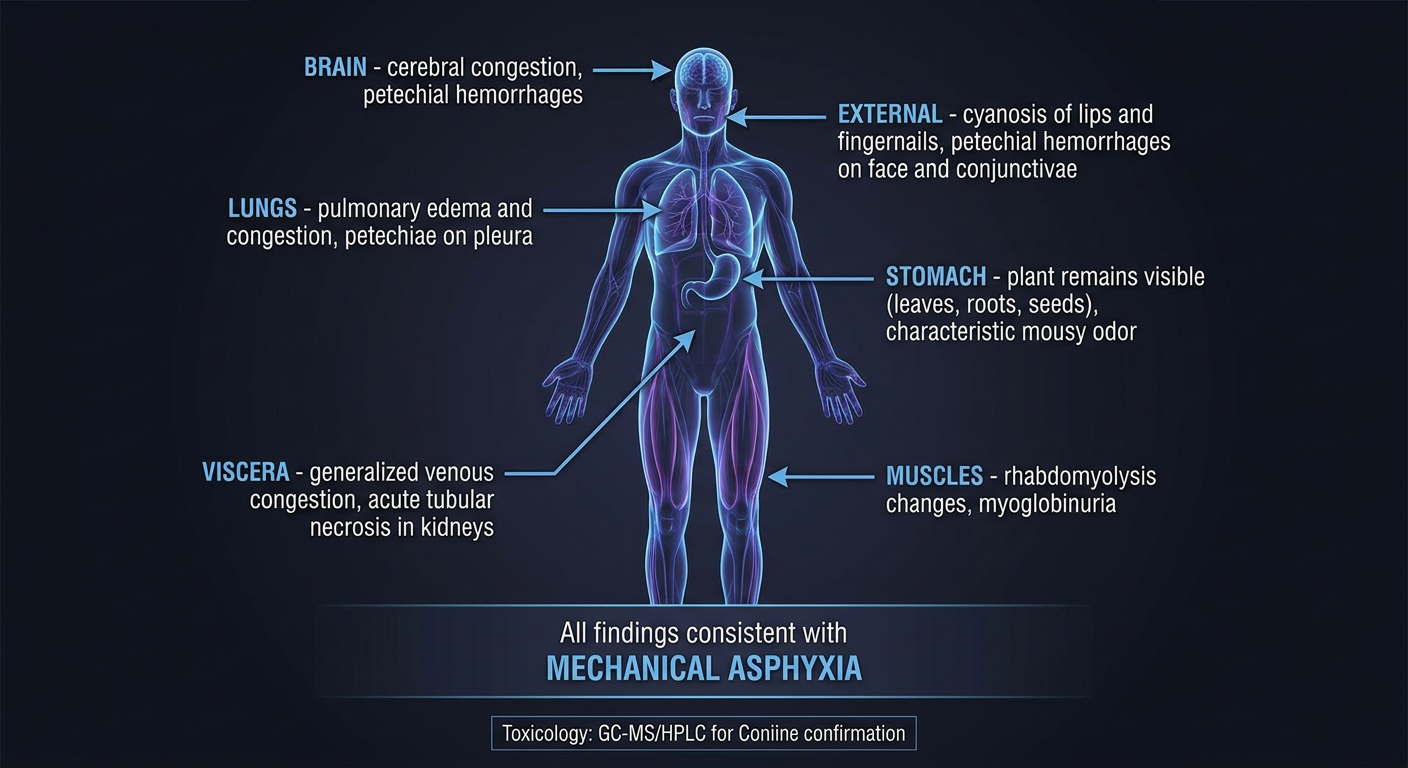
| Region | Findings |
|---|---|
| External | Cyanosis of lips & nails, petechial hemorrhages on face & conjunctivae |
| Lungs | Pulmonary oedema, congestion, pleural petechiae |
| Brain | Cerebral congestion, petechial haemorrhages |
| Viscera | Generalised venous congestion, acute tubular necrosis (kidneys) |
| Stomach | Plant remains (leaves/roots/seeds), mousy odour |
| Muscles | Rhabdomyolysis, myoglobinuria |
| Overall | All findings = Mechanical Asphyxia picture |
| Toxicology | GC-MS / HPLC for Coniine & gamma-Coniceine confirmation |