
Cataract opthalmology notes for mbbs exam with easy mnemonics and explanation
Reading File
Now let me search the medical library for cataract content across multiple angles simultaneously.
Finding Sources
Finding Sources
Kanski's Clinical Ophthalmology is the gold standard reference. Let me read the key cataract sections in parallel.
Reading File
Reading File
Reading File
Excellent content! Let me continue reading for cataract maturity, systemic associations, congenital cataract, and management.
Reading File
Reading File
Reading File
I now have very rich content from Kanski's. Let me fetch one key clinical image showing the cataract types, and also get the management/phacoemulsification content.
Loading Image
Reading File
I now have comprehensive material from Kanski's. I have enough to write thorough MBBS exam notes with mnemonics. Let me compose the full answer now.
Cataract - Complete MBBS Ophthalmology Notes
Source: Kanski's Clinical Ophthalmology, 10th Edition
1. DEFINITION & IMPORTANCE
A cataract is any opacity of the crystalline lens. It is the commonest cause of reversible visual disability in the world, and phacoemulsification with IOL implantation is the commonest surgical procedure performed worldwide.
There is NO medical treatment to prevent or reverse cataract - surgery is the only cure.
2. ANATOMY OF THE LENS (Quick Recap)
LENS STRUCTURE - Mnemonic: "CZEG"
C - Capsule (acellular, outermost)
Z - Zonules (hold lens in position)
E - Epithelium (cuboid cells under anterior capsule)
G - Germinative zone (cells divide → lens fibers)
- Lens substance = Central nucleus + surrounding cortex
- Anterior capsule is thicker than posterior capsule
- The lens is avascular - nutrition comes from aqueous humor
3. SYMPTOMS OF CATARACT
Mnemonic: "GLCMD"
| Letter | Symptom |
|---|---|
| G | Glare (especially night driving, oncoming headlights) |
| L | Loss of contrast sensitivity |
| C | Color change (poor blue perception) |
| M | Monocular diplopia (point source of light) |
| D | Diminished visual acuity (initially correctable with glasses) |
- Symptoms worsen with miosis (bright light, near work) - especially PSC
- Symptoms develop slowly and insidiously
4. TYPES OF AGE-RELATED (SENILE) CATARACT
Mnemonic: "SPNC" (Some People Need Correction)
A. Subcapsular Cataract (Posterior > Anterior)
-
Posterior subcapsular (PSC): Granular/plaque-like opacity just in front of posterior capsule
- Appears black and vacuolated on retroillumination
- Vacuoles = Bladder (Wedl) cells - swollen migratory epithelial cells
- Worst visual impact - located at nodal point of eye
- Causes profound glare; worsened by miosis and near vision
- Classic causes: Steroids, radiation, diabetes
-
Anterior subcapsular: Fibrous metaplasia of lens epithelium
B. Nuclear Sclerotic Cataract
- Exaggeration of normal aging
- Yellowish hue due to urochrome pigment deposition
- Causes myopic shift → "Second sight of the aged" (elderly patients can read without glasses again!)
- Best assessed with oblique slit lamp beam
- Advanced: nucleus turns brown (brunescent), rarely black (black cataract)
- Red reflex preserved on retroillumination
C. Cortical Cataract
- Clefts and vacuoles between lens fibers due to cortical hydration
- Typical cuneiform (wedge-shaped) or spoke-like opacities
- Often start in inferonasal quadrant first
- Glare is a common symptom
D. Christmas Tree Cataract (uncommon)
- Polychromatic needle-like formations in deep cortex and nucleus
- Associated with myotonic dystrophy
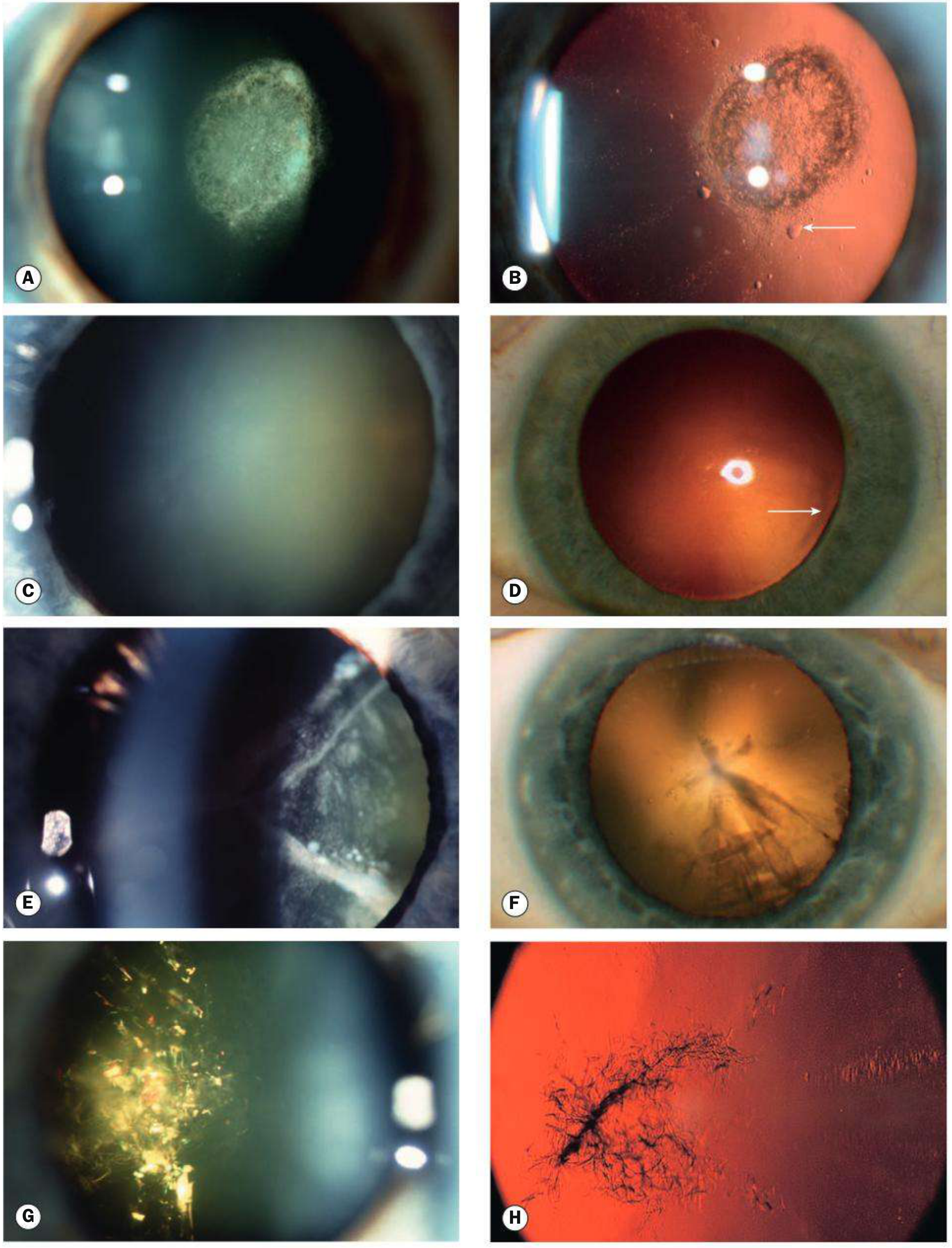
5. MATURITY STAGES OF CATARACT
Mnemonic: "I M HyM" (Immature → Mature → Hypermature → Morgagnian)
| Stage | Description | Key Feature |
|---|---|---|
| Immature | Partially opaque | Some clear areas; red reflex present |
| Mature | Completely opaque | No red reflex; white pupil (leukocoria) |
| Hypermature | Shrunken + wrinkled anterior capsule | Water leaks OUT of lens; may cause phacolytic glaucoma |
| Morgagnian | Hypermature + liquefied cortex | Nucleus sinks INFERIORLY (due to gravity) |
Phacolytic glaucoma = leaking lens proteins clog trabecular meshwork in hypermature cataract Phacomorphic glaucoma = swollen immature/intumescent cataract causes pupil block → angle closure
6. CATARACT IN SYSTEMIC DISEASES
Mnemonic: "DIABETES DIMS"
| Disease | Type of Cataract | Key Fact |
|---|---|---|
| Diabetes mellitus | Snowflake cortical (young), Nuclear sclerosis (older) | Sorbitol accumulates via aldose reductase → osmotic overhydration |
| Myotonic dystrophy | Iridescent cortical → star-shaped PSC | ~90% affected; Christmas tree pattern early |
| Hypocalcaemia (hypoparathyroidism) | Punctate/lamellar cortical | ↓Ca²⁺ disrupts lens metabolism |
| Wilson's disease | "Sunflower cataract" | Copper deposition → anterior PSC with petal pattern |
| Atopic dermatitis | Anterior/posterior subcapsular | "Shield-like" anterior subcapsular; seen in young patients |
| Steroids (systemic/topical) | Posterior subcapsular | Dose + duration dependent |
| Radiation | Posterior subcapsular | Months to years latency |
Steroid cataract = PSC - easy to remember: Steroids → PSC (same initials, reversed)
7. TRAUMATIC CATARACT
Mnemonic: "PEIBRI" (Penetrating, Electric, Infrared, Blunt, Radiation, Ionizing)
| Cause | Pattern |
|---|---|
| Penetrating trauma | Anterior capsule rupture → total opacification |
| Blunt trauma | Flower-shaped (rosette) opacity - classic exam Q |
| Electric shock / Lightning | Diffuse milky-white OR stellate subcapsular snowflakes |
| Infrared (glassblower) | True exfoliation of anterior lens capsule |
| Ionizing radiation | Posterior subcapsular; months-years latency |
Remember: Vossius ring = iron ring on anterior lens after blunt trauma (from iris pigment impact)
8. CONGENITAL CATARACT
Rule of Thirds:
1/3 - Systemic disease
1/3 - Inherited (AD most common)
1/3 - Unknown cause
- 2/3 are bilateral
- Unilateral = usually sporadic, otherwise healthy infant
Metabolic Causes - Mnemonic: "GLM"
| Condition | Inheritance | Cataract type | Key feature |
|---|---|---|---|
| Galactosaemia | AR (GALT enzyme deficiency) | Oil-droplet opacity | Develops in first weeks of life; reversible if galactose excluded early |
| Lowe syndrome (oculo-cerebro-renal) | X-linked recessive | Universal cataract + microphakia | 50% also get congenital glaucoma |
| Mannosidosis | AR (α-mannosidase deficiency) | Spoke-like posterior cortical opacities | Mental deterioration, musculoskeletal problems |
Intrauterine Infections - Mnemonic: "TORCH"
| Infection | Cataract features |
|---|---|
| Toxoplasmosis | Cataract + chorioretinitis + microphthalmos + optic atrophy |
| Rubella | Pearly nuclear OR diffuse cataract in ~15%; classic triad: deaf, cardiac, cataract |
| CMV | Cataract + chorioretinitis; systemic: jaundice, hepatosplenomegaly, microcephaly |
| Varicella | Cataract + microphthalmos + chorioretinitis |
Rubella triad: "3 C's" - Cataract, Cardiac defects (PDA), Cochlear deafness
Other Systemic Associations for Congenital Cataract:
- Down syndrome (Trisomy 21) - Brushfield spots + cataract
- Turner syndrome - cataract
- Nance-Horan syndrome - X-linked, dense cataract + dental abnormalities
- Marfan syndrome - ectopia lentis (subluxed lens, NOT cataract per se)
9. SECONDARY (COMPLICATED) CATARACT
Causes from intraocular disease:
- Uveitis (chronic) - PSC most common
- Retinitis pigmentosa - PSC
- Acute angle-closure glaucoma - glaukomflecken (white anterior subcapsular deposits)
- High myopia - nuclear cataract
- Intraocular tumors
10. INVESTIGATIONS BEFORE CATARACT SURGERY
Mnemonic: "BASK" (Basic Assessments for Surgery Kit)
- Visual acuity - Snellen chart
- IOL power calculation - A-scan biometry + keratometry (SRK/T, Holladay, Haigis formulas)
- Slit lamp examination - assess type, density, corneal endothelium
- B-scan ultrasound - if posterior pole not visible
- Specular microscopy - endothelial cell count (important if Fuchs' dystrophy suspected)
- Blood glucose - especially if diabetic
- No routine blood tests or ECG needed for local anaesthesia
Important clinical point: Cataract NEVER causes afferent pupillary defect (APD). If APD is present, there is significant posterior pole pathology (retinal/optic nerve disease).
11. SURGICAL OPTIONS
A. Phacoemulsification ("Phaco") - GOLD STANDARD
- High-frequency ultrasound probe emulsifies the lens nucleus
- Small incision (~2.2-2.8 mm), self-sealing
- IOL inserted through the same incision
- Advantages: Fast recovery, minimal astigmatism, day-case procedure
B. Small Incision Cataract Surgery (SICS)
- Manual technique; slightly larger incision (~5-7 mm)
- No ultrasound needed - used in dense/hard cataracts
- More suitable for developing world settings
C. ECCE (Extracapsular Cataract Extraction)
- Larger incision (~10-12 mm), requires sutures
- Used when nucleus is too hard for phaco
- Higher astigmatism, longer recovery
D. ICCE (Intracapsular Cataract Extraction) - HISTORICAL
- Entire lens + capsule removed
- No longer routinely performed
- Risk of vitreous prolapse; aphakia requires thick "pebble" glasses
Preferred order for MBBS: Phaco > SICS > ECCE > ICCE
12. INTRAOCULAR LENSES (IOL)
Types - Mnemonic: "MAPP"
| Type | Notes |
|---|---|
| Monofocal | Single focus (usually distance); patient needs reading glasses |
| Accommodating | Shifts position with ciliary muscle contraction |
| Premium/Multifocal | Multiple focal points; reduces spectacle dependence |
| Phakia (PCIOL vs ACIOL) | Posterior chamber IOL (PCIOL) is standard; ACIOL used when capsule inadequate |
- Standard IOL material: Hydrophobic/hydrophilic acrylic
- Power calculated using: A-scan + keratometry
13. COMPLICATIONS
Intraoperative:
- Posterior capsule rupture (PCR) - most common serious complication
- Vitreous loss
- Zonular dialysis
- Suprachoroidal hemorrhage (expulsive hemorrhage - rare, catastrophic)
- IFIS (Intraoperative Floppy Iris Syndrome) - due to tamsulosin (alpha-blocker)
Postoperative - Early:
- Endophthalmitis (most feared) - causative organism: Staphylococcus epidermidis (commonest)
- Corneal edema
- Raised IOP (steroid response or retained viscoelastic)
- Uveitis
- Wound leak
Postoperative - Late:
- Posterior Capsule Opacification (PCO) - COMMONEST late complication
- "After-cataract" or secondary cataract
- Caused by residual lens epithelial cells (Elschnig's pearls)
- Treatment: Nd:YAG laser capsulotomy
- Cystoid Macular Edema (CME) - Irvine-Gass syndrome
- Retinal detachment (especially in myopes)
- Glaucoma
- IOL dislocation
Mnemonic for late complications: "PCO GRIM" P-osterior capsule opacification, C-ME, O-cular hypertension, G-laucoma, R-etinal detachment, I-OL problems, M-acular degeneration unmasked
14. SPECIAL SITUATIONS
Intraoperative Floppy Iris Syndrome (IFIS):
- Caused by alpha-1A blockers (tamsulosin most common, used for BPH)
- Triad: billowing iris, iris prolapse through wounds, progressive intraoperative miosis
- Risk persists even if drug stopped; surgeon must be warned preoperatively
Phacolytic Glaucoma (Open angle):
- Hypermature cataract leaks high MW lens proteins
- Proteins clog trabecular meshwork → raised IOP
- Treatment: urgent lens extraction
Phacomorphic Glaucoma (Closed angle):
- Intumescent (swollen) cataract → pupil block → angle closure
- Treatment: urgent lens extraction + glaucoma treatment
15. QUICK SUMMARY TABLE FOR MCQs
| Feature | Answer |
|---|---|
| Commonest cause of preventable blindness worldwide | Cataract |
| Second sight of the aged | Nuclear sclerotic cataract (myopic shift) |
| Worst visual effect for its size | Posterior subcapsular (PSC) |
| Morgagnian cataract | Nucleus sinks inferiorly in liquefied cortex |
| Glaukomflecken | Acute angle closure → anterior subcapsular deposits |
| Snowflake cataract | Juvenile diabetic cataract |
| Sunflower cataract | Wilson's disease |
| Oil-droplet cataract | Galactosaemia |
| Flower/rosette cataract | Blunt trauma |
| Congenital cataract + deafness + heart | Rubella (TORCH) |
| Alpha-blocker + surgery risk | Tamsulosin → IFIS |
| Commonest late complication | PCO (posterior capsule opacification) |
| Treatment of PCO | Nd:YAG laser capsulotomy |
| Endophthalmitis organism | S. epidermidis (commonest) |
| No APD in cataract | Cataract never causes APD - posterior pathology if present |
16. HIGH-YIELD MNEMONICS SUMMARY
| Mnemonic | What it covers |
|---|---|
| GLCMD | Symptoms (Glare, Loss of contrast, Color, Monocular diplopia, Diminished VA) |
| I M HyM | Maturity stages |
| SPNC | Age-related types (Subcapsular, Posterior, Nuclear, Cortical) |
| TORCH | Congenital cataract infections |
| GLM | Congenital metabolic (Galactosaemia, Lowe, Mannosidosis) |
| 3 C's of Rubella | Cataract, Cardiac, Cochlear |
| PCO GRIM | Late post-op complications |
| Steroids → PSC | Steroid cataract type |
| Blunt → Rosette | Blunt trauma cataract shape |
| Nucleus sinks | Morgagnian = hypermature + liquefied cortex |
References: Kanski's Clinical Ophthalmology: A Systematic Approach, 10th Edition - Chapter 10 (The Lens)
This is a shared conversation. Sign in to Orris to start your own chat.