
CDC classification of wound
Reading File
Searching the Web
CDC wound classification surgical site infection categories
Finding Sources
Reading File
Reading File
Here is the complete CDC classification of wounds (also used by NHSN/NSQIP):
CDC Surgical Wound Classification
Originally established in 1964 and refined by the CDC, this system stratifies operative wound contamination into 4 classes based on the degree of microbial contamination at the time of surgery. It is used to predict SSI risk and guide antibiotic prophylaxis decisions.
Class I - Clean
- Uninfected operative wound with no inflammation
- No entry into the respiratory, alimentary, genital, or urinary tracts
- No break in sterile technique
- Wound is closed primarily; if drained, closed drainage is used
- SSI risk: ~1-5%
- Examples: hernia repair, thyroid surgery, mastectomy, orthopedic joint replacement
Class II - Clean-Contaminated
- The respiratory, alimentary, genital, or urinary tract is entered under controlled conditions without unusual contamination
- Operations involving the biliary tract, appendix, vagina, and oropharynx are included - provided no evidence of infection or major break in technique is encountered
- SSI risk: ~3-11%
- Examples: elective colorectal surgery, cholecystectomy, hysterectomy, gastrectomy
Class III - Contaminated
- Fresh, open, accidental wounds
- Operations with a major break in sterile technique or gross spillage/leakage from the GI tract into the wound
- Incisions in which there is acute, non-purulent inflammation (including necrotic tissue without purulent drainage)
- SSI risk: ~10-17%
- Examples: penetrating abdominal trauma (<4 hours), Crohn's disease with fistula, ruptured appendix without abscess
Class IV - Dirty or Infected
- Old traumatic wounds with retained devitalized tissue
- Wounds involving existing clinical infection or perforated viscera
- Preexisting bacteria are present in the operative field before surgery
- SSI risk: >27%
- Examples: ruptured appendix with abscess, fecal peritonitis, perforated colon with soilage
SSI Risk Summary
| Class | Description | SSI Risk |
|---|---|---|
| I | Clean | 1-5% |
| II | Clean-Contaminated | 3-11% |
| III | Contaminated | 10-17% |
| IV | Dirty/Infected | >27% |
Clinical Relevance
Antibiotic prophylaxis: Recommended for Class II (clean-contaminated) and Class III (contaminated). For Class I, prophylaxis is warranted only when SSI consequences would be severe (e.g., prosthetic implant placement) or when patient risk factors are high.
NNIS Risk Index: The CDC's National Nosocomial Infections Surveillance System further refined SSI prediction by adding two variables to wound class:
- ASA score ≥ 3
- Operative duration > 75th percentile for that procedure type
SSI rates increase significantly with each additional risk factor, regardless of wound class.
~70-95% of SSIs are caused by the patient's own endogenous flora, highlighting the importance of skin prep and antimicrobial selection tailored to expected organisms.
- Sabiston Textbook of Surgery, Table 25.4
- Fischer's Mastery of Surgery, Table 9.3 (NHSN Criteria)
Enumerate the various surgical complication of leprosy and outline their management
Finding Sources
Finding Sources
Searching the Web
surgical complications of leprosy management deformity nerve abscess
Reading File
Reading File
Reading File
Finding Sources
Reading File
Reading File
Reading File
Loading Image
Loading Image
I now have a comprehensive picture from Bailey and Love. Let me now compile the complete, well-structured response.
Surgical Complications of Leprosy and Their Management
Leprosy (Mycobacterium leprae) produces two broad classes of deformity: primary (directly caused by the bacillus or its reactions) and secondary (resulting from the sequelae of anaesthesia, e.g. repeated unnoticed trauma). The surgical complications arise primarily from peripheral nerve destruction and can be grouped systematically below.
I. Nerve-Related Deformities of the Upper Limb
1. Claw Hand
- Mechanism: Ulnar nerve involvement at the elbow causes paralysis of the intrinsic hand muscles (lumbricals, interossei, hypothenar muscles) with sparing of the long flexors → classic "claw hand" (hyperextension at MCP joints, flexion at IP joints). Median nerve involvement at the wrist adds thenar wasting and weakens opposition.
- Management:
- Conservative: Physiotherapy, splinting to prevent fixed contracture
- Surgical: Tendon transfer procedures (e.g., flexor digitorum superficialis tenodesis, lumbrical replacement using FDS slips - "Brand's procedure") to restore intrinsic function and correct clawing. Requires a hand surgeon with expertise in tendon transfer.
2. Burns and Injuries from Anaesthetic Hands
- Mechanism: Anaesthesia of hands (from ulnar + median nerve damage) makes patients unable to detect pain from heat or sharp objects, leading to recurrent burns, cuts, and secondary infection.
- Management:
- Patient education about protective behaviour
- Wound care and treatment of secondary infections
- Reconstructive surgery for established deformity
II. Nerve-Related Deformities of the Lower Limb
3. Claw Toes
- Mechanism: Involvement of the posterior tibial nerve causes paralysis of intrinsic foot muscles, resulting in clawing of the toes.
- Management:
- Appropriate footwear and protective padding
- Tendon transfer if function is significantly impaired
- Orthopaedic correction of fixed deformity
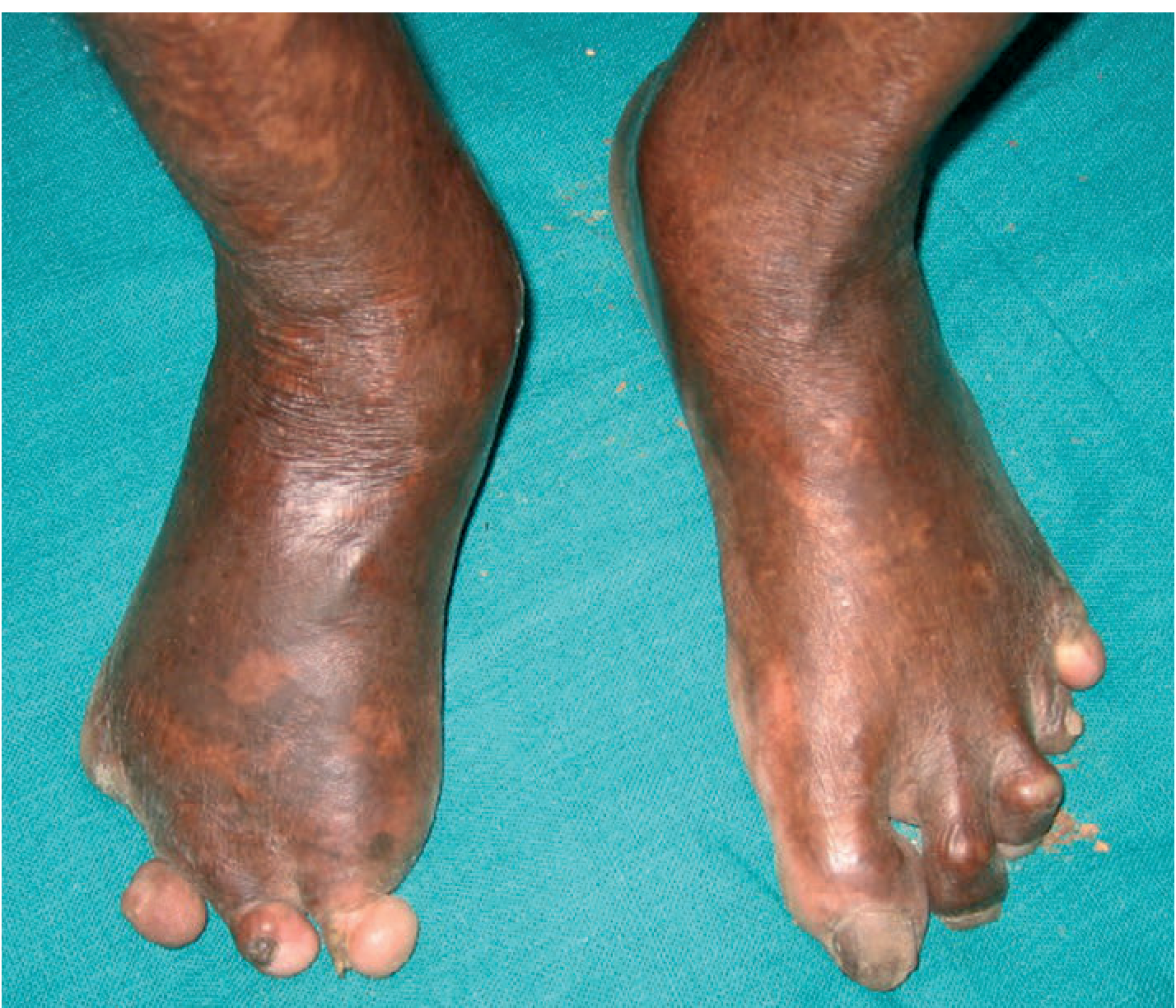
4. Foot Drop
- Mechanism: Involvement of the lateral popliteal (common peroneal) nerve at the upper fibula head leads to weakness of dorsiflexion and eversion, causing foot drop. The nerve is palpably thickened at this site.
- Management:
- Conservative: Foot drop splint (ankle-foot orthosis)
- Surgical: If splinting is inadequate, tendon transfer - tibialis posterior tendon rerouted into the dorsum of the foot to restore dorsiflexion
5. Trophic / Plantar Ulcers
- Mechanism: Anaesthesia of the sole (posterior tibial nerve) prevents detection of pressure and trauma, leading to recurrent, deep, chronic plantar ulcers. These progress to chronic infection, osteomyelitis, and soft tissue contraction.
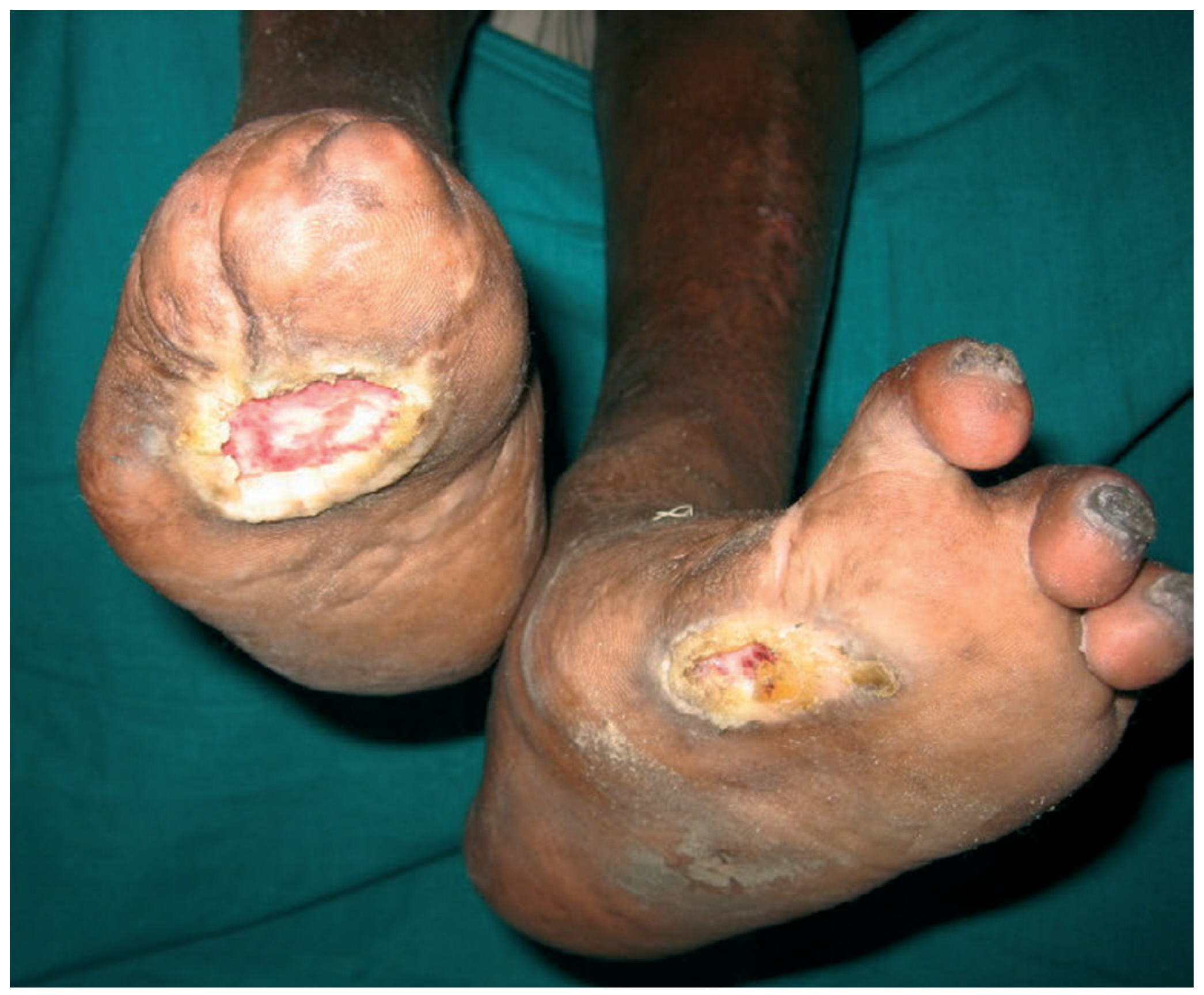
- Management:
- Complete surgical debridement of the ulcer
- Offloading with a total contact plaster cast
- Treatment of underlying infection (antibiotics)
- Education: protective footwear, regular foot inspection
- Skin grafting for large wounds post-debridement
6. Autoamputation of Digits
- Mechanism: Repeated trauma, infection, and ischaemia to insensate digits lead to progressive resorption and eventual autoamputation of fingers or toes.
- Management:
- Prevention is key - protective footwear, patient education
- Formal surgical amputation when spontaneous autoamputation is incomplete or infection is uncontrolled
- Prosthetic rehabilitation
III. Facial and Ocular Complications
7. Lagophthalmos (Inability to Close the Eye)
- Mechanism: Leprosy affects the facial nerve (zygomatic branch) as it exits the stylomastoid foramen, causing paralysis of orbicularis oculi. This results in incomplete eye closure (lagophthalmos), exposure keratitis, epiphora, and conjunctivitis - potentially leading to blindness.
- Management:
- Lubricating eye drops and taping the eye closed at night
- Surgical: Tarsorrhaphy (partial/lateral) to narrow the palpebral fissure, or gold weight implantation in the upper eyelid to assist closure
- Treatment of keratitis
8. Nasal Deformity / Saddle-Nose
- Mechanism: Destruction of the lateral cartilages and septum of the nose leads to collapse of the nasal bridge with lifting of the nasal tip.
- Management:
- Reconstructive rhinoplasty (cartilage/bone graft to nasal bridge) once disease is controlled on MDT
9. Loss of Eyebrows (Madarosis)
- Primarily a cosmetic problem; can be addressed by eyebrow reconstruction using hair transplant techniques if desired.
IV. Deep Tissue and Systemic Complications
10. Nerve Abscess
- Mechanism: Acute inflammatory reaction within an involved nerve (particularly ulnar, median, lateral popliteal) may lead to caseation and abscess formation within the nerve sheath.
- Management:
- First-line: High-dose corticosteroids may resolve early cases
- Surgical indication: Failure to respond to steroids, progressive neurological loss, or a tense fluctuant abscess requiring incision and drainage (nerve decompression with drainage of pus)
11. Nerve Decompression (for Acute Neuropathy)
- When acute leprosy reactions cause rapid nerve swelling and function loss, surgical external neurolysis/decompression at the tunnel/canal can be performed to prevent permanent paralysis.
12. Testicular Atrophy and Gynaecomastia
- Mechanism: In lepromatous leprosy, the testes are directly invaded by bacilli (a cooler body part), causing orchitis and atrophy, which results in low testosterone and secondary gynaecomastia.
- Management:
- Antileprosy MDT to control the primary disease
- Gynaecomastia: surgical correction (subcutaneous mastectomy) if causing significant distress after disease control
13. Amputation (Advanced Disease)
- When deformity is so advanced that the limb is functionless or chronically infected with uncontrollable osteomyelitis, the general surgeon may be required to perform amputation as an emergency or elective procedure.
V. Summary of Surgical Procedures Used
| Complication | Surgical Procedure |
|---|---|
| Claw hand | Tendon transfer (Brand's FDS procedure) |
| Foot drop | Tibialis posterior transfer to dorsum |
| Plantar ulcer | Debridement + total contact casting |
| Lagophthalmos | Tarsorrhaphy / gold weight implant |
| Nasal collapse | Reconstructive rhinoplasty |
| Nerve abscess | Incision and drainage / neurolysis |
| Advanced deformity/infection | Amputation |
| Gynaecomastia | Subcutaneous mastectomy |
Key Principles of Management
- All surgery must be performed under active antileprosy MDT (rifampicin, dapsone, clofazimine for multibacillary disease).
- Team approach: Hand surgeon + orthopaedic surgeon + plastic surgeon + ophthalmologist, all working together.
- Corticosteroids are used to manage acute lepra reactions causing rapid nerve damage; surgery is reserved for complications not responding to steroids.
- Patient education is the cornerstone of prevention - teaching patients about protective behaviour for insensate limbs, regular foot inspection, and avoiding burns.
- Physiotherapy and rehabilitation before and after surgery optimise outcomes.
- Bailey and Love's Short Practice of Surgery, 28th Edition, Chapter 6
This is a shared conversation. Sign in to Orris to start your own chat.