
Respiration mechanism in detail with flowcharts and simple explanation
Reading File
Now let me search the medical library and web in parallel for detailed respiration content.
Finding Sources
Finding Sources
Searching the Web
respiration mechanism overview cellular respiration steps flowchart
Finding Sources
Finding Sources
Finding Sources
Reading File
Reading File
Finding Sources
Reading File
Reading File
Excellent! I now have rich content from Guyton & Hall Physiology and Basic Medical Biochemistry. Let me fetch the key diagrams and get more content on ETC and pulmonary respiration.
Loading Image
Loading Image
Loading Image
I now have excellent textbook images. Let me also get the Guyton content on oxidative phosphorylation details and get a pulmonary respiration section.
Reading File
Finding Sources
I have excellent, comprehensive information now. Let me compile the full, detailed answer with all the diagrams.
Respiration: A Complete Explanation with Flowcharts
Respiration is the process by which living cells break down glucose (and other fuels) to release energy stored as ATP. There are two levels to understand:
- Pulmonary (External) Respiration - breathing in O2 and breathing out CO2
- Cellular (Internal) Respiration - using O2 inside cells to burn glucose for ATP
OVERVIEW FLOWCHART
FOOD (Glucose, C6H12O6)
         |
         ▼
┌─────────────────────┐
│    GLYCOLYSIS        │  ← Cytoplasm (no O2 needed)
│  Glucose → 2 Pyruvate│
│  Net: 2 ATP + 2 NADH │
└─────────┬───────────┘
          │
     [O2 available?]
    /              \
  YES               NO
  |                 |
  ▼                 ▼
PYRUVATE         FERMENTATION
OXIDATION        (Lactic acid / Ethanol)
  |              Only 2 ATP total
  ▼
┌─────────────────────┐
│  KREBS CYCLE         │  ← Mitochondrial matrix
│  2 Acetyl-CoA →      │
│  CO2 + 2 ATP         │
│  + NADH + FADH2      │
└─────────┬───────────┘
          ▼
┌─────────────────────┐
│ ELECTRON TRANSPORT   │  ← Inner mitochondrial membrane
│ CHAIN + OXIDATIVE    │
│ PHOSPHORYLATION      │
│ 30-32 ATP produced   │
│ H2O formed, O2 used  │
└─────────────────────┘

TOTAL: ~36-38 ATP per glucose molecule
STAGE 1: GLYCOLYSIS
Where: Cytoplasm (cytosol) of every cell
Oxygen needed: No (anaerobic)
Simple explanation: Glucose (6-carbon) is split into two 3-carbon pyruvate molecules while capturing a small amount of energy.
Two Phases:
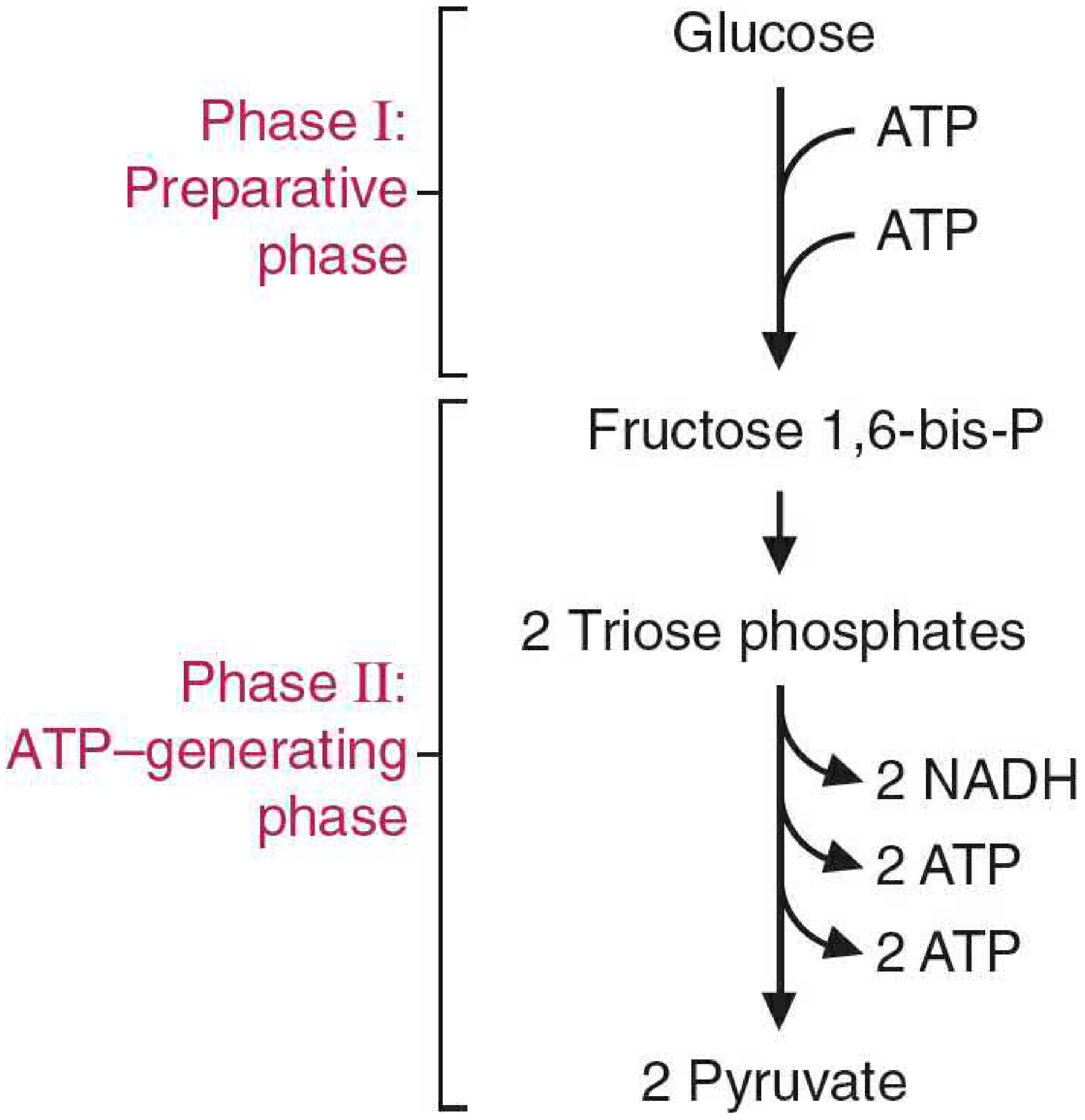
Figure: Phases of the glycolytic pathway (Basic Medical Biochemistry, 6e)
Phase I - Preparative ("Investment") Phase:
- Glucose is phosphorylated twice using 2 ATP
- Forms Fructose 1,6-bisphosphate (primes the pump)
- This 6-carbon molecule is split into 2 triose phosphates (3-carbon each)
Phase II - ATP-Generating Phase:
- Each triose phosphate is oxidized by NAD+ and phosphorylated
- Energy released generates 4 ATP and 2 NADH
Net yield per glucose:
| Product | Amount |
|---|---|
| ATP (net) | 2 |
| NADH | 2 |
| Pyruvate | 2 |
"Glycolysis is one of the principal pathways for generating ATP in cells and is present in all cell types. The central role of glycolysis in fuel metabolism is related to its ability to generate ATP with, and without, oxygen." - Basic Medical Biochemistry, 6e
STAGE 2: PYRUVATE OXIDATION (Bridge Reaction)
Where: Mitochondrial matrix
Simple explanation: Pyruvate enters the mitochondria and is converted to Acetyl-CoA, releasing one CO2 per pyruvate.
Pyruvate (3C) + CoA + NAD+
         |
         ▼  (Pyruvate dehydrogenase complex)
Acetyl-CoA (2C) + CO2 + NADH
- Happens twice (one for each pyruvate from glycolysis)
- Yields: 2 Acetyl-CoA + 2 CO2 + 2 NADH
STAGE 3: CITRIC ACID CYCLE (Krebs Cycle / TCA Cycle)
Where: Mitochondrial matrix
Simple explanation: The 2-carbon Acetyl group from Acetyl-CoA enters a cycle that spins twice per glucose, releasing CO2 and hydrogen atoms (captured as NADH/FADH2) for use in the next stage.
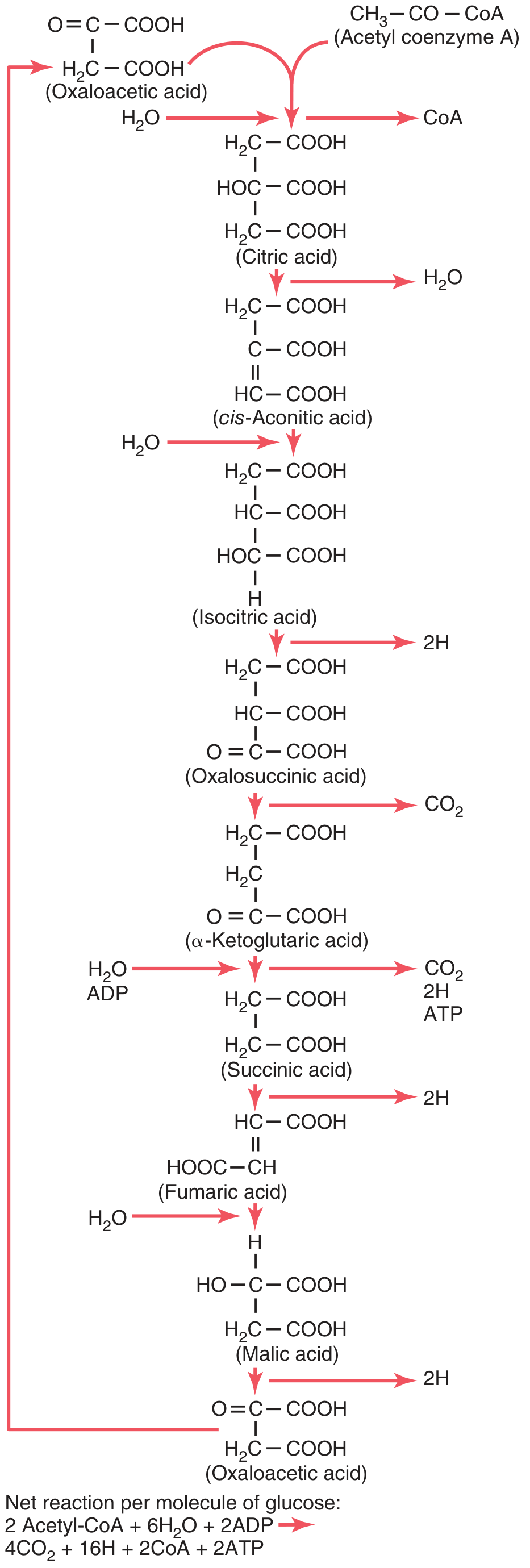
Figure: Chemical reactions of the Citric Acid Cycle (Guyton & Hall, Medical Physiology)
Step-by-step (per turn of the cycle):
- Acetyl-CoA (2C) + Oxaloacetate (4C) → Citrate (6C)
- Citrate → cis-Aconitate → Isocitrate
- Isocitrate → Oxalosuccinate → α-Ketoglutarate (releases CO2 + NADH)
- α-Ketoglutarate → Succinyl-CoA (releases CO2 + NADH)
- Succinyl-CoA → Succinate (releases 1 ATP via GTP)
- Succinate → Fumarate (releases FADH2)
- Fumarate → Malate (adds H2O)
- Malate → Oxaloacetate (releases NADH) - cycle restarts
Net yield per glucose (cycle runs twice):
| Product | Amount |
|---|---|
| ATP | 2 |
| NADH | 6 |
| FADH2 | 2 |
| CO2 | 4 |
"The net results of the entire citric acid cycle are demonstrated for each molecule of glucose: 2 acetyl-CoA molecules enter with 6 water molecules and are degraded into 4 CO2 molecules, 16 hydrogen atoms, and 2 coenzyme A. Two ATP are formed." - Guyton & Hall Medical Physiology
STAGE 4: ELECTRON TRANSPORT CHAIN (ETC) + OXIDATIVE PHOSPHORYLATION
Where: Inner mitochondrial membrane
Oxygen needed: YES (aerobic) - O2 is the final electron acceptor
Simple explanation: NADH and FADH2 donate electrons down a chain of proteins. The energy released pumps H+ ions across the membrane, which then flow back through ATP synthase - like water turning a turbine - generating huge amounts of ATP.
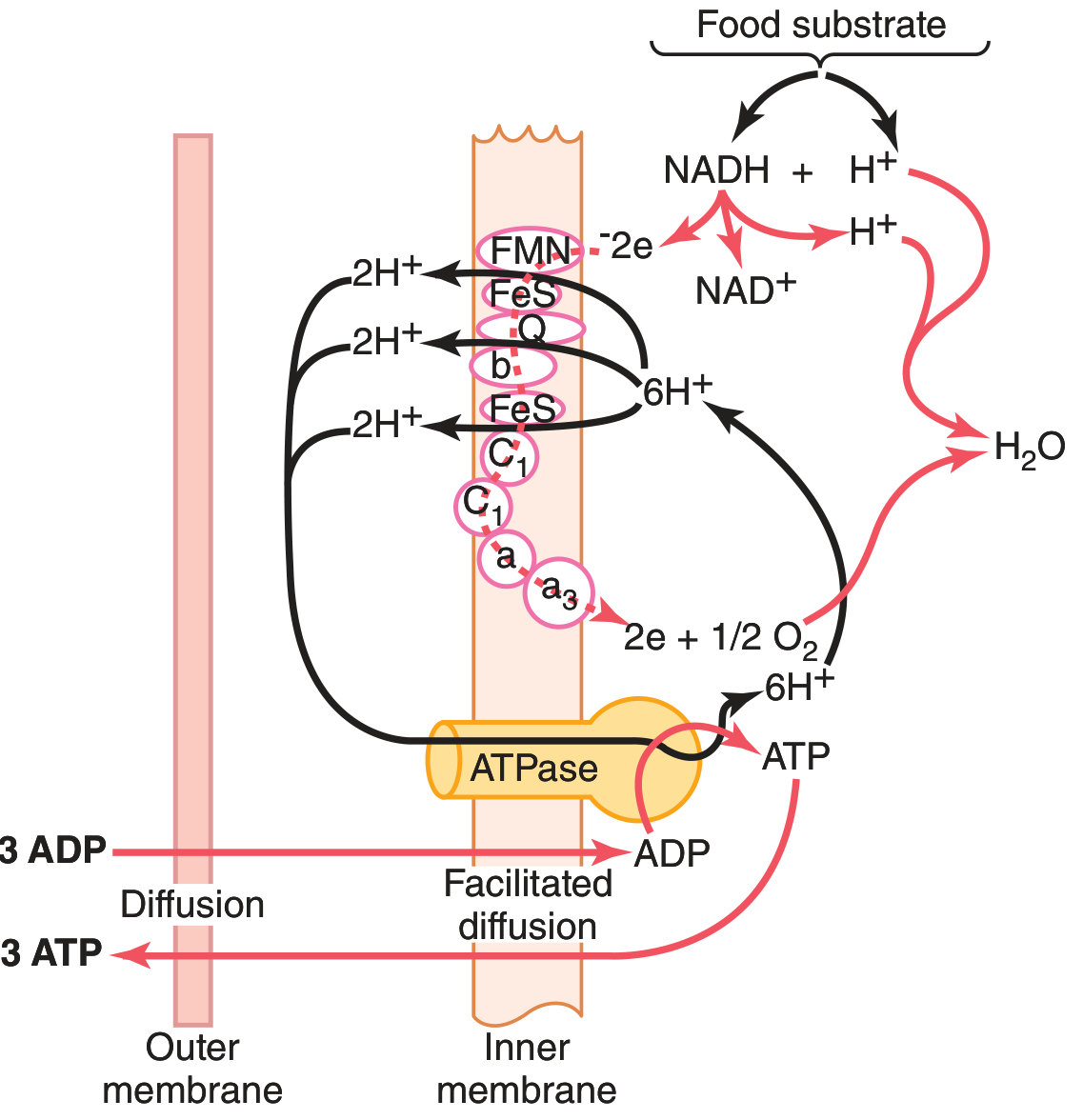
Figure: Mitochondrial chemiosmotic mechanism of oxidative phosphorylation (Guyton & Hall, Medical Physiology)
How it Works (Chemiosmotic Mechanism):
NADH / FADH2
     |
     ▼ (donate electrons)
ELECTRON TRANSPORT CHAIN
  Complex I  →  FMN → FeS proteins
  Complex II →  FADH2 enters here
  Complex III → Ubiquinone (Q) → Cytochrome b → FeS → Cytochrome c1 → c
  Complex IV  → Cytochrome a → a3 (Cytochrome Oxidase)
                         |
                         ▼
               2e + ½ O2 + 2H+ → H2O  ← O2 is CONSUMED HERE

PROTON GRADIENT:
  H+ pumped OUT of matrix → into intermembrane space
  H+ flows back IN through ATP Synthase (Complex V)
  Energy from H+ flow → ADP + Pi → ATP  (3 ATP per NADH, ~2 per FADH2)
Key chain members:
- Flavoprotein (FMN) - receives electrons from NADH
- Iron-Sulfur proteins (FeS) - pass electrons along
- Ubiquinone (CoQ) - mobile carrier
- Cytochromes b, c1, c, a, a3 - shuttle electrons
- Cytochrome oxidase (a3) - reacts with O2 to form water
- ATP Synthase - uses proton gradient to make ATP
"The electrons that are removed from the hydrogen atoms immediately enter an electron transport chain of electron acceptors that are an integral part of the inner membrane of the mitochondrion... Each electron is shuttled from one acceptor to the next until it finally reaches cytochrome A3, which reduces elemental oxygen to form ionic oxygen, which combines with hydrogen ions to form water." - Guyton & Hall Medical Physiology
TOTAL ATP YIELD SUMMARY
| Stage | ATP Produced | NADH | FADH2 | ATP via ETC |
|---|---|---|---|---|
| Glycolysis | 2 (direct) | 2 | 0 | ~5 |
| Pyruvate Oxidation | 0 | 2 | 0 | ~5 |
| Krebs Cycle | 2 (direct) | 6 | 2 | ~20 |
| Total | ~36-38 ATP |
ANAEROBIC RESPIRATION (When O2 is Absent)
If oxygen is unavailable, cells cannot run the ETC. To keep glycolysis going (which requires NAD+), pyruvate is reduced instead:
Pyruvate + NADH
     |
     ▼ (Lactate dehydrogenase)
LACTATE + NAD+   ← in animal/human muscle cells

OR

Pyruvate → Acetaldehyde + CO2
Acetaldehyde + NADH → Ethanol + NAD+  ← in yeast
- Yield: Only 2 ATP per glucose
- Lactic acid buildup causes muscle fatigue/burning
- This is why you get sore after intense exercise
PULMONARY RESPIRATION (The Breathing Mechanism)
Cellular respiration needs O2 delivered and CO2 removed. This is the job of the lungs:
INHALATION:
  Diaphragm contracts → chest cavity expands
  Lung volume ↑ → pressure ↓ (Boyle's Law)
  Air flows IN: O2 reaches alveoli

GAS EXCHANGE (at alveoli):
  O2 diffuses: alveoli → blood (PO2 gradient)
  CO2 diffuses: blood → alveoli (PCO2 gradient)

EXHALATION:
  Diaphragm relaxes → chest cavity shrinks
  Lung volume ↓ → pressure ↑
  Air flows OUT: CO2 expelled

O2 TRANSPORT in blood:
  O2 binds Hemoglobin (Hb) → Oxyhemoglobin (HbO2)
  Delivered to tissues

CO2 TRANSPORT:
  ~70% as bicarbonate (HCO3-) in plasma
  ~23% bound to Hb
  ~7% dissolved in plasma
COMPLETE SUMMARY FLOWCHART
O2 (inhaled) ────────────────────────────────────────┐
                                                      ▼
GLUCOSE → [GLYCOLYSIS] → Pyruvate → [BRIDGE] → Acetyl-CoA
           Cytoplasm       (net 2 ATP)  Mitochondria     |
                                                         ▼
                                               [KREBS CYCLE]
                                                (2 ATP + NADH/FADH2)
                                                         |
                                                         ▼
                                               [ETC + OX. PHOS.]
                                               (~30-32 ATP + H2O)
                                                         |
CO2 (exhaled) ◄──────────────────────────────── CO2 released
Simple analogy: Think of glucose as a log of wood. Glycolysis is like splitting the log. The Krebs cycle is like burning it in a furnace. The ETC is like using the heat to run a generator. ATP is the electricity produced - the usable energy currency of the cell.
Sources:
- Guyton & Hall Textbook of Medical Physiology, Chapter 68 - Metabolism of Carbohydrates
- Basic Medical Biochemistry: A Clinical Approach, 6e, Chapter 22 - Glycolysis
This is a shared conversation. Sign in to Orris to start your own chat.