
Beta lactams
Reading File
Now let me search the medical library for comprehensive beta-lactam coverage in parallel:
Finding Sources
Finding Sources
The main source is Katzung Chapter 43. Let me read the comprehensive beta-lactam section:
Reading File
Finding Sources
Reading File
Reading File
Reading File
Reading File
Reading File
Loading Image
Reading File
Finding Sources
Reading File
Reading File
I now have comprehensive data to write a thorough answer. Let me compile everything.
Beta-Lactam Antibiotics
Beta-lactam antibiotics are the largest and most widely used class of antibiotics. They all share a four-membered beta-lactam ring as their core structural feature and share the same fundamental mechanism of action - inhibiting bacterial cell wall synthesis.
Chemistry and Structure
All beta-lactams contain the four-membered beta-lactam ring (ring B). The different classes fuse this ring with additional ring systems:
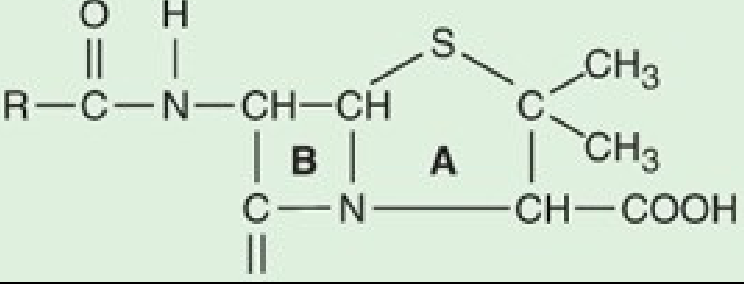
- Penicillins: beta-lactam ring + thiazolidine ring (5-membered sulfur ring). Variable R-group on the amino group creates the many different penicillins (Figure 43-1, Katzung 16e).
- Cephalosporins: beta-lactam ring + dihydrothiazine ring (6-membered ring). Derived from 7-aminocephalosporanic acid.
- Carbapenems: similar bicyclic structure but with a different stereochemical configuration in the lactam ring - this confers resistance to most common beta-lactamases.
- Monobactams: monocyclic beta-lactam ring only (no fused ring). Only aztreonam is available in the USA.
Structural integrity of the beta-lactam nucleus is essential for activity. Hydrolysis of the beta-lactam ring (by bacterial beta-lactamases) yields penicilloic acid, which lacks antibacterial activity.
Mechanism of Action
Beta-lactams inhibit bacterial growth by blocking the transpeptidation reaction in cell wall synthesis. Here is the sequence:
- The bacterial cell wall is made of peptidoglycan - a cross-linked polymer of alternating N-acetylglucosamine and N-acetylmuramic acid sugars, with pentapeptide side chains.
- Transpeptidase enzymes (also called penicillin-binding proteins, PBPs) normally remove the terminal d-alanine residue from the peptide side chain and form cross-links between adjacent chains - this cross-linking gives the wall its rigidity.
- Beta-lactams are structural analogs of the natural d-Ala-d-Ala substrate. They covalently bind to the active site of PBPs, irreversibly inhibiting the transpeptidation reaction.
- Peptidoglycan synthesis stops; bacterial autolysins continue degrading the wall and the cell dies.
Key point: Beta-lactams are bactericidal only against actively growing cells synthesizing new cell wall - they are ineffective against dormant or stationary-phase bacteria.
Classes of Beta-Lactams
1. Penicillins
| Subclass | Key Drugs | Spectrum / Notes |
|---|---|---|
| Natural penicillins | Penicillin G (IV), Penicillin V (oral) | Streptococci, meningococci, spirochetes, syphilis |
| Long-acting formulations | Benzathine penicillin, Procaine penicillin | IM; maintain levels for days-weeks; used for strep throat, syphilis |
| Antistaphylococcal | Nafcillin, Oxacillin, Dicloxacillin | Resistant to staphylococcal beta-lactamase; used for MSSA infections |
| Aminopenicillins | Ampicillin, Amoxicillin | Extended gram-negative coverage (E. coli, H. influenzae, Listeria) |
| Extended-spectrum | Piperacillin | Anti-pseudomonal activity; always used with tazobactam |
Pharmacokinetics of penicillins:
- Most are renally excreted (90% by tubular secretion); dose-adjust in renal failure.
- Normal half-life of penicillin G is ~30 minutes (up to 10 hours in renal failure).
- Food impairs absorption of most oral penicillins (amoxicillin is an exception).
- Penetration into CNS is poor normally, but adequate for meningitis treatment when inflamed meninges are present (with high IV doses).
- Nafcillin is cleared by bile, not kidneys - no dose adjustment needed in renal failure.
2. Cephalosporins (by generation)
1st generation (cefazolin IV, cephalexin PO):
- Good gram-positive (MSSA, streptococci), limited gram-negative.
- Used for: skin/soft tissue infections, UTI, surgical prophylaxis.
- Poor CNS penetration.
2nd generation (cefuroxime, cefoxitin, cefotetan):
- Improved gram-negative (H. influenzae, M. catarrhalis).
- Cefoxitin/cefotetan have anaerobic coverage (B. fragilis) - used for abdominal/pelvic infections, PID.
- Cefuroxime crosses blood-brain barrier but inferior to 3rd gen for meningitis.
3rd generation (ceftriaxone, cefotaxime, ceftazidime; oral: cefixime, cefpodoxime, cefdinir):
- Expanded gram-negative coverage including Citrobacter, Serratia, Providencia.
- Most penetrate CSF - used for meningitis.
- Ceftazidime is the only 3rd-gen agent with useful anti-Pseudomonas activity.
- Ceftriaxone: half-life 7-8 hours (once-daily dosing); used for pneumonia, meningitis, gonorrhea.
- Hydrolyzed by AmpC beta-lactamases; not reliably active against Enterobacter sp.
4th generation (cefepime):
- Extended gram-negative activity including Pseudomonas.
- Stable to AmpC beta-lactamases (can treat Enterobacter).
- Good gram-positive activity.
- Penetrates CSF; used for nosocomial pneumonia, febrile neutropenia.
5th generation (ceftaroline):
- Activity against MRSA (unique among cephalosporins).
- Used for community-acquired pneumonia, skin/soft tissue infections.
ESBL note: Strains of E. coli and Klebsiella expressing extended-spectrum beta-lactamases (ESBLs) can hydrolyze most cephalosporins - this is a growing clinical problem.
3. Carbapenems (imipenem, meropenem, ertapenem, doripenem)
- Broadest spectrum of all beta-lactams.
- Active against gram-positives, gram-negatives (including most Pseudomonas and Enterobacter), and anaerobes.
- Resistant to most beta-lactamases due to altered stereochemistry of the lactam ring.
- Imipenem is combined with cilastatin (a renal dehydropeptidase inhibitor) to prevent renal inactivation.
- Used for: severe hospital-acquired infections, polymicrobial infections, infections with ESBL-producing organisms.
- Carbapenemases (KPC, NDM, OXA-48 enzymes) represent the most serious resistance threat - can render organisms resistant to essentially all beta-lactams.
4. Monobactams (Aztreonam)
- Monocyclic beta-lactam; the only available agent.
- Spectrum limited to aerobic gram-negative bacteria only (including Pseudomonas) - no activity against gram-positives or anaerobes.
- Structurally similar to ceftazidime - potential cross-reactivity with ceftazidime allergy.
- Safe in penicillin-allergic patients (no cross-reactivity with penicillins).
- IV dosing: 1-2 g every 8 hours; penetrates CSF well.
- Half-life 1-2 hours; requires dose adjustment in renal failure.
5. Beta-Lactamase Inhibitors (BLIs)
BLIs are not antibiotics themselves (weak intrinsic activity), but they protect their partner beta-lactam from enzymatic destruction. They are always given in combination.
| Inhibitor | Type | Partner Drug | Coverage |
|---|---|---|---|
| Clavulanic acid | Traditional (Ambler class A) | Amoxicillin, ticarcillin | Class A beta-lactamases |
| Sulbactam | Traditional (class A) | Ampicillin | Class A; also direct Acinetobacter activity |
| Tazobactam | Traditional (class A) | Piperacillin | Class A; broader than clavulanate |
| Avibactam | Novel (non-beta-lactam) | Ceftazidime | Class A, C, and some class D (OXA-48) |
| Vaborbactam | Novel (non-beta-lactam) | Meropenem | Class A and C (including KPC) |
| Relebactam | Novel | Imipenem-cilastatin | Similar to avibactam |
Traditional BLIs are not effective against class C AmpC beta-lactamases produced by Enterobacter, Citrobacter, Serratia, and Pseudomonas.
Mechanisms of Resistance
Three main mechanisms (Goodman & Gilman; Katzung 16e):
-
Alteration of PBP target - reduced affinity for beta-lactams:
- MRSA acquires an additional low-affinity PBP (PBP2a, encoded by mecA) via a transposon - conferring resistance to all beta-lactams.
- Penicillin-resistant pneumococci have altered PBPs via interspecies homologous recombination.
-
Reduced concentration at the target site:
- Porin loss in gram-negative bacteria - reduced outer membrane permeability.
- Efflux pumps - actively remove the drug before it can act.
- When porin loss + efflux combine with beta-lactamase production = high-level resistance.
-
Enzymatic degradation - beta-lactamases:
- The most common and clinically important mechanism.
- Gram-positive bacteria: secrete large amounts of narrow-spectrum penicillinase (encoded on plasmids; transferable by bacteriophage).
- Gram-negative bacteria: beta-lactamases in the periplasmic space provide maximal protection.
- ESBL (extended-spectrum beta-lactamases): hydrolize most penicillins AND cephalosporins.
- Carbapenemases (KPC, NDM, OXA-48): hydrolize carbapenems too - organisms carrying these may resist virtually all beta-lactams in clinical use.
Adverse Effects
Hypersensitivity (most important)
- ~5-8% of patients report penicillin allergy, but only a small fraction have true type I hypersensitivity.
- Antigenic determinants: degradation products (penicilloic acid and alkaline hydrolysis products) bound to host proteins.
- Anaphylaxis: very rare (0.05% of recipients) but potentially fatal.
- Serum sickness: urticaria, fever, joint swelling, angioedema, occurs 7-12 days after exposure (now rare).
- Skin rashes, eosinophilia, interstitial nephritis, hemolytic anemia, vasculitis.
- Skin testing for type I hypersensitivity: negative result allows safe re-administration in most patients.
- Desensitization possible when penicillin is absolutely needed (e.g., enterococcal endocarditis, neurosyphilis).
Cephalosporin cross-reactivity
- Risk of cross-reactivity with penicillins is low (historically overestimated at ~10%; actual rate ~1-2%).
- Highest risk when the R1 side chain is identical (e.g., amoxicillin-cefadroxil, ampicillin-cefaclor).
- Aztreonam has NO cross-reactivity with penicillins but does cross-react with ceftazidime (shared R1 side chain).
Other toxicities
- Seizures: high-dose IV penicillin in renal failure.
- Nafcillin: neutropenia, interstitial nephritis.
- Oxacillin: hepatitis.
- Ampicillin/amoxicillin: maculopapular rash (especially with concurrent EBV infection).
- Piperacillin-tazobactam + vancomycin: increased risk of acute kidney injury vs. other beta-lactams combined with vancomycin.
- C. difficile colitis: all antibiotics including beta-lactams can predispose.
- Secondary candidiasis: oropharyngeal and vaginal thrush.
PK/PD Principle
Beta-lactams exhibit time-dependent killing - bactericidal effect depends on the time the free drug concentration remains above the MIC (%T>MIC), NOT on peak concentration. This drives dosing strategies such as extended infusions of carbapenems and piperacillin-tazobactam in critically ill patients.
Quick Clinical Reference
| Indication | Preferred Beta-Lactam |
|---|---|
| Strep throat, syphilis | Penicillin G / benzathine penicillin |
| MSSA skin/soft tissue | Dicloxacillin (oral), nafcillin/oxacillin (IV) |
| MRSA | None (beta-lactams ineffective; use vancomycin, linezolid) - except ceftaroline |
| Community-acquired pneumonia | Amoxicillin-clavulanate or ceftriaxone + macrolide |
| Bacterial meningitis | Ceftriaxone (cefotaxime for neonates) |
| Pseudomonal infections | Piperacillin-tazobactam, cefepime, ceftazidime, carbapenems |
| Intra-abdominal/pelvic | Piperacillin-tazobactam, ertapenem; cefoxitin/cefotetan for mild |
| ESBL-producing organisms | Carbapenems |
| KPC carbapenemase organisms | Ceftazidime-avibactam, meropenem-vaborbactam |
| Penicillin allergy (gram-neg) | Aztreonam (safe in PCN allergy) |
| Surgical prophylaxis | Cefazolin |
Sources: Katzung's Basic and Clinical Pharmacology 16e, Ch. 43; Goodman & Gilman's Pharmacological Basis of Therapeutics, Ch. 58
This is a shared conversation. Sign in to Orris to start your own chat.