
style, hordeolum, chalazion
Reading File
Finding Sources
Searching the Web
hordeolum chalazion stye clinical features treatment
Reading File
Reading File
Reading File
Reading File
Loading Image
Loading Image
Here is a comprehensive overview of these three related but distinct eyelid conditions.
Stye / Hordeolum / Chalazion
Stye (External Hordeolum)
A stye is the colloquial term for an external hordeolum — an acute bacterial infection of the follicle of an eyelash and the adjacent sebaceous glands of Zeis or sweat glands of Moll. It appears as a small pustule at the eyelid margin, visible at the lash line.
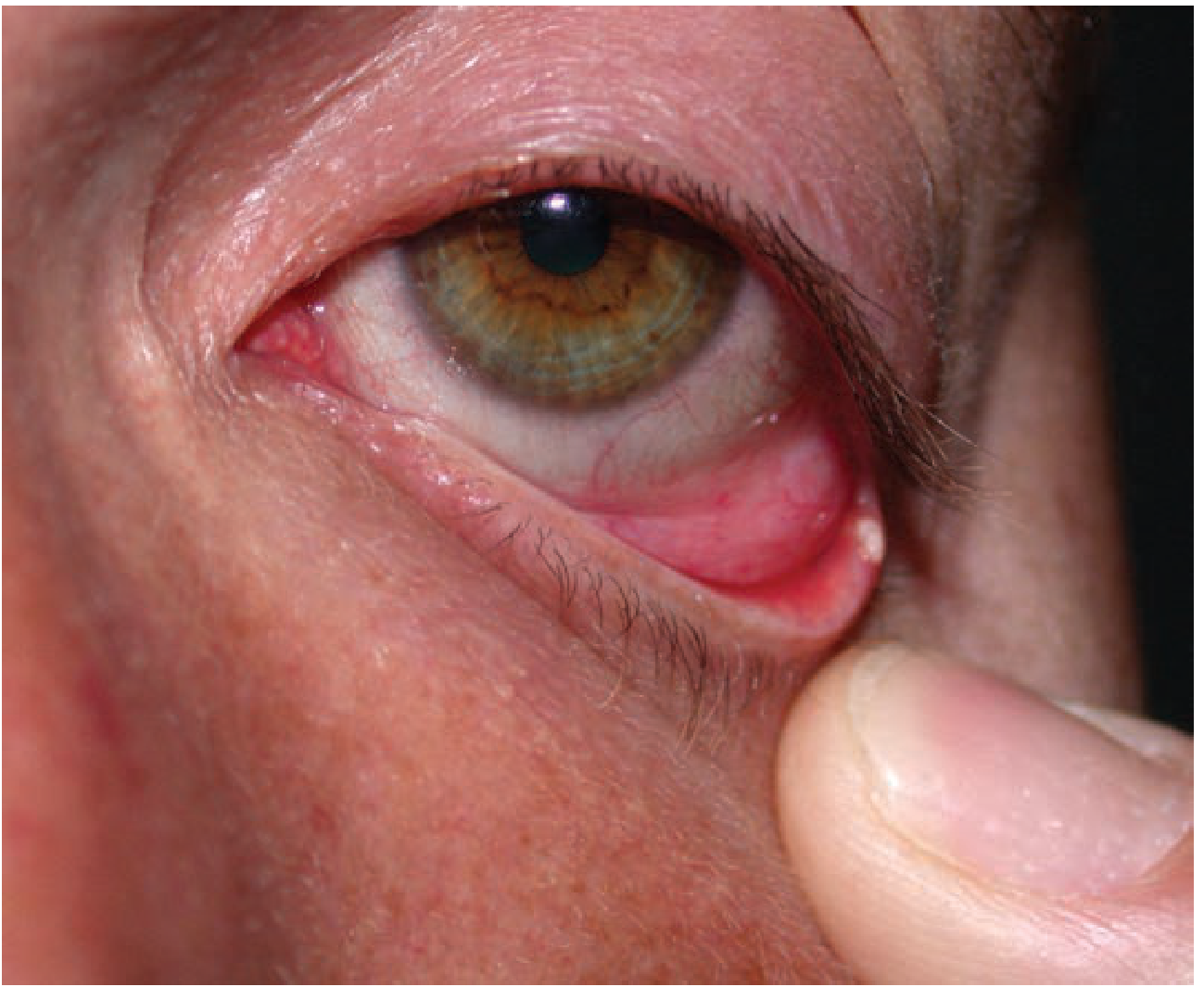
External hordeolum (lower lid stye). — Tintinalli's Emergency Medicine
Hordeolum
| Feature | External Hordeolum (Stye) | Internal Hordeolum |
|---|---|---|
| Gland involved | Glands of Zeis (sebaceous) or Moll (sweat) | Meibomian glands |
| Location | Eyelid margin, base of lash | Within tarsal plate, inner surface |
| Cause | Acute bacterial infection — usually Staphylococcus spp. | Same — Staphylococcus spp. |
| Appearance | Small pustule at margin | Pustule on inner tarsal surface |
| Pain | Painful, tender, erythematous | Painful, edema + erythema of lid |
| Risk | May evolve into preseptal cellulitis | Same |
Chalazion
A chalazion is a focal, lipogranulomatous inflammation (not infection) within the eyelid secondary to obstruction of a meibomian gland or gland of Zeis. The retained lipid-rich sebaceous material acts as a foreign body, triggering a chronic granulomatous inflammatory reaction.
Key distinctions from hordeolum:
- Usually painless (or mildly tender), non-infectious
- Presents as a firm, well-defined subcutaneous nodule — not at the lash line
- Develops gradually (subacute to chronic course)
- May be associated with blepharitis or acne rosacea
Comparison Table
| Feature | Hordeolum | Chalazion |
|---|---|---|
| Etiology | Bacterial infection (S. aureus) | Sterile lipogranulomatous inflammation |
| Onset | Acute | Subacute to chronic |
| Pain | Painful, tender | Usually painless |
| Location | Lash line (external) or tarsal plate (internal) | Within eyelid, away from margin |
| Texture | Soft, fluctuant pustule | Firm, rubbery nodule |
| Resolution | Usually self-limited, days–1 week | Weeks to months; may need intervention |
Clinical differentiation between an acute chalazion and an internal hordeolum can be impossible — treatment is the same initially. — Tintinalli's Emergency Medicine
Treatment
First-line (both conditions)
- Warm compresses ≥10 min, 4× daily with gentle massage — encourages gland drainage
Hordeolum
- Topical antibiotic ointment: bacitracin, erythromycin, or tobramycin b.i.d. × 7–14 days
- Removal of the offending eyelash may be considered
- Systemic antibiotics if surrounding cellulitis develops
- If worsening → incision & drainage (refer to ophthalmologist)
Chalazion
- Topical antibiotic/steroid combination (e.g., neomycin/polymyxin B/dexamethasone ointment) b.i.d. × 1–2 weeks
- For multiple or recurrent lesions: low-dose doxycycline 20–50 mg daily–b.i.d. (antibacterial + anti-inflammatory)
- If no resolution after 3–4 weeks:
- Intralesional corticosteroid injection (e.g., triamcinolone 40 mg/mL mixed 1:1 with 2% lidocaine with epinephrine, 0.2–1.0 mL)
- Incision and curettage (I&C)
- All excised chalazia should be sent for pathology
⚠️ Steroid injection carries a risk of permanent skin depigmentation or atrophy, especially in dark-skinned individuals. Rarely, vigorous injection can cause retrograde intra-arterial infiltration with central retinal artery occlusion. — Wills Eye Manual
Differential Diagnosis to Keep in Mind
| Condition | Clue |
|---|---|
| Preseptal cellulitis | Diffuse periorbital erythema, edema, warmth — not a localized nodule |
| Sebaceous carcinoma | Recurrent chalazia, madarosis (lash loss), chronic unilateral blepharitis in older patients — must biopsy |
| Pyogenic granuloma | Pedunculated, deep-red conjunctival lesion following chalazion, trauma, or surgery |
| Forniceal foreign body | Eyelid swelling, especially in contact lens wearers or after trauma |
A chalazion recurring in the same location should raise suspicion for underlying carcinoma (sebaceous cell carcinoma). — Goldman-Cecil Medicine
Sources: Wills Eye Manual (6.2); Tintinalli's Emergency Medicine (§241); Goldman-Cecil Medicine (§391); Pfenninger & Fowler's Procedures for Primary Care.
This is a shared conversation. Sign in to Orris to start your own chat.