
Classification of Muscles on the basis of Shape fiber and architecture
Classification of Muscles on the Basis of Shape, Fiber, and Architecture
1. Classification Based on Microscopic Appearance (Fiber Type by Striations)
A. Striated Muscle
| Subtype | Location | Control | Key Features |
|---|---|---|---|
| Skeletal Muscle | Attached to bone (axial & appendicular skeleton); also tongue, pharynx, diaphragm, upper esophagus | Voluntary | Multinucleated syncytium; peripheral nuclei; diameter 10-100 µm; used for posture, movement |
| Visceral (Striated) Muscle | Tongue, pharynx, upper esophagus, lumbar diaphragm | Voluntary | Morphologically identical to skeletal; roles in speech, swallowing, breathing |
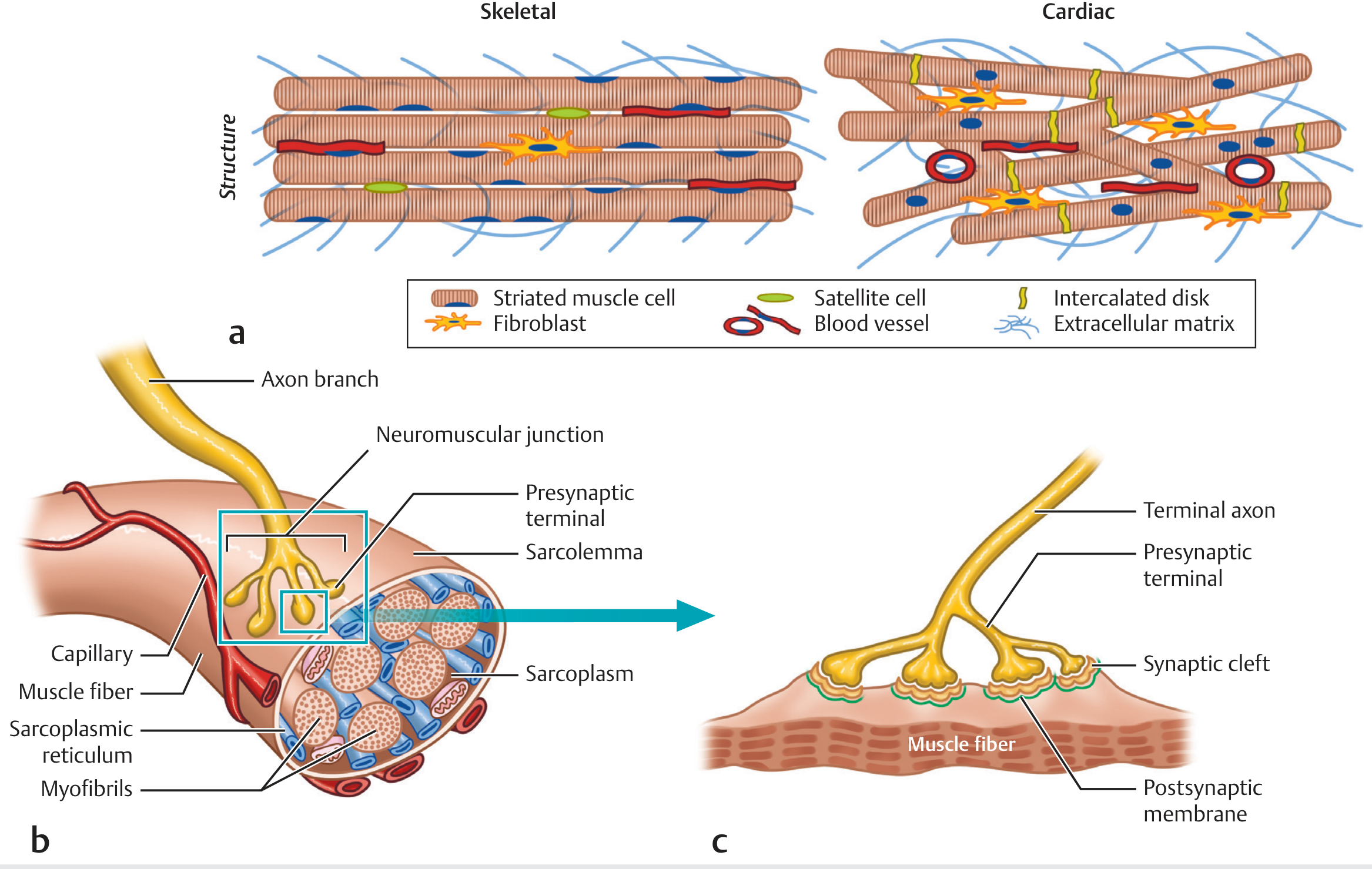
| Cardiac Muscle | Wall of heart; base of great veins | Involuntary | Branched, mono/binucleated cells; intercalated discs; rhythmic contraction |
B. Smooth Muscle
- Cells lack cross-striations because myofilaments do not achieve the same ordered arrangement.
- Myosin-containing myofilaments are highly labile.
- Found in: viscera, vascular walls, arrector pili of skin, intrinsic eye muscles.
- Histology: A Text and Atlas with Correlated Cell and Molecular Biology
2. Classification Based on Fiber Type (Metabolic/Contractile Properties)
| Property | Type I (Slow-Twitch / Red) | Type II (Fast-Twitch / White) |
|---|---|---|
| Also called | Slow oxidative (SO) | Fast glycolytic (FG) |
| Myoglobin content | High (red) | Low (white) |
| Mitochondria | Numerous | Fewer |
| Energy source | Oxidative phosphorylation | Glycogen, phosphocreatine |
| Fatiguability | Fatigue-resistant | Easily fatigable |
| Contraction speed | Slow | Fast |
| Typical location | Postural muscles (e.g., soleus) | Extremity muscles needing quick bursts (e.g., biceps) |
- Imaging Anatomy: Text and Atlas, Volume 3 - Bones, Joints, Vessels and Nerves
3. Classification Based on Shape and Gross Architecture
A. Longitudinal / Parallel Fiber Architecture
- Greater length changes
- Higher velocity of shortening
- Less force but more excursion
i. Fusiform (Spindle-shaped)
- Fibers parallel, tapering at both ends into tendons
- Wide belly, narrow at attachments
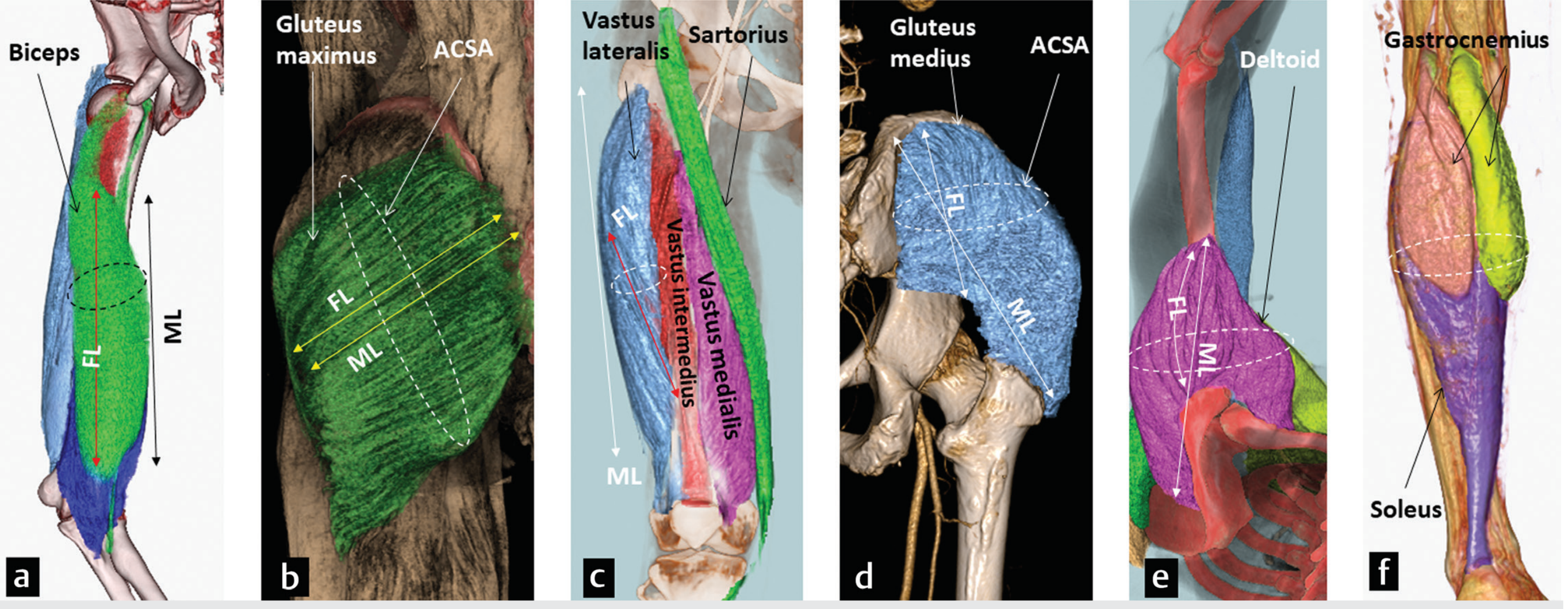
- Examples: biceps brachii, hamstrings, brachialis
ii. Strap (Straplike / Parallel-fibered)
- Long, ribbon-like muscle with parallel fibers spanning the whole length
- The longest muscles in the body; greatest excursion
- Examples: sartorius, sternohyoid, gracilis, semitendinosus
iii. Circular (Sphincteric)
- Fibers arranged in concentric rings around an opening
- Contract to close the opening
- Examples: orbicularis oculi, orbicularis oris
iv. Fan-shaped (Convergent / Triangular)
- Broad origin converging to a narrow tendon
- Fibers run at angles, allowing varied direction of pull
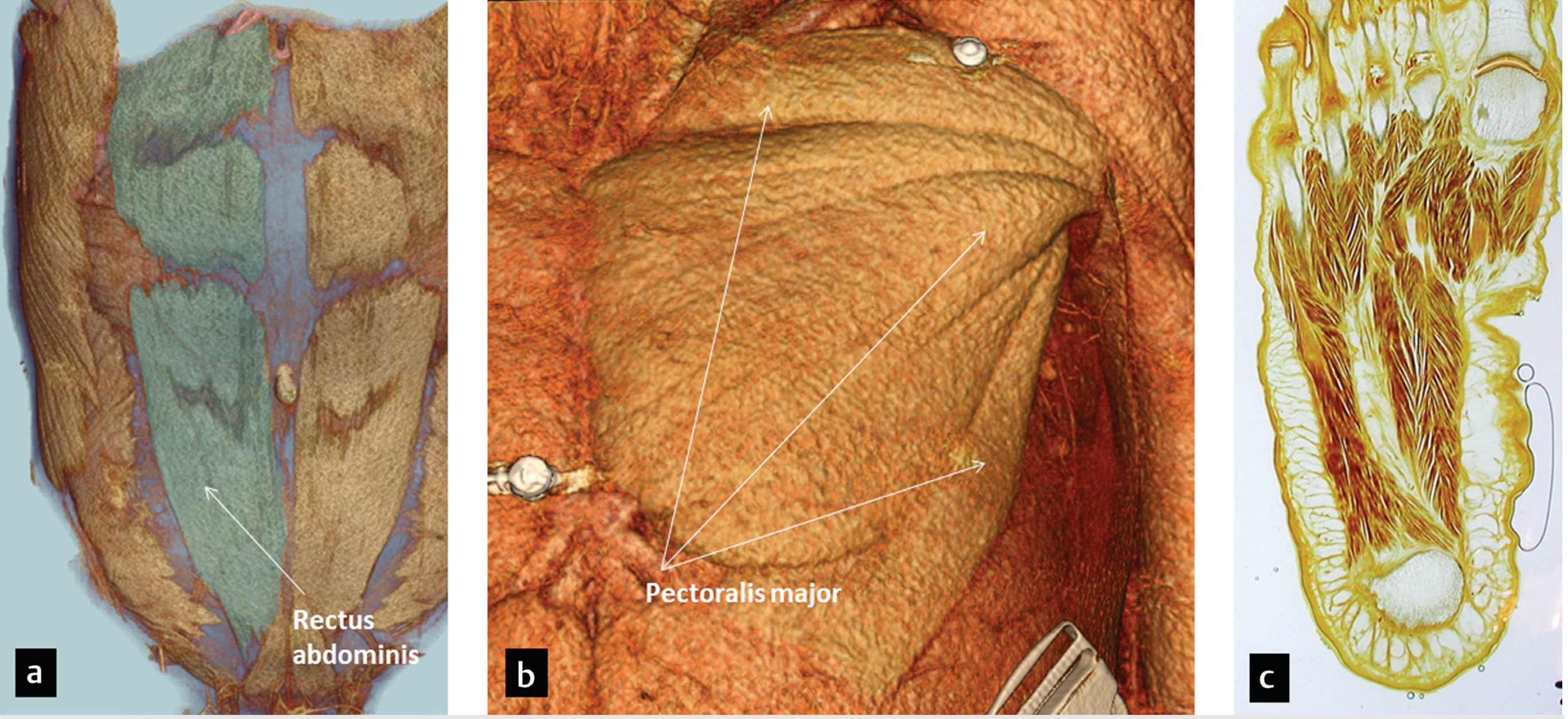
- Example: pectoralis major (5 subsegments converging to a twisted tendon on proximal humerus)
v. Strap with Tendinous Intersections
- Parallel muscle divided into distinct bellies by fibrous intersections
- Example: rectus abdominis
B. Pennate Fiber Architecture
- Short-length contractions
- High force production
- Greater PCSA
i. Unipennate
- Fibers attach to one side of a central tendon, like a half-feather
- Example: vastus lateralis, flexor pollicis longus, tibialis posterior
ii. Bipennate
- Fibers attach to both sides of a central tendon, like a full feather (V-shaped pattern)
- Example: gastrocnemius, dorsal foot interossei, rectus femoris
iii. Multipennate
- Complex pattern with fibers oriented at multiple angles to the line of action
- These muscles have exceptionally large PCSA for their size
- Example: soleus (modest mass, very short fibers of ~4 cm → large PCSA), deltoid, trapezius, gluteus medius
- The three strongest lower extremity muscles by PCSA: soleus, vastus lateralis, gluteus medius
iv. Circumpennate (special subtype)
- Fibers surround a central tendon on all sides
- Example: tibialis anterior
Summary Table
| Classification Basis | Types |
|---|---|
| Striations (microscopic) | Striated (skeletal, visceral, cardiac) / Smooth |
| Fiber metabolic type | Type I (slow-twitch, oxidative) / Type II (fast-twitch, glycolytic) |
| Fiber orientation / Architecture | Longitudinal/Parallel / Pennate |
| Shape (parallel subgroups) | Fusiform, Strap, Circular, Fan-shaped, Strap with intersections |
| Pennate subgroups | Unipennate, Bipennate, Multipennate, Circumpennate |
Sources: Histology: A Text and Atlas with Correlated Cell and Molecular Biology | Imaging Anatomy: Text and Atlas, Volume 3 - Bones, Joints, Vessels and Nerves
Explain the Classification of Muscles on the basis of Shape fiber and architecture with diagrams
Classification of Muscles on the Basis of Shape, Fiber, and Architecture
PART 1 - Classification by Microscopic Appearance (Striations)
A. Striated Muscle
| Skeletal Muscle | Visceral Striated Muscle | Cardiac Muscle | |
|---|---|---|---|
| Location | Attached to bone; also tongue, pharynx, upper esophagus, diaphragm | Soft tissues only (tongue, pharynx, upper esophagus) | Wall of heart; base of great veins |
| Nuclei | Multiple, peripheral (beneath sarcolemma) | Multiple, peripheral | 1-2, central |
| Control | Voluntary | Voluntary | Involuntary (autonomous) |
| Special feature | Multinucleated syncytium; diameter 10-100 µm | Morphologically identical to skeletal | Branched cells; intercalated discs |
| Function | Movement, posture | Speech, swallowing, breathing | Rhythmic cardiac contraction |
B. Smooth Muscle
- No cross-striations - myofilaments are not arranged in the same ordered pattern
- Myosin-containing filaments are highly labile
- Cells are spindle-shaped with a single central nucleus
- Location: viscera, blood vessel walls, arrector pili of skin, intrinsic eye muscles
- Control: involuntary
PART 2 - Classification by Fiber Type (Metabolic/Contractile Properties)
| Property | Type I (Slow-Twitch Oxidative) | Type II (Fast-Twitch Oxidative/Glycolytic) | Type III (Fast-Twitch Glycolytic) |
|---|---|---|---|
| Color | Red | Red | White |
| Myoglobin | High | High | Low |
| Mitochondria | Numerous | More than Type I | Few |
| Energy source | Oxidative phosphorylation | Oxidative + glycolytic | Glycogen, phosphocreatine |
| Fatiguability | Fatigue-resistant | Fatigue-resistant | Easily fatigable |
| Capillary density | Dense | Dense | Sparse |
| Fiber diameter | Thin | Large | - |
| Typical location | Postural muscles (e.g., soleus) | Mixed muscles | Extremity muscles - short bursts |
PART 3 - Classification by Shape and Fiber Architecture
- FL = Fiber Length
- ML = Muscle Length
- ACSA = Anatomical Cross-Sectional Area (largest single cross-section)
- PCSA = Physiological Cross-Sectional Area (sum of all fiber cross-sections) - best predictor of maximal force
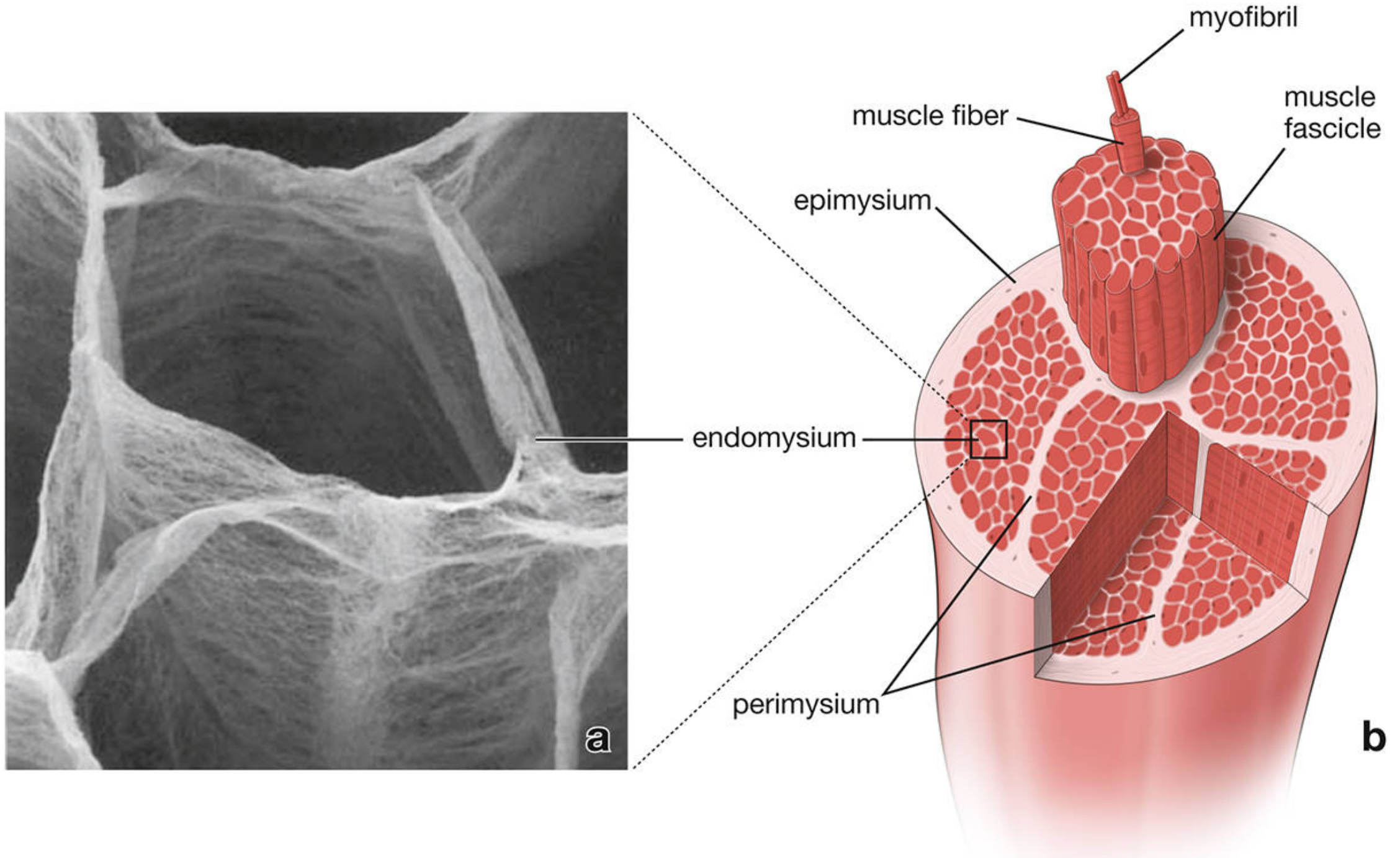
Connective Tissue Hierarchy (structural basis of architecture)
GROUP 1 - Longitudinal / Parallel Fiber Architecture
1. Fusiform (Spindle-shaped)
- Thick in the middle, tapering at both ends
- Wide fleshy belly between two tendons
- Examples: biceps brachii, brachialis, hamstrings
2. Strap (Straplike / Parallel-fibered)
- Long, flat, ribbon-like muscle
- Fibers run the entire muscle length
- Longest fibers in the body → greatest excursion
- Examples: sartorius (longest muscle), gracilis, semitendinosus, sternohyoid
3. Circular (Sphincteric)
- Fibers arranged in concentric rings around an orifice
- Contraction closes the opening
- Examples: orbicularis oculi, orbicularis oris
4. Strap with Tendinous Intersections
- Parallel muscle divided into distinct bellies by transverse fibrous bands
- Example: rectus abdominis (divided into 4 bellies by tendinous inscriptions)
5. Fan-shaped (Convergent / Triangular)
- Broad origin, fibers converge to a narrow tendon
- Allows pull from multiple directions depending on which portion contracts
- Example: pectoralis major - 5 subsegments with a complex, twisted distal tendon inserting on the proximal humerus
GROUP 2 - Pennate Fiber Architecture
The soleus muscle has a modest mass but very short fibers (~4 cm), giving it an exceptionally large PCSA. The vastus lateralis has 50% greater mass but much longer fibers (~10 cm), resulting in a smaller PCSA than soleus.The three strongest muscles in the lower extremity (by PCSA): soleus > vastus lateralis > gluteus medius
1. Unipennate
- Fibers attach to one side only of a central tendon (half-feather pattern)
- Examples: vastus lateralis, flexor pollicis longus, tibialis posterior, extensor digitorum longus
2. Bipennate
- Fibers attach to both sides of a central tendon (full feather / V-shape)
- Examples: gastrocnemius, dorsal foot interossei, rectus femoris
3. Multipennate
- Fibers oriented at multiple angles to the line of action - highly complex internal architecture
- Examples: soleus, deltoid, trapezius, gluteus medius
- These muscles have the greatest force-generating capacity relative to their size
4. Circumpennate
- Fibers surround a central tendon on all sides (cylindrical pennation)
- Example: tibialis anterior
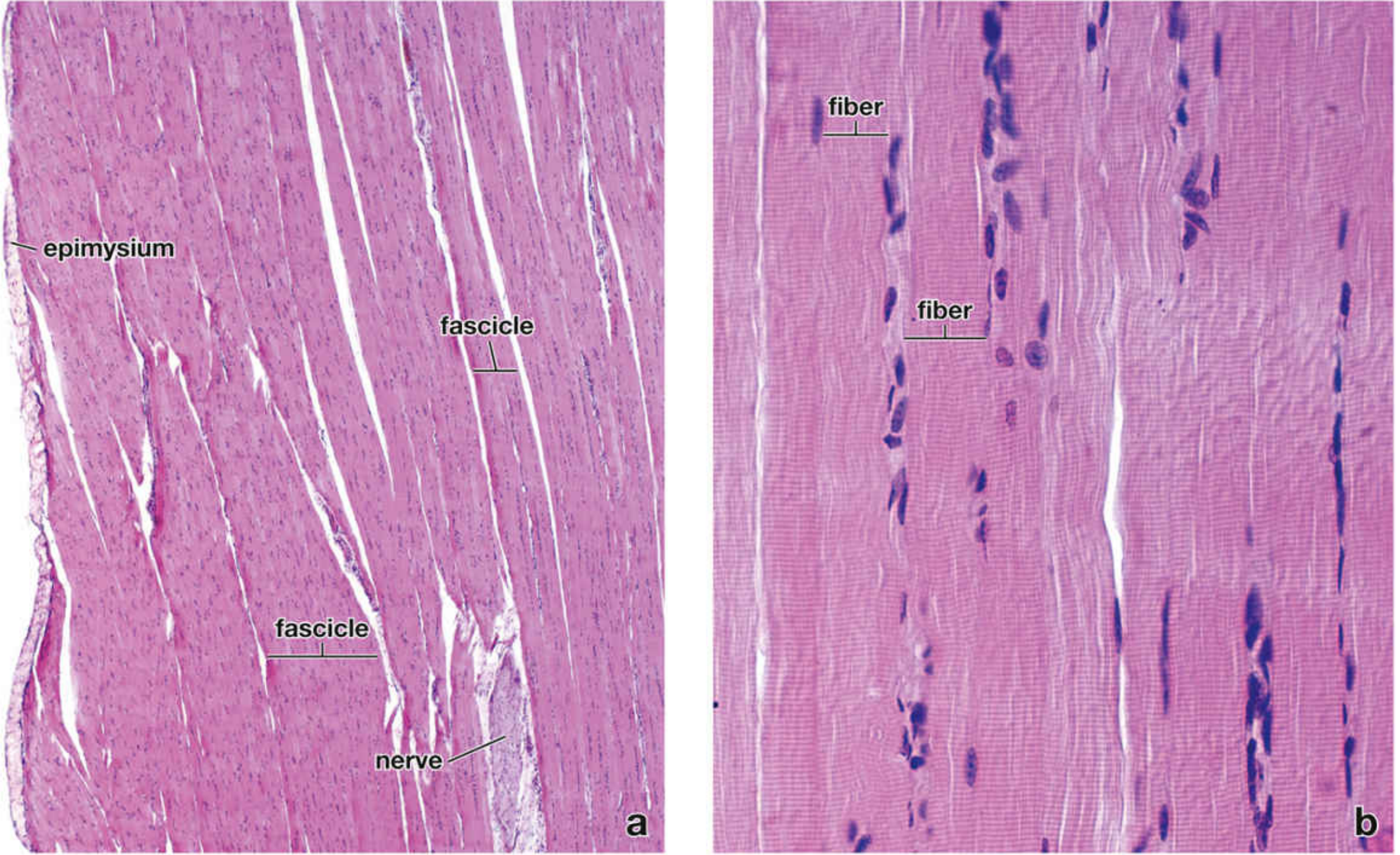
Histological appearance of skeletal muscle fibers
Summary: All Classifications at a Glance
MUSCLE CLASSIFICATION
│
├── 1. BY MICROSCOPIC APPEARANCE
│ ├── Striated
│ │ ├── Skeletal (voluntary, multinucleated, peripheral nuclei)
│ │ ├── Visceral striated (tongue, pharynx, esophagus)
│ │ └── Cardiac (involuntary, branched, intercalated discs)
│ └── Smooth (no striations, viscera/vessels)
│
├── 2. BY FIBER METABOLIC TYPE
│ ├── Type I → Slow-twitch, oxidative, red, fatigue-resistant
│ ├── Type II → Fast-twitch, oxidative/glycolytic, red
│ └── Type III → Fast-twitch, glycolytic, white, fatigable
│
└── 3. BY SHAPE AND ARCHITECTURE
├── Parallel/Longitudinal (favor velocity & range)
│ ├── Fusiform (biceps, brachialis)
│ ├── Strap (sartorius, semitendinosus)
│ ├── Circular/Sphincteric (orbicularis)
│ ├── Fan-shaped/Convergent (pectoralis major)
│ └── Strap with intersections (rectus abdominis)
└── Pennate (favor force production)
├── Unipennate (vastus lateralis)
├── Bipennate (gastrocnemius, rectus femoris)
├── Multipennate (soleus, deltoid, trapezius)
└── Circumpennate (tibialis anterior)
Create a detailed presentation comparing pennate vs. parallel muscle architecture
mkdir -p /home/daytona/workspace/muscle-architecture-pptx && ls /home/daytona/workspace/muscle-architecture-pptx
node /home/daytona/skills/shared/scripts/fetch_images.js \ "https://cdn.orris.care/cdss_images/d14d493bc0a7371d41e1cc1598d1e0bf253209e5668f7f4b04fd9c17432ce24b.png" \ "https://cdn.orris.care/cdss_images/da329bcc58aa0f028ad26eb5a09730019bb717786718c0729d14458587edb0e7.png" \ "https://cdn.orris.care/cdss_images/cf8277db6bcc42a1d8a1f0da513111431c010ef4821bc0e9c71c9cea97ca3ac9.png" \ "https://cdn.orris.care/cdss_images/945252f74b4b6f7e9f0fd72c68578417e6cc4a47f623605619e0149a4a23056e.png" \ > /home/daytona/workspace/muscle-architecture-pptx/images.json 2>&1 echo "Exit: $?" head -c 200 /home/daytona/workspace/muscle-architecture-pptx/images.json
~/muscle-architecture-pptx/build.js
const pptxgen = require("pptxgenjs");
const fs = require("fs");
// Load pre-fetched images
const images = JSON.parse(fs.readFileSync("/home/daytona/workspace/muscle-architecture-pptx/images.json"));
const imgArchTypes = images[0].base64; // architecture types (biceps, gluteus, vastus...)
const imgAdditional = images[1].base64; // rectus, pectoralis, bipennate foot
const imgStriated = images[2].base64; // skeletal vs cardiac structure
const imgConnective = images[3].base64; // epimysium/perimysium/endomysium
// ─── Color palette ───────────────────────────────────────────────────────────
const C = {
darkBg: "0D1B2A", // deep navy - title/section slides
midBg: "162032", // slightly lighter navy
cardBg: "FFFFFF", // white cards
parallel: "1A9E74", // teal-green → parallel muscle
pennate: "E05C2A", // burnt orange → pennate muscle
accent: "F2C94C", // gold accent
lightText: "F0F4F8",
mutedText: "94A3B8",
darkText: "1E293B",
white: "FFFFFF",
parallelLight: "D1F5EA",
pennateLight: "FDEBD5",
divider: "334155",
};
let pres = new pptxgen();
pres.layout = "LAYOUT_16x9";
pres.author = "Orris Medical";
pres.title = "Pennate vs Parallel Muscle Architecture";
pres.subject = "Anatomy – Muscle Architecture";
// ══════════════════════════════════════════════════════════════════════════════
// Helper: dark full-bleed background
function darkBg(slide, color) {
slide.addShape(pres.shapes.RECTANGLE, {
x: 0, y: 0, w: 10, h: 5.625,
fill: { color: color || C.darkBg }, line: { color: color || C.darkBg }
});
}
// Helper: accent bar at top
function topAccentBar(slide, color) {
slide.addShape(pres.shapes.RECTANGLE, {
x: 0, y: 0, w: 10, h: 0.06,
fill: { color: color || C.accent }, line: { color: color || C.accent }
});
}
// Helper: label pill/badge
function badge(slide, label, x, y, w, bgColor, textColor) {
slide.addShape(pres.shapes.ROUNDED_RECTANGLE, {
x, y, w, h: 0.34, fill: { color: bgColor }, line: { color: bgColor }, rectRadius: 0.05
});
slide.addText(label, {
x, y, w, h: 0.34, fontSize: 10, bold: true, color: textColor,
align: "center", valign: "middle", margin: 0
});
}
// Helper: section heading label
function sectionLabel(slide, text, color) {
slide.addText(text, {
x: 0.5, y: 0.08, w: 9, h: 0.3,
fontSize: 9, bold: true, color: color || C.accent,
charSpacing: 3, align: "left", margin: 0
});
}
// ══════════════════════════════════════════════════════════════════════════════
// SLIDE 1 — Title
// ══════════════════════════════════════════════════════════════════════════════
{
let s = pres.addSlide();
darkBg(s, C.darkBg);
// Diagonal color split
s.addShape(pres.shapes.RECTANGLE, {
x: 0, y: 0, w: 4.9, h: 5.625,
fill: { color: "0F2A1E" }, line: { color: "0F2A1E" }
});
s.addShape(pres.shapes.RECTANGLE, {
x: 5.1, y: 0, w: 4.9, h: 5.625,
fill: { color: "2A1408" }, line: { color: "2A1408" }
});
// Thin vertical divider
s.addShape(pres.shapes.RECTANGLE, {
x: 4.92, y: 0.3, w: 0.06, h: 5.0,
fill: { color: C.accent }, line: { color: C.accent }
});
// Left label
badge(s, "PARALLEL ARCHITECTURE", 0.5, 0.5, 4.1, C.parallel, C.white);
// Right label
badge(s, "PENNATE ARCHITECTURE", 5.4, 0.5, 4.1, C.pennate, C.white);
// Main title
s.addText("PENNATE vs. PARALLEL", {
x: 0.4, y: 1.2, w: 9.2, h: 0.9,
fontSize: 38, bold: true, color: C.white,
align: "center", charSpacing: 2
});
s.addText("Muscle Architecture", {
x: 0.4, y: 2.0, w: 9.2, h: 0.65,
fontSize: 26, bold: false, color: C.accent,
align: "center", charSpacing: 1
});
// Subtitle
s.addText("A Detailed Comparative Analysis", {
x: 1, y: 2.75, w: 8, h: 0.4,
fontSize: 14, color: C.mutedText, align: "center", italic: true
});
// Divider line
s.addShape(pres.shapes.RECTANGLE, {
x: 3.0, y: 3.22, w: 4.0, h: 0.03,
fill: { color: C.divider }, line: { color: C.divider }
});
// Key topics
const topics = ["Shape & Structure", "Fiber Orientation", "Force vs. Velocity", "PCSA & Mechanics", "Clinical Examples"];
topics.forEach((t, i) => {
s.addText("• " + t, {
x: 1.0 + i * 1.62, y: 3.35, w: 1.5, h: 0.3,
fontSize: 8.5, color: C.mutedText, align: "center"
});
});
// Footer
s.addText("Source: Imaging Anatomy Vol. 3 | Histology: A Text and Atlas", {
x: 0.3, y: 5.2, w: 9.4, h: 0.25,
fontSize: 8, color: C.divider, align: "center"
});
}
// ══════════════════════════════════════════════════════════════════════════════
// SLIDE 2 — Overview / Agenda
// ══════════════════════════════════════════════════════════════════════════════
{
let s = pres.addSlide();
darkBg(s, C.midBg);
topAccentBar(s);
sectionLabel(s, "OVERVIEW");
s.addText("What We'll Cover", {
x: 0.5, y: 0.5, w: 9, h: 0.55,
fontSize: 26, bold: true, color: C.white, margin: 0
});
const items = [
{ n: "01", title: "Structural Classification", desc: "How muscles are grouped by fiber orientation and shape", color: C.parallel },
{ n: "02", title: "Parallel Architecture", desc: "Fusiform, strap, circular, fan-shaped — structure, mechanics, examples", color: C.parallel },
{ n: "03", title: "Pennate Architecture", desc: "Unipennate, bipennate, multipennate — fiber angle and force output", color: C.pennate },
{ n: "04", title: "Biomechanics: Force & Speed", desc: "PCSA, fiber length, pennation angle (θ), sarcomere logic", color: C.accent },
{ n: "05", title: "Head-to-Head Comparison", desc: "Direct comparison table across 8 key parameters", color: C.mutedText },
{ n: "06", title: "Clinical Relevance", desc: "Injury patterns, rehabilitation, surgical planning", color: "E879F9" },
];
items.forEach((item, i) => {
const col = i % 3;
const row = Math.floor(i / 3);
const x = 0.3 + col * 3.22;
const y = 1.25 + row * 2.0;
s.addShape(pres.shapes.RECTANGLE, {
x, y, w: 3.05, h: 1.7,
fill: { color: "1E2D3D" }, line: { color: item.color },
shadow: { type: "outer", color: "000000", blur: 8, offset: 2, angle: 135, opacity: 0.25 }
});
// number
s.addText(item.n, {
x: x + 0.12, y: y + 0.1, w: 0.55, h: 0.45,
fontSize: 20, bold: true, color: item.color, align: "left", margin: 0
});
// title
s.addText(item.title, {
x: x + 0.12, y: y + 0.52, w: 2.8, h: 0.4,
fontSize: 11.5, bold: true, color: C.white, margin: 0
});
// desc
s.addText(item.desc, {
x: x + 0.12, y: y + 0.92, w: 2.8, h: 0.68,
fontSize: 9, color: C.mutedText, margin: 0
});
});
}
// ══════════════════════════════════════════════════════════════════════════════
// SLIDE 3 — Structural Classification (the two main groups)
// ══════════════════════════════════════════════════════════════════════════════
{
let s = pres.addSlide();
darkBg(s, C.darkBg);
topAccentBar(s, C.parallel);
sectionLabel(s, "STRUCTURAL CLASSIFICATION", C.parallel);
s.addText("Two Major Architectural Groups", {
x: 0.5, y: 0.45, w: 9, h: 0.55,
fontSize: 24, bold: true, color: C.white, margin: 0
});
s.addText("Muscle architecture is defined as the number and orientation of fibers relative to the axis of force generation.", {
x: 0.5, y: 0.97, w: 9, h: 0.35,
fontSize: 11, color: C.mutedText, italic: true
});
// LEFT block — Parallel
s.addShape(pres.shapes.RECTANGLE, {
x: 0.25, y: 1.45, w: 4.55, h: 3.75,
fill: { color: "0E2A1E" }, line: { color: C.parallel, pt: 2 }
});
s.addShape(pres.shapes.RECTANGLE, {
x: 0.25, y: 1.45, w: 4.55, h: 0.44,
fill: { color: C.parallel }, line: { color: C.parallel }
});
s.addText("PARALLEL / LONGITUDINAL", {
x: 0.35, y: 1.45, w: 4.35, h: 0.44,
fontSize: 11, bold: true, color: C.white, align: "center", valign: "middle", margin: 0
});
const parallelItems = [
["Fiber orientation", "Parallel to line of action"],
["Sarcomere arrangement", "In series"],
["Functional advantage", "Greater velocity & range"],
["Key parameter", "Fiber length (FL)"],
["Shape subtypes", "Fusiform, Strap, Circular, Fan"],
["Best suited for", "Postural endurance & speed"],
];
parallelItems.forEach(([k, v], i) => {
s.addText(k + ":", { x: 0.4, y: 2.02 + i * 0.52, w: 2.0, h: 0.4, fontSize: 9.5, bold: true, color: C.parallel, margin: 0 });
s.addText(v, { x: 2.3, y: 2.02 + i * 0.52, w: 2.3, h: 0.4, fontSize: 9.5, color: C.lightText, margin: 0 });
});
// RIGHT block — Pennate
s.addShape(pres.shapes.RECTANGLE, {
x: 5.2, y: 1.45, w: 4.55, h: 3.75,
fill: { color: "2A1108" }, line: { color: C.pennate, pt: 2 }
});
s.addShape(pres.shapes.RECTANGLE, {
x: 5.2, y: 1.45, w: 4.55, h: 0.44,
fill: { color: C.pennate }, line: { color: C.pennate }
});
s.addText("PENNATE", {
x: 5.3, y: 1.45, w: 4.35, h: 0.44,
fontSize: 11, bold: true, color: C.white, align: "center", valign: "middle", margin: 0
});
const pennateItems = [
["Fiber orientation", "Oblique — at pennation angle (θ)"],
["Sarcomere arrangement", "In parallel"],
["Functional advantage", "Greater force production"],
["Key parameter", "PCSA (physiological CSA)"],
["Shape subtypes", "Uni-, Bi-, Multi-pennate"],
["Best suited for", "High-force, short contractions"],
];
pennateItems.forEach(([k, v], i) => {
s.addText(k + ":", { x: 5.35, y: 2.02 + i * 0.52, w: 2.0, h: 0.4, fontSize: 9.5, bold: true, color: C.pennate, margin: 0 });
s.addText(v, { x: 7.3, y: 2.02 + i * 0.52, w: 2.3, h: 0.4, fontSize: 9.5, color: C.lightText, margin: 0 });
});
// Middle divider + "vs"
s.addShape(pres.shapes.RECTANGLE, {
x: 4.87, y: 1.5, w: 0.26, h: 3.65,
fill: { color: C.divider }, line: { color: C.divider }
});
s.addShape(pres.shapes.ROUNDED_RECTANGLE, {
x: 4.68, y: 3.1, w: 0.64, h: 0.44,
fill: { color: C.accent }, line: { color: C.accent }, rectRadius: 0.05
});
s.addText("VS", {
x: 4.68, y: 3.1, w: 0.64, h: 0.44,
fontSize: 12, bold: true, color: C.darkText, align: "center", valign: "middle", margin: 0
});
}
// ══════════════════════════════════════════════════════════════════════════════
// SLIDE 4 — Parallel Architecture Subtypes
// ══════════════════════════════════════════════════════════════════════════════
{
let s = pres.addSlide();
darkBg(s, "0C1F14");
topAccentBar(s, C.parallel);
sectionLabel(s, "PARALLEL ARCHITECTURE — SUBTYPES", C.parallel);
s.addText("Types of Parallel Muscle Architecture", {
x: 0.5, y: 0.45, w: 9, h: 0.52,
fontSize: 22, bold: true, color: C.white, margin: 0
});
const subtypes = [
{
name: "Fusiform",
icon: "◆",
desc: "Spindle-shaped with a wide fleshy belly tapering to tendons at both ends.",
chars: "Fibers span full length | Parallel to force axis",
examples: "Biceps brachii, brachialis, hamstrings",
color: C.parallel
},
{
name: "Strap",
icon: "▬",
desc: "Long, flat, ribbon-like muscle. Longest fiber lengths in the body.",
chars: "Greatest excursion | Highest velocity",
examples: "Sartorius (longest), gracilis, semitendinosus",
color: "14B8A6"
},
{
name: "Circular",
icon: "○",
desc: "Fibers arranged concentrically around an orifice. Contract to close opening.",
chars: "Sphincteric action | Surrounds opening",
examples: "Orbicularis oculi, orbicularis oris",
color: "34D399"
},
{
name: "Fan-shaped",
icon: "◤",
desc: "Broad origin converging to narrow tendon. Multiple pull directions possible.",
chars: "Convergent | Selective fiber recruitment",
examples: "Pectoralis major (5 subsegments)",
color: "6EE7B7"
},
{
name: "Strap + Intersections",
icon: "≡",
desc: "Parallel strap muscle divided into distinct bellies by tendinous bands.",
chars: "Segmented contraction | Parallel bellies",
examples: "Rectus abdominis (4 bellies)",
color: "A7F3D0"
},
];
subtypes.forEach((sub, i) => {
const x = 0.18 + i * 1.93;
s.addShape(pres.shapes.RECTANGLE, {
x, y: 1.1, w: 1.75, h: 4.1,
fill: { color: "112B1D" }, line: { color: sub.color, pt: 1.5 }
});
// Color header
s.addShape(pres.shapes.RECTANGLE, {
x, y: 1.1, w: 1.75, h: 0.38,
fill: { color: sub.color }, line: { color: sub.color }
});
s.addText(sub.name, {
x, y: 1.1, w: 1.75, h: 0.38,
fontSize: 10, bold: true, color: C.darkText,
align: "center", valign: "middle", margin: 0
});
s.addText(sub.icon, {
x, y: 1.56, w: 1.75, h: 0.5,
fontSize: 28, color: sub.color, align: "center"
});
s.addText(sub.desc, {
x: x + 0.08, y: 2.05, w: 1.6, h: 1.1,
fontSize: 8.5, color: C.lightText
});
s.addShape(pres.shapes.RECTANGLE, {
x: x + 0.08, y: 3.18, w: 1.6, h: 0.03,
fill: { color: sub.color }, line: { color: sub.color }
});
s.addText(sub.chars, {
x: x + 0.08, y: 3.24, w: 1.6, h: 0.55,
fontSize: 7.5, color: C.mutedText, italic: true
});
s.addText("e.g. " + sub.examples, {
x: x + 0.08, y: 3.82, w: 1.6, h: 0.68,
fontSize: 8, color: sub.color, bold: true
});
});
// Bottom note
s.addText("⟳ Sarcomeres in series: favorable for high velocity and long excursion", {
x: 0.3, y: 5.28, w: 9.4, h: 0.25,
fontSize: 8.5, color: C.parallel, align: "center", bold: true
});
}
// ══════════════════════════════════════════════════════════════════════════════
// SLIDE 5 — Pennate Architecture Subtypes
// ══════════════════════════════════════════════════════════════════════════════
{
let s = pres.addSlide();
darkBg(s, "1F0D05");
topAccentBar(s, C.pennate);
sectionLabel(s, "PENNATE ARCHITECTURE — SUBTYPES", C.pennate);
s.addText("Types of Pennate Muscle Architecture", {
x: 0.5, y: 0.45, w: 9, h: 0.52,
fontSize: 22, bold: true, color: C.white, margin: 0
});
s.addText("Penna (Latin) = feather | Fibers insert obliquely onto a central tendon at pennation angle θ", {
x: 0.5, y: 0.94, w: 9, h: 0.3,
fontSize: 10, color: C.mutedText, italic: true
});
const pennSubtypes = [
{
name: "Unipennate",
symbol: "⟋",
desc: "Fibers attach to one side of a central tendon only — like one half of a feather.",
note: "FL < ML | Moderate PCSA",
examples: "Vastus lateralis, flexor pollicis longus, tibialis posterior",
color: C.pennate
},
{
name: "Bipennate",
symbol: "⟨⟩",
desc: "Fibers attach to both sides of a central tendon — V-shaped pattern. Forces sum from both directions.",
note: "Very high force | Short excursion",
examples: "Gastrocnemius, rectus femoris, dorsal foot interossei",
color: "F97316"
},
{
name: "Multipennate",
symbol: "⊞",
desc: "Fibers oriented at multiple angles. Exceptionally large PCSA. Most complex internal architecture.",
note: "Largest PCSA | Max force output",
examples: "Soleus, deltoid, trapezius, gluteus medius",
color: "FBBF24"
},
{
name: "Circumpennate",
symbol: "⊙",
desc: "Fibers completely surround a central tendon on all sides — cylindrical pennation.",
note: "Radial symmetry | Uniform force",
examples: "Tibialis anterior",
color: "FDE68A"
},
];
pennSubtypes.forEach((sub, i) => {
const x = 0.2 + i * 2.4;
s.addShape(pres.shapes.RECTANGLE, {
x, y: 1.3, w: 2.22, h: 4.0,
fill: { color: "2D1105" }, line: { color: sub.color, pt: 1.5 }
});
s.addShape(pres.shapes.RECTANGLE, {
x, y: 1.3, w: 2.22, h: 0.4,
fill: { color: sub.color }, line: { color: sub.color }
});
s.addText(sub.name, {
x, y: 1.3, w: 2.22, h: 0.4,
fontSize: 11, bold: true, color: C.darkBg,
align: "center", valign: "middle", margin: 0
});
s.addText(sub.symbol, {
x, y: 1.78, w: 2.22, h: 0.58,
fontSize: 32, color: sub.color, align: "center"
});
s.addText(sub.desc, {
x: x + 0.1, y: 2.4, w: 2.0, h: 1.1,
fontSize: 9, color: C.lightText
});
s.addShape(pres.shapes.RECTANGLE, {
x: x + 0.1, y: 3.52, w: 2.0, h: 0.03,
fill: { color: sub.color }, line: { color: sub.color }
});
s.addText(sub.note, {
x: x + 0.1, y: 3.58, w: 2.0, h: 0.45,
fontSize: 8.5, color: sub.color, bold: true, italic: true
});
s.addText("e.g. " + sub.examples, {
x: x + 0.1, y: 4.06, w: 2.0, h: 0.8,
fontSize: 8, color: C.mutedText
});
});
s.addText("⟳ Sarcomeres in parallel: forces ADD → higher force, shorter range", {
x: 0.3, y: 5.28, w: 9.4, h: 0.25,
fontSize: 8.5, color: C.pennate, align: "center", bold: true
});
}
// ══════════════════════════════════════════════════════════════════════════════
// SLIDE 6 — Textbook Architecture Diagram
// ══════════════════════════════════════════════════════════════════════════════
{
let s = pres.addSlide();
darkBg(s, C.darkBg);
topAccentBar(s, C.accent);
sectionLabel(s, "TEXTBOOK ILLUSTRATIONS", C.accent);
s.addText("Muscle Architecture Types — Anatomical Imaging", {
x: 0.5, y: 0.45, w: 9, h: 0.52,
fontSize: 22, bold: true, color: C.white, margin: 0
});
// Main architecture image
s.addImage({ data: imgArchTypes, x: 0.3, y: 1.05, w: 9.4, h: 3.0 });
// Caption labels below
const captions = [
{ label: "PARALLEL", sub: "Biceps brachii", x: 0.3, color: C.parallel },
{ label: "PARALLEL", sub: "Gluteus maximus", x: 1.85, color: C.parallel },
{ label: "UNIPENNATE", sub: "Vastus lateralis\n+ Sartorius (strap)", x: 3.4, color: C.pennate },
{ label: "MULTIPENNATE", sub: "Gluteus medius", x: 5.3, color: C.pennate },
{ label: "MULTIPENNATE", sub: "Deltoid", x: 7.0, color: C.pennate },
{ label: "BIPENNATE", sub: "Gastrocnemius\n+ Soleus (multi)", x: 8.45, color: C.pennate },
];
captions.forEach(c => {
s.addText(c.label, { x: c.x, y: 4.12, w: 1.5, h: 0.25, fontSize: 7, bold: true, color: c.color, align: "center", margin: 0 });
s.addText(c.sub, { x: c.x, y: 4.36, w: 1.5, h: 0.45, fontSize: 7, color: C.mutedText, align: "center", margin: 0 });
});
s.addText("FL = Fiber Length | ML = Muscle Length | ACSA = Anatomical Cross-Sectional Area", {
x: 0.3, y: 5.28, w: 9.4, h: 0.22,
fontSize: 7.5, color: C.mutedText, align: "center"
});
s.addText("Source: Imaging Anatomy Vol. 3, Bones, Joints, Vessels and Nerves", {
x: 0.3, y: 5.44, w: 9.4, h: 0.2, fontSize: 7, color: C.divider, align: "center"
});
}
// ══════════════════════════════════════════════════════════════════════════════
// SLIDE 7 — Additional Architecture Diagram
// ══════════════════════════════════════════════════════════════════════════════
{
let s = pres.addSlide();
darkBg(s, C.darkBg);
topAccentBar(s, C.accent);
sectionLabel(s, "TEXTBOOK ILLUSTRATIONS — ADDITIONAL TYPES", C.accent);
s.addText("Rectus Abdominis, Pectoralis Major & Bipennate Foot Muscles", {
x: 0.4, y: 0.45, w: 9.2, h: 0.52,
fontSize: 20, bold: true, color: C.white
});
s.addImage({ data: imgAdditional, x: 0.6, y: 1.08, w: 8.8, h: 3.7 });
// Labels
const labels3 = [
{ t: "Strap + Intersections", s: "Rectus abdominis\n(4 bellies)", x: 1.2, color: C.parallel },
{ t: "Fan-shaped", s: "Pectoralis major\n(5 subsegments, twisted tendon)", x: 4.1, color: C.parallel },
{ t: "Bi- & Unipennate", s: "Plantar foot muscles\nV-shape + half-feather", x: 7.2, color: C.pennate },
];
labels3.forEach(l => {
s.addText(l.t, { x: l.x, y: 4.86, w: 2.2, h: 0.28, fontSize: 8.5, bold: true, color: l.color, align: "center", margin: 0 });
s.addText(l.s, { x: l.x, y: 5.14, w: 2.2, h: 0.45, fontSize: 7.5, color: C.mutedText, align: "center", margin: 0 });
});
}
// ══════════════════════════════════════════════════════════════════════════════
// SLIDE 8 — Biomechanics: PCSA, Fiber Length, Pennation Angle
// ══════════════════════════════════════════════════════════════════════════════
{
let s = pres.addSlide();
darkBg(s, C.midBg);
topAccentBar(s, C.accent);
sectionLabel(s, "BIOMECHANICS — KEY PARAMETERS");
s.addText("The Physics of Architecture", {
x: 0.5, y: 0.45, w: 9, h: 0.52,
fontSize: 24, bold: true, color: C.white, margin: 0
});
// Three parameter boxes
const params = [
{
title: "PCSA (Physiological CSA)",
formula: "PCSA = Volume / Fiber Length",
color: C.accent,
points: [
"Sum of ALL fiber cross-sections",
"Best predictor of maximal force",
"Larger in pennate muscles",
"Soleus: modest mass, 4 cm fibers → huge PCSA",
"Vastus lateralis: 50% more mass, 10 cm fibers → smaller PCSA",
"Top 3 by PCSA: Soleus > Vastus lat. > Glut. medius",
]
},
{
title: "Fiber Length & Velocity",
formula: "Velocity ∝ Fiber Length",
color: C.parallel,
points: [
"Longer fibers → greater shortening distance",
"More sarcomeres in series = faster contraction",
"Longest fibers: sartorius, gracilis, semitendinosus",
"Parallel muscles maximize fiber length",
"Pennate muscles sacrifice length for force",
"Fiber length is key for excursion & speed",
]
},
{
title: "Pennation Angle θ",
formula: "Force = PCSA × cos(θ)",
color: C.pennate,
points: [
"Angle between fiber and line of action",
"Larger θ = more fibers packed in → more force",
"But: effective force = F × cos(θ)",
"Trade-off: packing vs. efficiency",
"Typical θ = 0°–30° in most muscles",
"Architecture altered by training, bed rest, DMD",
]
},
];
params.forEach((p, i) => {
const x = 0.2 + i * 3.27;
s.addShape(pres.shapes.RECTANGLE, {
x, y: 1.15, w: 3.08, h: 4.15,
fill: { color: "192435" }, line: { color: p.color, pt: 1.5 }
});
s.addShape(pres.shapes.RECTANGLE, {
x, y: 1.15, w: 3.08, h: 0.46,
fill: { color: p.color }, line: { color: p.color }
});
s.addText(p.title, {
x: x + 0.08, y: 1.15, w: 2.92, h: 0.46,
fontSize: 10, bold: true, color: C.darkBg,
align: "center", valign: "middle", margin: 0
});
s.addText(p.formula, {
x: x + 0.08, y: 1.68, w: 2.92, h: 0.36,
fontSize: 11, bold: true, color: p.color, align: "center"
});
s.addShape(pres.shapes.RECTANGLE, {
x: x + 0.08, y: 2.06, w: 2.92, h: 0.025,
fill: { color: p.color }, line: { color: p.color }
});
p.points.forEach((pt, j) => {
s.addText("• " + pt, {
x: x + 0.12, y: 2.12 + j * 0.5, w: 2.84, h: 0.42,
fontSize: 8.5, color: C.lightText, margin: 0
});
});
});
}
// ══════════════════════════════════════════════════════════════════════════════
// SLIDE 9 — Bar Chart: Force vs. Velocity trade-off
// ══════════════════════════════════════════════════════════════════════════════
{
let s = pres.addSlide();
darkBg(s, C.midBg);
topAccentBar(s, C.accent);
sectionLabel(s, "BIOMECHANICS — FORCE vs. VELOCITY TRADE-OFF");
s.addText("Force vs. Velocity: Architecture Determines Function", {
x: 0.5, y: 0.45, w: 9, h: 0.52,
fontSize: 22, bold: true, color: C.white, margin: 0
});
// Chart — Relative Force
s.addChart(pres.charts.BAR, [
{
name: "Relative Force (%)",
labels: ["Soleus\n(multipennate)", "Gastrocnemius\n(bipennate)", "Vastus lat.\n(unipennate)", "Biceps\n(fusiform)", "Sartorius\n(strap)"],
values: [100, 82, 75, 45, 28]
}
], {
x: 0.3, y: 1.1, w: 4.7, h: 3.8, barDir: "col",
chartColors: [C.pennate, "F97316", "FBBF24", C.parallel, "34D399"],
chartArea: { fill: { color: "192435" }, roundedCorners: false },
catAxisLabelColor: C.mutedText, valAxisLabelColor: C.mutedText,
valGridLine: { color: C.divider, size: 0.5 },
catGridLine: { style: "none" },
showValue: true, dataLabelColor: C.white, dataLabelFontSize: 9,
catAxisLabelFontSize: 8, valAxisLabelFontSize: 8,
showLegend: false,
title: "Relative Force Output", titleColor: C.accent, titleFontSize: 10,
});
// Chart — Relative Velocity
s.addChart(pres.charts.BAR, [
{
name: "Relative Velocity (%)",
labels: ["Sartorius\n(strap)", "Biceps\n(fusiform)", "Semitendinosus\n(strap)", "Gastrocnemius\n(bipennate)", "Soleus\n(multipennate)"],
values: [100, 85, 80, 42, 28]
}
], {
x: 5.2, y: 1.1, w: 4.5, h: 3.8, barDir: "col",
chartColors: [C.parallel, "14B8A6", "34D399", "F97316", C.pennate],
chartArea: { fill: { color: "192435" }, roundedCorners: false },
catAxisLabelColor: C.mutedText, valAxisLabelColor: C.mutedText,
valGridLine: { color: C.divider, size: 0.5 },
catGridLine: { style: "none" },
showValue: true, dataLabelColor: C.white, dataLabelFontSize: 9,
catAxisLabelFontSize: 8, valAxisLabelFontSize: 8,
showLegend: false,
title: "Relative Shortening Velocity", titleColor: C.accent, titleFontSize: 10,
});
s.addText("← Pennate muscles dominate force | Parallel muscles dominate velocity →", {
x: 0.3, y: 5.28, w: 9.4, h: 0.27,
fontSize: 9, color: C.accent, align: "center", bold: true
});
}
// ══════════════════════════════════════════════════════════════════════════════
// SLIDE 10 — Head-to-Head Comparison Table
// ══════════════════════════════════════════════════════════════════════════════
{
let s = pres.addSlide();
darkBg(s, C.darkBg);
topAccentBar(s);
sectionLabel(s, "DIRECT COMPARISON");
s.addText("Pennate vs. Parallel — Head-to-Head", {
x: 0.5, y: 0.45, w: 9, h: 0.52,
fontSize: 24, bold: true, color: C.white, margin: 0
});
// Table data
const rows = [
["Parameter", "Parallel Architecture", "Pennate Architecture"],
["Fiber orientation", "Parallel to force axis (0°)", "Oblique to force axis (θ = 5°–30°)"],
["Sarcomere arrangement", "In series", "In parallel"],
["Key metric", "Fiber length (FL)", "Physiological CSA (PCSA)"],
["Force production", "Moderate", "High to very high"],
["Shortening velocity", "High", "Low to moderate"],
["Excursion / Range", "Large", "Small"],
["No. of fibers", "Fewer (limited by volume)", "More (packed at angle)"],
["Fatigue resistance", "Variable (depends on fiber type)", "Variable (depends on fiber type)"],
["Best examples", "Biceps, sartorius, orbicularis", "Soleus, deltoid, gastrocnemius"],
["Injury pattern", "Tears at myotendinous junction", "More complex partial tears"],
["Rehab consideration", "Focus on range & velocity", "Focus on strength & PCSA"],
];
rows.forEach((row, ri) => {
const isHeader = ri === 0;
const y = 1.1 + ri * 0.375;
const h = isHeader ? 0.42 : 0.34;
const colWidths = [2.4, 3.6, 3.6];
const colX = [0.2, 2.62, 6.24];
row.forEach((cell, ci) => {
const bg = isHeader
? (ci === 0 ? C.divider : ci === 1 ? C.parallel : C.pennate)
: (ri % 2 === 0 ? "192435" : "1E2D3D");
const textColor = isHeader ? C.white : (ci === 1 ? C.parallelLight : ci === 2 ? C.pennateLight : C.mutedText);
s.addShape(pres.shapes.RECTANGLE, {
x: colX[ci], y, w: colWidths[ci], h,
fill: { color: bg }, line: { color: C.divider, pt: 0.5 }
});
s.addText(cell, {
x: colX[ci] + 0.1, y, w: colWidths[ci] - 0.15, h,
fontSize: isHeader ? 9.5 : 8.5,
bold: isHeader || ci === 0,
color: textColor,
valign: "middle", margin: 0
});
});
});
}
// ══════════════════════════════════════════════════════════════════════════════
// SLIDE 11 — Connective Tissue & Structural Hierarchy
// ══════════════════════════════════════════════════════════════════════════════
{
let s = pres.addSlide();
darkBg(s, C.midBg);
topAccentBar(s, C.parallel);
sectionLabel(s, "STRUCTURAL HIERARCHY — CONNECTIVE TISSUE", C.parallel);
s.addText("From Myofibril to Whole Muscle", {
x: 0.5, y: 0.45, w: 6, h: 0.52,
fontSize: 22, bold: true, color: C.white, margin: 0
});
// Connective tissue image
s.addImage({ data: imgConnective, x: 0.25, y: 1.1, w: 5.5, h: 4.25 });
// Hierarchy labels on right
const levels = [
{ level: "Whole Muscle", wrap: "Epimysium", color: C.accent, desc: "Dense CT sheath surrounding entire muscle" },
{ level: "Fascicle", wrap: "Perimysium", color: C.parallel, desc: "Groups of ~10-100 muscle fibers" },
{ level: "Fiber (cell)", wrap: "Endomysium", color: "34D399", desc: "Single multinucleated muscle cell (10-100 µm)" },
{ level: "Myofibril", wrap: "—", color: C.mutedText, desc: "Contractile unit of actin + myosin sarcomeres" },
];
levels.forEach((l, i) => {
const y = 1.15 + i * 1.08;
s.addShape(pres.shapes.RECTANGLE, {
x: 6.0, y, w: 3.75, h: 0.96,
fill: { color: "192435" }, line: { color: l.color, pt: 1.5 }
});
s.addText(l.level, { x: 6.1, y: y + 0.05, w: 2.0, h: 0.32, fontSize: 11, bold: true, color: l.color, margin: 0 });
s.addText("Wrapped by: " + l.wrap, { x: 6.1, y: y + 0.36, w: 3.5, h: 0.24, fontSize: 8.5, color: C.accent, italic: true, margin: 0 });
s.addText(l.desc, { x: 6.1, y: y + 0.6, w: 3.5, h: 0.3, fontSize: 8, color: C.mutedText, margin: 0 });
});
s.addText("Architecture is determined at the fascicle level — how fascicles are oriented relative to the tendon defines parallel vs. pennate.", {
x: 6.0, y: 5.22, w: 3.75, h: 0.37,
fontSize: 7.5, color: C.mutedText, italic: true
});
}
// ══════════════════════════════════════════════════════════════════════════════
// SLIDE 12 — Muscle Fiber Types (Metabolic Classification)
// ══════════════════════════════════════════════════════════════════════════════
{
let s = pres.addSlide();
darkBg(s, C.darkBg);
topAccentBar(s, "E879F9");
sectionLabel(s, "FIBER METABOLIC TYPES", "E879F9");
s.addText("Metabolic Classification of Muscle Fibers", {
x: 0.5, y: 0.45, w: 9, h: 0.52,
fontSize: 22, bold: true, color: C.white, margin: 0
});
const fiberTypes = [
{
type: "Type I",
nick: "Slow-Twitch Oxidative",
color: "DC2626",
icon: "🔴",
props: [
["Color", "Red (high myoglobin)"],
["Mitochondria", "Numerous"],
["Energy source", "Oxidative phosphorylation"],
["Glycogen", "Low"],
["Fatiguability", "Fatigue-resistant"],
["Contraction", "Slow"],
["Capillary density", "Dense"],
["Fiber diameter", "Thin"],
["Typical location", "Postural muscles (soleus)"],
]
},
{
type: "Type II",
nick: "Fast-Twitch Oxidative/Glycolytic",
color: "D97706",
icon: "🟠",
props: [
["Color", "Red"],
["Mitochondria", "Many (more than Type I)"],
["Energy source", "Oxidative + Glycolytic"],
["Glycogen", "High"],
["Fatiguability", "Fatigue-resistant"],
["Contraction", "Fast"],
["Capillary density", "Dense"],
["Fiber diameter", "Large"],
["Typical location", "Mixed limb muscles"],
]
},
{
type: "Type III",
nick: "Fast-Twitch Glycolytic",
color: "4B5563",
icon: "⚪",
props: [
["Color", "White (low myoglobin)"],
["Mitochondria", "Few"],
["Energy source", "Glycogen, phosphocreatine"],
["Glycogen", "High"],
["Fatiguability", "Easily fatigable"],
["Contraction", "Fast"],
["Capillary density", "Sparse"],
["Fiber diameter", "Variable"],
["Typical location", "Extremity muscles, rapid bursts"],
]
},
];
fiberTypes.forEach((ft, i) => {
const x = 0.2 + i * 3.27;
s.addShape(pres.shapes.RECTANGLE, {
x, y: 1.1, w: 3.08, h: 4.2,
fill: { color: "192435" }, line: { color: ft.color, pt: 2 }
});
s.addShape(pres.shapes.RECTANGLE, {
x, y: 1.1, w: 3.08, h: 0.52,
fill: { color: ft.color }, line: { color: ft.color }
});
s.addText(ft.type + " — " + ft.nick, {
x: x + 0.1, y: 1.1, w: 2.88, h: 0.52,
fontSize: 9.5, bold: true, color: C.white,
valign: "middle", align: "center", margin: 0
});
ft.props.forEach(([k, v], j) => {
const bg = j % 2 === 0 ? "1E2D3D" : "192435";
s.addShape(pres.shapes.RECTANGLE, {
x, y: 1.7 + j * 0.39, w: 3.08, h: 0.37,
fill: { color: bg }, line: { color: bg }
});
s.addText(k, { x: x + 0.08, y: 1.7 + j * 0.39, w: 1.2, h: 0.37, fontSize: 8.5, bold: true, color: ft.color, valign: "middle", margin: 0 });
s.addText(v, { x: x + 1.3, y: 1.7 + j * 0.39, w: 1.7, h: 0.37, fontSize: 8.5, color: C.lightText, valign: "middle", margin: 0 });
});
});
s.addText("Note: Pennate muscles often contain more Type I fibers (postural); parallel muscles more Type II/III (phasic movement)", {
x: 0.3, y: 5.3, w: 9.4, h: 0.26,
fontSize: 8.5, color: C.mutedText, italic: true, align: "center"
});
}
// ══════════════════════════════════════════════════════════════════════════════
// SLIDE 13 — Clinical Relevance
// ══════════════════════════════════════════════════════════════════════════════
{
let s = pres.addSlide();
darkBg(s, "0F1E2D");
topAccentBar(s, "E879F9");
sectionLabel(s, "CLINICAL RELEVANCE", "E879F9");
s.addText("Why Architecture Matters Clinically", {
x: 0.5, y: 0.45, w: 9, h: 0.52,
fontSize: 22, bold: true, color: C.white, margin: 0
});
const clinCards = [
{
title: "Injury Patterns",
color: "EF4444",
icon: "⚡",
body: [
"Parallel muscles: tears typically at myotendinous junction where force concentration is highest",
"Pennate muscles: partial intramuscular tears more common — complex architecture distributes stress",
"Classic example: biceps (parallel) vs. gastrocnemius (bipennate) tears show different MRI patterns",
]
},
{
title: "Rehabilitation",
color: "3B82F6",
icon: "🔄",
body: [
"Parallel muscle rehab: restore fiber length, excursion, and contraction velocity",
"Pennate muscle rehab: rebuild PCSA and strength; hypertrophy increases force output",
"Bed rest reduces pennation angle and PCSA; targeted loading reverses this",
"Eccentric training increases fiber length in parallel muscles (hamstring injury prevention)",
]
},
{
title: "Surgical Planning",
color: C.parallel,
icon: "✂",
body: [
"Flap design: pennate muscles (e.g. gracilis) preferred for free flaps — single pedicle, robust blood supply",
"Tendon transfers: architecture determines expected force and range post-transfer",
"Pennate muscles lose more function with partial denervation than parallel muscles",
"DTI-based architecture mapping improves pre-operative planning",
]
},
{
title: "Pathology & Genetics",
color: C.pennate,
icon: "🧬",
body: [
"Duchenne muscular dystrophy: architectural disorganization precedes fiber necrosis",
"Infiltrative disease (lipoma, tumors): alters pennation angle detectable by ultrasound",
"Architecture measurable by high-resolution ultrasound and MRI diffusion tensor imaging (DTI)",
"Training induces architectural changes: pennation angle increases with hypertrophy",
]
},
];
clinCards.forEach((card, i) => {
const col = i % 2;
const row = Math.floor(i / 2);
const x = 0.2 + col * 4.95;
const y = 1.1 + row * 2.1;
s.addShape(pres.shapes.RECTANGLE, {
x, y, w: 4.7, h: 1.9,
fill: { color: "162032" }, line: { color: card.color, pt: 1.5 }
});
s.addShape(pres.shapes.RECTANGLE, {
x, y, w: 4.7, h: 0.38,
fill: { color: card.color }, line: { color: card.color }
});
s.addText(card.icon + " " + card.title, {
x: x + 0.1, y, w: 4.5, h: 0.38,
fontSize: 11, bold: true, color: C.white,
valign: "middle", margin: 0
});
card.body.forEach((line, j) => {
s.addText("• " + line, {
x: x + 0.12, y: y + 0.42 + j * 0.36, w: 4.46, h: 0.34,
fontSize: 8, color: C.lightText, margin: 0
});
});
});
}
// ══════════════════════════════════════════════════════════════════════════════
// SLIDE 14 — Summary / Key Takeaways
// ══════════════════════════════════════════════════════════════════════════════
{
let s = pres.addSlide();
darkBg(s, C.darkBg);
topAccentBar(s, C.accent);
// Bold title bar
s.addShape(pres.shapes.RECTANGLE, {
x: 0, y: 0, w: 10, h: 1.1,
fill: { color: "192435" }, line: { color: "192435" }
});
s.addText("KEY TAKEAWAYS", {
x: 0.5, y: 0.06, w: 9, h: 0.52,
fontSize: 28, bold: true, color: C.accent, charSpacing: 4, align: "center"
});
s.addText("Pennate vs. Parallel Muscle Architecture", {
x: 0.5, y: 0.58, w: 9, h: 0.38,
fontSize: 14, color: C.mutedText, align: "center"
});
// Left column — Parallel
s.addShape(pres.shapes.RECTANGLE, {
x: 0.2, y: 1.18, w: 4.55, h: 4.1,
fill: { color: "0E2A1E" }, line: { color: C.parallel, pt: 2 }
});
badge(s, "PARALLEL / LONGITUDINAL", 0.2, 1.18, 4.55, C.parallel, C.white);
const parallelTakes = [
"Fibers run parallel to force axis",
"Sarcomeres in series → speed & range",
"High velocity of shortening",
"Large range of motion / excursion",
"Key metric: fiber length (FL)",
"Shapes: fusiform, strap, circular, fan",
"Best examples: biceps, sartorius",
"Dominant in limb phasic movement",
];
parallelTakes.forEach((t, i) => {
s.addText("✓ " + t, {
x: 0.35, y: 1.62 + i * 0.44, w: 4.25, h: 0.38,
fontSize: 9.5, color: C.lightText, margin: 0
});
});
// Right column — Pennate
s.addShape(pres.shapes.RECTANGLE, {
x: 5.25, y: 1.18, w: 4.55, h: 4.1,
fill: { color: "2A1108" }, line: { color: C.pennate, pt: 2 }
});
badge(s, "PENNATE", 5.25, 1.18, 4.55, C.pennate, C.white);
const pennateTakes = [
"Fibers oblique at pennation angle θ",
"Sarcomeres in parallel → force",
"High force production (large PCSA)",
"Short range, high power output",
"Key metric: PCSA (all fiber CSA summed)",
"Subtypes: uni-, bi-, multipennate",
"Best examples: soleus, deltoid",
"Dominant in postural & power muscles",
];
pennateTakes.forEach((t, i) => {
s.addText("✓ " + t, {
x: 5.4, y: 1.62 + i * 0.44, w: 4.25, h: 0.38,
fontSize: 9.5, color: C.lightText, margin: 0
});
});
// Central "vs"
s.addShape(pres.shapes.ROUNDED_RECTANGLE, {
x: 4.68, y: 3.0, w: 0.64, h: 0.5,
fill: { color: C.accent }, line: { color: C.accent }, rectRadius: 0.05
});
s.addText("VS", {
x: 4.68, y: 3.0, w: 0.64, h: 0.5,
fontSize: 13, bold: true, color: C.darkText, align: "center", valign: "middle", margin: 0
});
// Bottom footer
s.addShape(pres.shapes.RECTANGLE, {
x: 0, y: 5.35, w: 10, h: 0.275,
fill: { color: "192435" }, line: { color: "192435" }
});
s.addText("Most muscles combine both patterns, dominated by one. Architecture can be altered by training, injury, or disease.", {
x: 0.3, y: 5.35, w: 9.4, h: 0.275,
fontSize: 8.5, color: C.accent, align: "center", italic: true
});
}
// ══════════════════════════════════════════════════════════════════════════════
// Write file
// ══════════════════════════════════════════════════════════════════════════════
pres.writeFile({ fileName: "/home/daytona/workspace/muscle-architecture-pptx/Pennate_vs_Parallel_Muscle_Architecture.pptx" })
.then(() => console.log("SUCCESS"))
.catch(e => { console.error("ERROR:", e); process.exit(1); });
cd /home/daytona/workspace/muscle-architecture-pptx && node build.js 2>&1
ls -lh /home/daytona/workspace/muscle-architecture-pptx/Pennate_vs_Parallel_Muscle_Architecture.pptx
Pennate vs Parallel Muscle Architecture
Presentation · PPTX
| Slide | Content |
|---|---|
| 1 | Title slide - Bold split dark design (teal/orange palette) with key topics listed |
| 2 | Agenda / Overview - 6 topic cards with numbered sections |
| 3 | Structural Classification - Side-by-side parallel vs. pennate comparison blocks with 6 key properties each |
| 4 | Parallel Architecture Subtypes - 5 column cards: Fusiform, Strap, Circular, Fan-shaped, Strap+Intersections |
| 5 | Pennate Architecture Subtypes - 4 column cards: Unipennate, Bipennate, Multipennate, Circumpennate |
| 6 | Textbook Anatomy Diagram - Full CT-based image of all architecture types (biceps, gluteus, vastus, deltoid, soleus, gastrocnemius) with labels |
| 7 | Additional Diagrams - Rectus abdominis, pectoralis major fan, and bipennate foot muscles from imaging textbook |
| 8 | Biomechanics - Three parameter boxes: PCSA formula, Fiber Length & Velocity, Pennation Angle θ |
| 9 | Force vs. Velocity Charts - Two bar charts showing relative force and velocity rankings across muscle types |
| 10 | Head-to-Head Table - 11-row comparison across fiber orientation, sarcomere arrangement, PCSA, force, velocity, excursion, injury pattern, rehab |
| 11 | Connective Tissue Hierarchy - SEM/diagram image with 4-level hierarchy: epimysium → perimysium → endomysium → myofibril |
| 12 | Metabolic Fiber Types - Type I / II / III comparison across 9 properties each |
| 13 | Clinical Relevance - 4 cards: Injury Patterns, Rehabilitation, Surgical Planning, Pathology & Genetics |
| 14 | Key Takeaways - Summary split panel with 8 bullet takeaways per architecture type |