
Hallmarks of cancer
Reading File
Finding Sources
Searching Images
Hallmarks of cancer diagram Hanahan Weinberg
Searching PubMed
"hallmarks of cancer"
Reading File
Reading File
Loading Image
Hallmarks of Cancer
The concept, introduced by Hanahan and Weinberg, describes the common biologic properties acquired by cancer cells despite the enormous diversity of underlying genetic and epigenetic alterations across different tumor types. Rather than tracking cancer gene-by-gene, this framework identifies shared functional capabilities that all cancers eventually acquire.
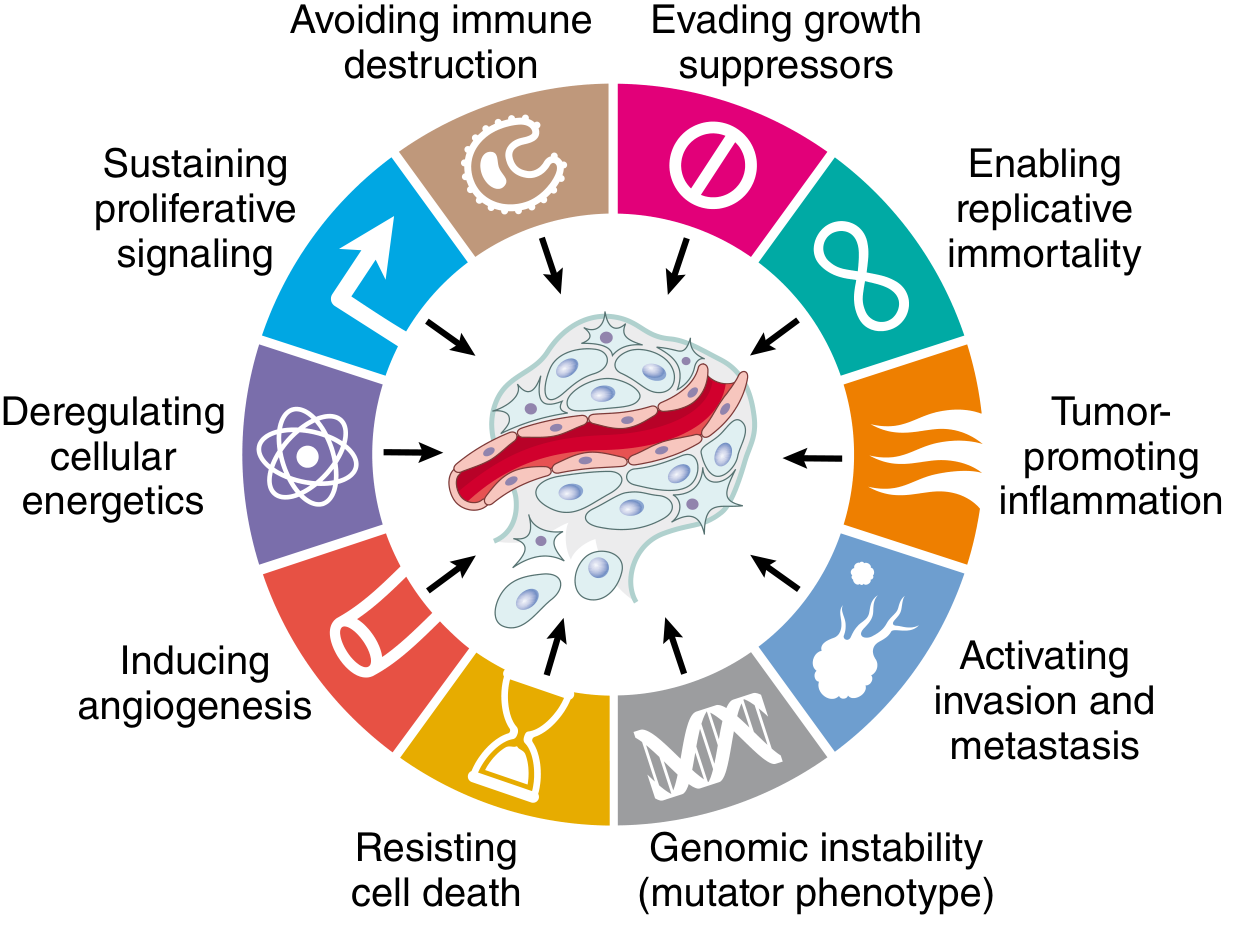
The Core Hallmarks
-
Self-sufficiency in growth signals (sustaining proliferative signaling) - tumor cells proliferate without needing external growth stimuli, usually through oncogene activation (e.g., RAS, growth factor receptor mutations).
-
Insensitivity to growth-inhibitory signals (evading growth suppressors) - cancer cells fail to respond to anti-proliferative signals, typically due to inactivation of tumor suppressor genes (e.g., RB, TP53) that normally enforce growth-inhibitory pathways.
-
Altered cellular metabolism (deregulating cellular energetics) - tumor cells switch to aerobic glycolysis even in the presence of oxygen (the Warburg effect), which supports the biosynthesis of macromolecules and organelles needed for rapid proliferation.
-
Evasion of apoptosis (resisting cell death) - tumors become resistant to programmed cell death, often via loss of pro-apoptotic signaling or overexpression of anti-apoptotic proteins (e.g., BCL2).
-
Limitless replicative potential (enabling replicative immortality) - a stem cell-like property, often via telomerase reactivation, that lets tumor cells bypass senescence and mitotic catastrophe and divide indefinitely.
-
Sustained angiogenesis (inducing angiogenesis) - tumors induce new blood vessel growth (e.g., via VEGF) since they cannot grow beyond a small size without a vascular supply for oxygen, nutrients, and waste removal.
-
Ability to invade and metastasize (activating invasion and metastasis) - the cause of most cancer deaths, arising from an interplay of tumor-intrinsic processes (e.g., epithelial-mesenchymal transition, loss of cell adhesion molecules like E-cadherin) and tissue microenvironment signals.
-
Ability to evade the host immune response (avoiding immune destruction) - cancer cells develop mechanisms to escape recognition and elimination by innate and adaptive immunity, despite displaying abnormal antigens.
Enabling Characteristics
Two additional features are not independent hallmarks themselves but accelerate the acquisition of the above traits:
- Genomic instability (mutator phenotype) - defects in DNA repair and genome maintenance increase mutation rates, speeding acquisition of hallmark capabilities.
- Tumor-promoting inflammation - chronic inflammation in the tumor microenvironment can supply growth factors, survival signals, and pro-angiogenic factors that abet transformation and progression.
(Source: Robbins & Kumar Basic Pathology and Robbins, Cotran & Kumar Pathologic Basis of Disease - Cellular and Molecular Hallmarks of Cancer, p. 251/268; originally from Hanahan D, Weinberg RA. "Hallmarks of cancer: the next generation." Cell. 2011;144:646.)
Note on evolving evidence
The original framework (2000, updated 2011) is being actively extended. Recent reviews propose additional or refined hallmarks worth being aware of if you're studying current literature:
- Complement system activity as a modulator of multiple hallmarks (2025) - [PMID: 40179675]
- Epigenetic dysregulation increasingly framed as a distinct hallmark in its own right (2024) - [PMID: 39363741]
- Re-examination of the framework specifically in sarcomas (2024) - [PMID: 38434982]
These don't contradict the classic 8+2 framework above but reflect ongoing expansion of the model (some newer versions from Hanahan's own group now include "unlocking phenotypic plasticity," "nonmutational epigenetic reprogramming," "polymorphic microbiomes," and "senescent cells" as emerging hallmarks/enabling characteristics).
analyse_media
Your notes are accurate and match the well-known 2022 update to the framework, Hanahan's "Hallmarks of Cancer: New Dimensions" (an expansion beyond the original 2000/2011 model I outlined earlier). Here's how your 14 items map onto that structure:
The 8 core hallmarks
- Sustaining proliferative signaling
- Evading growth suppressors
- Resisting cell death
- Enabling replicative immortality
- Inducing angiogenesis
- Activating invasion and metastasis
- Reprogramming cellular metabolism
- Avoiding (evading) immune destruction
The 2 classic enabling characteristics
9. Genomic instability and mutation
10. Tumor-promoting (tumor-induced) inflammation
4 newly proposed/emerging hallmarks (added in the 2022 update)
11. Unlocking phenotypic plasticity
12. Non-mutational epigenetic reprogramming
13. Polymorphic microbiomes
14. Senescent cells
A couple of small clarifications on your wording:
- Item 10 in your list ("Non-mutated Epigenetic Reprogramming") - the standard term is non-mutational epigenetic reprogramming, referring to heritable changes in gene expression (DNA methylation, histone modification, chromatin remodeling) that alter cancer cell behavior without changing the underlying DNA sequence.
- Item 12 ("Senescent cell") refers to the hallmark of senescent cells - cells that have stopped dividing but resist clearance and secrete factors (the "senescence-associated secretory phenotype," SASP) that can actually promote tumor growth and inflammation in the surrounding tissue, which is somewhat paradoxical since senescence was originally thought of as a tumor-suppressive mechanism.
- Item 11 ("Unlocking phenotypic plasticity") refers to cancer cells escaping their normal differentiated state (e.g., dedifferentiation, transdifferentiation, or blocked terminal differentiation) to adopt more stem-like or alternate identities that aid survival and progression.
Your list is a solid, complete summary of the current expanded framework. Want me to go deeper into the mechanism of any specific one of these 14 (e.g., the microbiome or phenotypic plasticity hallmarks, since those are the newest and least covered in older textbooks)?
Teach me this
The 14 hallmarks form a large topic - too much to teach properly in one shot. Let me break it into a roadmap, give you a quick overview of the whole picture, then we'll go deep on whichever piece you want.
Topic Breakdown
A. The 8 Core Hallmarks (functional capabilities every cancer cell acquires)
- Sustaining proliferative signaling
- Evading growth suppressors
- Resisting cell death
- Enabling replicative immortality
- Inducing angiogenesis
- Activating invasion and metastasis
- Reprogramming cellular metabolism
- Avoiding immune destruction
B. The 2 Classic Enabling Characteristics (mechanisms that accelerate acquisition of the above)
9. Genomic instability and mutation
10. Tumor-promoting inflammation
C. The 4 Emerging Hallmarks/Enablers (added in Hanahan's 2022 update)
11. Unlocking phenotypic plasticity
12. Non-mutational epigenetic reprogramming
13. Polymorphic microbiomes
14. Senescent cells
Quick Overview
The whole framework answers one question: what does a normal cell need to change biologically to become a cancer that grows, survives, spreads, and evades destruction? Hanahan and Weinberg's original insight (2000) was that despite the near-infinite variety of mutations found across different tumors, cancer cells converge on the same small set of acquired capabilities.
The 8 core hallmarks cover the basic biology of unrestrained growth: cells learn to drive their own proliferation, ignore signals that would normally stop them, resist programmed death, become immortal by maintaining telomeres, build their own blood supply, invade tissue and spread to distant organs, rewire metabolism to fuel rapid division (the Warburg effect), and hide from or suppress the immune system.
The 2 enabling characteristics aren't hallmarks themselves but they make acquiring the hallmarks easier and faster: genomic instability generates the mutations that drive the process, and chronic inflammation in the tumor microenvironment supplies growth factors and survival signals.
The 4 newer additions (2022) reflect a decade of research showing cancer biology is more than genetics: cells can dedifferentiate or shift identity (plasticity) without new mutations, gene expression can be reprogrammed epigenetically, gut/tissue microbiomes influence tumor behavior, and senescent cells that resist clearance can paradoxically fuel tumor progression through secreted factors.
Each of these 14 topics has real depth (specific genes, pathways, drug targets, clinical relevance). Which one do you want to go into first?
Asking for Preferences
Which hallmark do you want to go deep on first?
This is a shared conversation. Sign in to Orris to start your own chat.