
Why in liver failure spironolactone is used and not other diuretics like thiazides and loop diuretics
spironolactone liver failure ascites mechanism why not loop diuretics thiazides
Why Spironolactone - Not Thiazides or Loop Diuretics - in Liver Failure
Step 1: Understand the Pathophysiology
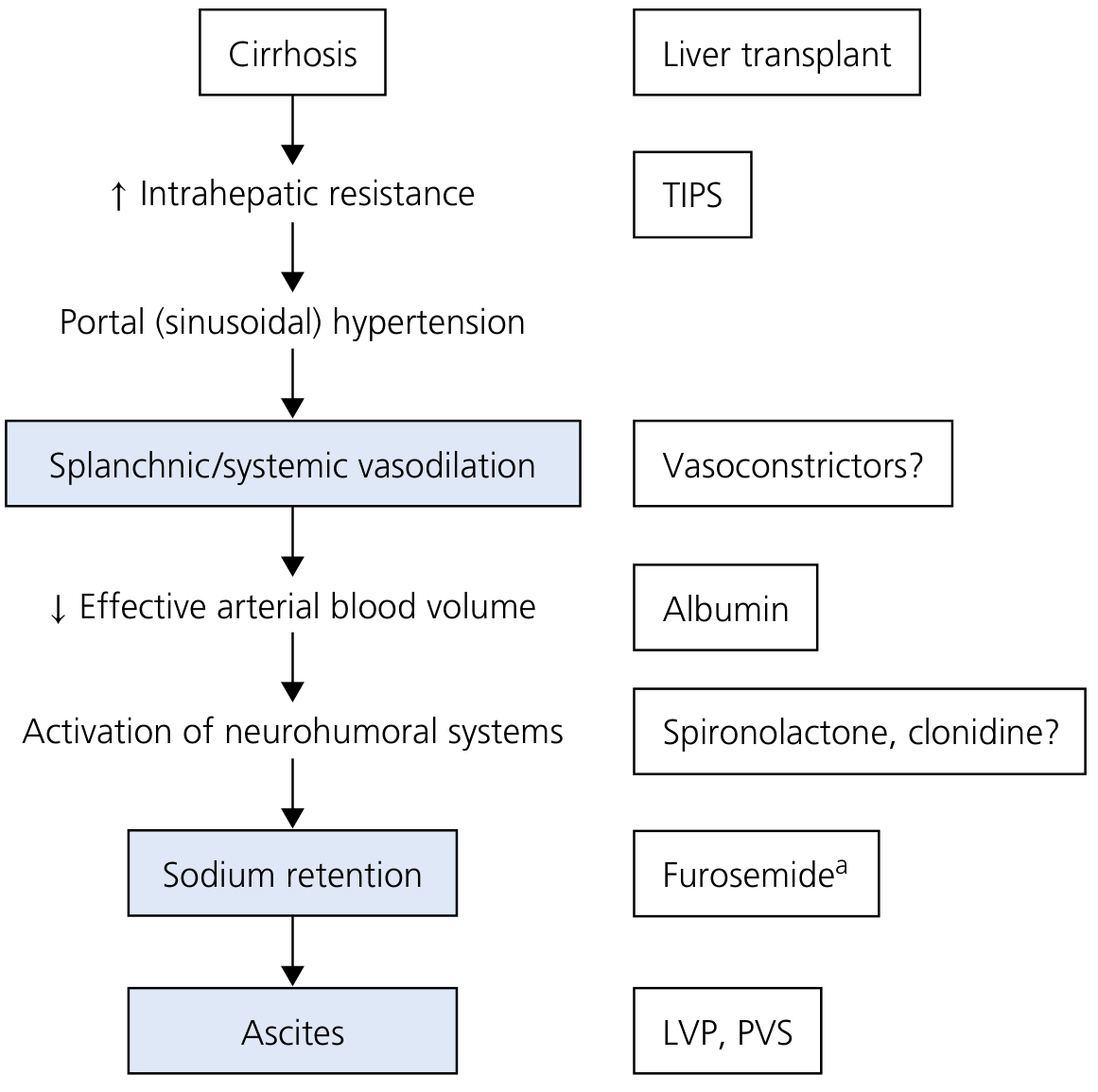
- Increased production - activated RAAS drives the adrenal gland to make more aldosterone
- Decreased hepatic degradation - the failed liver cannot metabolize aldosterone at normal rates
Step 2: Why Spironolactone Works
"Because hyperaldosteronism plays a key role in renal sodium retention in cirrhosis, anti-mineralocorticoids (particularly spironolactone or eplerenone) represent the first line of treatment in the management of cirrhotic ascites."
Step 3: Why Loop Diuretics (e.g., Furosemide) Fail Alone
"When furosemide is used alone, sodium not reabsorbed in the loop of Henle is avidly absorbed in the distal and collecting tubules as a result of the hyperaldosteronism characteristic of most cirrhotic patients with ascites."
- Yamada's Textbook of Gastroenterology
- Hypokalemia - worsens hepatic encephalopathy (K+ depletion promotes ammonia production and renal ammonia generation)
- Metabolic alkalosis - further impairs brain function in encephalopathy
- Volume depletion - triggers hepatorenal syndrome (HRS), one of the most feared complications; only ~500 mL/day can safely be mobilized from ascites without causing circulatory dysfunction
Step 4: Why Thiazides Are Not Used
- Thiazides carry a high risk of hyponatremia - already a major problem in advanced cirrhosis (dilutional hyponatremia from ADH activation)
- Thiazides also cause hypokalemia, again risking encephalopathy
- There is no evidence they offer any advantage over the spironolactone/furosemide combination
- As noted by Yamada's Gastroenterology: "There is no evidence that other diuretics, such as metolazone, thiazides, or other loop diuretics such as bumetanide or torsemide, offer an advantage over spironolactone and furosemide."
Practical Clinical Protocol
| Situation | First-line |
|---|---|
| Mild-moderate ascites | Spironolactone 100 mg/day alone |
| Inadequate response | Add furosemide 40 mg/day (ratio kept at 100:40 to maintain normokalemia) |
| Titrate up to maximum | Spironolactone 400 mg + Furosemide 160 mg |
| Painful gynecomastia | Switch to amiloride (another K+-sparing diuretic, though less effective) |
- Renal impairment from intravascular depletion (~25% of patients)
- Hyponatremia (~28%)
- Hepatic encephalopathy (~26%)
- Hyperkalemia (especially with spironolactone in renal impairment)
Summary Table
| Diuretic | Site of action | Problem in liver failure |
|---|---|---|
| Spironolactone | Collecting duct (blocks aldosterone) | Preferred - targets the root cause |
| Furosemide | Loop of Henle | Sodium reabsorbed downstream by aldosterone; causes hypokalemia/HRS |
| Thiazides | Distal convoluted tubule | Same bypass problem; causes hyponatremia/hypokalemia |
| Amiloride | Collecting duct (blocks ENaC directly) | Alternative if gynecomastia; less natriuretic effect |
Action of loop diuretics in the blood electrolytes levels
loop diuretics electrolyte effects blood Na K Mg Ca mechanism
Effects of Loop Diuretics on Blood Electrolytes
The Root Mechanism
1. Hyponatremia (↓ Na⁺)
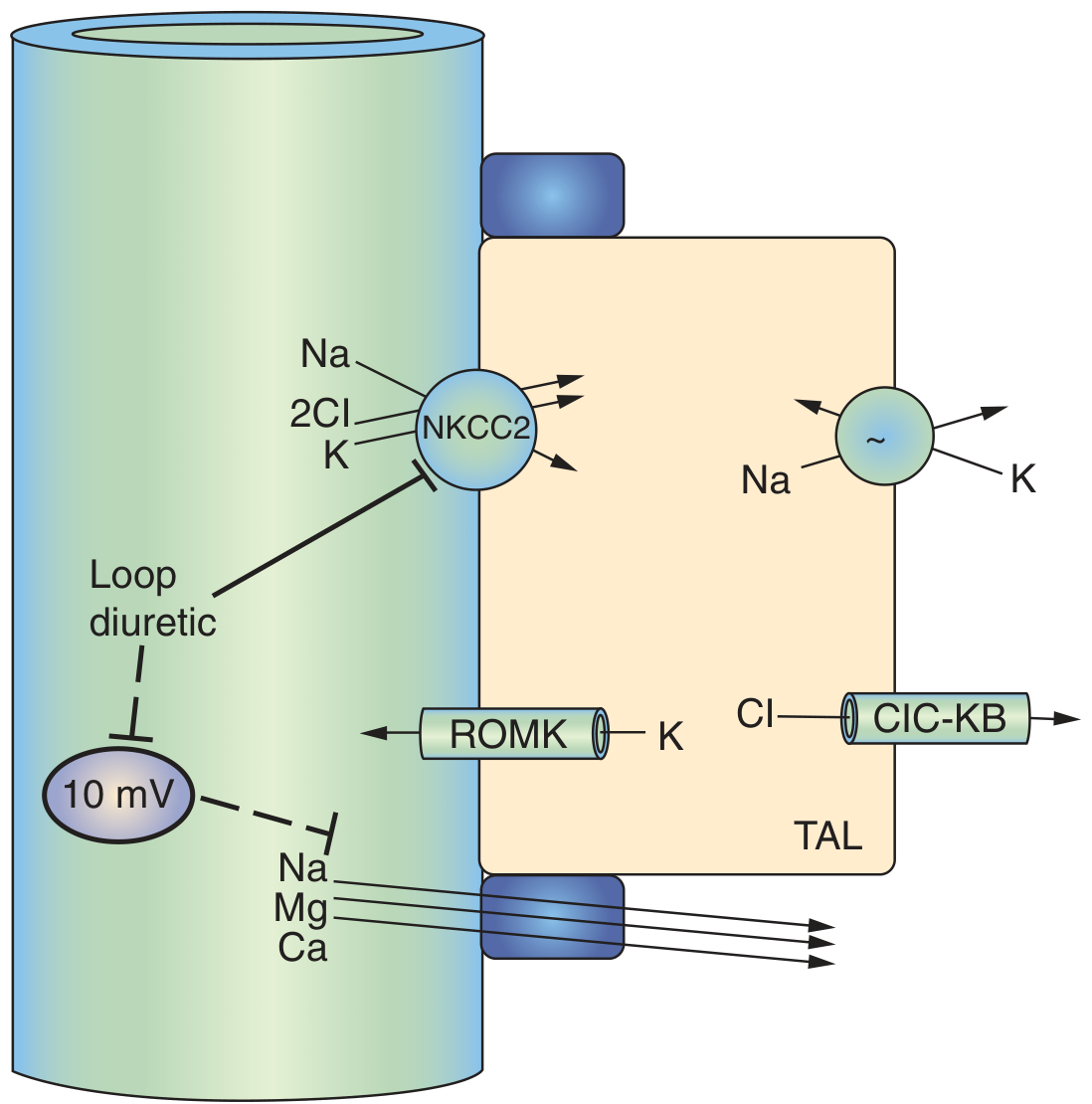
- NKCC2 blockade directly prevents Na⁺ reabsorption in the TAL, which accounts for ~25% of all filtered sodium
- The increased distal sodium delivery overwhelms downstream reabsorption capacity
- Volume depletion from Na⁺ loss stimulates ADH release (non-osmotic), causing water retention - this dilutes serum Na⁺ further
- Secondary RAAS activation causes more renin/aldosterone release, driving more Na⁺ retention (partially compensatory), but at the expense of K⁺
2. Hypokalemia (↓ K⁺) - the most clinically important electrolyte effect
- NKCC2 blockade means more Na⁺ is delivered to the principal cells of the collecting duct
- The Na⁺/K⁺-ATPase in principal cells reabsorbs this extra Na⁺ by exchanging it for K⁺ secretion into the lumen - K⁺ is lost in urine
- Loop diuretics stimulate renin secretion directly via the macula densa (by blocking NaCl entry into macula densa cells, reducing TGF-mediated feedback)
- As Brenner & Rector states: "Loop diuretics also stimulate renin secretion, both in the short term and long term... a major component is from direct effects on the macula densa"
- More renin → more angiotensin II → more aldosterone → aldosterone further amplifies K⁺ secretion at the collecting duct
3. Hypochloremia (↓ Cl⁻)
- NKCC2 directly transports 2 Cl⁻ per cycle - blocking it massively increases urinary Cl⁻ loss
- Cl⁻ is lost in urine alongside Na⁺ and K⁺
4. Metabolic Alkalosis (↑ HCO₃⁻, ↑ pH)
- Volume contraction alkalosis - loss of Cl⁻-rich fluid contracts the ECF volume; a fixed amount of HCO₃⁻ is now dissolved in a smaller volume → "contraction alkalosis"
- Hypokalemia drives alkalosis - K⁺ depletion causes H⁺ to shift into cells in exchange for K⁺, lowering extracellular [H⁺] → alkalosis
- Aldosterone effect - secondary hyperaldosteronism drives H⁺ secretion by intercalated cells of the collecting duct, generating more HCO₃⁻
5. Hypomagnesemia (↓ Mg²⁺)
"Loop diuretics eliminate this potential difference and can therefore increase calcium and magnesium excretion."
6. Hypocalcemia (↓ Ca²⁺) - key distinction from thiazides
- Ca²⁺ (~20% of filtered load) is reabsorbed passively via paracellular route in the TAL, driven by the +10 mV transepithelial voltage
- Loop diuretics abolish this voltage → Ca²⁺ lost in urine
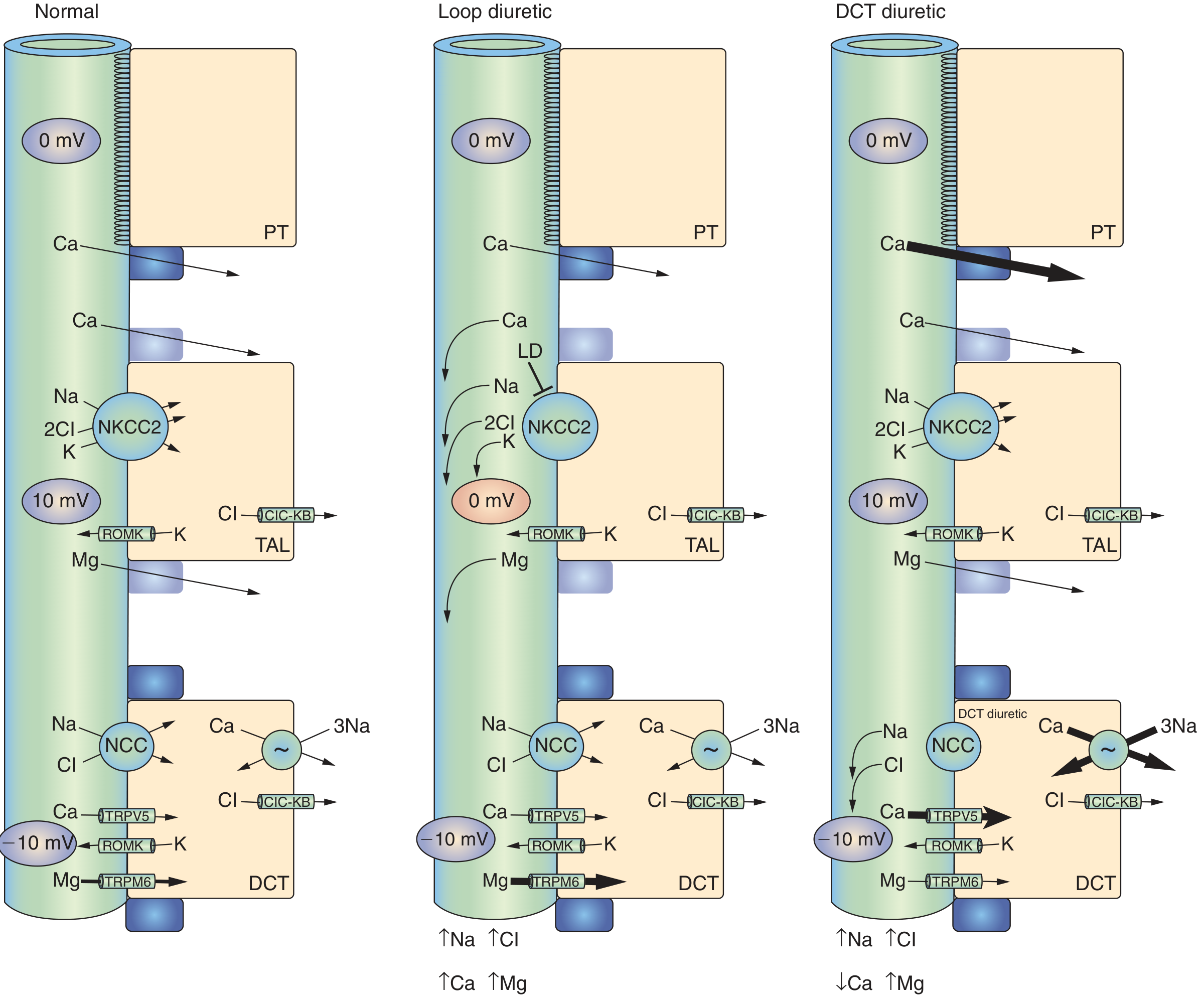
- Loop diuretics → hypocalcemia → used clinically to treat hypercalcemia
- Thiazides → hypercalcemia → preferred in patients with osteoporosis or calcium stones
7. Hyperuricemia (↑ Uric acid) - bonus effect
- Acutely, loop diuretics increase uric acid excretion
- Chronically, volume depletion enhances proximal tubular uric acid reabsorption (via OAT transporters), raising serum uric acid
- Can precipitate gout in susceptible patients
Summary Table
| Electrolyte | Blood Level | Key Mechanism |
|---|---|---|
| Na⁺ | ↓ (hyponatremia) | Direct TAL blockade + ADH-driven water retention |
| K⁺ | ↓ (hypokalemia) | ↑ distal Na⁺ delivery + secondary hyperaldosteronism |
| Cl⁻ | ↓ (hypochloremia) | NKCC2 directly transports 2Cl⁻ |
| HCO₃⁻/pH | ↑ (metabolic alkalosis) | Volume contraction + hypokalemia + aldosterone |
| Mg²⁺ | ↓ (hypomagnesemia) | Loss of +10mV transepithelial voltage in TAL |
| Ca²⁺ | ↓ (hypocalcemia) | Loss of +10mV transepithelial voltage in TAL |
| Uric acid | ↑ (hyperuricemia) | Chronic proximal tubular reabsorption via volume contraction |
- Hypokalemia and hypomagnesemia are interlinked - you often cannot correct K⁺ without first repleting Mg²⁺, because low Mg²⁺ impairs renal K⁺ retention
- The metabolic alkalosis from loop diuretics is Cl⁻-responsive (corrects with volume and KCl repletion)
- Furosemide's calciuric effect is exploited therapeutically in hypercalcemic crisis (IV furosemide + IV saline drives urinary Ca²⁺ loss)
How does metformin causes B12 deficiency
metformin vitamin B12 deficiency mechanism calcium intrinsic factor ileum
metformin vitamin B12 deficiency mechanism
How Metformin Causes Vitamin B12 Deficiency
Normal B12 Absorption (Brief Review)
- Stomach - Dietary B12 (cobalamin) is released from food proteins by pepsin and gastric acid, then binds to a salivary protein called haptocorrin (R-protein)
- Duodenum - Pancreatic proteases release B12 from haptocorrin; free B12 then binds intrinsic factor (IF), secreted by gastric parietal cells
- Terminal ileum - The B12-IF complex binds to a specific receptor called cubilin on the surface of ileal epithelial cells. This step is calcium-dependent - Ca²⁺ is required for the complex to dock onto the receptor
- Endocytosis - The B12-IF-cubilin complex is internalized; within the cell, B12 binds transcobalamin II and enters the portal circulation
- Liver - B12 is stored in large amounts (enough for 3-5 years), and undergoes enterohepatic recirculation via bile
How Metformin Disrupts This
Mechanism 1: Calcium-Dependent Ileal Absorption Blockade (Primary Mechanism)
- Metformin is a biguanide with a hydrophobic tail that inserts into the hydrocarbon core of intestinal cell membranes
- This insertion imparts a net positive charge to the cell membrane surface
- The positively charged membrane repels Ca²⁺ ions at the ileal lumen-cell interface
- Without adequate Ca²⁺, the B12-IF complex cannot bind to the cubilin receptor on ileal epithelial cells
- The complex passes through the gut unabsorbed and is lost in stool
"Metformin → Vitamin B₁₂ → Impairs absorption" (drug-nutrient interaction table)
Mechanism 2: Gut Microbiome Alteration and Bacterial Overgrowth
- Metformin is known to significantly alter the gut microbiome - it promotes growth of certain bacteria (notably Akkermansia muciniphila and Bifidobacterium) and suppresses others
- Some of the altered bacterial species consume vitamin B12 for their own metabolic needs, reducing the amount available for absorption
- Additionally, bacterial overgrowth in the small intestine can compete for the B12-IF complex before it reaches the terminal ileum
- Metformin also slows intestinal transit (contributes to its GI side effects), which may prolong bacterial exposure to the B12-IF complex
Mechanism 3: Direct Structural Interference with the B12-IF Complex
- A third proposed mechanism suggests metformin may directly bind to the B12-IF complex, altering its structure
- A structurally modified complex would have reduced affinity for the cubilin receptor, even if calcium is available
- This mechanism is less well characterized than Mechanism 1
Why This Matters Clinically
- Dose-dependent - higher daily doses = greater risk
- Duration-dependent - longer treatment = greater cumulative depletion of hepatic stores
- Seen in up to 10-30% of long-term users in various studies
- Clinically silent early - hepatic B12 stores last 3-5 years, so deficiency can develop insidiously over years of treatment
Risk Factors for Greater Depletion
| Risk Factor | Why It Worsens B12 Depletion |
|---|---|
| High metformin dose (>1.5 g/day) | More membrane charge displacement |
| Duration >5 years | Hepatic stores eventually depleted |
| Vegetarian/vegan diet | Low dietary B12 intake to begin with |
| Concomitant PPI or H2 blocker use | PPIs reduce gastric acid → impair B12 release from food; together with metformin, up to 65% reduction in B12 absorption |
| Elderly patients | More atrophic gastritis, reduced IF secretion, reduced gastric acid |
| Pre-existing low B12 stores | Less buffer before clinical deficiency |
Summary of the Mechanism
Metformin (hydrophobic tail inserts into ileal cell membrane)
        ↓
Net positive charge on membrane surface
        ↓
Ca²⁺ ions repelled from ileal lumen-cell interface
        ↓
B12-Intrinsic Factor complex cannot bind cubilin receptor
        ↓
B12-IF complex not endocytosed → lost in stool
        ↓
Reduced circulating B12 → hepatic stores slowly depleted
        ↓
Megaloblastic changes + Peripheral/autonomic neuropathy
Management
- Routine monitoring: Check serum B12 every 1-2 years in long-term metformin users; use MMA levels if borderline
- Calcium supplementation: 1200 mg/day calcium carbonate can partially restore absorption
- B12 supplementation: Oral B12 1000 µg/day (works via passive diffusion, even without IF) or IM cyanocobalamin if severe deficiency
- Do not stop metformin for this reason alone - the cardiovascular and glycemic benefits far outweigh the risk when monitored and supplemented appropriately
List me the various names effects in medicine ex Macklin effect
famous named effects phenomena in medicine eponymous list clinical
named effects in medicine "Bohr effect" "Haldane effect" "Cushing reflex" "Starling law" "Bainbridge reflex" physiology eponymous effects list
Named Effects in Medicine - A Comprehensive List
RESPIRATORY
CARDIOVASCULAR
RENAL / FLUID
BLOOD / HEMATOLOGY
PHARMACOLOGY / TOXICOLOGY
NEUROLOGICAL / BRAIN
ENDOCRINE / METABOLIC
PULMONARY / CRITICAL CARE
GASTROENTEROLOGY / SURGERY
IMMUNOLOGY / ONCOLOGY
QUICK-REFERENCE SUMMARY TABLE
| Effect | System | One-Line Summary |
|---|---|---|
| Macklin | Respiratory | Alveolar rupture → pneumomediastinum via bronchovascular sheath |
| Bohr | Respiratory | ↑CO₂/↑H⁺ → right shift of ODC → O₂ unloading |
| Haldane | Respiratory | Deoxy-Hb carries more CO₂ than oxy-Hb |
| Euler-Liljestrand | Respiratory | Hypoxia → local pulmonary vasoconstriction → V/Q matching |
| Frank-Starling | Cardiac | ↑Preload → ↑Stroke volume |
| Bowditch/Treppe | Cardiac | ↑Heart rate → ↑Contractility |
| Anrep | Cardiac | ↑Afterload → slow recovery of contractility |
| Cushing | Neuro/Cardiac | ↑ICP → hypertension + bradycardia + irregular breathing |
| Bainbridge | Cardiac | ↑Atrial pressure → tachycardia |
| Bezold-Jarisch | Cardiac | Cardiac C-fiber stimulation → bradycardia + hypotension |
| Windkessel | Vascular | Aortic elastic recoil maintains diastolic pressure |
| Doppler | Vascular | Wave frequency shift used in blood flow measurement |
| Starling Forces | Renal | Four forces governing capillary fluid exchange |
| Warburg | Oncology | Cancer cells use aerobic glycolysis (↑PET uptake) |
| Abscopal | Oncology | Local RT causes systemic tumor regression via immunity |
| Prozone | Immunology | Antigen excess → false negative serology |
| First-Pass | Pharmacology | Hepatic pre-systemic drug metabolism |
| Tachyphylaxis | Pharmacology | Rapid drug tolerance with repeated doses |
| Somogyi | Endocrine | Nocturnal hypoglycemia → morning hyperglycemia rebound |
| Dawn Phenomenon | Endocrine | GH/cortisol surge → morning hyperglycemia |
| Spreading Depression | Neuro | Wave of depolarization across cortex → migraine aura |
| Kindling | Neuro | Repeated sub-threshold stimulation → seizures |
| 2,3-BPG Effect | Hematology | ↑2,3-BPG → right shift ODC → better O₂ delivery in hypoxia |
| Courvoisier | GI | Palpable painless gallbladder = malignant obstruction |
Create a study guide PDF of named effects organized by system
ls /home/daytona/workspace/ 2>/dev/null && echo "---" && python3 -c "import reportlab; print('reportlab ok')"
mkdir -p /home/daytona/workspace/named-effects-guide
~/named-effects-guide/build_pdf.py
from reportlab.lib.pagesizes import A4
from reportlab.lib import colors
from reportlab.lib.styles import getSampleStyleSheet, ParagraphStyle
from reportlab.lib.units import cm, mm
from reportlab.platypus import (
SimpleDocTemplate, Paragraph, Spacer, Table, TableStyle,
HRFlowable, PageBreak, KeepTogether
)
from reportlab.lib.enums import TA_LEFT, TA_CENTER, TA_JUSTIFY
from reportlab.platypus import BaseDocTemplate, Frame, PageTemplate
from reportlab.lib.colors import HexColor
OUTPUT = "/home/daytona/workspace/named-effects-guide/Named_Effects_in_Medicine.pdf"
# ── Colour palette ──────────────────────────────────────────────────────────
C_NAVY = HexColor("#1a3a5c") # deep navy – title / system headers
C_TEAL = HexColor("#0d7c8c") # teal – effect name labels
C_STEEL = HexColor("#3d7ab5") # mid-blue – sub-headings
C_LIGHT = HexColor("#e8f4f8") # pale blue – row shading
C_PALE = HexColor("#f4f9fc") # near-white – page bg tint effect
C_ACCENT = HexColor("#e05e2a") # warm orange – "Clinical pearl" accent
C_GRAY = HexColor("#6b7c93") # gray – body text complement
C_LGRAY = HexColor("#dce7f0") # light gray – table borders
C_WHITE = colors.white
C_BLACK = colors.black
PAGE_W, PAGE_H = A4
# ── Styles ───────────────────────────────────────────────────────────────────
base = getSampleStyleSheet()
def S(name, **kw):
"""Create a ParagraphStyle from base Normal + overrides."""
s = ParagraphStyle(name, parent=base["Normal"], **kw)
return s
sTitle = S("sTitle",
fontSize=28, fontName="Helvetica-Bold", textColor=C_WHITE,
alignment=TA_CENTER, leading=34, spaceAfter=4)
sSubtitle = S("sSubtitle",
fontSize=13, fontName="Helvetica", textColor=HexColor("#cce0f0"),
alignment=TA_CENTER, leading=18, spaceAfter=2)
sTocHead = S("sTocHead",
fontSize=14, fontName="Helvetica-Bold", textColor=C_NAVY,
spaceAfter=6, spaceBefore=4)
sTocItem = S("sTocItem",
fontSize=11, fontName="Helvetica", textColor=C_NAVY,
leftIndent=14, spaceAfter=3)
sSysHeader = S("sSysHeader",
fontSize=16, fontName="Helvetica-Bold", textColor=C_WHITE,
alignment=TA_LEFT, leading=20, spaceBefore=6, spaceAfter=2)
sEffectName = S("sEffectName",
fontSize=12, fontName="Helvetica-Bold", textColor=C_TEAL,
spaceBefore=8, spaceAfter=2, leading=15)
sAltName = S("sAltName",
fontSize=10, fontName="Helvetica-Oblique", textColor=C_GRAY,
spaceBefore=0, spaceAfter=2, leading=13)
sBody = S("sBody",
fontSize=10, fontName="Helvetica", textColor=HexColor("#1e2a38"),
leading=14, spaceAfter=4, alignment=TA_JUSTIFY)
sPearl = S("sPearl",
fontSize=9.5, fontName="Helvetica-Oblique", textColor=C_ACCENT,
leading=13, leftIndent=12, spaceAfter=6)
sFooter = S("sFooter",
fontSize=8, fontName="Helvetica", textColor=C_GRAY,
alignment=TA_CENTER)
# ── Data ─────────────────────────────────────────────────────────────────────
SYSTEMS = [
{
"name": "Respiratory",
"color": HexColor("#1a6b7a"),
"effects": [
{
"name": "Macklin Effect",
"alt": "Also called: Macklin pathway",
"desc": (
"Air dissects from ruptured alveoli along bronchovascular sheaths "
"toward the mediastinum, causing pneumomediastinum. Occurs in blunt "
"chest trauma, severe asthma, mechanical ventilation barotrauma, and "
"COVID-19 pneumonia. The air follows the path of least resistance "
"centrally rather than escaping to the pleural space."
),
"pearl": "Clinical pearl: Look for streaky perihilar air on CT following blunt chest trauma — classic Macklin appearance.",
},
{
"name": "Bohr Effect",
"alt": "Described by Christian Bohr, 1904",
"desc": (
"Increased CO₂ and H⁺ (lower pH) shift the oxyhemoglobin dissociation "
"curve to the RIGHT, reducing hemoglobin's affinity for O₂. This "
"facilitates O₂ unloading at metabolically active, acidic tissues "
"(e.g., exercising muscle). The reverse occurs in the lungs (lower "
"PCO₂, higher pH → left shift → O₂ loading)."
),
"pearl": "Clinical pearl: The Bohr effect is why fever and acidosis promote O₂ tissue delivery. Conversely, stored bank blood (low 2,3-BPG, low CO₂) has a left-shifted curve — poor O₂ unloading.",
},
{
"name": "Haldane Effect",
"alt": "Described by John Scott Haldane",
"desc": (
"Deoxygenated hemoglobin carries significantly more CO₂ than "
"oxygenated hemoglobin at the same PCO₂. Deoxy-Hb more readily "
"accepts protons (H⁺), driving the carbonate buffer toward "
"HCO₃⁻ formation and carbamino-Hb binding. In the lungs, "
"O₂ binding displaces CO₂, facilitating CO₂ excretion."
),
"pearl": "Clinical pearl: The Haldane effect explains why giving high-flow O₂ to COPD patients (raising O₂-Hb saturation) can paradoxically increase PaCO₂ — O₂-Hb releases CO₂ from Hb, raising dissolved CO₂.",
},
{
"name": "Euler-Liljestrand Mechanism",
"alt": "Also: Hypoxic Pulmonary Vasoconstriction (HPV)",
"desc": (
"Alveolar hypoxia causes local pulmonary arteriolar vasoconstriction, "
"diverting blood away from poorly ventilated lung segments to better-"
"ventilated ones. This optimizes V/Q matching. The mechanism involves "
"inhibition of K⁺ channels in pulmonary vascular smooth muscle → "
"membrane depolarization → Ca²⁺ influx → vasoconstriction."
),
"pearl": "Clinical pearl: Inhibited by volatile anaesthetics, Ca²⁺ channel blockers, and vasodilators. Chronically activated in COPD/high altitude → pulmonary hypertension.",
},
{
"name": "Pendelluft",
"alt": "German: 'swinging air'",
"desc": (
"Gas oscillates between lung units with different time constants "
"during spontaneous breathing in ARDS. Regional over-distension "
"occurs even with low tidal volumes. A key mechanism of patient "
"self-inflicted lung injury (P-SILI) — particularly dangerous with "
"strong inspiratory efforts against non-uniform lung compliance."
),
"pearl": "Clinical pearl: Neuromuscular blockade in severe ARDS partly works by eliminating pendelluft.",
},
{
"name": "Oxygen Toxicity (Paul Bert Effect)",
"alt": "Paul Bert, 1878 — CNS O₂ toxicity",
"desc": (
"Breathing high-pressure O₂ (hyperbaric, >1.6 ATA) causes CNS "
"toxicity — visual disturbances, tinnitus, nausea, and tonic-clonic "
"seizures. Due to excess ROS overwhelming antioxidant defenses in "
"neuronal tissue. Distinct from Lorrain Smith effect (pulmonary O₂ "
"toxicity from prolonged normobaric high FiO₂ > 0.6)."
),
"pearl": "Clinical pearl: Lorrain Smith effect in ICU — avoid FiO₂ >0.6 for >24–48 hours; causes alveolar inflammation and diffuse alveolar damage.",
},
{
"name": "Bernoulli / Venturi Effect",
"alt": "Basis of Venturi masks and nebulisers",
"desc": (
"In a flowing fluid, increased velocity through a constriction "
"produces decreased lateral (side-wall) pressure (Bernoulli principle). "
"Applied in Venturi masks: high-velocity O₂ jet entrains room air "
"through side ports in a fixed ratio, delivering a precise FiO₂ "
"regardless of patient's breathing pattern."
),
"pearl": "Clinical pearl: Dynamic airway collapse in COPD during forced expiration is also explained by Bernoulli — intraluminal pressure drops at high flow, and atmospheric pressure crushes the airway.",
},
],
},
{
"name": "Cardiovascular",
"color": HexColor("#8b1a2e"),
"effects": [
{
"name": "Frank-Starling Law",
"alt": "Otto Frank (1895) & Ernest Starling (1914)",
"desc": (
"Within physiological limits, stroke volume increases proportionally "
"with end-diastolic volume (preload). Greater sarcomere stretch → "
"greater overlap of actin-myosin cross-bridges → stronger contraction. "
"This intrinsic autoregulation allows the heart to match output to "
"venous return beat-to-beat without neural input."
),
"pearl": "Clinical pearl: In heart failure, the Starling curve is depressed and flattened — increasing preload produces little increase in stroke volume but causes pulmonary congestion.",
},
{
"name": "Bowditch Effect (Treppe / Staircase)",
"alt": "Henry Pickering Bowditch, 1871",
"desc": (
"Increasing heart rate leads to a stepwise increase in myocardial "
"contractility (positive force-frequency relationship). More frequent "
"action potentials → less time for Na⁺/Ca²⁺ exchanger to extrude Ca²⁺ "
"→ greater intracellular Ca²⁺ accumulation → greater force per beat. "
"Important during exercise-induced tachycardia."
),
"pearl": "Clinical pearl: Exploited pharmacologically — cardiac glycosides (digoxin) raise intracellular Ca²⁺ by blocking Na/K-ATPase, mimicking this effect to increase contractility.",
},
{
"name": "Anrep Effect",
"alt": "Von Anrep, 1912",
"desc": (
"When aortic pressure (afterload) is abruptly increased, stroke volume "
"initially falls but then slowly recovers over 1–2 minutes back toward "
"baseline. Attributed to stretch-induced autocrine/paracrine release of "
"angiotensin II and endothelin from cardiac myocytes, increasing "
"contractility. A form of slow-response autoregulation."
),
"pearl": "Clinical pearl: Contrasted with the immediate Frank-Starling response to preload. The Anrep effect is an intrinsic response to afterload changes — relevant in sudden hypertensive crises.",
},
{
"name": "Cushing Reflex (Cushing Response)",
"alt": "Harvey Cushing, 1901 — also: CNS ischemic response",
"desc": (
"Acute rise in intracranial pressure (ICP) → brainstem ischemia → "
"massive sympathetic discharge → systemic hypertension. The hypertension "
"reflexly causes bradycardia (baroreceptor-mediated) and the brainstem "
"compression causes irregular (Cheyne-Stokes) respiration. "
"Cushing's triad: hypertension + bradycardia + irregular breathing = "
"sign of imminent herniation."
),
"pearl": "Clinical pearl: A late and ominous sign — when you see the Cushing triad, the patient is minutes from herniation. Requires immediate neurosurgical intervention.",
},
{
"name": "Bainbridge Reflex",
"alt": "Francis Bainbridge, 1915",
"desc": (
"Increased right atrial pressure (from volume loading or increased "
"venous return) stretches atrial mechanoreceptors, triggering a reflex "
"tachycardia via vagal afferents to medullary cardiovascular centers. "
"This helps increase cardiac output to clear venous overload. Opposes "
"the baroreflex-mediated bradycardia at high pressures."
),
"pearl": "Clinical pearl: The net heart rate response to volume loading depends on the balance between the Bainbridge reflex (tachycardia) and baroreceptor reflex (bradycardia).",
},
{
"name": "Bezold-Jarisch Reflex",
"alt": "Albert von Bezold & Adolf Jarisch",
"desc": (
"Stimulation of cardiac C-fiber afferents (vagal) in the inferoposterior "
"left ventricle by chemical irritants or ischemia causes the triad of: "
"bradycardia, hypotension, and apnea. Seen in inferior STEMI (RCA "
"occlusion), spinal anaesthesia, and vasovagal syncope. The reflex "
"arises from receptor activation in ischemic myocardium."
),
"pearl": "Clinical pearl: Inferior STEMI patients often have paradoxical bradycardia and hypotension — Bezold-Jarisch reflex. Treat with atropine (not more fluids alone).",
},
{
"name": "Windkessel Effect",
"alt": "German: 'air chamber'; concept by Stephen Hales, formalized by Otto Frank",
"desc": (
"The aorta and large elastic arteries behave like a pressure reservoir: "
"they expand (storing energy) during systole and recoil during diastole, "
"maintaining continuous flow to the periphery. This converts the pulsatile "
"cardiac output into a more continuous flow, sustaining diastolic pressure."
),
"pearl": "Clinical pearl: Arteriosclerosis (stiff aorta) loses the Windkessel effect → widened pulse pressure, systolic hypertension, low diastolic pressure — common in the elderly.",
},
{
"name": "Fick Principle",
"alt": "Adolf Fick, 1870",
"desc": (
"Cardiac output = O₂ consumption ÷ arteriovenous O₂ difference. "
"The amount of substance taken up by an organ per unit time equals "
"the blood flow × the arteriovenous concentration difference. "
"Gold standard for measuring cardiac output via right heart catheterisation."
),
"pearl": "Clinical pearl: Thermodilution (PA catheter) and echo methods are used clinically; the Fick method remains the reference standard for research and complex cases.",
},
],
},
{
"name": "Renal & Fluid",
"color": HexColor("#1a5c3a"),
"effects": [
{
"name": "Starling Forces",
"alt": "Ernest Starling, 1896",
"desc": (
"Four forces determine transcapillary fluid movement: (1) capillary "
"hydrostatic pressure (Pc) — pushes fluid OUT; (2) interstitial "
"hydrostatic pressure (Pi) — pushes fluid IN; (3) capillary oncotic "
"pressure (πc) — pulls fluid IN; (4) interstitial oncotic pressure "
"(πi) — pulls fluid OUT. Net filtration = Kf × [(Pc − Pi) − σ(πc − πi)]."
),
"pearl": "Clinical pearl: Hypoalbuminaemia (low πc) → oedema. Increased capillary hydrostatic pressure (heart failure, portal hypertension) → oedema / ascites.",
},
{
"name": "Tubuloglomerular Feedback (Macula Densa Effect)",
"alt": "TGF — renal autoregulation",
"desc": (
"Increased NaCl delivery to the macula densa cells of the distal tubule "
"→ release of adenosine → afferent arteriolar constriction → reduced "
"GFR. This negative feedback loop maintains constant single-nephron GFR "
"despite changes in perfusion pressure. NaCl entry via NKCC2 in macula "
"densa cells is the sensor — blocked by loop diuretics."
),
"pearl": "Clinical pearl: NSAIDs impair renal autoregulation (block prostaglandin-mediated afferent dilation), causing acute kidney injury especially with co-existing dehydration or RAAS activation.",
},
{
"name": "Gibbs-Donnan Effect",
"alt": "Josiah Gibbs & Frederick Donnan",
"desc": (
"When a charged, non-diffusible molecule (e.g., plasma proteins) is "
"confined to one side of a semipermeable membrane, diffusible ions "
"distribute unequally to maintain electrical neutrality, generating a "
"Donnan equilibrium potential. Plasma proteins (negative) cause [Cl⁻] "
"to be lower and [Na⁺] to be higher in plasma vs. interstitium."
),
"pearl": "Clinical pearl: Explains why plasma [Cl⁻] is slightly lower than interstitial fluid — relevant in anion gap calculations and ICU electrolyte interpretation.",
},
{
"name": "Countercurrent Multiplication (Henle's Loop Effect)",
"alt": "Mechanism of urinary concentration",
"desc": (
"The hairpin structure of the loop of Henle allows the descending limb "
"(water-permeable) and ascending limb (water-impermeable, ion-transporting) "
"to amplify a small transverse osmotic gradient into a large axial gradient "
"in the medullary interstitium (up to 1200 mOsm/kg). ADH then allows the "
"collecting duct to equilibrate with this hyperosmotic environment."
),
"pearl": "Clinical pearl: Loop diuretics (block NKCC2 in TAL) wash out the medullary gradient → inability to concentrate urine — therapeutic and also the mechanism of polyuria with furosemide.",
},
],
},
{
"name": "Haematology",
"color": HexColor("#6b1a1a"),
"effects": [
{
"name": "2,3-BPG (Bisphosphoglycerate) Effect",
"alt": "Also: Rapoport-Luebering shunt product",
"desc": (
"2,3-BPG is produced in red blood cells via the Rapoport-Luebering "
"shunt. It binds to the central cavity of deoxy-Hb (T state), stabilising "
"it and reducing O₂ affinity — right-shifting the ODC. Levels increase "
"in chronic hypoxia, high altitude, anaemia, and chronic lung disease, "
"enhancing O₂ delivery to tissues."
),
"pearl": "Clinical pearl: Stored bank blood loses 2,3-BPG over days (left shift, poor O₂ unloading). Massive transfusion of old blood may temporarily impair tissue O₂ delivery despite normal SpO₂.",
},
{
"name": "Prozone Effect (Hook Effect)",
"alt": "Antigen excess phenomenon",
"desc": (
"At very high antigen concentrations, an immunoassay gives a falsely "
"low or negative result because antigen excess saturates all antibody "
"binding sites individually, preventing the cross-linking needed for "
"precipitation or agglutination. A dilution of the sample restores "
"a positive result."
),
"pearl": "Clinical pearl: Classic example — RPR/VDRL may be falsely negative in secondary syphilis (very high antigen load). Always dilute the sample if syphilis is strongly suspected despite a negative RPR.",
},
{
"name": "Rouleaux Formation",
"alt": "French: 'roll of coins'",
"desc": (
"Red blood cells stack like coins due to elevated plasma proteins "
"(fibrinogen, immunoglobulins) that bridge between adjacent RBCs, "
"reducing the normal negative surface charge (zeta potential) that "
"keeps RBCs apart. Elevates ESR. Seen in multiple myeloma, infection, "
"pregnancy, and chronic inflammatory states."
),
"pearl": "Clinical pearl: Rouleaux on a peripheral blood film in a patient with bone pain, hypercalcaemia, and anaemia — think multiple myeloma.",
},
],
},
{
"name": "Neurology",
"color": HexColor("#4a1a6b"),
"effects": [
{
"name": "Spreading Cortical Depression (Leão Effect)",
"alt": "Aristides Leão, 1944",
"desc": (
"A self-propagating wave of neuronal and glial depolarisation that "
"travels across the cortex at ~3–5 mm/min, followed by prolonged "
"neuronal suppression. Involves massive redistribution of ions (K⁺ "
"efflux, Na⁺/Ca²⁺ influx). The established neurobiological basis of "
"the migraine aura — the aura 'march' corresponds to the wave front."
),
"pearl": "Clinical pearl: Triptans work partly by preventing spreading depression initiation and by causing trigeminovascular vasoconstriction — do not give in hemiplegic migraine (risk of true infarction).",
},
{
"name": "Kindling Effect",
"alt": "Graham Goddard, 1967",
"desc": (
"Repeated sub-threshold electrical or chemical stimulation of limbic "
"brain structures progressively lowers the seizure threshold, eventually "
"producing spontaneous seizures. Permanent synaptic reorganisation occurs "
"(long-term potentiation-like mechanisms). Also proposed as a model for "
"recurrent mood episodes in bipolar disorder becoming progressively "
"easier to trigger over time."
),
"pearl": "Clinical pearl: Clinical implication — early aggressive treatment of seizures may prevent kindling-induced epileptogenesis. Carbamazepine (anti-kindling properties) preferred in some epilepsy types.",
},
{
"name": "Mass Effect (Cerebral)",
"alt": "Radiological / clinical term",
"desc": (
"An intracranial space-occupying lesion (tumour, haematoma, abscess, "
"infarct with oedema) displaces and compresses adjacent brain structures. "
"Causes midline shift, effacement of sulci, ventricular compression, "
"and ultimately transtentorial or tonsillar herniation syndromes."
),
"pearl": "Clinical pearl: >5 mm midline shift on CT is a surgical emergency. Early signs: ipsilateral CN III palsy (blown pupil) from uncal herniation against the tentorial edge.",
},
{
"name": "Doppler Effect",
"alt": "Christian Doppler, 1842",
"desc": (
"The apparent frequency of a wave changes when source and observer "
"are in relative motion. Applied in transcranial Doppler (TCD) to "
"measure cerebral blood flow velocity. Also widely used in "
"echocardiography and vascular ultrasound to assess blood flow "
"direction and velocity."
),
"pearl": "Clinical pearl: TCD-detected microemboli in the middle cerebral artery predict stroke risk in carotid stenosis and patent foramen ovale.",
},
],
},
{
"name": "Pharmacology & Toxicology",
"color": HexColor("#5c4a1a"),
"effects": [
{
"name": "First-Pass Effect",
"alt": "Pre-systemic hepatic metabolism",
"desc": (
"Orally administered drugs are absorbed via gut into the portal vein "
"and pass through the liver before reaching systemic circulation. "
"Hepatic enzymes (CYP450) may substantially metabolise the drug, "
"dramatically reducing bioavailability. Drugs with high first-pass "
"effect require much higher oral vs. IV doses (e.g., morphine 30:10, "
"glyceryl trinitrate essentially 100% first-pass)."
),
"pearl": "Clinical pearl: GTN given sublingually or transdermally bypasses first-pass. Propranolol, verapamil, and lignocaine all have significant first-pass — IV doses are much smaller than oral.",
},
{
"name": "Tachyphylaxis",
"alt": "Greek: 'rapid protection'",
"desc": (
"Rapid diminution of a drug's effect with closely repeated doses — "
"distinct from tolerance (slower, develops over days-weeks). "
"Mechanisms: receptor downregulation/desensitisation, depletion of "
"neurotransmitter stores, or ion channel inactivation. Classic "
"examples: ephedrine (indirect sympathomimetic — depletes NE stores), "
"desensitisation of β₂ receptors with frequent SABA use."
),
"pearl": "Clinical pearl: Patients who overuse salbutamol inhalers develop tachyphylaxis — paradoxical worsening of asthma control. Requires stepping up to ICS rather than increasing SABA frequency.",
},
{
"name": "Warburg Effect",
"alt": "Otto Warburg, 1924",
"desc": (
"Cancer cells preferentially use aerobic glycolysis (fermenting glucose "
"to lactate even in the presence of oxygen) rather than oxidative "
"phosphorylation. This provides biosynthetic precursors for rapid "
"proliferation. The resulting massively upregulated glucose uptake "
"is the basis of ¹⁸F-FDG PET scanning — tumours 'light up' due to "
"high glucose transporter expression."
),
"pearl": "Clinical pearl: FDG-PET is most useful for staging high-grade tumours (high Warburg activity). Low-grade or mucinous tumours may be FDG-cold — false negatives.",
},
{
"name": "Crabtree Effect",
"alt": "Herbert Grace Crabtree, 1929",
"desc": (
"In the presence of high glucose concentrations, cells (especially "
"yeast and cancer cells) suppress mitochondrial respiration and shift "
"to fermentation/glycolysis — the reverse of the Pasteur effect. "
"Contributes to the Warburg phenomenon in cancer metabolism."
),
"pearl": "Clinical pearl: Relevant in understanding cancer cell metabolism and the rationale for ketogenic diet trials in oncology (reducing glucose availability to exploit Warburg dependency).",
},
],
},
{
"name": "Endocrine & Metabolic",
"color": HexColor("#1a4a5c"),
"effects": [
{
"name": "Somogyi Effect",
"alt": "Michael Somogyi, 1938 — 'rebound hyperglycaemia'",
"desc": (
"Excessive insulin (typically nocturnal) → hypoglycaemia → counter-"
"regulatory hormone release (glucagon, cortisol, adrenaline, GH) → "
"rebound morning hyperglycaemia. The response overshoots, making "
"it appear as though insulin is insufficient when actually too much "
"was given. Management: reduce evening/bedtime insulin dose."
),
"pearl": "Clinical pearl: Distinguished from Dawn phenomenon by CGM — Somogyi shows a mid-night glucose nadir before morning rise; Dawn phenomenon shows a smooth early-morning rise without prior hypoglycaemia.",
},
{
"name": "Dawn Phenomenon",
"alt": "Physiological early-morning hyperglycaemia",
"desc": (
"Physiological surge of growth hormone and cortisol between 4–8 AM "
"increases hepatic glucose output and reduces peripheral insulin "
"sensitivity, causing morning hyperglycaemia. Occurs in both Type 1 "
"and Type 2 diabetes. Not preceded by nocturnal hypoglycaemia "
"(distinguishes from Somogyi). Managed by adjusting basal insulin "
"timing or using insulin pump with pre-dawn basal increase."
),
"pearl": "Clinical pearl: The most common cause of unexplained fasting hyperglycaemia in well-controlled diabetics — check 3 AM glucose to differentiate from Somogyi.",
},
{
"name": "Staub-Traugott Effect",
"alt": "H. Staub & K. Traugott, 1922",
"desc": (
"Successive oral glucose loads produce progressively smaller and shorter "
"rises in blood glucose. The first glucose load primes insulin-secreting "
"β cells, enhancing the secretory response to subsequent loads. Reflects "
"the dynamic glucose-stimulated insulin secretion capacity of the "
"endocrine pancreas."
),
"pearl": "Clinical pearl: This is the physiological principle behind the 2-hour glucose tolerance test — the 'challenge' nature of sequential loading unmasks impaired insulin secretion in pre-diabetes.",
},
],
},
{
"name": "Gastroenterology & Surgery",
"color": HexColor("#3a5c1a"),
"effects": [
{
"name": "Courvoisier's Law",
"alt": "Ludwig Courvoisier, 1890",
"desc": (
"A palpable, non-tender, distended gallbladder in a jaundiced patient "
"is unlikely to be due to gallstones — it suggests malignant biliary "
"obstruction (most commonly pancreatic head cancer). Chronic cholelithiasis "
"causes scarring and fibrosis of the gallbladder wall, preventing it from "
"distending. Therefore, a palpable gallbladder implies a newly obstructed, "
"previously normal gallbladder."
),
"pearl": "Clinical pearl: 'Law' is a misnomer — exceptions exist. Gallbladder may be palpable in Mirizzi syndrome (stone in Hartmann's pouch). Always investigate with US/CT/MRCP.",
},
{
"name": "Pringle Manoeuvre",
"alt": "James Hogarth Pringle, 1908",
"desc": (
"Manual compression or clamping of the hepatoduodenal ligament (portal "
"triad — portal vein, hepatic artery, bile duct) to temporarily arrest "
"hepatic inflow during liver surgery, reducing haemorrhage. The 'Pringle "
"effect' refers to the ischaemia-reperfusion injury that follows clamp "
"release — managed with antioxidants and controlled reperfusion."
),
"pearl": "Clinical pearl: Safe warm ischaemia time for the liver is approximately 15–20 minutes. Cirrhotic livers tolerate less — increased sensitivity to ischaemia-reperfusion injury.",
},
],
},
{
"name": "Immunology & Oncology",
"color": HexColor("#5c1a3a"),
"effects": [
{
"name": "Abscopal Effect",
"alt": "Latin: 'ab scopus' — away from target; R.H. Mole, 1953",
"desc": (
"Local radiotherapy to a tumour causes regression of distant, "
"non-irradiated metastases, mediated by systemic immune activation. "
"Radiation induces immunogenic tumour cell death → releases tumour "
"antigens → dendritic cell activation → systemic cytotoxic T-cell "
"response targeting metastases. Rare spontaneously but dramatically "
"enhanced by combination with immune checkpoint inhibitors."
),
"pearl": "Clinical pearl: The abscopal effect is the scientific rationale for combining radiotherapy with anti-PD1/anti-CTLA4 immunotherapy — now an active clinical trial area.",
},
{
"name": "Radiation Bystander Effect",
"alt": "Non-targeted radiation effect",
"desc": (
"Cells not directly irradiated but adjacent to irradiated cells "
"exhibit DNA damage, chromosomal instability, and increased cell "
"death. Mediated by gap junction communication, ROS diffusion, "
"and secreted cytokines from irradiated cells. Relevant for "
"understanding low-dose radiation risk and targeted radiotherapy "
"side effects."
),
"pearl": "Clinical pearl: The bystander effect means radiation damage is not purely cell-autonomous — neighbouring normal tissue may be injured by signals from irradiated tumour cells.",
},
{
"name": "Epitope Spreading",
"alt": "Determinant spreading — autoimmunity amplification",
"desc": (
"In autoimmune disease, the immune response initially directed at one "
"specific antigen (epitope) progressively diversifies to target additional "
"epitopes on the same protein (intramolecular) or different proteins "
"(intermolecular). Driven by bystander cell damage releasing new antigens. "
"Explains why autoimmune diseases progressively worsen and diversify over time."
),
"pearl": "Clinical pearl: Seen in lupus (initially anti-dsDNA → spreads to anti-Sm, anti-Ro), MS, and Type 1 diabetes — explains why disease broadens despite initial partial response to therapy.",
},
],
},
]
# ── Helpers ──────────────────────────────────────────────────────────────────
def make_system_header(name, color):
"""Coloured banner with system name."""
data = [[Paragraph(f"● {name}", sSysHeader)]]
t = Table(data, colWidths=[PAGE_W - 4*cm])
t.setStyle(TableStyle([
("BACKGROUND", (0, 0), (-1, -1), color),
("TOPPADDING", (0, 0), (-1, -1), 7),
("BOTTOMPADDING", (0, 0), (-1, -1), 7),
("LEFTPADDING", (0, 0), (-1, -1), 12),
("RIGHTPADDING", (0, 0), (-1, -1), 12),
("ROUNDEDCORNERS", [4]),
]))
return t
def make_effect_block(effect):
"""Compound flowable block for one effect."""
items = []
items.append(Paragraph(effect["name"], sEffectName))
if effect.get("alt"):
items.append(Paragraph(effect["alt"], sAltName))
items.append(Paragraph(effect["desc"], sBody))
if effect.get("pearl"):
items.append(Paragraph(f"🔑 {effect['pearl']}", sPearl))
items.append(HRFlowable(width="100%", thickness=0.5,
color=C_LGRAY, spaceAfter=4))
return KeepTogether(items)
def header_footer(canvas, doc):
canvas.saveState()
w, h = PAGE_W, PAGE_H
# header bar
canvas.setFillColor(C_NAVY)
canvas.rect(0, h - 1.1*cm, w, 1.1*cm, fill=1, stroke=0)
canvas.setFillColor(C_WHITE)
canvas.setFont("Helvetica-Bold", 9)
canvas.drawString(1.5*cm, h - 0.72*cm, "Named Effects in Medicine — Study Guide")
canvas.setFont("Helvetica", 9)
canvas.drawRightString(w - 1.5*cm, h - 0.72*cm, "Orris Medical Reference")
# footer
canvas.setFillColor(C_NAVY)
canvas.rect(0, 0, w, 0.9*cm, fill=1, stroke=0)
canvas.setFillColor(C_WHITE)
canvas.setFont("Helvetica", 8)
canvas.drawCentredString(w/2, 0.32*cm, f"Page {doc.page}")
canvas.restoreState()
# ── Cover page builder ───────────────────────────────────────────────────────
def build_cover():
items = []
# big colour block
cover_data = [[Paragraph("Named Effects<br/>in Medicine", sTitle)]]
cover_tbl = Table(cover_data, colWidths=[PAGE_W - 4*cm], rowHeights=[6*cm])
cover_tbl.setStyle(TableStyle([
("BACKGROUND", (0, 0), (-1, -1), C_NAVY),
("VALIGN", (0, 0), (-1, -1), "MIDDLE"),
("TOPPADDING", (0, 0), (-1, -1), 20),
("BOTTOMPADDING", (0, 0), (-1, -1), 20),
("LEFTPADDING", (0, 0), (-1, -1), 20),
]))
items.append(cover_tbl)
items.append(Spacer(1, 0.6*cm))
items.append(Paragraph(
"A Comprehensive Study Guide for Medical Students & Clinicians",
sSubtitle))
items.append(Spacer(1, 0.3*cm))
items.append(Paragraph(
"Organised by Body System · Mechanisms · Clinical Pearls",
S("cov2", fontSize=11, textColor=C_STEEL, alignment=TA_CENTER)))
items.append(Spacer(1, 1*cm))
# system list as a 2-col table
sys_names = [s["name"] for s in SYSTEMS]
half = (len(sys_names) + 1) // 2
rows = list(zip(sys_names[:half], sys_names[half:] + [""]))
dot_style = S("dot", fontSize=10.5, fontName="Helvetica",
textColor=C_NAVY, leading=16)
tdata = [[Paragraph(f"▸ {a}", dot_style), Paragraph(f"▸ {b}" if b else "", dot_style)]
for a, b in rows]
sys_tbl = Table(tdata, colWidths=[(PAGE_W - 4*cm)/2]*2)
sys_tbl.setStyle(TableStyle([
("BACKGROUND", (0, 0), (-1, -1), C_LIGHT),
("TOPPADDING", (0, 0), (-1, -1), 5),
("BOTTOMPADDING", (0, 0), (-1, -1), 5),
("LEFTPADDING", (0, 0), (-1, -1), 14),
("LINEBELOW", (0, 0), (-1, -2), 0.3, C_LGRAY),
]))
items.append(sys_tbl)
items.append(Spacer(1, 1*cm))
# stats
total = sum(len(s["effects"]) for s in SYSTEMS)
items.append(Paragraph(
f"{total} named effects across {len(SYSTEMS)} body systems",
S("stat", fontSize=12, textColor=C_TEAL, alignment=TA_CENTER,
fontName="Helvetica-Bold")))
items.append(PageBreak())
return items
# ── TOC ──────────────────────────────────────────────────────────────────────
def build_toc():
items = []
items.append(Paragraph("Contents", sTocHead))
items.append(HRFlowable(width="100%", thickness=1, color=C_TEAL, spaceAfter=8))
for s in SYSTEMS:
count = len(s["effects"])
items.append(Paragraph(
f"<b>{s['name']}</b> <font color='#6b7c93'>({count} effects)</font>",
sTocItem))
for e in s["effects"]:
items.append(Paragraph(
f"<font color='#0d7c8c'> · {e['name']}</font>",
S("toci2", fontSize=9.5, leftIndent=28, spaceAfter=2,
textColor=C_TEAL, fontName="Helvetica")))
items.append(PageBreak())
return items
# ── Quick-reference table ────────────────────────────────────────────────────
def build_quick_ref():
items = []
items.append(Paragraph("Quick Reference Table", sTocHead))
items.append(HRFlowable(width="100%", thickness=1, color=C_TEAL, spaceAfter=6))
hdr_style = S("th", fontSize=9, fontName="Helvetica-Bold", textColor=C_WHITE)
cell_style = S("td", fontSize=8.5, fontName="Helvetica", textColor=HexColor("#1e2a38"), leading=12)
sys_style = S("ts", fontSize=8.5, fontName="Helvetica-Bold", textColor=C_NAVY, leading=12)
header_row = [
Paragraph("Effect", hdr_style),
Paragraph("System", hdr_style),
Paragraph("One-Line Summary", hdr_style),
]
rows = [header_row]
one_liners = {
"Macklin Effect": "Alveolar rupture → pneumomediastinum via bronchovascular sheath",
"Bohr Effect": "↑CO₂ / ↑H⁺ → right-shift ODC → O₂ unloading at tissues",
"Haldane Effect": "Deoxy-Hb carries more CO₂ than oxy-Hb",
"Euler-Liljestrand Mechanism": "Alveolar hypoxia → local pulmonary vasoconstriction → V/Q match",
"Pendelluft": "Inter-unit gas oscillation in ARDS → regional lung overdistension",
"Oxygen Toxicity (Paul Bert Effect)": "Hyperbaric O₂ → CNS seizures; normobaric high FiO₂ → lung injury",
"Bernoulli / Venturi Effect": "High-velocity flow → ↓ lateral pressure; basis of Venturi masks",
"Frank-Starling Law": "↑ Preload → ↑ Stroke volume (sarcomere stretch → ↑ force)",
"Bowditch Effect (Treppe / Staircase)": "↑ Heart rate → ↑ Contractility (Ca²⁺ accumulation)",
"Anrep Effect": "↑ Afterload → slow intrinsic recovery of contractility",
"Cushing Reflex (Cushing Response)": "↑ ICP → hypertension + bradycardia + irregular breathing",
"Bainbridge Reflex": "↑ Atrial pressure → reflex tachycardia",
"Bezold-Jarisch Reflex": "Cardiac C-fiber stimulation → bradycardia + hypotension + apnoea",
"Windkessel Effect": "Aortic elastic recoil maintains diastolic pressure",
"Fick Principle": "Cardiac output = O₂ consumption ÷ A-V O₂ difference",
"Starling Forces": "4 forces govern transcapillary fluid: Pc, Pi, πc, πi",
"Tubuloglomerular Feedback (Macula Densa Effect)": "↑ NaCl at macula densa → afferent arteriole constriction → ↓ GFR",
"Gibbs-Donnan Effect": "Non-diffusible proteins → unequal ion distribution across membrane",
"Countercurrent Multiplication (Henle's Loop Effect)": "Loop of Henle builds medullary osmotic gradient for urine concentration",
"2,3-BPG (Bisphosphoglycerate) Effect": "↑ 2,3-BPG → right-shift ODC → better O₂ delivery in hypoxia",
"Prozone Effect (Hook Effect)": "Antigen excess → false-negative serology (e.g., RPR in 2° syphilis)",
"Rouleaux Formation": "↑ Plasma proteins → RBC stacking → ↑ ESR",
"Spreading Cortical Depression (Leão Effect)": "Wave of cortical depolarisation → migraine aura",
"Kindling Effect": "Repeated sub-threshold stimuli → spontaneous seizures",
"Mass Effect (Cerebral)": "SOL displaces brain → midline shift → herniation syndromes",
"Doppler Effect": "Wave frequency shift → measure blood flow velocity (US/TCD)",
"First-Pass Effect": "Hepatic pre-systemic drug metabolism → reduced bioavailability",
"Tachyphylaxis": "Rapid drug desensitisation with repeated close doses",
"Warburg Effect": "Cancer aerobic glycolysis → ↑ glucose uptake → basis of FDG-PET",
"Crabtree Effect": "High glucose → suppression of mitochondrial respiration",
"Somogyi Effect": "Nocturnal hypoglycaemia → counter-regulatory rebound morning hyperglycaemia",
"Dawn Phenomenon": "GH/cortisol surge 4-8 AM → morning hyperglycaemia (no prior hypo)",
"Staub-Traugott Effect": "Successive glucose loads → progressively smaller glycaemic rises",
"Courvoisier's Law": "Palpable painless gallbladder + jaundice = malignant obstruction",
"Pringle Manoeuvre": "Portal triad clamping → arrest hepatic inflow during surgery",
"Abscopal Effect": "Local RT → systemic immune-mediated distant tumour regression",
"Radiation Bystander Effect": "Irradiated cells signal neighbouring cells → DNA damage",
"Epitope Spreading": "Autoimmune response diversifies to new epitopes over time",
}
for s in SYSTEMS:
for e in s["effects"]:
summary = one_liners.get(e["name"], "")
rows.append([
Paragraph(e["name"], cell_style),
Paragraph(s["name"], sys_style),
Paragraph(summary, cell_style),
])
col_w = PAGE_W - 4*cm
tbl = Table(rows, colWidths=[col_w*0.28, col_w*0.18, col_w*0.54])
style = TableStyle([
("BACKGROUND", (0, 0), (-1, 0), C_NAVY),
("ROWBACKGROUNDS", (0, 1), (-1, -1), [C_WHITE, C_LIGHT]),
("GRID", (0, 0), (-1, -1), 0.4, C_LGRAY),
("TOPPADDING", (0, 0), (-1, -1), 4),
("BOTTOMPADDING", (0, 0), (-1, -1), 4),
("LEFTPADDING", (0, 0), (-1, -1), 5),
("RIGHTPADDING", (0, 0), (-1, -1), 5),
("VALIGN", (0, 0), (-1, -1), "TOP"),
])
tbl.setStyle(style)
items.append(tbl)
items.append(PageBreak())
return items
# ── Main build ───────────────────────────────────────────────────────────────
def build():
doc = SimpleDocTemplate(
OUTPUT,
pagesize=A4,
leftMargin=2*cm, rightMargin=2*cm,
topMargin=1.6*cm, bottomMargin=1.4*cm,
title="Named Effects in Medicine — Study Guide",
author="Orris Medical Reference",
)
story = []
story += build_cover()
story += build_toc()
for sys in SYSTEMS:
story.append(make_system_header(sys["name"], sys["color"]))
story.append(Spacer(1, 0.25*cm))
for effect in sys["effects"]:
story.append(make_effect_block(effect))
story.append(PageBreak())
story += build_quick_ref()
doc.build(story, onFirstPage=header_footer, onLaterPages=header_footer)
print(f"PDF written to {OUTPUT}")
if __name__ == "__main__":
build()
cd /home/daytona/workspace/named-effects-guide && python3 build_pdf.py 2>&1
ls -lh /home/daytona/workspace/named-effects-guide/Named_Effects_in_Medicine.pdf
Named Effects in Medicine
PDF Document · PDF
- Cover page - title, system overview, total count (38 effects across 8 systems)
- Table of contents - all effects listed by system with sub-entries
- 8 colour-coded system sections, each with a distinct banner colour:
- Respiratory (7 effects) - Macklin, Bohr, Haldane, Euler-Liljestrand, Pendelluft, Paul Bert, Bernoulli/Venturi
- Cardiovascular (8 effects) - Frank-Starling, Bowditch, Anrep, Cushing, Bainbridge, Bezold-Jarisch, Windkessel, Fick
- Renal & Fluid (4 effects) - Starling Forces, Tubuloglomerular Feedback, Gibbs-Donnan, Countercurrent Multiplication
- Haematology (3 effects) - 2,3-BPG, Prozone, Rouleaux
- Neurology (4 effects) - Leão spreading depression, Kindling, Mass effect, Doppler
- Pharmacology & Toxicology (4 effects) - First-pass, Tachyphylaxis, Warburg, Crabtree
- Endocrine & Metabolic (3 effects) - Somogyi, Dawn phenomenon, Staub-Traugott
- Gastroenterology & Surgery, Immunology & Oncology
- Each effect includes: name, eponymous credit, mechanism description, and a clinical pearl in orange
- Final quick-reference table - all 38 effects in a single scannable table with one-line summaries
What is brisk diuretics
brisk diuresis medical term meaning clinical use
"brisk diuresis" clinical meaning urine output rate mL/kg/hr
Toxaemia meaning
toxaemia meaning definition medicine pregnancy preeclampsia sepsis
Toxaemia - Meaning
1. General / Older Meaning - Blood Poisoning
- Septicaemia - bacteria themselves in the blood
- Sepsis - the body's dysregulated response to infection with systemic organ effects
- Endotoxaemia - specifically gram-negative bacterial lipopolysaccharide (LPS/endotoxin) in the blood
2. Obstetric Meaning - Toxaemia of Pregnancy (Pre-eclampsia)
What is Pre-eclampsia?
- New-onset hypertension (BP ≥ 140/90 mmHg) after 20 weeks' gestation
- Proteinuria (≥ 300 mg/24 hours, or protein:creatinine ratio ≥ 30 mg/mmol)
- And/or signs of end-organ damage (renal, hepatic, neurological, haematological, or uteroplacental)
The Toxaemia → Pre-eclampsia → Eclampsia Spectrum
| Stage | Defining Features |
|---|---|
| Gestational hypertension | High BP after 20 weeks, no proteinuria, no organ damage |
| Pre-eclampsia (Toxaemia) | High BP + proteinuria and/or organ damage after 20 weeks |
| Severe pre-eclampsia | BP ≥ 160/110, severe headache, visual disturbance, pulmonary oedema, oliguria, epigastric pain |
| Eclampsia | Pre-eclampsia + generalised tonic-clonic seizures |
| HELLP syndrome | Haemolysis + Elevated Liver enzymes + Low Platelets - a severe variant |
Why Does Pre-eclampsia Happen? (Pathophysiology in Brief)
- Shallow trophoblast invasion of spiral arteries in early pregnancy - the arteries fail to remodel into wide, low-resistance vessels
- Placental ischaemia results, causing the placenta to release anti-angiogenic factors into maternal circulation, especially:
- sFlt-1 (soluble FMS-like tyrosine kinase-1) - traps VEGF and PlGF, reducing their vasodilatory effects
- sEng (soluble endoglin) - blocks TGF-β signalling
- These factors cause widespread maternal endothelial dysfunction → vasoconstriction → hypertension, proteinuria (glomerular endotheliosis), oedema, and multi-organ damage
Risk Factors for Pre-eclampsia (Toxaemia)
| Risk Factor | Relative Risk |
|---|---|
| Prior pre-eclampsia | ~8× |
| Chronic hypertension | ~5× |
| Antiphospholipid syndrome | ~3× |
| Nulliparity (first pregnancy) | ~2× |
| Multiple gestation (twins/triplets) | ↑ |
| Diabetes, obesity, renal disease | ↑ |
Bottom Line
"Toxaemia" = an old term with two uses:
- Broadly: toxins/bacteria in the blood (now called sepsis/septicaemia)
- In obstetrics: the old name for pre-eclampsia - hypertension + proteinuria after 20 weeks of pregnancy, caused by placental dysfunction and maternal endothelial injury