
How to arrive to a pathological and suspicious and normal ctg
Reading File
Now let me search the medical library for CTG classification content in parallel:
Finding Sources
Finding Sources
Finding Sources
Finding Sources
Searching the Web
CTG classification normal suspicious pathological FIGO 2015 criteria fetal heart rate
Finding Sources
Reading Web Page
https://www.sigo.it/wp-content/uploads/2024/05/Linee-Guida-F…
Finding Sources
Searching Images
CTG cardiotocography classification normal suspicious pathological fetal heart rate
Reading File
Loading Image
Loading Image
I now have comprehensive information to give a complete answer. Let me also fetch the pathological CTG image:
Loading Image
Here is a comprehensive guide to CTG (cardiotocography) classification using the FIGO 2015 guidelines — the current international standard that divides tracings into Normal, Suspicious, and Pathological.
CTG Classification: Normal, Suspicious, and Pathological
Step 1 — Evaluate the Four Core CTG Features
Before classifying, assess each of these independently:
| Feature | What to measure |
|---|---|
| Baseline FHR | Mean FHR over a 10-min window (excluding accelerations/decelerations) |
| Variability | Amplitude of beat-to-beat fluctuation around the baseline |
| Accelerations | Transient rises in FHR ≥15 bpm lasting ≥15 sec |
| Decelerations | Transient falls in FHR — classify by timing and shape |
Step 2 — Define Each Feature (Normal Ranges)
Baseline FHR
- Normal: 110–160 bpm
- Tachycardia: >160 bpm
- Bradycardia: <110 bpm (100–110 bpm = intermediate/suspicious zone)
Baseline Variability
- Normal: 5–25 bpm amplitude
- Reduced: <5 bpm
- Increased (saltatory): >25 bpm
- Sinusoidal: smooth, undulating sine-wave pattern ≥30 min — always pathological
Accelerations
- Presence = reassuring (fetus without hypoxia/acidosis)
- Absence during labour is not itself pathological, but is of uncertain significance
Decelerations — Types
| Type | Onset | Cause | Significance |
|---|---|---|---|
| Early | Gradual, mirrors contraction | Head compression | Benign |
| Variable | Abrupt (<30 sec to nadir) | Cord compression | Context-dependent |
| Late | Gradual, begins after contraction peak; nadir >30 sec after onset | Uteroplacental insufficiency → fetal hypoxemia | Most concerning |
| Prolonged | Single deceleration lasting ≥2 min | Various | Duration determines severity |
Step 3 — Classify the Tracing (FIGO 2015)
| Feature | Normal | Suspicious | Pathological |
|---|---|---|---|
| Baseline | 110–160 bpm | Lacks ≥1 normal feature, but no pathological feature | <100 bpm |
| Variability | 5–25 bpm | Reduced <5 bpm for >50 min, or increased >25 bpm for >30 min | Sinusoidal pattern ≥30 min |
| Decelerations | No repetitive decelerations | Repetitive decelerations present (but don't meet pathological criteria) | Repetitive late or prolonged decelerations for >30 min (or >20 min if variability is also reduced), OR a single prolonged deceleration >5 min |
| Clinical meaning | No hypoxia/acidosis | Low probability of hypoxia/acidosis | High probability of hypoxia/acidosis |
"Repetitive" = occurring with ≥50% of contractions over a 20–30 min window.
Step 4 — Management by Category
| Classification | Action |
|---|---|
| Normal | No intervention needed for fetal oxygenation; continue monitoring |
| Suspicious | Correct reversible causes (maternal position, hydration, oxytocin reduction), close monitoring, consider additional fetal assessment (e.g. scalp pH/lactate, fetal pulse oximetry) |
| Pathological | Immediate action: correct reversible causes + additional fetal assessment OR expedite delivery. In acute situations (cord prolapse, uterine rupture, placental abruption) → immediate delivery |
ACOG Three-Tier System (used in the USA)
The USA uses a parallel Category I/II/III system:
| Category | Equivalent | Criteria |
|---|---|---|
| Category I (Normal) | Normal | Baseline 110–160 bpm, moderate variability, ± accelerations, no late/variable decelerations |
| Category II (Indeterminate) | Suspicious | Everything not in I or III — requires continued observation |
| Category III (Abnormal) | Pathological | Absent variability WITH: recurrent late decelerations, recurrent variable decelerations, bradycardia, OR sinusoidal pattern |
(Barash, Clinical Anesthesia 9e)
Visual Examples
Normal vs. Suspicious CTG:
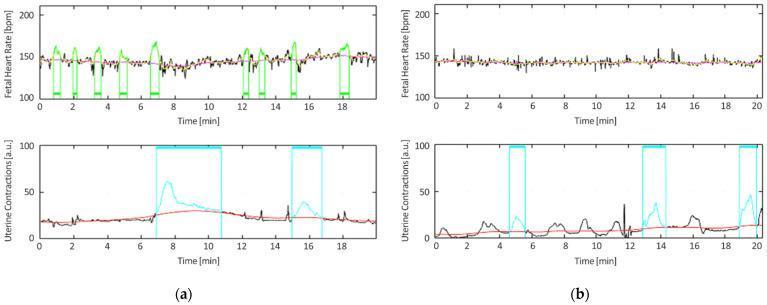
Left (a): Normal — high beat-to-beat variability with multiple accelerations. Right (b): Suspicious — flattened trace with reduced variability.
Pathological vs. Normal comparison:
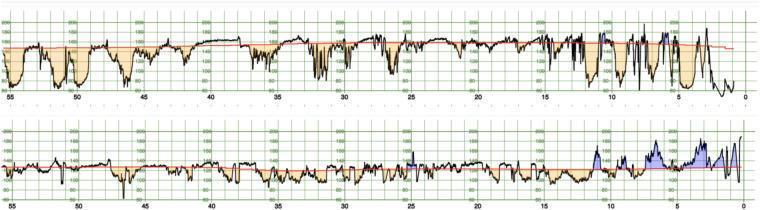
Top: Pathological trace (pH < 7.05) — frequent, deep decelerations, minimal accelerations. Bottom: Normal — reactive pattern with accelerations.
Pathological — deep variable decelerations:
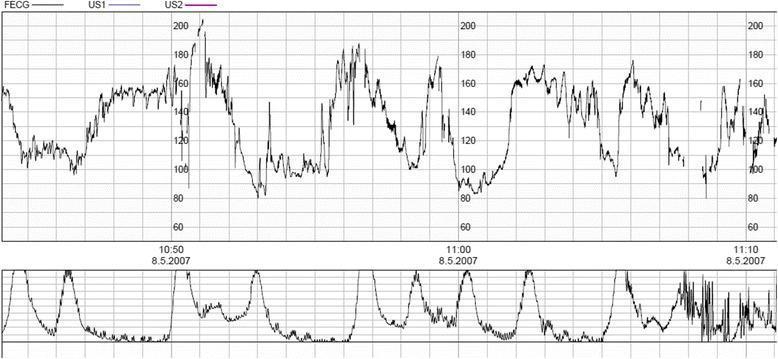
Deep, prolonged variable decelerations (>60 bpm depth, >60 sec duration) with frequent contractions — pathological by FIGO criteria.
Key Pitfalls
- Absent accelerations alone do not make a trace suspicious during labour — this is of uncertain significance
- Reduced variability is only suspicious if present for >50 minutes continuously; short periods may reflect fetal sleep cycle (~20 min)
- A single prolonged deceleration >5 min = pathological regardless of other features
- CTG has significant inter-observer variability — the suspicious/pathological boundary has the lowest agreement among clinicians
- A normal CTG effectively excludes current hypoxia/acidosis; however, suspicious and pathological traces have a high false-positive rate for metabolic acidosis
Sources: FIGO 2015 Consensus Guidelines on Intrapartum Fetal Monitoring; Barash, Cullen & Stoelting's Clinical Anesthesia 9e (Table 41-8); NICE CTG classification framework.
This is a shared conversation. Sign in to Orris to start your own chat.