
Explain PEM with kwashiorkor and marasmus
Reading File
Now let me search the medical library for PEM, kwashiorkor, and marasmus content in parallel.
Finding Sources
Finding Sources
Excellent results. Now let me read the most comprehensive sources in parallel - Robbins Pathology, Park's Preventive Medicine, and Harper's Biochemistry.
Reading File
Reading File
Reading File
Great data. Let me now read the morphology/pathology section and Harper's biochemistry section, plus fetch the clinical image.
Reading File
Reading File
Reading File
I have comprehensive information. Let me also fetch the clinical image from Robbins for the response.
Loading Image
I now have everything needed for a thorough, well-cited answer. Here it is:
Protein-Energy Malnutrition (PEM): Kwashiorkor and Marasmus
Protein-energy malnutrition (PEM) is the umbrella term for two major clinical syndromes of severe undernutrition in children - kwashiorkor and marasmus. Both are forms of Severe Acute Malnutrition (SAM), differing chiefly in whether protein deficiency or total caloric deficiency is predominant.
Overview
| Feature | Marasmus | Kwashiorkor |
|---|---|---|
| Primary deficit | Both protein AND calories | Protein >> Calories |
| Weight | <60% of normal | 60-80% of normal (masked by edema) |
| Edema | Absent | Present (hallmark) |
| Serum albumin | Normal or near-normal | Markedly low (hypoalbuminemia) |
| Subcutaneous fat | Severely depleted | Relatively spared |
| Muscle wasting | Severe | Mild-moderate |
| Liver | Normal | Enlarged, fatty |
| Skin/hair changes | Minimal | Characteristic (see below) |
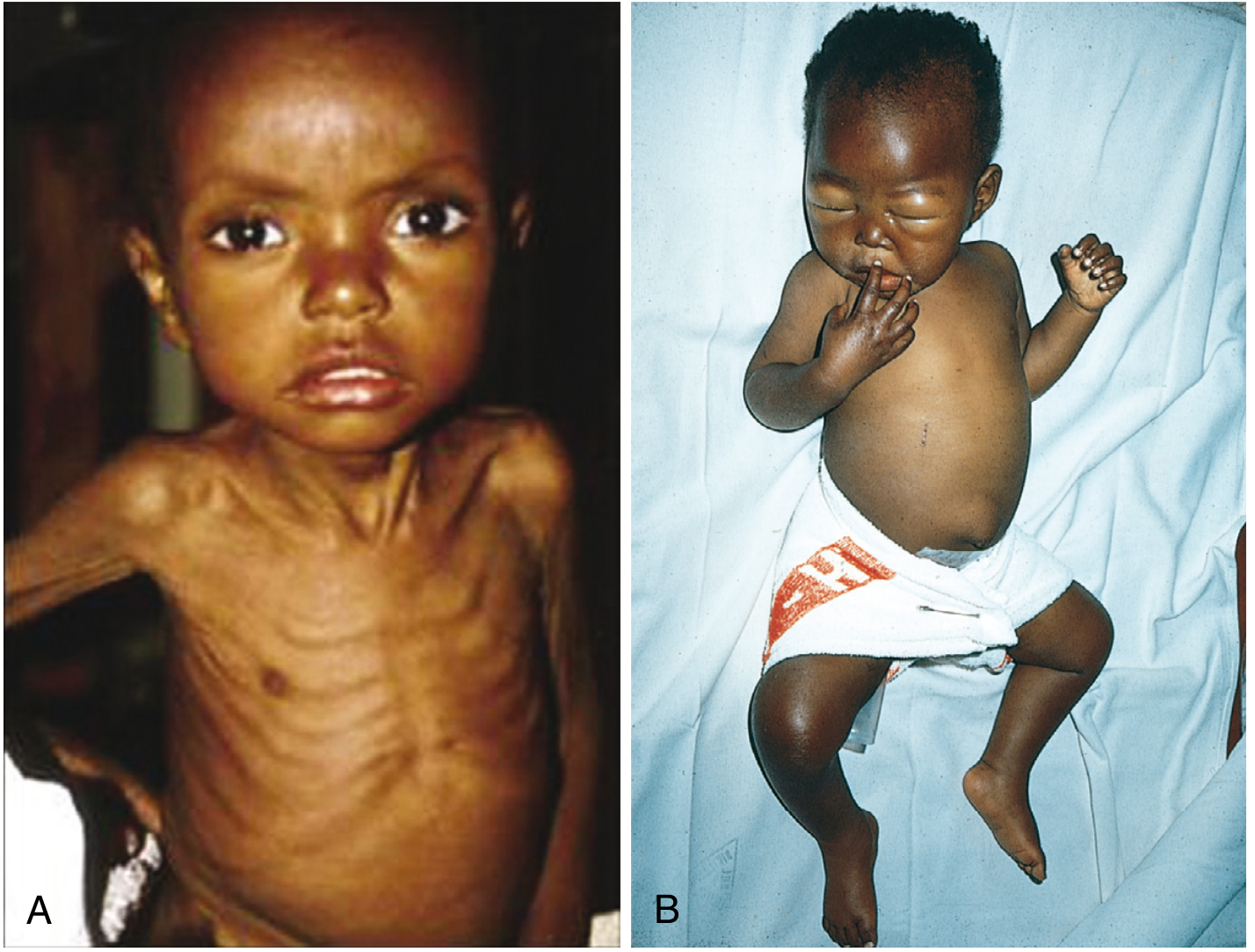
| Appearance | "Old man" look - emaciated, head too large | Puffy, edematous |
1. Marasmus
Definition & Cause
Marasmus develops when the diet is severely deficient in total calories (both protein and energy). A child is considered marasmic when weight falls to <60% of normal for sex, height, and age. - Robbins, Cotran & Kumar Pathologic Basis of Disease
Pathophysiology
The body mounts an adaptive response to near-total starvation:
- Somatic protein compartment (skeletal muscle) is catabolized to supply amino acids for gluconeogenesis - essentially "eating itself" for energy
- The visceral protein compartment (plasma proteins, organ proteins) is relatively spared - this is why serum albumin remains near-normal and edema does NOT develop
- Subcutaneous fat is mobilized as fuel
- Leptin production falls, stimulating the hypothalamic-pituitary-adrenal (HPA) axis to raise cortisol levels, which drives lipolysis
Clinical Features
- Severe growth retardation
- Extreme wasting of muscle and fat - limbs are emaciated, ribs visible
- Head appears disproportionately large for the skeletal body
- No edema (because albumin is preserved)
- Anemia (multifactorial: iron, folate, protein deficiency)
- Immune deficiency - especially T-cell-mediated immunity - making concurrent infections nearly universal, which imposes further catabolic stress
2. Kwashiorkor
Definition & Etymology
Kwashiorkor occurs when protein deprivation is disproportionately greater than the caloric deficit. The word comes from the Ga language of Ghana and describes "the illness that comes to a child who is weaned when another baby is born" - reflecting the classic scenario of early weaning onto an almost exclusively carbohydrate diet. - Robbins, Cotran & Kumar Pathologic Basis of Disease
Epidemiology
- Most common form of SAM in African children
- Also high prevalence in Southeast Asia, Central America
- Can occur worldwide in protein-losing states: nephrotic syndrome, protein-losing enteropathy, extensive burns, chronic diarrhea, fad diets (rare cases in the USA with rice-based milk substitutes)
Pathophysiology
Because caloric intake is less severely restricted, there is NO adaptive shift to muscle catabolism. Instead:
- The visceral protein compartment is severely depleted - particularly albumin and carrier proteins
- Hypoalbuminemia drops oncotic pressure → fluid leaks into interstitium → pitting edema (the hallmark)
- Reduced synthesis of apolipoprotein components of VLDL → triglycerides accumulate in hepatocytes → fatty liver (hepatic steatosis)
- Subcutaneous fat and muscle are relatively spared (but losses are masked by edema)
- Oxidant stress plays a role: infection triggers a respiratory burst producing oxygen free radicals; superimposed on deficiency of antioxidants (zinc, copper, carotene, vitamins C and E), this oxidant load is thought to precipitate the full syndrome. - Harper's Illustrated Biochemistry, 32nd Ed
Clinical Features
- Pitting edema - generalized or dependent; ascites, periorbital puffiness, pedal edema
- Fatty hepatomegaly - due to impaired lipoprotein synthesis
- Skin lesions - alternating zones of hyperpigmentation, desquamation, and hypopigmentation - classic "flaky paint" or "crazy paving" dermatosis
- Hair changes - depigmentation, "flag sign" (alternating pale and dark bands), easy pluckability, straightening, fine texture
- Moon face - due to edema
- Apathy, listlessness, anorexia - these behavioral features distinguish kwashiorkor from marasmus
- Weight 60-80% of normal (true tissue loss masked by fluid)
- Immune deficiency and secondary infections (as in marasmus)
3. Pathological (Morphological) Changes
Liver
- Kwashiorkor: enlarged and fatty (hepatic steatosis) due to reduced ApoB synthesis → impaired VLDL export → fat accumulates. Cirrhosis is rare.
- Marasmus: liver is typically normal
Small Intestine
- Kwashiorkor: decreased mitotic index in intestinal crypts → mucosal atrophy, villous blunting, loss of microvilli → disaccharidase deficiency (especially lactase) → secondary lactose intolerance. Clinically important: infants with kwashiorkor initially do NOT tolerate full-strength milk-based feeds. These changes are reversible with treatment.
- Marasmus: minimal intestinal changes
Bone Marrow & Blood
- Both: bone marrow hypoplasia (decreased red cell precursors)
- Anemia is common and multifactorial - can be microcytic (iron deficiency), normocytic, or macrocytic (folate deficiency), or mixed
- Robbins, Cotran & Kumar Pathologic Basis of Disease
Brain
- In children born to malnourished mothers who also experience SAM in the first 1-2 years of life: cerebral atrophy, reduced neuron numbers, impaired myelination of white matter - with potential long-term neurodevelopmental consequences
Thymus and Lymphoid Tissue
- Atrophy in both, but more marked in kwashiorkor - contributing to impaired immune function
4. Detection of PEM
Early detection relies on growth monitoring and anthropometry (Park's Textbook of Preventive and Social Medicine):
- Weight-for-age: first indicator of PEM; maintained via growth charts
- Mid-upper arm circumference (MUAC):
-
13.5 cm: satisfactory nutrition
- 12.5-13.5 cm: mild-moderate malnutrition
- <12.5 cm: severe malnutrition
- (Not reliable under 1 year of age; relatively stable between ages 1-5 years)
-
- Serum albumin: low in kwashiorkor, near-normal in marasmus
5. Prevention
Adapted from FAO/WHO guidelines (Park's Textbook of Preventive and Social Medicine):
Health Promotion:
- Promote exclusive breastfeeding and appropriate weaning foods
- Develop low-cost, protein-and-energy-rich weaning formulas
- Nutrition education; family planning (spacing births reduces early weaning)
- Supplement pregnant and lactating women
Specific Protection:
- Diet must include protein-rich foods (milk, eggs, legumes)
- Immunization (reduces infections that precipitate/worsen PEM)
- Food fortification programs
Early Diagnosis and Treatment:
- Periodic nutritional surveillance
- Growth chart monitoring at community level
Quick Memory Summary
Marasmus = Muscle wasting, Meager calories (total starvation), No edema, normal albumin - the child is a "little old man"Kwashiorkor = Key feature is edema + Karbohydrate-only diet after weaning, fatty liver, flaky paint skin, apathy - the child looks "puffy but pale"
Sources:
- Robbins, Cotran & Kumar Pathologic Basis of Disease (9780443264528), pp. 411-413
- Robbins & Kumar Basic Pathology (9780323790185), pp. similar sections
- Harper's Illustrated Biochemistry, 32nd Ed (9781260469943), p. 545
- Park's Textbook of Preventive and Social Medicine (9789382219163), p. 737
This is a shared conversation. Sign in to Orris to start your own chat.