
Et
Etc
What would you like help with?
Electron transport chain
Reading File
Reading File
Finding Sources
Finding Sources
Searching PubMed
mitochondrial electron transport chain
Searching the Web
electron transport chain oxidative phosphorylation complexes I II III IV ATP synthase review
Reading File
Searching Images
mitochondrial electron transport chain complexes I II III IV coenzyme Q cytochrome c ATP synthase diagram
Reading File
Reading File
Electron transport chain (ETC)
The electron transport chain is a series of protein complexes in the inner mitochondrial membrane. It transfers electrons from NADH and FADH₂ to oxygen, using the released energy to pump protons (H⁺) from the matrix into the intermembrane space. The resulting proton gradient powers ATP synthase to make ATP. This electron transfer plus ATP formation is oxidative phosphorylation.
Biochemistry, 8th ed Lippincott Illustrated Reviews, pp. 224-225.
Biochemistry, 8th ed Lippincott Illustrated Reviews, pp. 224-225.
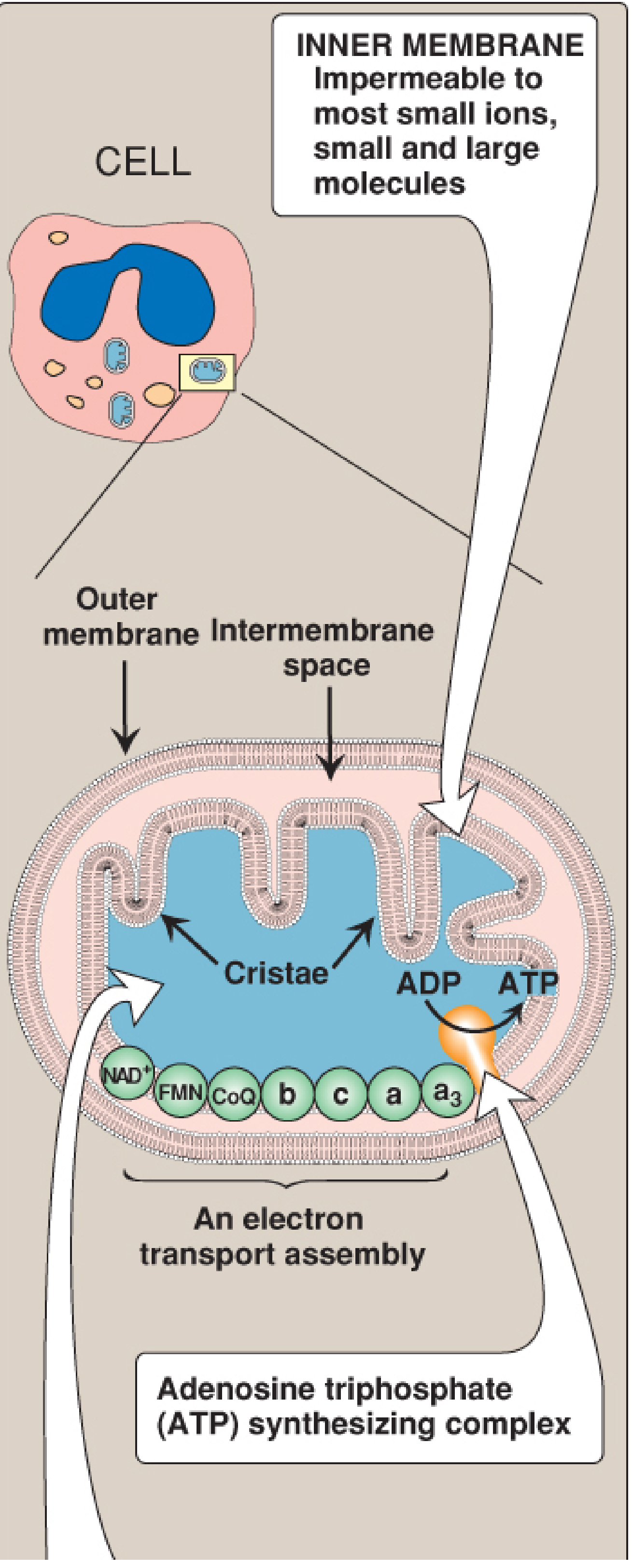
Location
- ETC complexes I-IV and ATP synthase: inner mitochondrial membrane
- Protons accumulate: intermembrane space
- NADH, FADH₂, TCA cycle enzymes: mitochondrial matrix
- Oxygen: final electron acceptor, reduced to water
Electron flow
NADH → Complex I → CoQ → Complex III → Cytochrome c → Complex IV → O₂ → H₂O
                     ↑
FADH₂ → Complex II ──┘
Components
| Component | Name | Main role | H⁺ pumped |
|---|---|---|---|
| Complex I | NADH dehydrogenase | Receives electrons from NADH, transfers them through FMN and Fe-S centers to coenzyme Q | 4 |
| Complex II | Succinate dehydrogenase | Transfers electrons from FADH₂, formed during succinate to fumarate conversion, to CoQ | 0 |
| Coenzyme Q | Ubiquinone | Lipid-soluble mobile carrier that transports electrons from I/II to III | - |
| Complex III | Cytochrome bc₁ complex | Transfers electrons from CoQ to cytochrome c | 4 |
| Cytochrome c | Small soluble protein | Carries electrons from III to IV | - |
| Complex IV | Cytochrome c oxidase | Transfers electrons to O₂, forming H₂O | 2 |
| Complex V | ATP synthase | Lets H⁺ return to the matrix and uses this energy to synthesize ATP | Does not pump H⁺ |
Complex I transfers electrons from NADH to CoQ and pumps four protons. Complex II does not pump protons, which explains why FADH₂ produces less ATP than NADH. CoQ links flavoprotein dehydrogenases to cytochromes.
Biochemistry, 8th ed Lippincott Illustrated Reviews, pp. 228-230.
Biochemistry, 8th ed Lippincott Illustrated Reviews, pp. 228-230.
ATP yield
-
1 NADH produces about 2.5 ATP
- Electrons enter at Complex I.
- About 10 H⁺ are pumped: 4 at I, 4 at III, 2 at IV.
-
1 FADH₂ produces about 1.5 ATP
- Electrons enter at Complex II, bypassing Complex I.
- About 6 H⁺ are pumped: 4 at III, 2 at IV.
Why oxygen is essential
Oxygen is the terminal electron acceptor:
[
O_2 + 4e^- + 4H^+ \rightarrow 2H_2O
]
Without oxygen, electron flow stops, NADH cannot be oxidized back to NAD⁺, the TCA cycle slows, and aerobic ATP production falls sharply.
Important inhibitors
| Agent | Blocked site |
|---|---|
| Rotenone | Complex I |
| Malonate | Complex II |
| Antimycin A | Complex III |
| Cyanide, carbon monoxide, azide | Complex IV |
| Oligomycin | ATP synthase, Complex V |
Cyanide is particularly dangerous because it prevents Complex IV from reducing oxygen to water, rapidly stopping oxidative phosphorylation.
Uncouplers
Uncouplers allow protons to re-enter the mitochondrial matrix without passing through ATP synthase. Electron transport and oxygen consumption continue, but ATP synthesis decreases and energy is released as heat.
Examples:
- Thermogenin (UCP1) in brown adipose tissue
- High-dose salicylates
- 2,4-dinitrophenol
For a concise external overview, the NCBI ETC review describes the same I-IV electron-transfer system and Complex V's ATP-generating role.
This is a shared conversation. Sign in to Orris to start your own chat.