

17824864498392290666891079402020.jpg
Question of Upper limb and lower limb only
Reading File
I can see the exam paper. From Section B, the upper and lower limb questions are:
- Q1 - Define joint. Mention the classification of synovial joints with examples. [1+5=6]
- Q2 - Explain boundaries, contents and applied aspects of cubital fossa. [2+2+1=5]
- Q3 - Mention the formation, branches and course of femoral nerve. [1+2+2=5]
Let me search the medical library for all three topics in parallel.
Finding Sources
Finding Sources
Finding Sources
Finding Sources
Reading File
Reading File
Reading File
Reading File
Reading File
Reading File
Reading File
I now have all the content needed. Let me fetch the key anatomical diagrams as well.
Loading Image
Loading Image
Here are complete answers for all three upper/lower limb questions from Section B:
Section B - Upper & Lower Limb Anatomy
Q1. Define Joint. Mention the Classification of Synovial Joints with Examples. [1+5=6]
Definition of a Joint
A joint (articulation) is the point of contact or union between two or more bones (or between a bone and cartilage) of the skeleton, designed to allow skeletal motion and mechanical function. Each joint is uniquely fitted to its anatomic location and the specific type and range of motion required.
Classification of Joints (Structural)
Joints are primarily classified into three types based on their main histologic component:
| Type | Also Called | Tissue | Movement | Examples |
|---|---|---|---|---|
| Fibrous | Synarthroses | Dense connective tissue | Minimal/none | Skull sutures, syndesmoses (radius-ulna), gomphoses (teeth) |
| Cartilaginous | Amphiarthroses | Hyaline cartilage or fibrocartilage | Slight | Pubic symphysis, intervertebral discs, 1st costo-sternal joint |
| Synovial | Diarthroses | Synovial cavity + fluid + articular cartilage | Freely moveable | Elbow, shoulder, knee, hip, wrist, ankle, interphalangeal |
Classification of Synovial Joints (with Examples)
Synovial joints are further classified by axes of motion and shape of articular surfaces:
| Sub-type | Axes | Shape | Example |
|---|---|---|---|
| Hinge (Ginglymus) | Uniaxial | Convex cylinder in concave groove | Elbow (humeroulnar), interphalangeal joints |
| Pivot (Trochoid) | Uniaxial | Rounded peg in ring | Proximal radioulnar joint, atlanto-axial joint |
| Condyloid (Ellipsoid) | Biaxial | Elliptical convex into elliptical concave | Metacarpophalangeal, wrist (radiocarpal) |
| Saddle | Biaxial | Each surface concave in one plane, convex in other | 1st carpometacarpal (thumb) |
| Ball and Socket (Spheroidal) | Multiaxial | Spherical head into cup-shaped socket | Shoulder (glenohumeral), hip |
| Plane (Gliding) | Multiaxial (gliding) | Flat or slightly curved surfaces | Acromioclavicular, patellofemoral, intercarpal |
Source: Firestein & Kelley's Textbook of Rheumatology, Table 1.1; Gray's Anatomy for Students
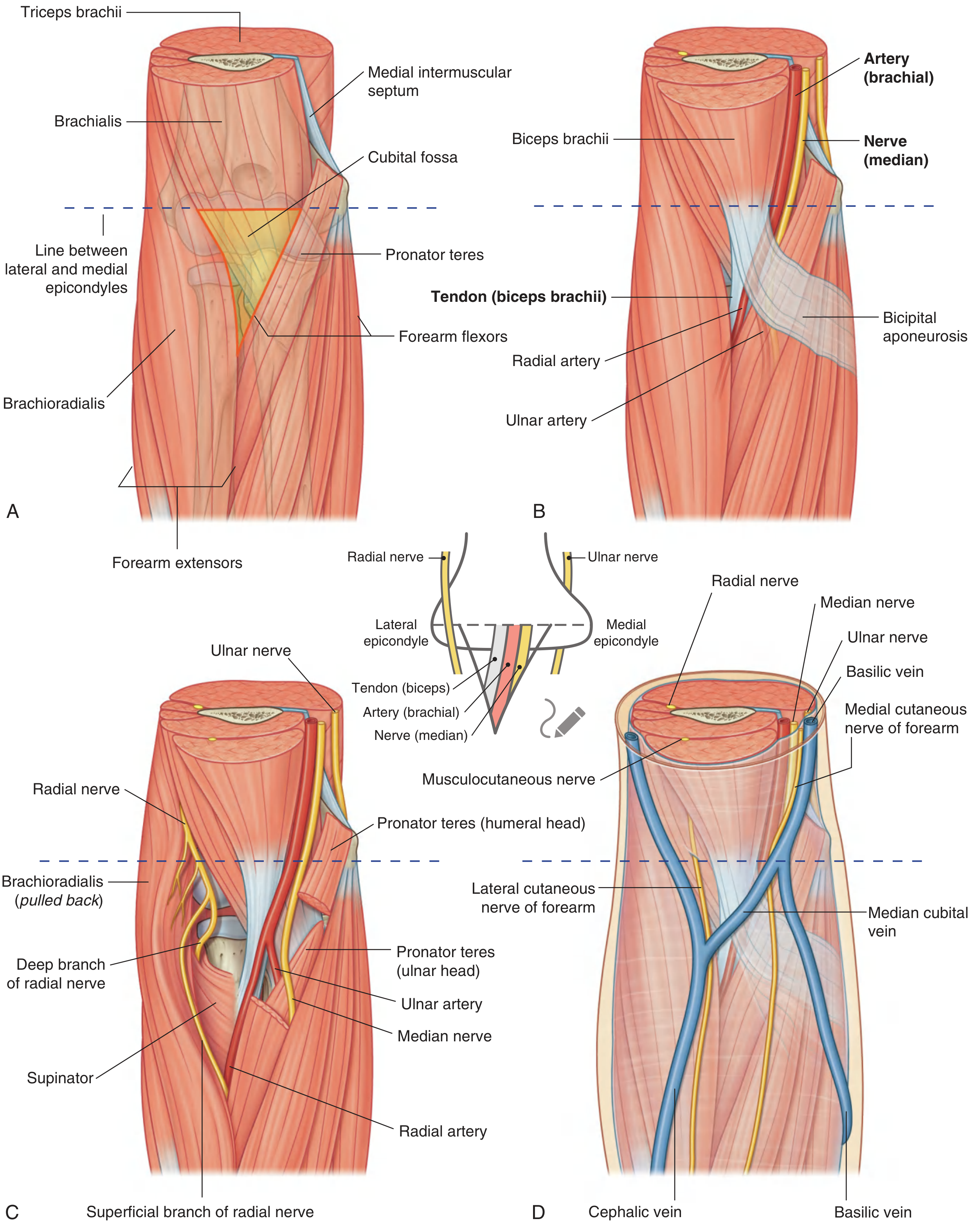
Q2. Explain Boundaries, Contents and Applied Aspects of Cubital Fossa. [2+2+1=5]
Definition
The cubital fossa is a triangular depression anterior to the elbow joint, representing an important transition zone between the arm and forearm.
Boundaries
| Boundary | Structure |
|---|---|
| Lateral | Brachioradialis muscle (from lateral supraepicondylar ridge) |
| Medial | Pronator teres muscle (from medial epicondyle) |
| Base (Superior) | Imaginary horizontal line between medial and lateral epicondyles |
| Apex (Inferior) | Intersection of brachioradialis and pronator teres |
| Floor (Bed) | Brachialis muscle (mainly); also supinator laterally |
| Roof | Superficial fascia and skin; reinforced by bicipital aponeurosis |
Contents (Lateral to Medial - "TAN")
From lateral to medial:
- T - Tendon of biceps brachii
- A - Brachial artery (bifurcates into radial and ulnar arteries within/at the apex)
- N - Median nerve (lies immediately medial to the brachial artery; exits by passing between the two heads of pronator teres)
Additional contents:
- Radial nerve - lies just under the lip of brachioradialis (lateral wall); divides here into superficial and deep branches. The deep branch enters the posterior compartment by piercing the supinator muscle.
- The bicipital aponeurosis covers and protects the brachial artery and median nerve anteriorly in the distal fossa.
- The ulnar nerve does NOT pass through the cubital fossa - it passes posterior to the medial epicondyle.
Applied Aspects
- Venepuncture site: The median cubital vein lies in the roof (within the superficial fascia), crossing diagonally from the cephalic to basilic vein. It is the most commonly used vein for blood sampling and IV cannulation. The bicipital aponeurosis separates it from the brachial artery, offering some protection.
- Blood pressure measurement: The brachial artery is auscultated here when measuring BP with a sphygmomanometer.
- Dialysis fistula: The brachial artery can be surgically anastomosed to the cephalic vein at the elbow to create an arteriovenous fistula for haemodialysis access.
- Injury risk: Forceful hyperextension of the elbow can damage the brachial artery and median nerve within the fossa.
Q3. Mention the Formation, Branches and Course of Femoral Nerve. [1+2+2=5]
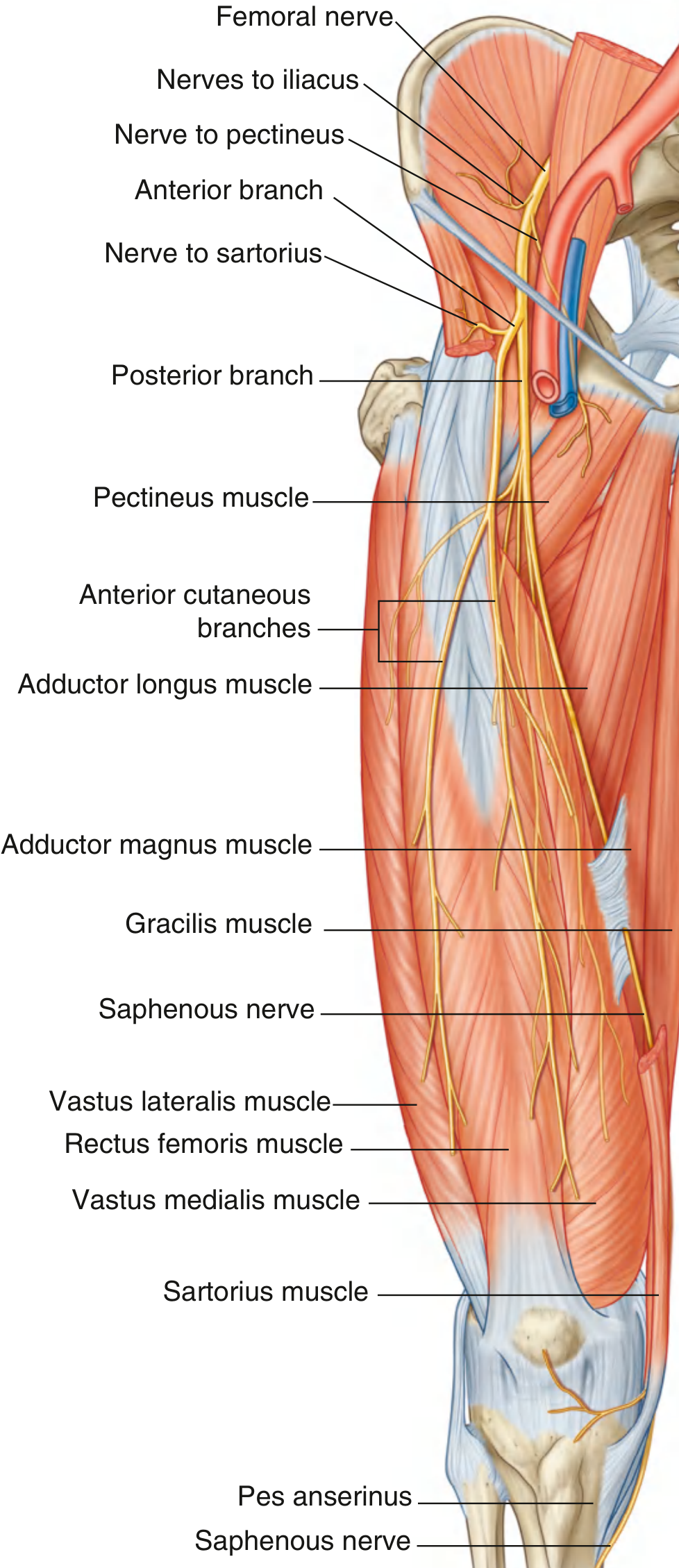
Formation
The femoral nerve arises from the lumbar plexus, formed by the anterior rami of L2, L3, and L4 (ventral divisions). It is formed within the substance of the psoas major muscle on the posterior abdominal wall.
Course
In the abdomen (posterior abdominal wall):
- Forms within psoas major
- Descends in the groove between psoas major and iliacus muscles
- Gives branches to iliacus and pectineus muscles before entering the thigh
Entering the thigh:
- Passes under the inguinal ligament (lateral to femoral artery and outside the femoral sheath) to enter the femoral triangle
- In the femoral triangle, lies lateral to the femoral artery
- Immediately after passing under the inguinal ligament, divides into anterior and posterior branches
In the femoral triangle and beyond:
- The saphenous nerve (longest branch) accompanies the femoral artery through the adductor canal but does not pass through the adductor hiatus - it exits through connective tissue near the end of the canal between sartorius and gracilis, then continues down the medial leg to the foot
Branches
Motor branches:
- Branches to iliacus and pectineus (in abdomen, before entering thigh)
- Nerves to all muscles of the anterior compartment of thigh: sartorius, rectus femoris, vastus lateralis, vastus medialis, vastus intermedius
Cutaneous (sensory) branches:
- Anterior cutaneous branches - supply skin on the front of the thigh and knee
- Saphenous nerve (longest branch of femoral nerve) - supplies the medial side of the knee, leg, and medial side of the foot. It is a purely sensory nerve.
Summary Table
| Component | Details |
|---|---|
| Formation | Anterior rami L2, L3, L4 (lumbar plexus) |
| Origin site | Within psoas major, posterior abdominal wall |
| Entry to thigh | Beneath inguinal ligament, lateral to femoral artery, outside femoral sheath |
| Motor supply | Iliacus, pectineus; all anterior thigh muscles (sartorius, quadriceps femoris) |
| Sensory supply | Anterior thigh, anteromedial knee, medial leg and medial foot (via saphenous nerve) |
Sources: Gray's Anatomy for Students (9780323934237); Firestein & Kelley's Textbook of Rheumatology (9780323935364)
This is a shared conversation. Sign in to Orris to start your own chat.