
Diet plan for a 10month old child with weight 7 kg in india
diet plan 10 month old baby India complementary feeding WHO guidelines 2024
complementary feeding infant 6-12 months India
10 month baby diet plan India 7kg underweight complementary feeding schedule Indian foods
https://gkfooddiary.com/10-months-indian-baby-food-chart
Diet Plan for a 10-Month-Old Baby (7 kg) - India
Important context about the weight
Core Principles (WHO + NHM Guidelines)
- Breast milk / formula first - remains the primary nutrition source. Give 4-5 feeds per day.
- Meal frequency at 9-11 months: 3 main meals + 1 snack between meals + breastfeeds (per NHM India guidelines)
- Portion size: 3/4 of a 250 ml katori (bowl) per meal
- Texture: Finely chopped or mashed foods; finger foods the baby can pick up
- Calorie boosting for 7 kg baby: Add 1/4 tsp ghee to every meal - it is the safest, most culturally appropriate calorie-dense addition
- No salt, no sugar, no honey before 1 year
- Introduce one new food every 3 days to watch for allergies
Daily Feeding Schedule
| Time | What to Give |
|---|---|
| Early Morning (wake-up, ~6-7 AM) | Breast milk or formula |
| Breakfast (~8-9 AM) | Soft semi-solid - see options below |
| Mid-Morning (~11 AM) | Breast milk or formula |
| Lunch (~12-1 PM) | Main solid meal - see options below |
| Evening Snack (~3-4 PM) | Fruit / finger food - see options below |
| Dinner (~6-7 PM) | Solid meal - see options below |
| Bedtime (~9 PM) | Breast milk or formula |
7-Day Sample Indian Meal Plan
| Day | Breakfast | Lunch | Evening Snack | Dinner |
|---|---|---|---|---|
| Day 1 | Wheat dosa / wheat halwa with ghee | Moong dal khichdi with mashed vegetables + ghee | Mashed banana or papaya pieces | Ragi porridge with banana |
| Day 2 | Soft idli with coconut chutney (mild) | Curd rice with homemade curd + grated carrot | Cooked carrot / peas pieces (finger food) | Vegetable-stuffed soft paratha with ghee |
| Day 3 | Vegetable suji (semolina) upma | Mashed rice with tomato rasam + a tsp ghee | Banana pancake / bread omelette | Soft chapati dipped in dal |
| Day 4 | Dalia (broken wheat) porridge with milk | Rice + dal + paneer mashed together | Apple-carrot puree / pumpkin kheer | Steamed idli or dosa |
| Day 5 | Ragi porridge with mashed apple | Mixed vegetable rice or egg rice | Chikoo / apple milkshake (with breast milk or formula) | Moong dal khichdi with ghee |
| Day 6 | Bread upma / whole wheat toast fingers | Spinach rice / mashed ghee rice + egg yolk | Plain curd with mashed fruit | Poha upma or moong dal chilla |
| Day 7 | Health mix porridge | Dal rice (toor dal) + ghee | Scrambled egg / crumbled paneer | Suji kheer or banana halwa |
Best Indian Foods for Weight Gain at This Age
- Dal khichdi with ghee - carbs + protein + fat together
- Ragi (finger millet) - excellent calcium and iron source
- Banana - soft, calorie-rich, no preparation needed
- Full-fat homemade curd - probiotic + protein + fat
- Paneer (homemade) - high protein and calcium
- Sweet potato - complex carbs, easy to mash
- Egg yolk - richest source of brain-healthy fats; can give daily
- Avocado (if available) - highest fat content of any fruit
- A cereal (rice, wheat, ragi, dalia)
- A pulse/protein (dal, paneer, egg)
- A vegetable or fruit
- A fat (ghee, or if non-veg family: from egg yolk/meat)
Foods to Avoid at 10 Months
| Avoid | Reason |
|---|---|
| Cow's milk as main drink | Not suitable before 1 year (can use in cooking) |
| Salt, sugar, jaggery added to food | Kidney immaturity; taste preference reasons |
| Honey | Risk of infant botulism |
| Whole nuts | Choking hazard |
| Citrus fruits (lemon, orange) | Risk of rash/allergy |
| Carbonated drinks, packaged juices | No nutritional value |
| Spicy food with chilli | Gut irritation |
Micronutrient Watch (important for 7 kg baby)
- Iron: Give iron-rich foods daily (ragi, green leafy vegetables, egg yolk, dal). Pair with vitamin C (tomato, mashed amla) to improve absorption. The WHO 2023 guideline recommends micronutrient powder (MNP) supplementation 3x/week for 9-11 month olds in India where dietary iron is insufficient.
- Vitamin D: Sunlight exposure 10-15 min daily, or drops as prescribed
- Zinc: Ensure dal, paneer, and egg are part of regular meals
Red Flags - See a Pediatrician if:
- Baby is not gaining at least 300-400 g/month
- Refusing feeds or showing no interest in food for more than 3-4 days
- Vomiting, loose stools, or rash after new foods
- Weight drops or remains static over 1 month
Portion Reminder (for 7 kg baby)
Diet plan for 10 month oldchild with weight 9 kg with calories content and protein of food
10 month old baby calorie protein requirement WHO India complementary feeding 2023
complementary feeding infant energy protein requirements 6-12 months
https://nin.res.in/dietaryguidelines/pdfjs/locale/DGI_2024.p…
Indian foods calorie protein content per 100g dal khichdi ragi egg curd banana NIN ICMR
Complete Diet Plan for a 10-Month-Old Baby (9 kg) with Calorie & Protein Content
Nutritional Requirements (ICMR-NIN 2024 / WHO 2023)
| Nutrient | Total Daily Requirement | From Breast Milk / Formula | From Complementary Foods |
|---|---|---|---|
| Energy | 720 kcal/day | ~335 kcal | ~385 kcal |
| Protein | 10.5 g/day | ~5 g | ~5.5 g |
| Feeds | 4-5 breastfeeds or formula feeds/day | - | 3 meals + 1 snack |
Source: ICMR-NIN Dietary Guidelines for Indians 2024 - Total energy 720 kcal/day for 9-12 months; complementary foods provide 385 kcal/day; balance 335 kcal from breast milk.
Calorie & Protein Content of Key Indian Baby Foods
| Food Item | Serving Size | Calories (kcal) | Protein (g) | Notes |
|---|---|---|---|---|
| Moong dal khichdi (rice 15g + dal 10g, cooked) | 3/4 katori (~60g cooked) | ~70 kcal | ~2.8 g | Add ghee for extra calories |
| Ragi porridge (ragi 15g + milk) | 1/2 katori | ~65 kcal | ~1.8 g | Best calcium source for babies |
| Idli (2 small) | ~40g | ~55 kcal | ~1.8 g | Fermented = better iron absorption |
| Soft dosa / wheat dosa | 1 small (~30g) | ~60 kcal | ~1.5 g | |
| Dalia (broken wheat) porridge (15g + milk) | 1/2 katori | ~70 kcal | ~2.2 g | |
| Egg yolk (boiled) | 1 yolk (~20g) | ~34 kcal | ~1.7 g | Daily is safe and recommended |
| Whole boiled egg | 1 egg (~50g) | ~68 kcal | ~6.6 g | Best protein per serving |
| Paneer (homemade) | 2 tbsp (~30g) | ~75 kcal | ~5.0 g | Highest protein dairy option |
| Full-fat curd (homemade) | 3 tbsp (~50g) | ~30 kcal | ~1.6 g | Probiotic + calcium |
| Banana (ripe, mashed) | 1/2 medium (~50g) | ~54 kcal | ~0.7 g | Best energy-dense fruit |
| Papaya (mashed) | 50g | ~20 kcal | ~0.3 g | Rich in Vit A + C |
| Sweet potato (mashed) | 50g cooked | ~45 kcal | ~0.7 g | Excellent carbohydrate source |
| Spinach rice (rice 15g + spinach 20g) | 3/4 katori | ~65 kcal | ~2.1 g | Iron-rich |
| Toor dal (cooked, 10g raw) | 3 tbsp | ~35 kcal | ~2.3 g | |
| Ghee | 1 tsp (5g) | 45 kcal | 0 g | Add to every meal for calorie boost |
| Breast milk (per feed, ~120-150 ml) | 1 feed | ~80-100 kcal | ~1.2 g |
Daily Schedule with Calorie + Protein Breakdown
Meal 1 - Early Morning (~6-7 AM)
- Calories: ~90 kcal | Protein: ~1.2 g
Meal 2 - Breakfast (~8:30-9 AM)
- Ragi porridge: ~65 kcal, 1.8g protein
- Banana: ~54 kcal, 0.7g protein
- Total: ~119 kcal | ~2.5g protein
- Idli: ~55 kcal, 1.8g protein
- Curd: ~15 kcal, 0.8g protein
- Total: ~70 kcal | ~2.6g protein
Meal 3 - Mid-Morning (~11 AM)
- Calories: ~90 kcal | Protein: ~1.2 g
Meal 4 - Lunch (~12:30-1 PM) - MAIN MEAL
- Khichdi: ~70 kcal, 2.8g protein
- Ghee: ~45 kcal, 0g protein
- Total: ~115 kcal | ~2.8g protein
- Spinach rice: ~65 kcal, 2.1g protein
- Egg yolk: ~34 kcal, 1.7g protein
- Ghee: ~45 kcal, 0g protein
- Total: ~144 kcal | ~3.8g protein
- Dal rice: ~105 kcal, 3.5g protein
- Chicken: ~33 kcal, 6.2g protein
- Ghee: 45 kcal
- Total: ~183 kcal | ~9.7g protein
Meal 5 - Evening Snack (~3:30-4 PM)
- ~50 kcal | ~1.0g protein
- ~75 kcal | ~5.0g protein (best protein snack)
- ~60 kcal | ~0.5g protein
Meal 6 - Dinner (~7 PM)
- ~115 kcal | ~2.8g protein
- ~110 kcal | ~3.0g protein
- ~90 kcal | ~3.0g protein
Meal 7 - Bedtime (~9-9:30 PM)
- Calories: ~90 kcal | Protein: ~1.2 g
Daily Calorie & Protein Summary (Sample Day - Vegetarian)
| Meal | Calories | Protein |
|---|---|---|
| Early morning BM | 90 kcal | 1.2 g |
| Breakfast (ragi + banana) | 119 kcal | 2.5 g |
| Mid-morning BM | 90 kcal | 1.2 g |
| Lunch (khichdi + ghee) | 115 kcal | 2.8 g |
| Evening snack (paneer) | 75 kcal | 5.0 g |
| Dinner (dalia + ghee) | 115 kcal | 2.8 g |
| Bedtime BM | 90 kcal | 1.2 g |
| TOTAL | ~694 kcal | ~16.7 g |
7-Day Meal Rotation Plan
| Day | Breakfast | Lunch | Evening Snack | Dinner |
|---|---|---|---|---|
| Mon | Ragi porridge + banana | Moong dal khichdi + ghee | Mashed papaya + curd | Dalia porridge + ghee |
| Tue | Soft idli + curd | Curd rice + mashed spinach | Crumbled paneer | Soft chapati in dal |
| Wed | Wheat dosa + coconut chutney (mild) | Spinach rice + egg yolk + ghee | Banana mash | Suji kheer with milk |
| Thu | Dalia porridge with milk | Rice + toor dal + sweet potato + ghee | Fruit smoothie (BM + banana) | Moong dal khichdi |
| Fri | Health mix porridge | Dal rice + scrambled egg + ghee | Boiled peas (finger food) | Vegetable upma + ghee |
| Sat | Banana pancake (wheat + banana) | Mixed veg khichdi + ghee | Full-fat curd | Ragi halwa with jaggery-free milk |
| Sun | Oats porridge with apple | Paneer rice + ghee | Chikoo puree | Soft chapati + dal |
Key Tips for Calorie Density
- Always add 1 tsp ghee per meal - adds 45 kcal without any volume increase
- Cook with whole milk (in porridges/halwa) instead of water - adds ~60 kcal per 100 ml
- Add paneer or egg daily - they are the most protein-efficient foods at this age
- Mash banana into porridge for natural sweetness + extra calories without sugar
- Never dilute food - thick consistency is better than watery for calorie density
Foods to Avoid
- Salt, sugar, honey (under 1 year)
- Cow's milk as main drink (fine to cook with)
- Whole nuts (choking risk)
- Citrus fruits (may irritate gut)
- Packaged/processed baby foods with added preservatives
Note: These values are based on the ICMR-NIN Dietary Guidelines for Indians 2024 and Indian Food Composition Tables 2017. A 9 kg baby at 10 months is at a healthy weight - maintain regular growth monitoring with your pediatrician every 1-2 months.
Paracetam drug
paracetamol pharmacology mechanism of action dose toxicity clinical uses 2024
paracetamol acetaminophen metabolism NAPQI hepatotoxicity pathway diagram
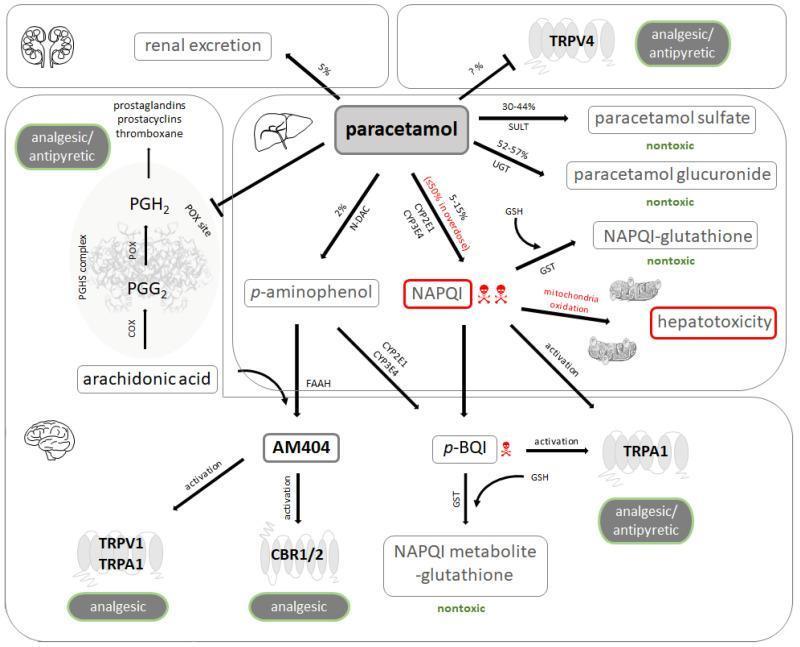
A comprehensive pharmacology and pathophysiology diagram illustrating the metabolic pathways and mechanism of action of paracetamol (acetaminophen). The schematic details three primary metabolic routes in the liver: glucuronidation (via UGT) and sulfation (via SULT) producing nontoxic metabolites for renal excretion, and a cytochrome P450-mediated pathway (CYP2E1, CYP3A4) forming the toxic intermediate N-acetyl-p-benzoquinone-imine (NAPQI). It depicts the detoxification of NAPQI by glutathione (GSH) and the adverse effects of excessive NAPQI, including mitochondrial oxidation and hepatotoxicity. The diagram also shows the N-deacetylation of paracetamol to p-aminophenol, leading to the formation of AM404, which activates TRPV1, TRPA1, and CBR1/2 receptors to provide analgesia. Furthermore, it illustrates the inhibition of the prostaglandin endoperoxide H synthase (PGHS) complex at the peroxidase (POX) site, preventing the conversion of PGG2 to PGH2, thereby explaining the drug's antipyretic and analgesic effects. Target receptors such as TRPV4 are also noted as potential sites of pharmacological interaction.
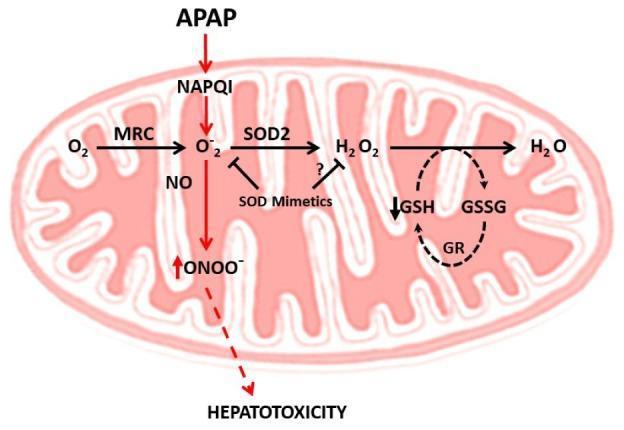
This pathophysiology diagram illustrates the biochemical mechanisms of Acetaminophen (APAP) induced hepatotoxicity within a mitochondrion. The process begins with APAP metabolism into NAPQI, which subsequently triggers the mitochondrial respiratory chain (MRC) to produce superoxide anions (O2.-). The diagram traces two primary pathways for these reactive species: 1) The reaction of O2.- with nitric oxide (NO) to form peroxynitrite (ONOO-), a potent mediator of nitrosative stress leading to hepatotoxicity. 2) The detoxification pathway involving superoxide dismutase 2 (SOD2), which converts O2.- into hydrogen peroxide (H2O2). The H2O2 is further neutralized to water (H2O) via the glutathione system, involving glutathione (GSH), glutathione disulfide (GSSG), and glutathione reductase (GR), though a downward arrow indicates GSH depletion. Pharmacological intervention is represented by SOD mimetics, which are shown to inhibit ONOO- formation, while their secondary effect on increasing H2O2 levels is noted as uncertain with a question mark. This educational visual explains the interplay between oxidative/nitrosative stress and mitochondrial dysfunction in drug-induced liver injury.
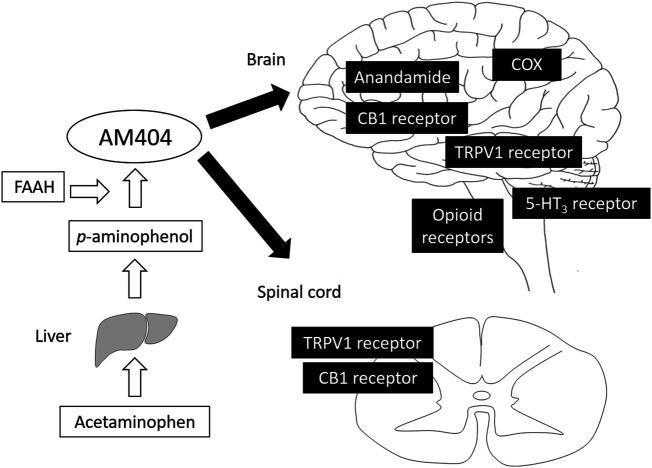
A pathophysiology diagram illustrating the central analgesic mechanisms of acetaminophen (paracetamol). The schematic outlines a metabolic pathway starting from the liver, where acetaminophen is converted into p-aminophenol. In the presence of the enzyme fatty acid amide hydrolase (FAAH), p-aminophenol is further metabolized into the active compound AM404 (N-acylphenolamine). The diagram demonstrates that AM404 acts on both the brain and the spinal cord through several neurotransmitter systems and receptors. In the brain, AM404 is shown to interact with cyclooxygenase (COX), anandamide, cannabinoid 1 (CB1) receptors, transient receptor potential vanilloid 1 (TRPV1) receptors, opioid receptors, and 5-HT3 receptors. In the spinal cord cross-section, the mechanism focuses on interactions with TRPV1 and CB1 receptors. The visual uses anatomical illustrations of the liver, brain, and spinal cord linked by arrows to signify the metabolic progression and central site of action, highlighting the drug's complex pharmacodynamics beyond simple COX inhibition.
Paracetamol (Acetaminophen) - Complete Drug Profile
1. Basic Information
| Property | Details |
|---|---|
| Generic name | Paracetamol (INN) / Acetaminophen (USAN) |
| Drug class | Non-opioid analgesic, Antipyretic |
| Chemical class | Para-aminophenol derivative |
| Origin | Metabolite of phenacetin (older analgesic now withdrawn) |
| Availability | OTC and prescription; oral, rectal, IV formulations |
2. Mechanism of Action
Primary - Central COX Inhibition
- A good analgesic and antipyretic
- A poor anti-inflammatory agent (unlike NSAIDs, which block COX peripherally)
Additional Mechanisms (newer evidence)
- COX-3 inhibition (a splice variant of COX-1, predominantly in CNS)
- AM404 pathway: Paracetamol is deacetylated in the liver to p-aminophenol, then conjugated with arachidonic acid to form AM404 (by fatty acid amide hydrolase - FAAH). AM404 activates TRPV1 and CB1 cannabinoid receptors in the brain and spinal cord, contributing to analgesia
- NMDA receptor antagonist properties (weak)
- 5-HT3 receptor interactions in the spinal cord
3. Pharmacokinetics
| Parameter | Details |
|---|---|
| Absorption | Rapid and complete after oral administration; onset ~30 min (PO) |
| IV onset | 5-10 minutes |
| Rectal onset | Slower, variable absorption - higher dose required |
| Peak plasma | 30-60 minutes (oral) |
| Duration | 4-6 hours |
| Protein binding | 10-25% |
| Metabolism | Hepatic - mainly glucuronidation (60%) and sulfation (30%); ~5-10% via CYP2E1/CYP3A4 to NAPQI |
| Half-life | Neonates: 7 hours; Infants: 4 hours; Children/adolescents: 3 hours; Adults: 2 hours |
| Excretion | Renal (as conjugates) |
4. Therapeutic Uses
| Indication | Notes |
|---|---|
| Mild-to-moderate pain | Headache, myalgia, toothache, dysmenorrhoea, osteoarthritis pain |
| Fever (pyrexia) | Drug of choice in children (preferred over aspirin - no Reye's syndrome risk) |
| Post-operative analgesia | IV form commonly used perioperatively |
| Musculoskeletal pain | First-line for osteoarthritis (lower GI and CV risk vs NSAIDs) |
| Migraine | Component of combination analgesics |
| Pain in pregnancy | Considered safest analgesic in pregnancy |
| Patients on anticoagulants | Preferred over NSAIDs (no platelet inhibition at standard doses) |
5. Dosing
Adults
| Route | Dose | Frequency | Max per day |
|---|---|---|---|
| Oral / Rectal | 500-1000 mg | Every 4-6 hours | 4000 mg (4 g) |
| IV (Ofirmev) | 1000 mg | Every 6 hours | 4000 mg |
Children (oral/rectal)
| Age | Dose |
|---|---|
| General pediatric | 10-15 mg/kg/dose every 4-6 hours |
| Max single dose | 15 mg/kg or 1000 mg (whichever is less) |
| Max daily | 60-75 mg/kg/day, not exceeding 4 g/day |
Reduce dose in: Liver disease, alcoholism, chronic malnutrition, neonates/infants (longer half-life)
6. Adverse Effects
- No GI ulceration or bleeding (unlike NSAIDs)
- No cardiovascular risk
- No platelet inhibition
- No renal toxicity at standard doses
Hepatotoxicity (dose-dependent)
Paracetamol (overdose)
        ↓ CYP2E1 / CYP3A4 (liver)
     NAPQI (N-acetyl-p-benzoquinone imine) — highly reactive toxic metabolite
        ↓ (normally neutralized by glutathione/GSH)
     Cysteine + mercapturic acid (harmless, excreted in urine)

BUT in overdose:
GSH stores depleted → NAPQI accumulates
        ↓
Mitochondrial oxidative stress → Superoxide (O2•⁻) → Peroxynitrite (ONOO⁻)
        ↓
CENTRILOBULAR LIVER NECROSIS → Acute Liver Failure
- Chronic alcohol use (CYP2E1 induced + GSH depleted)
- Chronic malnutrition (low GSH stores)
- Pre-existing liver disease / viral hepatitis
- Patients on enzyme-inducing drugs (rifampicin, phenytoin, carbamazepine)
7. Overdose / Toxicity (Clinical Stages)
| Stage | Time | Features |
|---|---|---|
| Stage I - GI | 0-24 hours | Nausea, vomiting (deceptively mild); patient fully conscious - false sense of security |
| Stage II - Latent | 24-72 hours | Apparent improvement; subclinical liver damage; anorexia, malaise, right hypochondrial pain |
| Stage III - Hepatic failure | 3-5 days | Jaundice, coagulopathy, encephalopathy, renal tubular necrosis, cerebral oedema, cardiomyopathy, GI haemorrhage |
| Stage IV | If survived | Complete resolution of liver injury in survivors |
8. Management of Overdose
- Gastric lavage - if within 4 hours of ingestion
- Rumack-Matthew nomogram - plot serum paracetamol level against time post-ingestion to determine treatment threshold
- N-acetylcysteine (NAC) - antidote of choice
- Replenishes glutathione stores
- Must be given early (within 8-10 hours for maximum benefit; still useful up to 24 hours)
- IV protocol: 150 mg/kg over 1 hour, then 50 mg/kg over 4 hours, then 100 mg/kg over 16 hours
- Oral protocol: 140 mg/kg loading, then 70 mg/kg every 4 hours × 17 doses
- IV fluids - cautious (paracetamol causes fluid retention; limit to <2.5 L/day)
- Liver transplant - for fulminant hepatic failure meeting King's College criteria
- Fomepizole - emerging role in massive overdose (2026 evidence)
9. Contraindications and Precautions
| Condition | Guidance |
|---|---|
| Severe hepatic impairment | Avoid or use with extreme caution; reduce dose |
| Chronic alcoholism | Reduce max daily dose to 2 g/day |
| G6PD deficiency | Use with caution (risk of haemolysis) |
| Renal impairment | Extend dosing interval (every 6-8 hours) |
| Pregnancy | Safe - drug of choice for pain/fever |
| Neonates / Infants | Reduce dose (longer half-life - 4-7 hours) |
10. Drug Interactions
| Drug | Interaction |
|---|---|
| Warfarin | Paracetamol at >2 g/day can enhance anticoagulant effect (INR monitoring needed) |
| Alcohol | Increases NAPQI formation → hepatotoxicity risk |
| Enzyme inducers (rifampicin, phenytoin, carbamazepine) | Increased CYP2E1 activity → more NAPQI production → higher hepatotoxicity risk |
| Isoniazid | Increases hepatotoxicity risk |
| Probenecid | Inhibits paracetamol conjugation → increases half-life and plasma levels |
| Metoclopramide | Increases absorption rate of paracetamol |
11. Comparison: Paracetamol vs NSAIDs vs Aspirin
| Property | Paracetamol | NSAIDs | Aspirin |
|---|---|---|---|
| Analgesic | Yes | Yes (stronger) | Yes |
| Antipyretic | Yes | Yes | Yes |
| Anti-inflammatory | No (peripheral) | Yes | Yes |
| GI side effects | None | Yes | Yes |
| Platelet inhibition | No | Yes | Yes (irreversible) |
| Renal toxicity | Minimal | Yes | Yes |
| CV risk | None | Yes (COX-2 selective) | No (cardioprotective) |
| Safe in pregnancy | Yes | Avoid 3rd trimester | Avoid 3rd trimester |
| Safe in children | Yes | Ibuprofen preferred | Contraindicated (Reye's) |