
Difference between cholecystitis and cholelithiasis
Cholecystitis is inflammation of the gallbladder, while cholelithiasis is the presence of gallstones. The two are closely related - gallstones are the most common cause of gallbladder inflammation - but they are distinct conditions. Cholelithiasis can exist silently with no symptoms, whereas cholecystitis almost always causes pain and systemic signs.
Searching sources...
Reading File
Finding Sources
Finding Sources
Good results. Let me read the most comprehensive sources - Robbins Pathology for both conditions, the Family Medicine textbook that covers both together, and Rosen's Emergency Medicine.
Reading File
Reading File
Reading File
Excellent content. Let me now get the cholecystitis section from Rosen's and the Robbins pathology section to complete the picture.
Reading File
Reading File
I now have rich, authoritative content from multiple textbooks. Let me fetch the ultrasound image that was referenced, then compose the full answer.
Loading Image
Here is a thorough comparison based on multiple authoritative medical textbooks.
Cholelithiasis vs. Cholecystitis
Definitions
| Cholelithiasis | Cholecystitis | |
|---|---|---|
| What it is | Presence of stones (calculi) within the gallbladder | Inflammation of the gallbladder |
| Core concept | A structural/metabolic condition | An inflammatory/infectious process |
Relationship Between the Two
More than 95% of biliary tract disease is attributable to gallstones. Cholelithiasis is the primary risk factor for cholecystitis - gallstones are found in 90-95% of patients with cholecystitis. However, they are distinct conditions: you can have gallstones for years without ever developing inflammation, and a minority of cholecystitis cases (~5-12%) occur without any stones at all (acalculous cholecystitis).
Cholelithiasis (Gallstones)
Types of Stones
1. Cholesterol stones (90% in the US/Western Europe)
- Contain >50% crystalline cholesterol monohydrate
- Form when bile becomes supersaturated with cholesterol relative to bile acids and phospholipids
2. Pigment stones
- Black stones - form in the gallbladder; associated with chronic hemolytic anemias (sickle cell, hereditary spherocytosis), older age
- Brown stones - associated with biliary infection; can form anywhere in the biliary tree
Risk Factors ("4 Fs" mnemonic)
- Female sex and female sex hormones (estrogen, OCP, pregnancy)
- Fat (obesity, metabolic syndrome, rapid weight loss)
- Forty (increasing age)
- Fertile (multiparity)
- Also: Native American descent (Pima/Hopi/Navajo), Crohn's disease, cystic fibrosis with pancreatic insufficiency, TPN, drugs (clofibrate, ceftriaxone)
Clinical Features
- Most patients are asymptomatic - only ~25.8% develop biliary colic at 10 years; complications occur in ~3% at 10 years
- Biliary colic: dull, steady RUQ or epigastric pain (not truly "colicky"), radiating to the right scapula/shoulder; nausea/vomiting; triggered by gallbladder contraction against obstructed cystic duct
- Patients appear well, no fever, no guarding/rebound
- No leukocytosis, liver enzymes usually normal
Cholecystitis (Gallbladder Inflammation)
Types
1. Acute Calculous Cholecystitis (most common, ~88-95% of cases)
- Triggered by a stone obstructing the gallbladder neck or cystic duct
- Sequence: obstruction → increased intraluminal pressure → mucosal ischemia → phospholipases hydrolyze biliary lecithin to toxic lysolecithin → disruption of the protective mucus layer → detergent action of bile salts → prostaglandin release → inflammation
- Bacterial superinfection common (E. coli most frequent; anaerobes in up to 40%)
2. Acute Acalculous Cholecystitis (5-12% of cases)
- Caused by gallbladder stasis and ischemia without stones
- Seen in critically ill patients: post-major surgery, severe trauma, burns, sepsis
- Carries a high mortality rate due to underlying illness
3. Chronic Cholecystitis
- May follow repeated acute attacks or develop silently
- Almost always associated with gallstones, but supersaturation of bile (rather than stones per se) appears to drive the inflammation
- E. coli and enterococci cultured in ~1/3 of cases
Clinical Features
- Pain - RUQ pain that starts colicky then becomes constant (distinguishes from uncomplicated biliary colic)
- Fever, nausea, vomiting
- Murphy's sign - inspiratory arrest on deep palpation of RUQ
- Guarding and rebound tenderness (peritoneal signs)
- Leukocytosis (though absent in ~50% of cases)
- Mild elevation of LFTs, alkaline phosphatase; markedly elevated lipase suggests concurrent pancreatitis
Head-to-Head Comparison
| Feature | Cholelithiasis | Cholecystitis |
|---|---|---|
| Definition | Gallstones present | Gallbladder inflamed |
| Cause | Cholesterol/pigment supersaturation | Cystic duct obstruction (usually by a stone) |
| Symptoms | Often none; intermittent biliary colic | Persistent RUQ pain, fever, nausea/vomiting |
| Pain character | Dull, intermittent, self-limiting | Constant, progressive |
| Fever | Absent | Present |
| Murphy's sign | Absent | Positive |
| Guarding/Rebound | Absent | Present (peritoneal irritation) |
| WBC | Normal | Leukocytosis (often with bandemia) |
| LFTs | Normal | May be mildly elevated |
| Ultrasound | Echogenic stones with posterior shadowing | Stones + thickened GB wall (>3 mm) + pericholecystic fluid + sonographic Murphy sign |
| Treatment | Elective; asymptomatic = watchful waiting; symptomatic = cholecystectomy | Urgent cholecystectomy, IV antibiotics, fluids |
| Complications | Cholecystitis, choledocholithiasis, pancreatitis, Mirizzi syndrome | Empyema, perforation, fistula, Mirizzi syndrome |
Ultrasound Findings
The image below shows what acute cholecystitis looks like on ultrasound - note the echogenic stones inside the gallbladder lumen, the thickened gallbladder wall (GBW), and pericholecystic free fluid (FF):
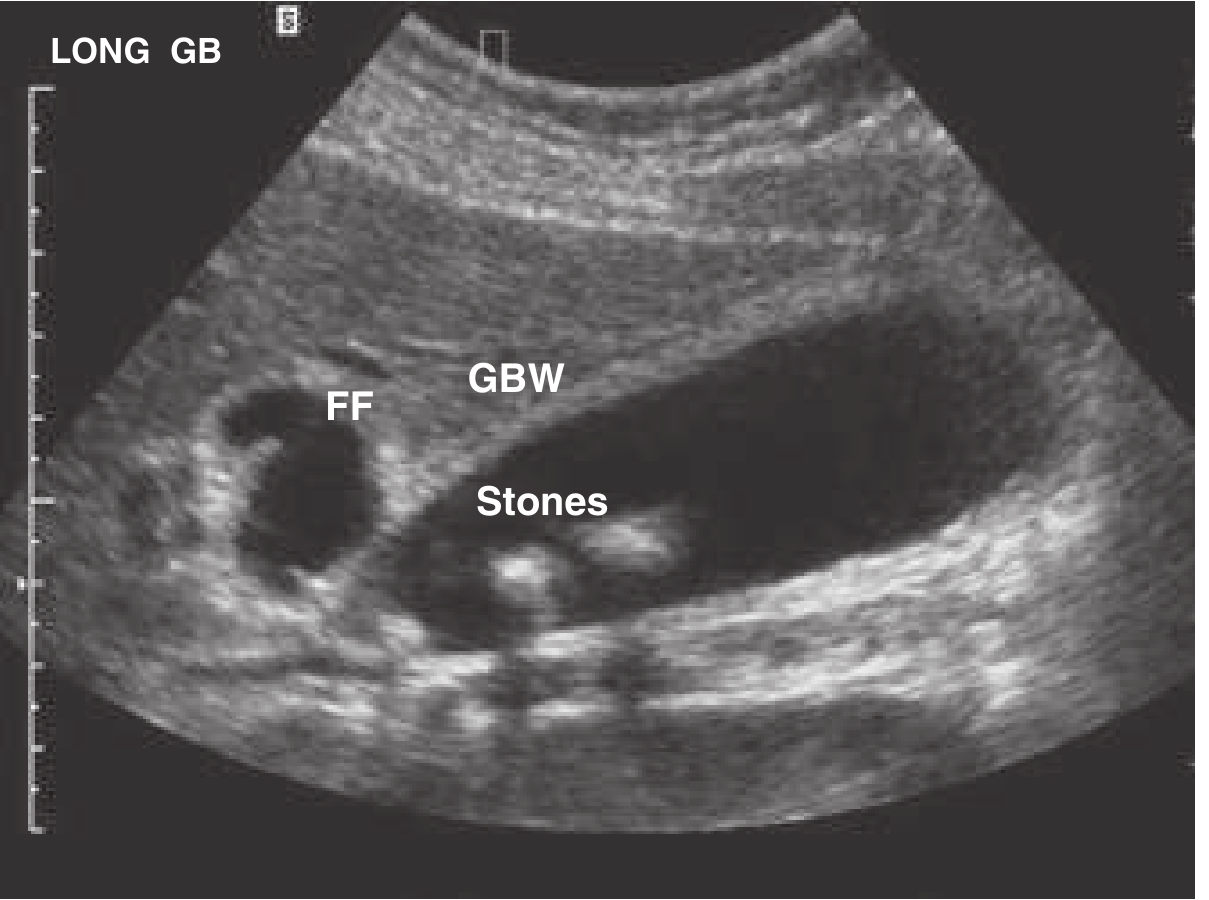
Fig. 76.22 - Gallbladder with gallstones (Stones), thickened gallbladder wall (GBW), and pericholecystic fluid (FF). Together with a sonographic Murphy sign, these findings constitute the diagnosis of cholecystitis.
When all four signs are present (stones + thickened wall + pericholecystic fluid + sonographic Murphy sign), the positive predictive value for cholecystitis exceeds 90%.
Complications Worth Knowing
- Choledocholithiasis - stone migrates to common bile duct → obstructive jaundice, cholangitis (Charcot's triad), pancreatitis
- Empyema - pus fills the gallbladder
- Gangrenous cholecystitis - ischemic necrosis of the wall
- Perforation - can lead to peritonitis or cholecystoenteric fistula
- Gallstone ileus - large stone erodes into bowel, causes small bowel obstruction
Sources: Robbins & Kumar Basic Pathology; Robbins, Cotran & Kumar Pathologic Basis of Disease; Rosen's Emergency Medicine; Textbook of Family Medicine 9e
This is a shared conversation. Sign in to Orris to start your own chat.