
Pelvic inflammatory disease integrated with microbiology and gynaecology and obstetrics
Reading File
Now let me run parallel searches across both microbiology and gynaecology textbooks for PID.
Finding Sources
Finding Sources
Searching PubMed
"pelvic inflammatory disease" diagnosis treatment
Excellent. Now let me read the richest sources in parallel - Harrison's (most comprehensive PID section), Goldman-Cecil, Berek & Novak's Gynecology, and Sherris & Ryan's Microbiology.
Reading File
Reading File
Reading File
Reading File
Excellent content from multiple books. Now let me read more from Harrison's for the complete clinical section, and get the gynaecology-specific content from Berek & Novak.
Reading File
Finding Sources
Finding Sources
Now let me get the Berek & Novak gynecology content (the key gynecology textbook) and the Fitz-Hugh-Curtis section:
Reading File
Reading File
Reading File
Excellent. Now let me get Harrison's sequelae/complications section and the Sherris microbiology Chlamydia/PID content, plus fetch the tubo-ovarian abscess image:
Reading File
Reading File
Loading Image
I now have comprehensive content from Harrison's, Goldman-Cecil, Berek & Novak's Gynecology, and Sherris & Ryan's Microbiology. I have enough material to write a thorough, integrated answer.
Pelvic Inflammatory Disease (PID) - Integrated Microbiology & Gynaecology
1. Definition
Pelvic inflammatory disease (PID) refers to infection that ascends from the cervix or vagina to involve the endometrium and/or fallopian tubes. The spectrum of disease includes endometritis, salpingitis, oophoritis, and peritonitis. Infection can extend further to cause perihepatitis (Fitz-Hugh-Curtis syndrome) or a pelvic/tubo-ovarian abscess (TOA).
"PID is a clinical diagnosis implying upper genital tract infection and inflammation present at any point along a continuum that includes endometritis, salpingitis, and peritonitis." - Berek & Novak's Gynecology
2. Microbiology and Etiology
PID is polymicrobial in virtually all cases. The principal organisms can be grouped:
Primary STI Pathogens (Cervicitis Agents Ascending Upward)
| Organism | Notes |
|---|---|
| Neisseria gonorrhoeae | Most common cause where gonorrhea prevalence is high; causes acute, severe PID |
| Chlamydia trachomatis | ~35% of cases; causes subclinical/silent PID - insidious symptoms often mimicking IBS; ascending infection in 5-30% of infected women; immune-mediated damage |
| Mycoplasma genitalium | Increasingly recognized; presents with mild, chlamydia-like symptoms; specifically associated with endometritis and salpingitis |
Endogenous/BV-Associated Organisms
Bacterial vaginosis (BV) organisms are co-isolated from the upper genital tract in 25-35% of cases:
- Prevotella spp.
- Peptostreptococcus spp.
- Gardnerella vaginalis
- Mobiluncus spp.
BV alters cervical mucus enzymatically, facilitating ascending spread of pathogens.
Aerobic & Facultative Organisms
- Escherichia coli
- Haemophilus influenzae
- Group B streptococci
- Group A streptococci (less common)
- Streptococcus pneumoniae (rare)
Special Causes
- Hematogenous spread: Mycobacterium tuberculosis (causes TB salpingitis - "pipe-stem" tubes), Staphylococcus aureus
- Secondary spread: from appendicitis, diverticulitis, regional ileitis
- Post-procedural: IUD insertion, D&C, hysterosalpingography, termination of pregnancy
N. gonorrhoeae causes 10-40% of women with untreated lower-tract infection to progress to PID. - Goldman-Cecil Medicine
3. Pathogenesis
The sequence of events:
- Colonization of endocervix by N. gonorrhoeae or C. trachomatis (or both)
- Disruption of cervical mucus barrier - BV enzymes, menstruation (menstrual blood is a growth medium; onset of symptoms at menstruation is typical)
- Ascending spread to endometrium → endometritis → salpingitis → peritonitis
- Polymicrobial superinfection - anaerobes join as disease progresses
- Immune-mediated damage - especially with C. trachomatis; repeated exposure causes the greatest inflammatory damage (immunopathology via delayed hypersensitivity)
- TOA formation - agglutination of pelvic organs (tube + ovary + bowel) with pus collection
Facilitating factors for ascending spread:
- Menstruation (most episodes begin peri-menstrually)
- IUD threads may act as a wick
- Instrumentation (IUD insertion, D&C)
- BV disrupting the protective lactobacilli
4. Epidemiology & Risk Factors
- USA: ~800,000 women develop PID annually; hospitalizations 70,000-100,000/year
- Age: Peak incidence in sexually active women aged 15-25 years
- Risk factors:
- Active endocervical gonorrheal or chlamydial infection
- Bacterial vaginosis
- History of prior PID (each episode increases risk of the next)
- Multiple sexual partners / new sexual partner
- Vaginal douching (disrupts flora)
- Recent IUD insertion (risk elevated in first 3 weeks post-insertion)
- Adolescence
- HIV infection
- Protective factors: Oral contraceptive pills (thicken cervical mucus, reduce menstrual flow); condom use; prior tubal ligation
5. Clinical Features
Symptoms
- Pelvic/lower abdominal pain - most common; bilateral, constant or intermittent, typically worse with movement, menses, and coitus
- Vaginal discharge (purulent/mucopurulent)
- Abnormal uterine bleeding (menorrhagia, metrorrhagia)
- Fever (>38.3°C), chills
- Nausea and vomiting (suggests severe disease or TOA)
- Urinary symptoms
Note: Chlamydial PID is classically "silent" or subclinical - it is an important cause of unrecognized tubal damage. - Sherris & Ryan's Medical Microbiology
Signs
- Cervical motion tenderness (CMT) - the hallmark sign (suggests peritoneal irritation)
- Uterine/adnexal tenderness on bimanual examination
- Elevated temperature and tachycardia
- Abdominal distension with decreased bowel sounds (secondary ileus in severe disease)
- Direct/rebound abdominal tenderness
- Cervical or vaginal mucopurulent discharge
- Right upper quadrant pain - Fitz-Hugh-Curtis syndrome (perihepatitis)
- Violin-string adhesions between the liver capsule and peritoneum
- Can mimic cholecystitis or hepatitis
- Occurs in both gonococcal and chlamydial PID
Severity Staging
| Stage | Description |
|---|---|
| Stage I | Acute salpingitis without peritonitis |
| Stage II | Acute salpingitis with peritonitis |
| Stage III | Tubo-ovarian abscess |
| Stage IV | Ruptured TOA with diffuse peritonitis |
6. Diagnosis
CDC Minimum Criteria (Initiate Treatment if Present)
In a sexually active woman with pelvic/lower abdominal pain and no other cause identified, at least one of:
- Cervical motion tenderness
- Uterine tenderness
- Adnexal tenderness
Additional Criteria (Increase Specificity)
| Finding | Notes |
|---|---|
| Oral temperature ≥38.3°C | |
| Mucopurulent cervical/vaginal discharge | |
| WBCs on saline wet mount of vaginal secretions | |
| Elevated ESR (>19.5 mm/hr) or CRP (>11.5 mg/L) | High ESR/CRP predict TOA |
| NAAT positive for N. gonorrhoeae or C. trachomatis |
Most Specific (Definitive) Criteria
- Endometrial biopsy showing endometritis (plasma cell infiltration)
- Laparoscopy - gold standard: tubal edema, erythema, purulent exudate from tubes
- Note: Clinical diagnosis confirmed laparoscopically in only ~70% of cases
- Transvaginal ultrasound/MRI: thickened fluid-filled fallopian tubes, TOA, free pelvic fluid
Imaging
- Transvaginal ultrasound: first-line; shows tubal hyperemia, thickened/fluid-filled tubes, TOA; can guide drainage
- MRI: better delineates equivocal ultrasound findings
- CT abdomen/pelvis: evaluates for complications beyond the pelvis (perihepatitis, generalized peritonitis)
Differential Diagnosis
- Ectopic pregnancy (always rule out with βhCG)
- Appendicitis
- Ovarian cyst torsion or rupture
- Urinary tract infection / pyelonephritis
- Endometriosis
- Inflammatory bowel disease
- Diverticulitis
7. Tubo-Ovarian Abscess (TOA)
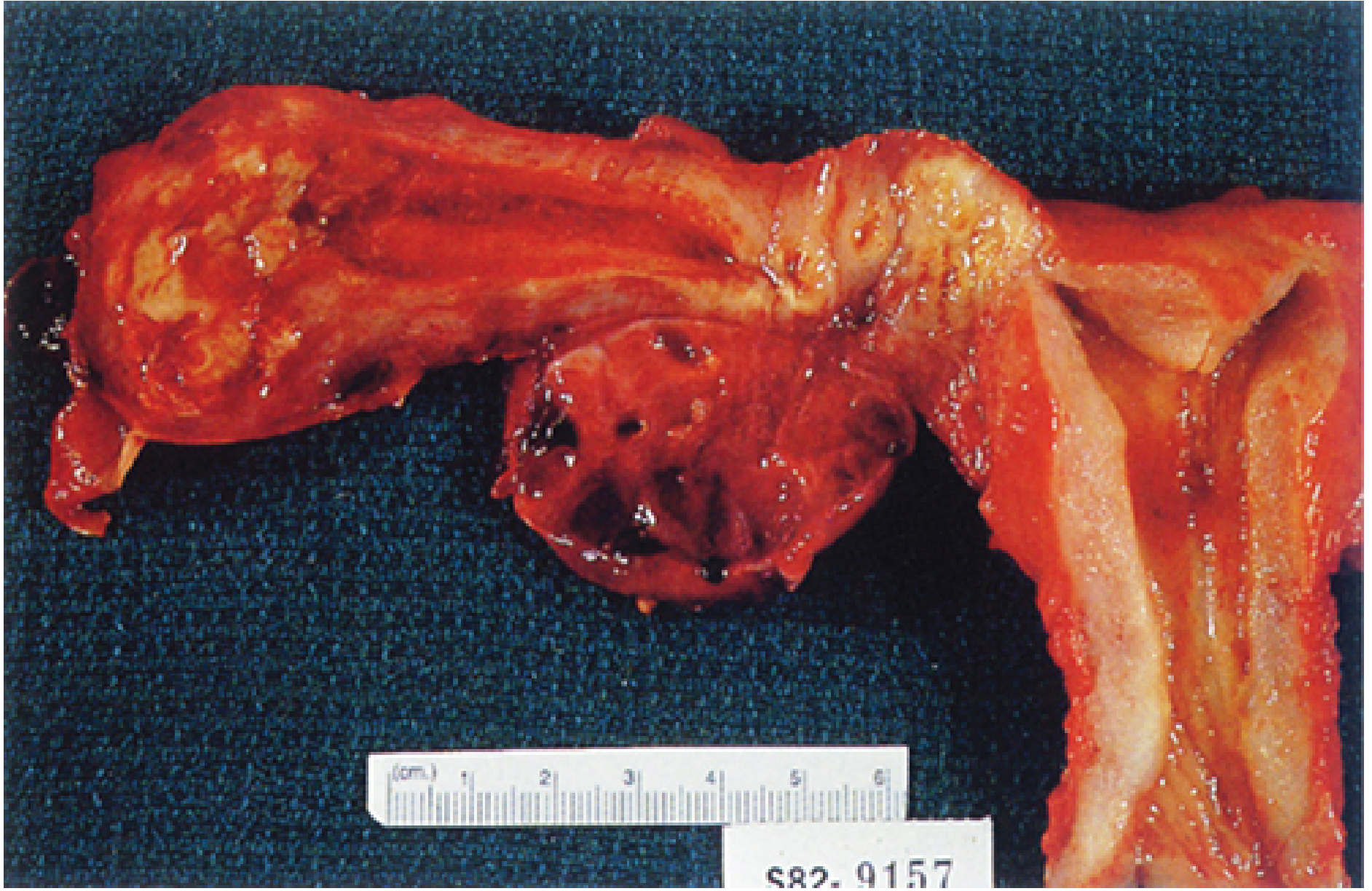
Tubo-ovarian abscess - a large abscess in the fallopian tube, part of the spectrum of PID of which N. gonorrhoeae is a major cause. (Sherris & Ryan's Medical Microbiology, 8th ed.)
- End-stage PID: agglutination of tube, ovary, and bowel forming a palpable complex
- Bimanual examination reveals a tender adnexal mass
- ESR >19.5 mm/hr and CRP >11.5 mg/L predict TOA (vs. PID without TOA)
- Management:
- ~75% respond to parenteral antibiotics alone (inpatient)
- Failure after 72 hours → percutaneous image-guided drainage (up to 90% success)
- Surgical drainage (posterior colpotomy, or laparoscopy/laparotomy) for refractory cases or rupture
- Ruptured TOA = surgical emergency
8. Treatment
General Principles
- All regimens must cover N. gonorrhoeae, C. trachomatis, and anaerobes
- M. genitalium should be addressed if present/suspected
- Remove IUD if no clinical improvement within 72 hours
- Treat all sexual partners empirically for gonorrhea and chlamydia
Indications for Hospitalization
- Diagnosis uncertain; surgical emergency (appendicitis, ectopic) cannot be excluded
- Pregnancy
- Suspected or confirmed TOA
- Severe illness: high fever, nausea/vomiting precluding oral therapy
- Failure to respond to outpatient therapy within 72 hours
- HIV infection
- Non-compliance with outpatient regimen likely
- Some experts recommend hospitalization for all adolescents
Antibiotic Regimens
Outpatient (Mild-Moderate Disease)
| Drug | Dose |
|---|---|
| Ceftriaxone | 500 mg IM single dose (1 g if ≥150 kg) |
| + Doxycycline | 100 mg PO twice daily × 14 days |
| + Metronidazole | 500 mg PO twice daily × 14 days |
Alternative: Cefoxitin 2 g IM + probenecid 1 g PO (single dose) + doxycycline 100 mg PO BD × 14 days + metronidazole
Inpatient Regimen A (Preferred)
| Drug | Dose |
|---|---|
| Cefotetan | 2 g IV q12h OR Cefoxitin 2 g IV q6h |
| + Doxycycline | 100 mg IV or PO q12h |
| Continue IV until 48h after improvement, then doxycycline 100 mg PO BD to complete 14 days total |
Inpatient Regimen B (Especially for TOA)
| Drug | Dose |
|---|---|
| Clindamycin | 900 mg IV q8h |
| + Gentamicin | 2 mg/kg loading dose IV/IM, then 1.5 mg/kg q8h (or 5 mg/kg/day once daily) |
| Continue IV until 48h after improvement, then clindamycin 450 mg PO QID to complete 14 days (better anaerobic coverage than doxycycline for TOA) |
A 2025 meta-analysis found that fluoroquinolone-based regimens for PID showed effectiveness but rising resistance to fluoroquinolones is a concern [PMID: 41327742].
9. Complications and Long-Term Sequelae
PID carries significant morbidity:
| Complication | Risk |
|---|---|
| Infertility (tubal occlusion) | 11% after 1 episode; 23% after 2 episodes; 54% after 3+ episodes (Swedish study) |
| Ectopic pregnancy | 7-fold increase after PID (tubal scarring without complete occlusion) |
| Chronic pelvic pain | Significant proportion of women |
| Recurrent PID | Each episode increases susceptibility |
| Hysterectomy | 8-fold increase in rate after PID (University of Washington) |
| TOA | 10-15% of hospitalized PID cases |
"Even with successful treatment, PID can cause tubal scarring and tubal obstruction. After one episode of PID, almost 10% of women may develop tubal occlusion." - Goldman-Cecil Medicine
10. PID in Special Circumstances
PID and IUDs
- IUDs are associated with increased risk, especially in first 3 weeks post-insertion
- Remove IUD if no improvement; however, IUD removal is NOT mandatory if response is good
- If pregnancy occurs with IUD in situ and PID is present - IUD should be removed
PID and Pregnancy
- PID as coexistent with intrauterine pregnancy is rare
- If pregnancy test is positive in suspected PID → consider ectopic pregnancy, infected abortion, or infected IUP
- Pregnant women with salpingitis: mandatory hospitalization
Subclinical PID
- Particularly with C. trachomatis - may present with only subtle symptoms
- Is a major cause of "unexplained" tubal factor infertility
- Screening sexually active women ≤25 years annually for chlamydia reduces PID incidence by 56% (CDC/USPSTF recommendation)
11. Prevention
- Annual NAAT screening for C. trachomatis in all sexually active women ≤25 years
- Consistent condom use
- Reducing number of sexual partners
- Treating BV (which facilitates ascending infection)
- Prompt treatment of lower genital tract STIs before ascent occurs
- Avoiding vaginal douching
12. Summary Table - Organism-Specific Features
| Organism | Gram stain/Type | Disease in PID | Key Feature |
|---|---|---|---|
| N. gonorrhoeae | Gram-negative diplococcus (intracellular) | Acute severe salpingitis; TOA | Beta-lactamase producing strains; antigenic variation (pili, OMP) prevents vaccine |
| C. trachomatis | Obligate intracellular; serovars D-K | Silent/subclinical salpingitis; major cause of infertility | NAAT for diagnosis; immunopathology key mechanism |
| M. genitalium | Cell-wall lacking; slowest-growing | Mild PID; endometritis | Doxycycline then moxifloxacin if resistant |
| Anaerobes (Prevotella, Peptostreptococcus) | Mixed | TOA; co-infection | Especially important in Stage III/IV |
| M. tuberculosis | AFB/Gram-positive rod | Chronic granulomatous salpingitis; infertility | "Pipe-stem" tubes; hematogenous spread |
Sources: Harrison's Principles of Internal Medicine 22E (2025) | Berek & Novak's Gynecology | Goldman-Cecil Medicine | Sherris & Ryan's Medical Microbiology, 8th Ed. | Recent meta-analysis on fluoroquinolones in PID [PMID: 41327742]
This is a shared conversation. Sign in to Orris to start your own chat.