
Epidiomiology approaches
Epidemiology uses several core study designs and methodological approaches to understand the distribution and determinants of disease in populations. Here's a quick overview:
Descriptive approaches - characterize who gets disease, where, and when (person, place, time).
Analytical approaches - test hypotheses about causes, using observational or experimental designs.
Key study types: cross-sectional, cohort, case-control, randomized controlled trials, and ecological studies.
Searching sources...
Reading File
Finding Sources
Finding Sources
Finding Sources
Finding Sources
I found excellent sources - Park's Preventive Medicine (the gold standard for epidemiology) and Bradley's Neurology. Let me pull the detailed content.
Finding Sources
Reading File
Now let me read the key sections on descriptive, analytical, and experimental epidemiology from Park's:
Reading File
Reading File
Reading File
Reading File
I now have comprehensive material. Let me also fetch the study design diagrams to include visually.
Loading Image
Loading Image
I now have all the material needed for a thorough, well-illustrated answer. Here is the complete overview:
Epidemiology Approaches
Epidemiology is the study of the distribution and determinants of health-related states in specified populations, and the application of that study to the control of health problems. There are three major approaches:
1. Descriptive Epidemiology
Descriptive studies are usually the first phase of an epidemiological investigation. They observe the distribution of disease in populations and identify characteristics associated with the disease. They ask three fundamental questions:
- When is the disease occurring? - time distribution
- Where is it occurring? - place distribution
- Who is getting the disease? - person distribution
Procedures in descriptive studies (Park's Table 8):
- Defining the population to be studied
- Defining the disease under study
- Describing the disease by time, place, and person
- Measurement of disease
- Comparing with known indices
- Formulation of an aetiological hypothesis
The "defined population" can be the whole population of a geographic area, or a representative sample. At the end of a descriptive study, you formulate a hypothesis - but you do not test it. That is the job of analytical studies.
Types of descriptive studies:
- Case reports / case series - observations about individual patients or small groups
- Cross-sectional studies - prevalence surveys; exposure and disease measured simultaneously in the population at a single point in time
- Ecological studies - population-level data are used (not individual data); unit of analysis is a group, not a person
2. Analytical Epidemiology
Analytical studies are the second major type. In contrast to descriptive studies that look at entire populations, analytical studies focus on the individual within the population. The object is not to formulate, but to test hypotheses. They determine:
- Whether or not a statistical association exists between a disease and a suspected factor
- If one exists, the strength of the association
Analytical studies comprise two distinct types of observational studies:
A. Case-Control Study (Retrospective)
Case-control studies are often called "retrospective studies" and are a common first approach to test causal hypotheses. Three distinct features:
- Both exposure and outcome (disease) have already occurred before the start of the study
- The study proceeds backwards from effect to cause
- It uses a control or comparison group
The investigator starts with cases (people with disease) and controls (people without disease), then looks back in time to compare their exposures.
Direction of inquiry: present → past
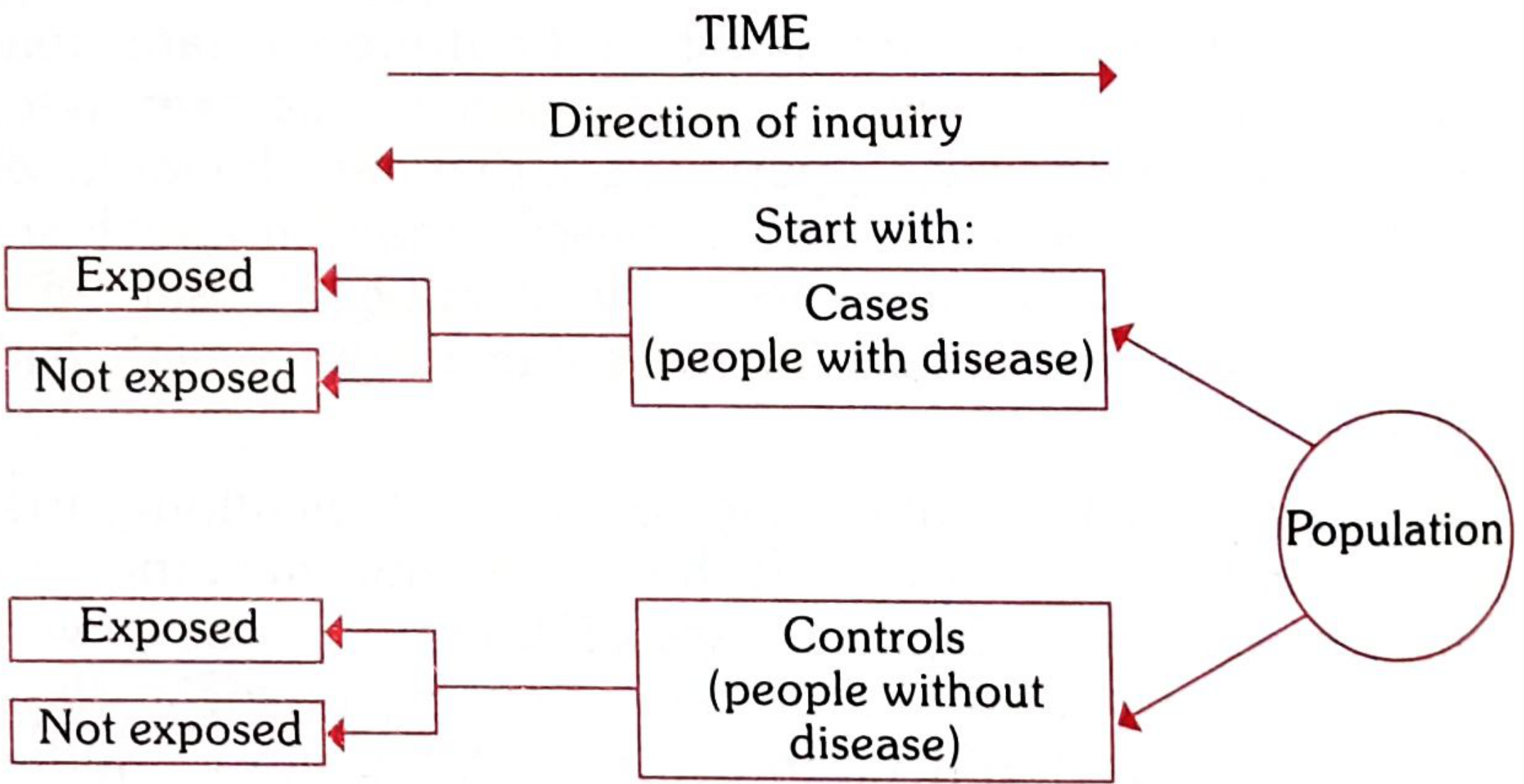
Measure of association: Odds Ratio (OR)
Basic steps:
- Selection of cases and controls
- Matching
- Measurement of exposure
- Analysis and interpretation (2×2 contingency table)
Advantages: Quick, cheap, good for rare diseases and diseases with long latency; can study multiple exposures.
Disadvantages: Susceptible to recall bias, selection bias; cannot calculate incidence; cannot study rare exposures.
B. Cohort Study (Prospective)
The cohort study starts with a group of disease-free individuals, classifies them by exposure status, and follows them over time to see who develops the disease.
Direction of inquiry: past/present → future
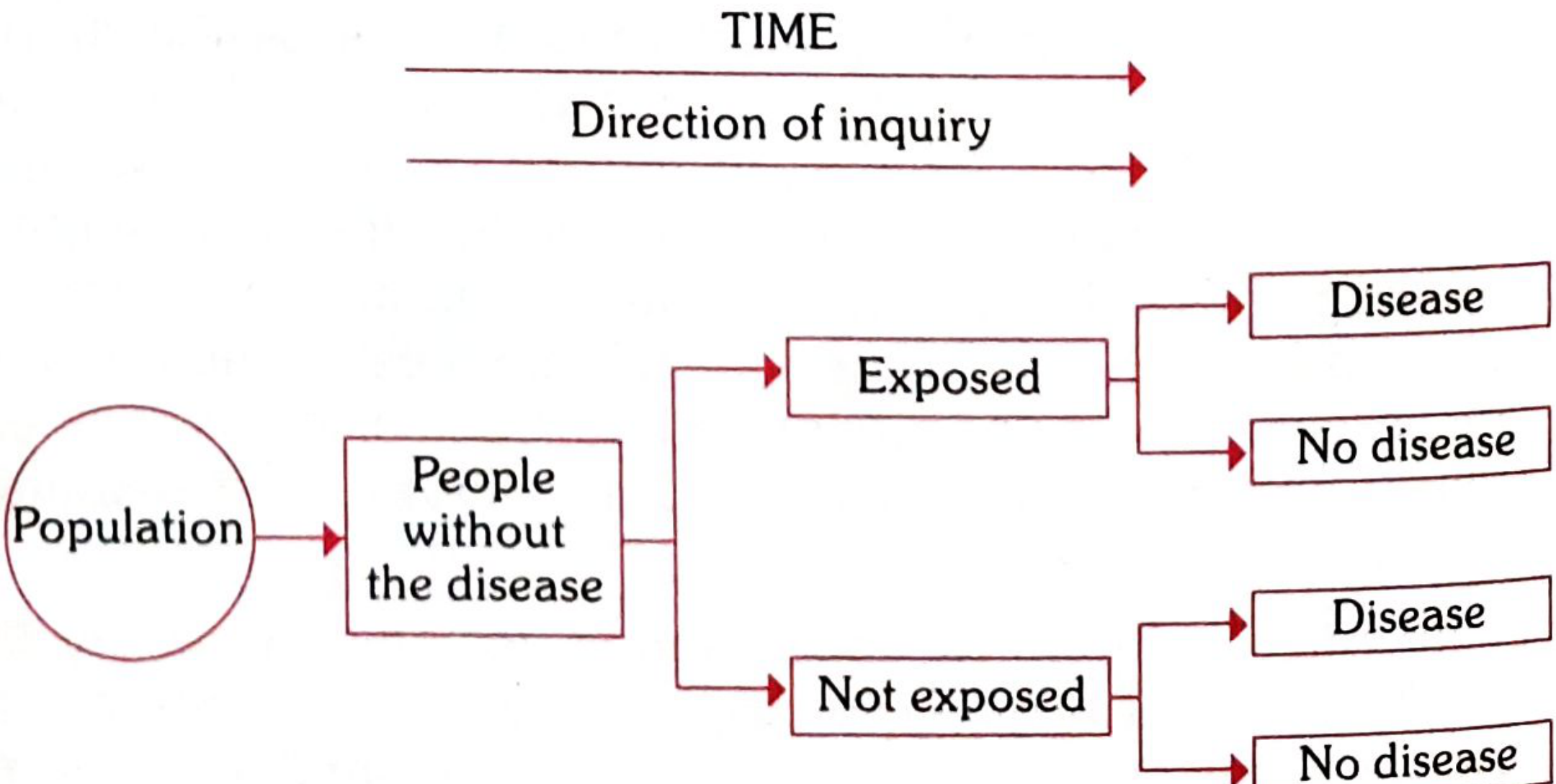
Comparison groups in cohort studies:
- Internal comparisons - single cohort classified by degree of exposure (e.g., smokers by number of cigarettes/day)
- External comparisons - separate exposed vs. unexposed cohort (e.g., radiologists vs. ophthalmologists)
- Comparison with general population rates - the exposed group's experience compared with general population rates in the same area
Measure of association: Relative Risk (RR) / Incidence Rate Ratio
Advantages: Can calculate incidence and relative risk; temporal sequence of exposure → disease is clear; can study multiple outcomes from one exposure; less susceptible to bias.
Disadvantages: Expensive, time-consuming; requires large numbers; loss to follow-up is a major problem.
| Feature | Case-Control | Cohort |
|---|---|---|
| Starting point | Disease (cases vs. controls) | Exposure status |
| Direction | Retrospective | Prospective (usually) |
| Measure | Odds Ratio | Relative Risk |
| Best for | Rare diseases | Rare exposures |
| Cost | Low | High |
3. Experimental (Interventional) Epidemiology
Experimental studies are similar in approach to cohort studies, except the conditions are under direct control of the investigator. They involve deliberate application or withdrawal of a suspected cause or intervention in the experimental group, while making no change in the control group, then comparing outcomes.
This contrasts sharply with observational studies (descriptive, case-control, cohort) where the epidemiologist only observes the natural course of events.
Aims:
- To provide "scientific proof" of aetiological or risk factors
- To measure the effectiveness and efficiency of health services for prevention, control, and treatment of disease
Types:
| Type | Description |
|---|---|
| Randomized Controlled Trial (RCT) | Gold standard; participants randomly allocated to intervention vs. control; minimizes confounding |
| Field trial | Intervention applied in the community to healthy people at risk (e.g., vaccine trials) |
| Community trial | Entire communities (not individuals) randomized to intervention |
| Animal experiments | Used to confirm aetiological hypotheses, test vaccines/drugs, and study pathogenesis |
Additional challenges compared to observational studies: cost, ethics, and feasibility.
Summary: The Epidemiological Hierarchy
Experimental Studies (RCTs)           ← Highest causal evidence
    ↑
Analytical Studies (Cohort, Case-Control)
    ↑
Descriptive Studies (Cross-sectional, Ecological, Case reports)
    ↑
Clinical impression / anecdote        ← Lowest evidence
The typical sequence in epidemiological research is:
- Descriptive study → generates hypothesis
- Analytical study → tests hypothesis
- Experimental study → confirms causation and tests interventions
- Park's Textbook of Preventive and Social Medicine, pp. 83-93
This is a shared conversation. Sign in to Orris to start your own chat.