
Paraganglioma microscopy
Reading File
This is a visual/histology query - image retrieval is critical. Let me search the library now.
Finding Sources
Finding Sources
Robbins Pathologic Basis of Disease has a MORPHOLOGY section on paraganglioma - that's the key source for microscopy. Let me read it along with the Scott-Brown's and Campbell-Walsh sections.
Reading File
Finding Sources
I can see there's an image at line 1054 in Robbins. Let me read that image URL and also get more detail from Cummings and Shambaugh, plus Harrison's.
Reading File
Reading File
Reading File
Reading File
Excellent - I have detailed textbook content. Now let me fetch the key microscopy image from Robbins and look for the Harrison's IHC image.
Loading Image
Reading File
I have the key microscopy image from Robbins. Let me also fetch the Harrison's IHC panel showing chromogranin, synaptophysin, S-100, and SDHB staining.
Loading Image
I now have excellent microscopy images and comprehensive textbook content. Here is the full answer:
Paraganglioma - Microscopic Features
H&E Appearance
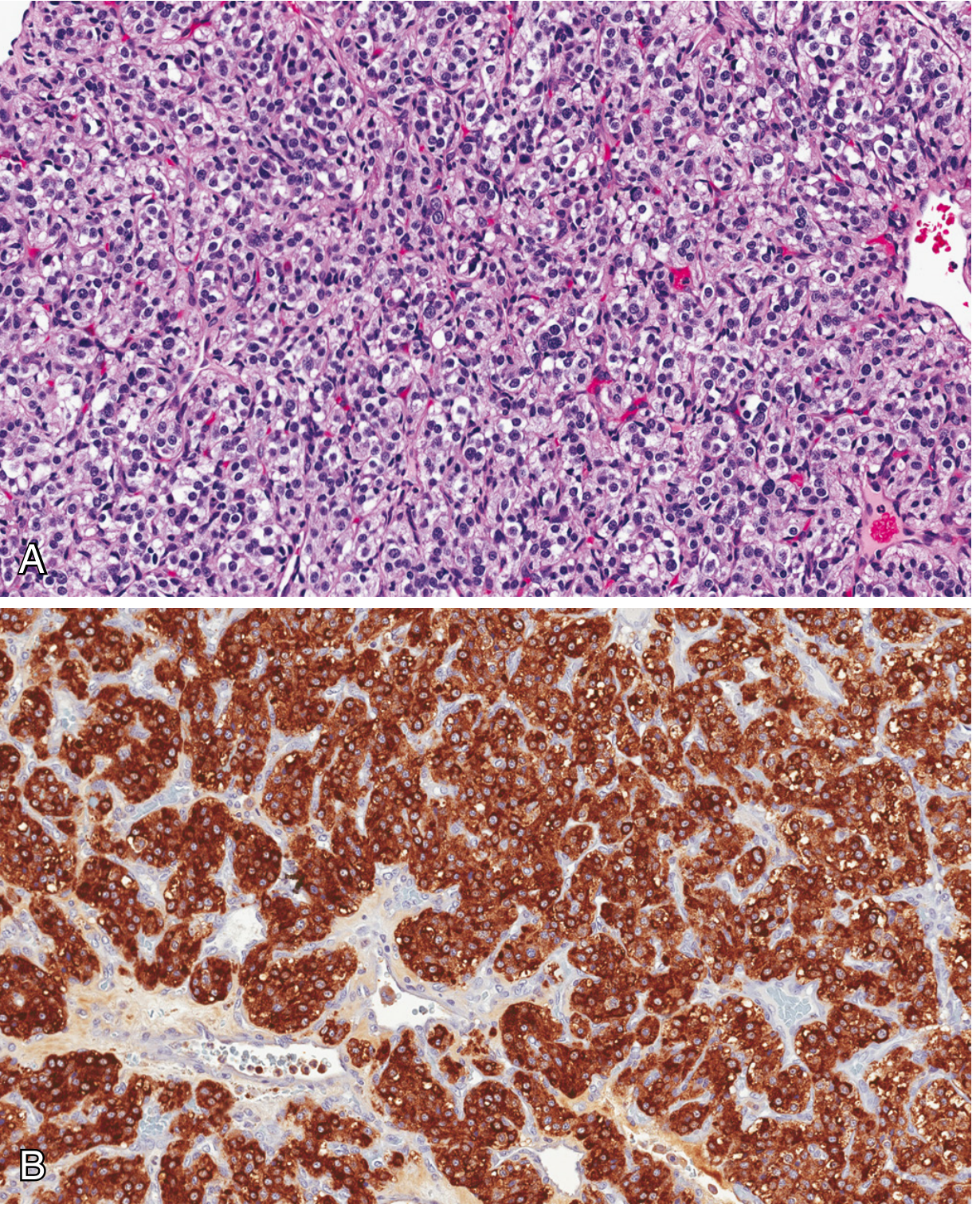
(A) H&E: Nests of tumor cells (zellballen) separated by delicate fibrovascular septa. (B) Chromogranin IHC: Intense brown cytoplasmic positivity in chief cells, with pale sustentacular cells at nest periphery.
Architectural Pattern: Zellballen
The single most characteristic microscopic feature is the zellballen (German: "cell balls") pattern - compact nests or clusters of tumor cells separated by thin fibrovascular septa containing capillaries. This architecture mirrors the normal paraganglia from which the tumor arises. - Robbins, Cotran & Kumar Pathologic Basis of Disease, p. 694
Cell Types
Type I - Chief Cells (predominant)
- Origin: Neuroectodermal (neural crest derived)
- Shape: Round to oval; polygonal
- Cytoplasm: Abundant, clear or granular eosinophilic cytoplasm
- Nuclei: Uniform, round to ovoid; sometimes vesicular
- Ultrastructure: Contain dense-core cytoplasmic granules storing catecholamines. Two subtypes - light and dark cells - are distinguishable ultrastructurally
- Mitoses: Scant; pleomorphism does NOT reliably indicate malignancy
Type II - Sustentacular Cells (supporting)
- Shape: Elongated spindle cells resembling Schwann cells
- Location: Peripherally surround the chief cell nests
- Visibility: Difficult to identify on light microscopy; appear as spindle-shaped basophilic cells
- Function: Not fully elucidated, analogous to glial support cells
- Cummings Otolaryngology Head and Neck Surgery, p. 2221; Shambaugh Surgery of the Ear
Immunohistochemistry
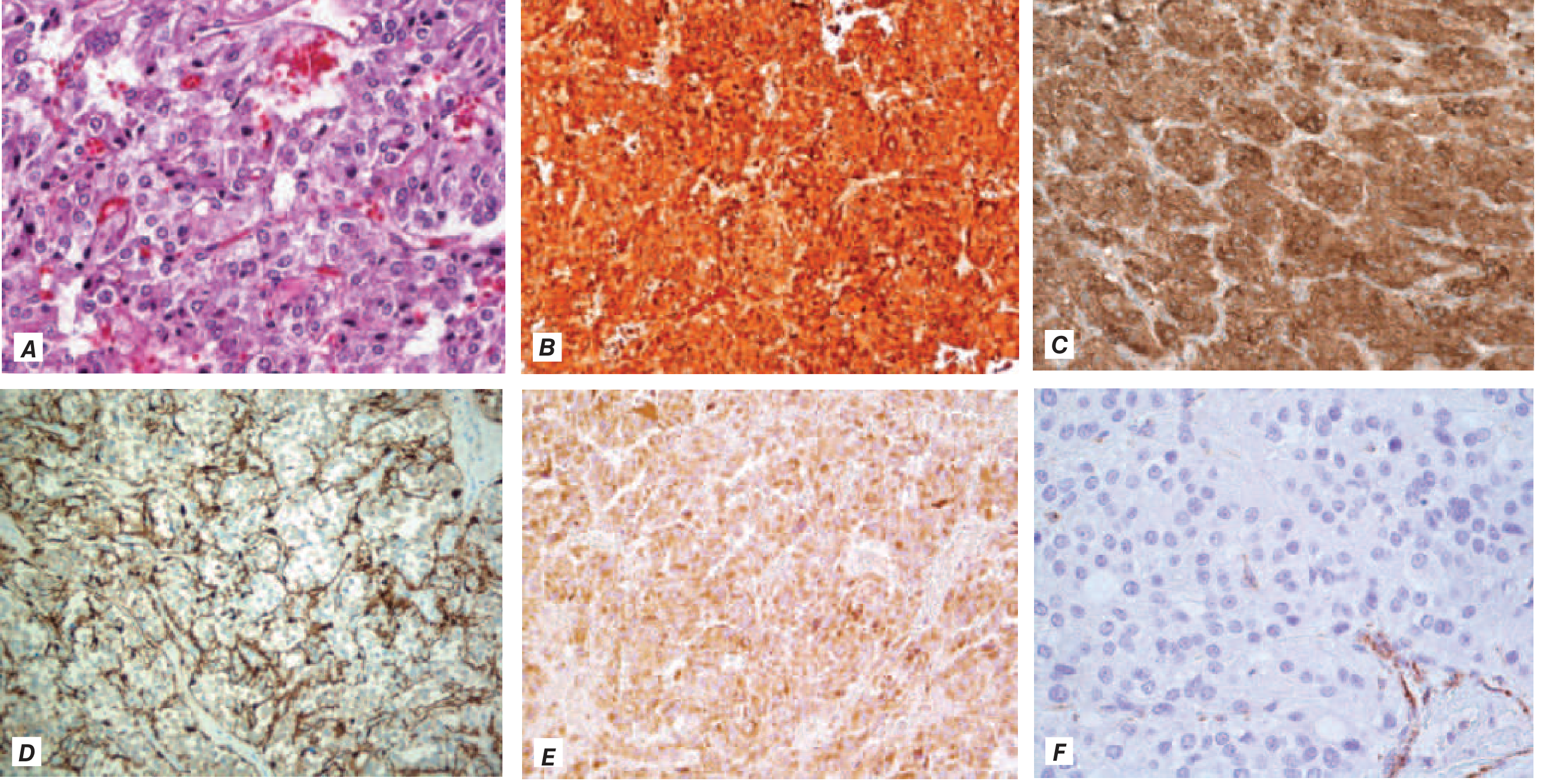
| Marker | Cell Type Stained | Result |
|---|---|---|
| Chromogranin A | Chief cells (Type I) | Strongly positive |
| Synaptophysin | Chief cells (Type I) | Positive |
| INSM1 (insulinoma-associated protein 1) | Chief cells | Positive |
| CD56 | Chief cells | Positive |
| NSE (neuron-specific enolase) | Chief cells | Positive |
| S-100 protein | Sustentacular cells (Type II) | Positive (peripheral rim pattern) |
| GFAP | Sustentacular cells | Focal positivity |
| Cytokeratin | All cells | Negative (key differential point from carcinomas) |
| SDHB | All cells | Lost in SDHB-mutated tumors |
- Robbins p. 694; Harrison's 22E p. 3118; Cummings p. 2221
Electron Microscopy
Dense-core membrane-bound neuroendocrine granules (catecholamine-storing) are identifiable within chief cell cytoplasm. They are well-demarcated in paravertebral (sympathetic) tumors but tend to be scant in non-functioning tumors. - Robbins, p. 694
Predicting Malignancy - A Histological Challenge
Standard microscopic features are unreliable for predicting malignant behavior:
- Mitoses, pleomorphism, nuclear hyperchromatism, and even vascular invasion are not reliable indicators of malignancy
- Malignancy is defined by the presence of metastases (to regional nodes or distant sites), not by histology alone
- SDHB mutation is the strongest histological/molecular predictor - associated with 30-50% metastatic rates; demonstrated by loss of SDHB immunostaining (panel F above)
- Some studies suggest that a reduced ratio of sustentacular cells to chief cells (fewer S-100 positive cells) correlates with more aggressive behavior
- Robbins p. 695; Shambaugh Surgery of the Ear
Quick Reference Summary
| Feature | Finding |
|---|---|
| Architecture | Zellballen (nests separated by fibrovascular septa) |
| Main cell | Chief cell - round, abundant eosinophilic granular cytoplasm |
| Supporting cell | Sustentacular cell - spindle, peripheral, S-100+ |
| IHC chief cells | Chromogranin+, Synaptophysin+, INSM1+, CD56+ |
| IHC sustentacular | S-100+, GFAP focal |
| Cytokeratin | Negative |
| Malignancy marker | SDHB loss (IHC) |
| Mitoses | Scant; not predictive of malignancy |
This is a shared conversation. Sign in to Orris to start your own chat.