
Describe Neuro-Muscular Junction 5 mark question
Reading File
Finding Sources
Finding Sources
Reading File
Reading File
Reading File
Reading File
Reading File
I now have comprehensive content from multiple authoritative physiology textbooks. Let me compile the answer.
Loading Image
Loading Image
Here is a complete 5-mark answer on the Neuromuscular Junction (NMJ):
Neuromuscular Junction (NMJ)
Definition
The neuromuscular junction is a specialized chemical synapse between a motor nerve terminal and a skeletal muscle fiber, through which a nerve impulse triggers muscle contraction.
Structure
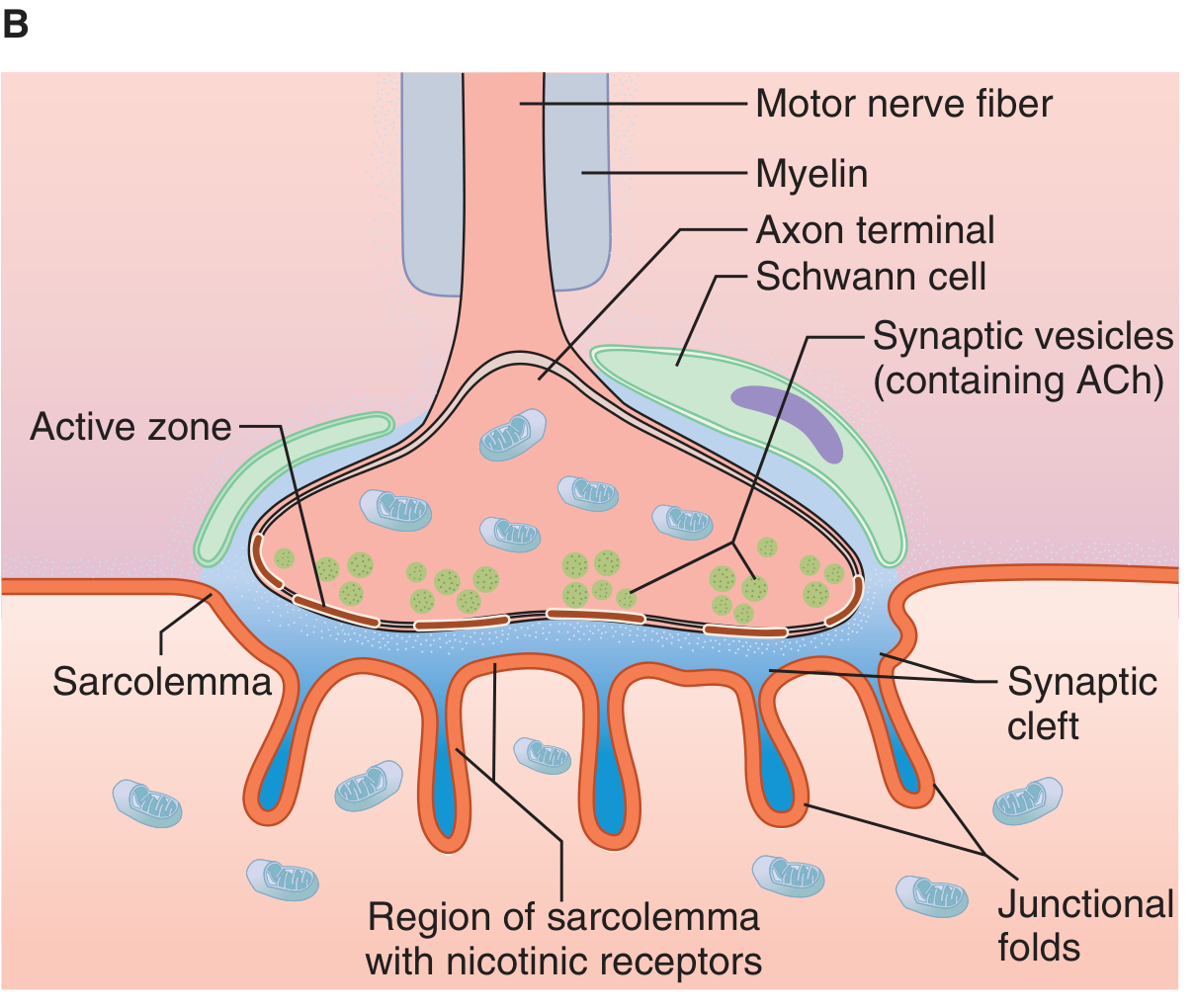
The NMJ has three components:
1. Presynaptic (nerve) terminal
- As the myelinated motor axon approaches the muscle, it loses its myelin sheath and divides into multiple terminal boutons that sit in grooves on the muscle surface.
- Each bouton contains: synaptic vesicles (each holding 6,000–10,000 molecules of ACh), mitochondria, and specialized release sites called active zones.
- ACh is synthesized from choline + acetyl-CoA by choline acetyltransferase (ChAT) in the cytoplasm, then packed into vesicles via an ACh-H⁺ exchanger.
- Schwann cells cap the nerve terminal on the side facing away from the muscle.
2. Synaptic cleft
- ~50 nm wide, filled with a basal lamina matrix containing collagen, laminin, agrin, and a high concentration of acetylcholinesterase (AChE).
3. Postsynaptic (motor end plate)
- The muscle membrane (sarcolemma) here is thickened and thrown into junctional folds, which vastly increase surface area.
- Nicotinic ACh receptors (N_M) are concentrated at the crests of these folds. Each receptor is a pentameric ligand-gated ion channel (2α, β, δ, γ in fetal; γ replaced by ε in adult).
Sequence of Transmission
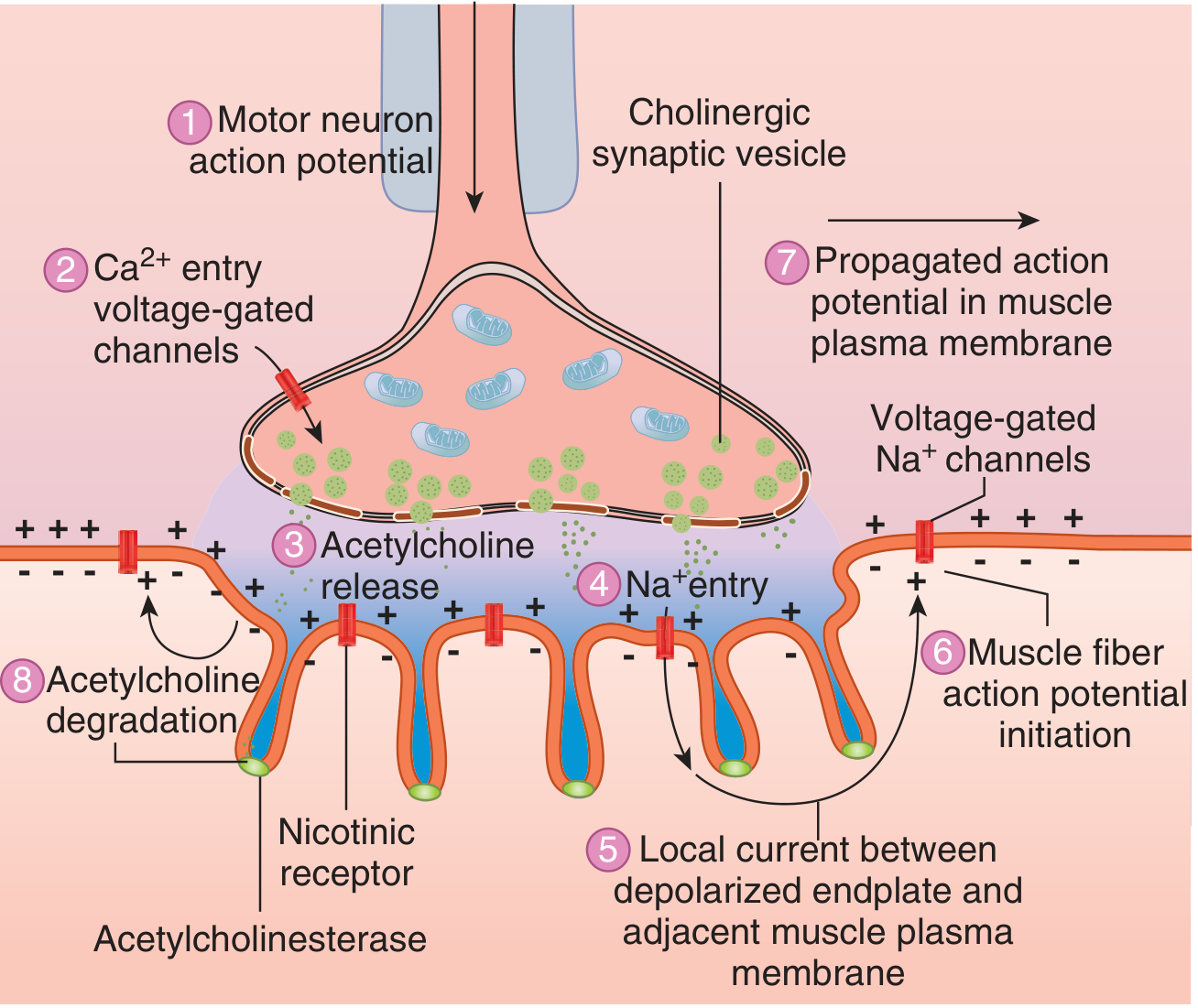
- Action potential arrives at the motor nerve terminal.
- Voltage-gated Ca²⁺ channels open → Ca²⁺ enters the terminal.
- Ca²⁺ triggers exocytosis of ACh-containing vesicles at the active zones.
- ACh diffuses across the synaptic cleft and binds to nicotinic N_M receptors (two ACh molecules per receptor required).
- The receptor channel opens, allowing influx of Na⁺ (and efflux of K⁺). The large inward Na⁺ current depolarizes the end plate → end plate potential (EPP).
- The EPP depolarizes adjacent sarcolemma, opening voltage-gated Na⁺ channels → action potential generated and propagated along the muscle fiber.
- AChE rapidly hydrolyzes ACh → choline + acetate, terminating the signal within milliseconds. Choline is recycled back into the terminal.
Key Points for Exam
| Feature | Detail |
|---|---|
| Neurotransmitter | Acetylcholine (ACh) |
| Postsynaptic receptor | Nicotinic (N_M) — ionotropic |
| Trigger for exocytosis | Ca²⁺ entry via voltage-gated channels |
| Postsynaptic potential | End plate potential (EPP) |
| Termination of signal | AChE in synaptic basal lamina |
| Safety factor | EPP is ~3× larger than needed to fire an action potential |
Clinical Relevance
- Myasthenia Gravis: autoantibodies against N_M receptors → fatigable muscle weakness.
- Lambert-Eaton Syndrome: autoantibodies against presynaptic voltage-gated Ca²⁺ channels → reduced ACh release.
- Curare/rocuronium: competitive antagonists at N_M receptors → used as neuromuscular blockers in anaesthesia.
- Organophosphates/neostigmine: AChE inhibitors → prolong ACh action.
Sources: Ganong's Review of Medical Physiology, 26e; Guyton and Hall Textbook of Medical Physiology; Medical Physiology (Boron & Boulpaep)
This is a shared conversation. Sign in to Orris to start your own chat.