
Please explain about orthopaedics implants with images
Please explain about orthopaedics implants with images
orthopedic implants AND complications
AAOS orthopedic implants internal fixation patient information
orthopedic implants internal fixation plates screws intramedullary nail external fixator diagram
https://orthoinfo.aaos.org/en/treatment/internal-fixation-fo…
What are orthopaedic implants?
- Reduce the fracture, meaning reposition the bone fragments.
- Fix the fragments with an implant.
- Protect the repair while bone healing occurs.
Main fracture-fixation implants
1. Plates and screws
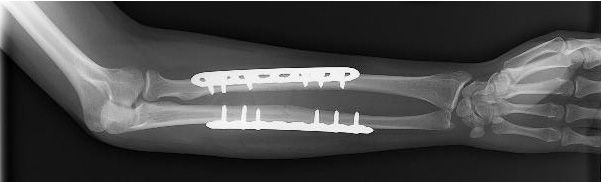
- Forearm, clavicle, ankle, wrist, and many fractures near joints
- Some complex fractures where accurate restoration of the joint surface is needed
- Conventional compression plates: can squeeze the plate against bone and generate compression across a fracture.
- Locking plates: screws lock into the plate, producing a fixed-angle construct. They are particularly useful in osteoporotic bone and fractures near joints.
- Bridge plates: span a comminuted zone without trying to attach every small fragment.
Limitations: requires surgical exposure; the plate can occasionally irritate overlying tendons or skin.
2. Screws alone
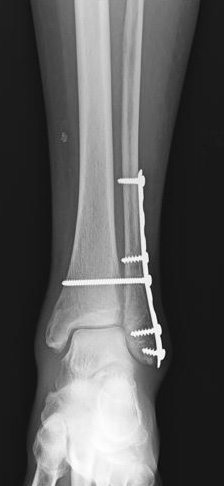
- Cortical screws for dense outer bone
- Cancellous screws for softer, spongy bone near the ends of long bones
- Cannulated screws, placed over a guidewire for accurate positioning
- Lag screws, designed to compress two bone fragments together
3. Intramedullary nails or rods
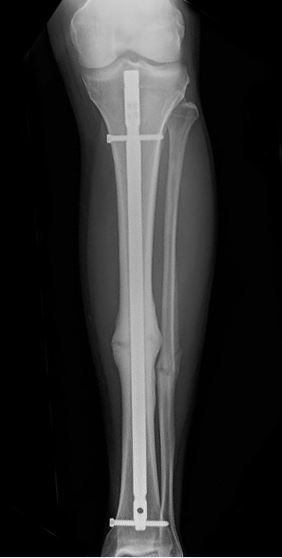
- Femoral shaft fractures
- Tibial shaft fractures
- Humeral shaft fractures
- Some fractures around the hip
- The implant lies close to the bone's mechanical axis.
- It often permits earlier mobilization than prolonged casting.
- It can be inserted through relatively small incisions compared with many plates.
- Not suitable for every fracture pattern.
- May cause pain around the entry point.
- Nail or locking-screw breakage can occur if bone union is delayed.
4. Wires, pins, and K-wires
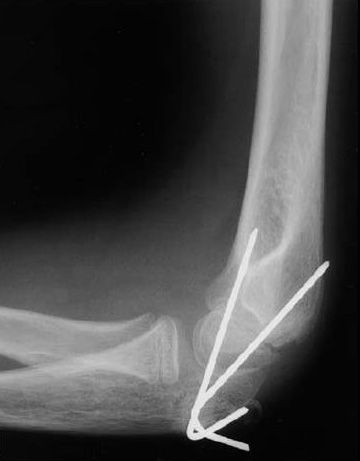
- Pediatric elbow fractures
- Hand and foot fractures
- Small bone fragments
- Temporary stabilization during surgery
5. External fixators
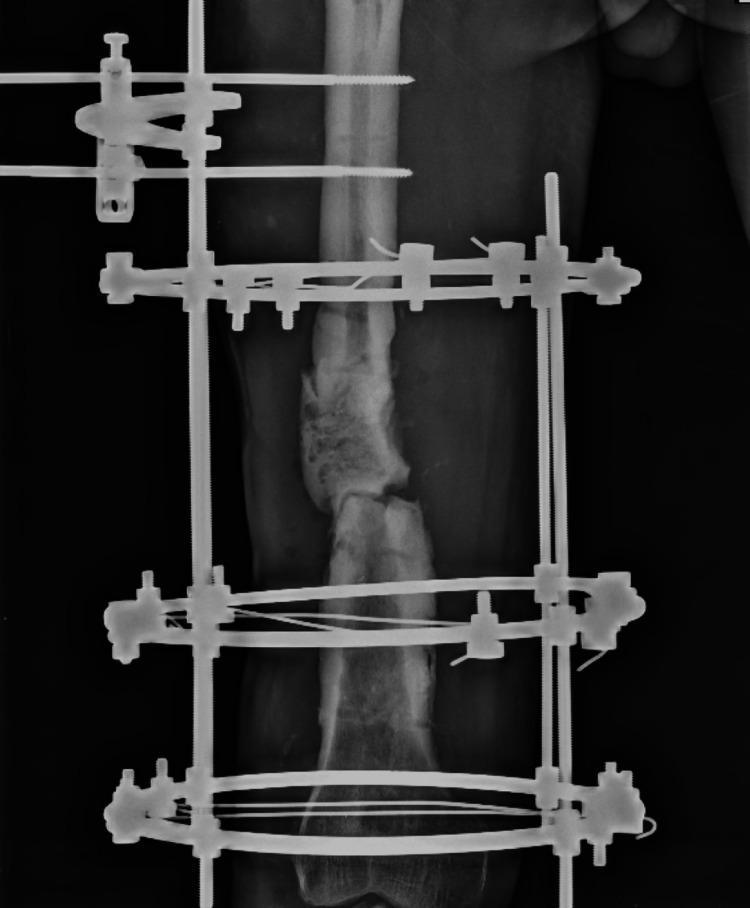
- Severe open fractures
- Major soft-tissue damage or contamination
- Polytrauma, when quick stabilization is necessary
- Infection, bone loss, deformity correction, or limb lengthening
- As temporary fixation before a later definitive operation
Implants beyond fracture fixation
| Implant group | Examples | Purpose |
|---|---|---|
| Joint-replacement implants | Total hip, knee, shoulder arthroplasty | Replace damaged joint surfaces in arthritis, fracture, or failed prior surgery |
| Spinal implants | Pedicle screws, rods, cages, plates | Stabilize the spine after trauma, deformity, instability, or selected degenerative conditions |
| Sports-medicine implants | Suture anchors, interference screws, buttons | Reattach tendons or ligaments, for example in rotator-cuff repair or ACL reconstruction |
| Bone-reconstruction implants | Rings, bone transport frames, porous augments | Treat bone loss, deformity, difficult nonunion, or revision joint replacement |
Implant materials
- Stainless steel
- Titanium or titanium alloys
- Cobalt-chromium alloys, commonly used in many joint-replacement components
- Tantalum, a porous metal sometimes used where bone ingrowth is desired
- In selected procedures, bioabsorbable polymers
Do implants need to be removed?
- Persistent implant-related pain or tendon irritation
- Infection
- Implant breakage or loosening
- Prominent hardware under thin skin
- A problem that requires revision surgery
- A temporary pin or wire intended for removal
Potential complications
- Surgical-site or deep implant infection
- Delayed union, nonunion, or malunion
- Implant loosening, bending, or breakage
- Injury to nearby nerves, vessels, tendons, or joints
- Stiffness, pain, and scar-related problems
- Blood clots after lower-limb or major surgery
- Metal sensitivity, which is relatively rare
Different types of plates and screws and where are they used
orthopedic plates and screws types locking compression buttress plate diagram
orthopedic plate screw fixation
AO Foundation types of bone plates screws locking compression buttress orthopedic
https://media.aofoundation.org/trauma/-/media/project/aocd/a…
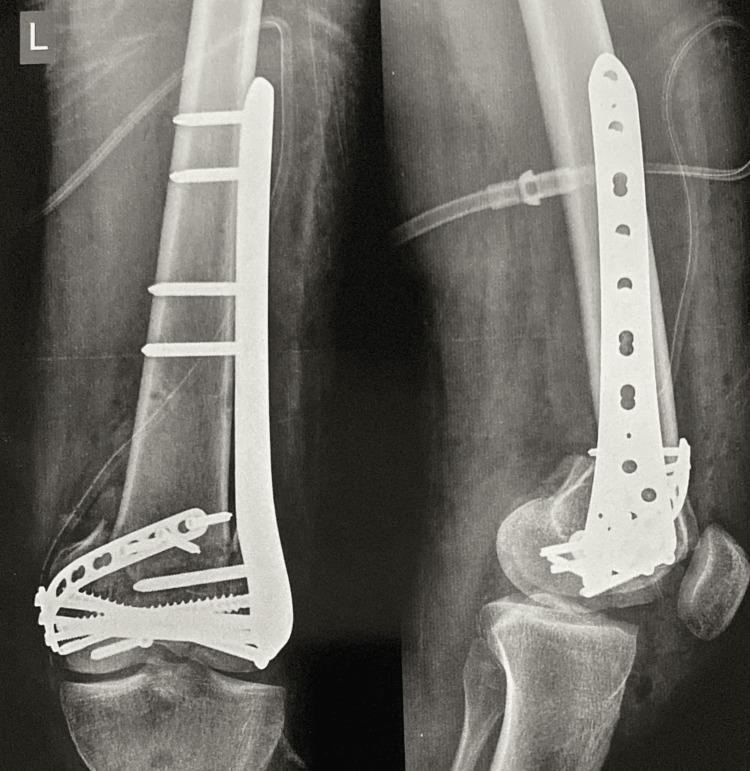
Orthopaedic plates and their uses
| Plate type | Main purpose | Typical uses |
|---|---|---|
| Dynamic compression plate (DCP) | Compresses a simple fracture when screws are inserted eccentrically in special oval holes | Simple transverse or short-oblique shaft fractures of humerus, radius, ulna, femur, or tibia |
| Limited-contact DCP (LC-DCP) | A DCP with reduced contact against bone, intended to lessen disruption of blood supply beneath the plate | Similar shaft-fracture applications, especially where biological fixation is preferred |
| Locking compression plate (LCP) | Screw heads lock into threaded plate holes, creating a fixed-angle construct | Osteoporotic bone, fractures near joints, periarticular fractures, comminuted fractures, distal radius, proximal humerus, distal femur, proximal tibia |
| Anatomical or pre-contoured plate | Shaped to fit a particular bone region | Clavicle, distal radius, proximal humerus, distal femur, proximal tibia, distal fibula, pelvis |
| Buttress plate | Prevents a fragment from collapsing or sliding, particularly under shear force | Tibial plateau, distal radius, posterior malleolus, medial femoral neck, acetabulum |
| T-plate / L-plate | A buttress-type plate with a broad end that captures a metaphyseal or joint fragment | Distal radius, distal humerus, proximal tibia, selected ankle and foot fractures |
| Neutralization plate | Protects an interfragmentary lag screw from bending, torsion, and shear | Oblique or spiral shaft fractures, commonly forearm and selected tibial/femoral fractures |
| Bridge plate | Spans a comminuted zone without stripping or fixing every small fragment | Comminuted fractures of femur, tibia, humerus, clavicle, and some periarticular fractures |
| Reconstruction plate | Highly bendable in several planes because of notched edges | Pelvis, acetabulum, clavicle, distal humerus, and other irregular surfaces |
| One-third tubular plate | Thin, narrow, easily contoured plate | Lateral malleolus, small bones of foot/hand, and as an antiglide plate in selected ankle fractures |
| Hook plate | Hook captures a small bony fragment or passes beneath an adjacent structure | Distal clavicle, selected acromioclavicular injuries, and small avulsion fragments |
| Blade plate / dynamic condylar screw plate | Fixed-angle device with a blade or large lag screw into the bone end | Selected proximal or distal femoral fractures and corrective osteotomies. Used less often in some settings because locking plates and nails are alternatives |
| Minifragment plates | Small plates and screws for small bones/fragments | Hand, foot, distal radius, radial head, olecranon, facial and selected pediatric applications |
Key concept: locking vs non-locking plates
- Non-locking plate: the screw pulls the plate against the bone. Stability depends heavily on screw grip and friction between plate and bone.
- Locking plate: the screw threads into the plate as well as bone. The plate and screws act as one fixed-angle frame. This is particularly helpful in weak osteoporotic bone and short fragments near a joint.
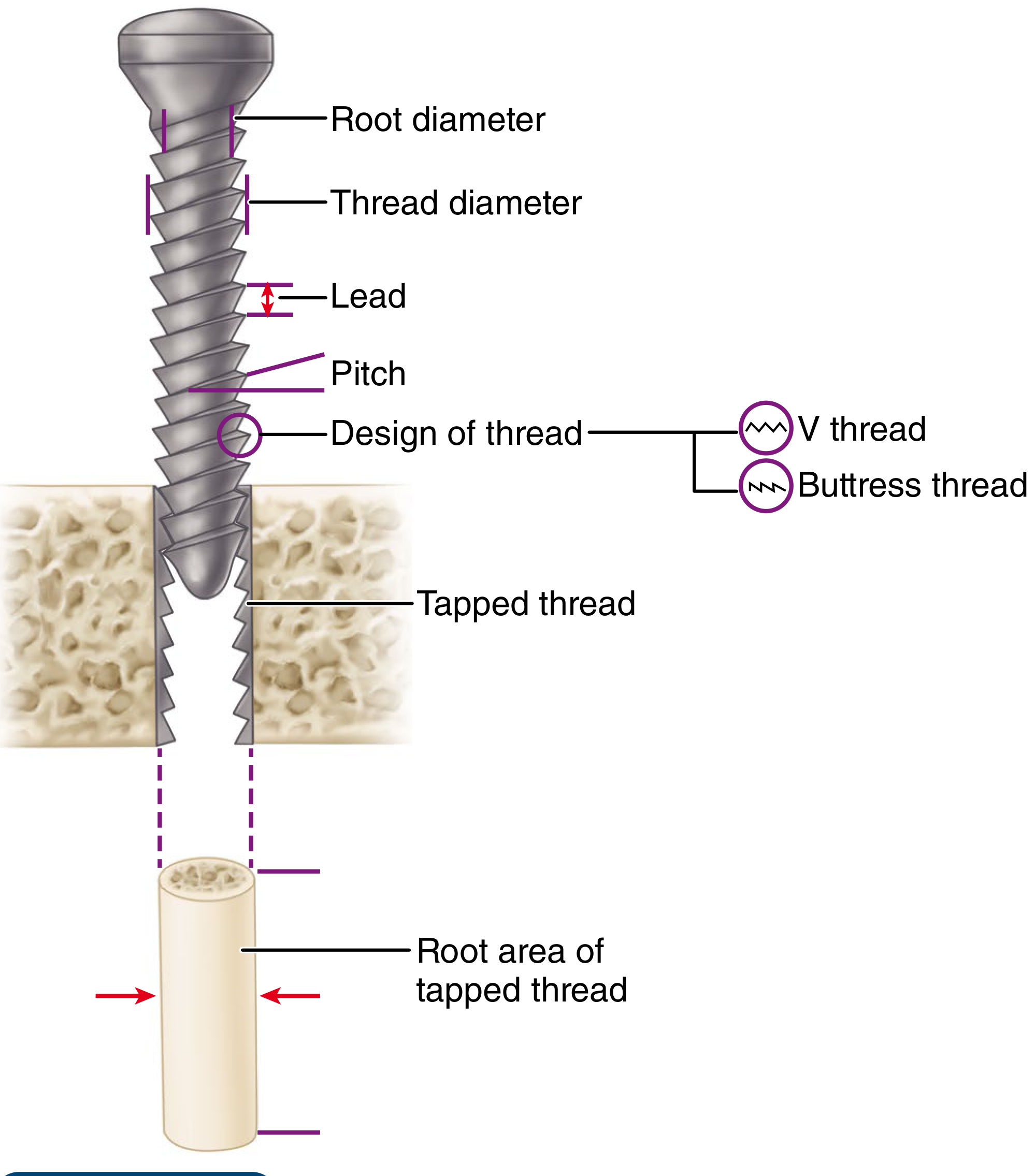
Types of orthopaedic screws and their uses
| Screw type | Design | Main uses |
|---|---|---|
| Cortical screw | Fine threads, relatively small thread depth, designed for dense cortical bone | Shaft of long bones, plate fixation in diaphysis, forearm and tibial shafts |
| Cancellous screw | Coarse, deeper threads for grip in softer spongy bone | Metaphysis and epiphysis, such as proximal humerus, tibial plateau, calcaneus, femoral neck, and malleoli |
| Partially threaded cancellous screw | Smooth shaft near the head and threads distally | Used as a lag screw to compress two fracture fragments together |
| Fully threaded cancellous screw | Threads along the full length | Positional fixation where compression or collapse must be limited, selected pelvic and metaphyseal applications |
| Lag screw | This is a function rather than a unique screw type. The near fragment glides and the far fragment is threaded, drawing fragments together | Simple oblique or spiral fractures, malleolar fractures, condylar or articular fragments |
| Cannulated screw | Hollow center, inserted over a guidewire | Femoral neck fractures, slipped capital femoral epiphysis, scaphoid fractures, ankle fractures, pelvic fixation |
| Headless compression screw | Buried screw with no prominent head, often variable-pitch to create compression | Scaphoid, radial head, capitellum, small joint and intra-articular fractures |
| Locking screw | Threaded head locks into a locking plate | Locking plate constructs, especially in osteoporotic bone or near joints |
| Non-locking plate screw | Head presses plate to bone | Conventional DCP and neutralization/compression plate constructs |
| Pedicle screw | Large, strong spinal screw placed through the vertebral pedicle | Spinal fusion for trauma, deformity, instability, infection, or selected degenerative conditions |
| Interference screw | Fixes a graft inside a bone tunnel | ACL and other ligament reconstruction |
| Suture anchor | Screw-like or plug-like implant with attached suture | Rotator-cuff repair, shoulder instability surgery, tendon/ligament reattachment |
Common examples by body region
| Region | Often used implant |
|---|---|
| Clavicle | Pre-contoured locking or non-locking clavicle plate |
| Proximal humerus | Proximal humeral locking plate with locking screws |
| Forearm shaft | Compression or neutralization plate with cortical screws |
| Distal radius | Volar locking plate with locking screws |
| Femoral neck | Cannulated cancellous screws, or a dynamic hip screw in selected patterns |
| Intertrochanteric hip | Dynamic hip screw with side plate, or an intramedullary nail |
| Distal femur | Anatomical distal femoral locking plate, occasionally dual plating for complex fractures |
| Tibial plateau | Lateral or medial buttress/locking plate, often with lag screws for joint fragments |
| Tibial shaft | Intramedullary nail is common; bridge plate in selected fractures |
| Ankle | One-third tubular or locking fibular plate, cortical screws in shaft, cancellous/lag screws for malleolar fragments |
| Foot and hand | Minifragment plates, small cortical screws, headless compression screws, or K-wires |
Practical points
- The same plate can serve different roles. For example, an LCP can be used as a compression, neutralization, or bridge plate depending on screw placement and fracture pattern.
- Plates and screws are chosen based on fracture location, bone quality, soft-tissue injury, whether the fracture enters a joint, infection risk, and the patient’s rehabilitation needs.
- A screw crossing a fracture may act as a lag screw only when the near fragment can glide and the threads grip the far fragment, producing compression. Campbell's Operative Orthopaedics, 15th ed., “Screw Fixation.”
- More hardware is not always better. In a comminuted fracture, excessive exposure and fixation of every small fragment can damage the blood supply needed for healing.
What is a locking screw and non-locking screw? Cancelous screw and cortical screw. Locking compression plate and no- No, this DCP. Please explain with images. Please explain with images.
diagram comparing locking screw and nonlocking screw locking compression plate dynamic compression plate cortical cancellous screw
locking compression plate AND cortical screw
AO Foundation locking compression plate locking screw DCP cortical cancellous screw difference
First, the big picture
- Screw design: locking vs non-locking, cortical vs cancellous
- Plate design: LCP vs DCP
- Locking or non-locking based on how its head relates to the plate
- Cortical or cancellous based on its thread design and the type of bone it grips
1. Locking screw vs non-locking screw
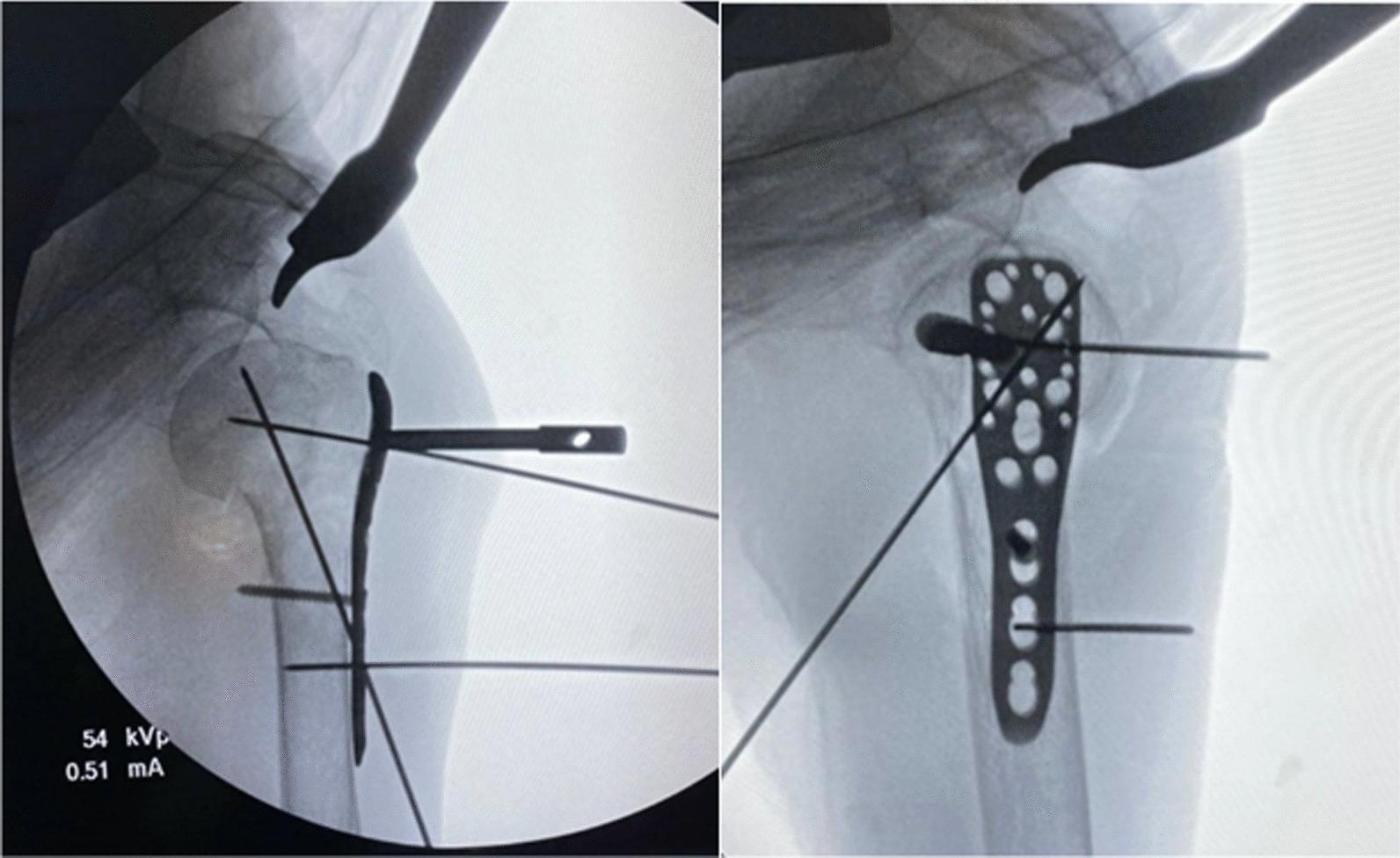
Locking screw
Locking screw construct

  Plate with threaded hole
       ┌─────────┐
       │  /////  │  ← screw head locks into plate
       └────┬────┘
            │
            │ screw
          ┌─┴─┐
          │bone│
How it works
- The screw locks to the plate.
- The plate and screws behave as a single fixed-angle frame.
- The plate does not need to be tightly pressed against bone to be stable.
- It is very useful when normal screw grip in bone may be poor.
Common uses
- Osteoporotic bone, especially in elderly patients
- Fractures near a joint where the fragment is short
- Distal radius fractures
- Proximal humerus fractures
- Distal femur fractures
- Proximal tibia/tibial plateau fractures
- Comminuted fractures treated by bridge plating
Key point
Non-locking screw, conventional screw
Non-locking screw construct

       Plate
    ┌─────────┐
    │    O    │ ← smooth plate hole
    └────┬────┘
         ▼
  Screw head presses plate
  firmly against bone
How it works
- As the screw is tightened, its head pulls the plate against the bone.
- Stability relies on:
- Screw grip in the bone
- Friction between plate and bone
- Good plate contouring to bone
Common uses
- Good-quality bone
- Conventional compression plating
- To bring a plate closer to bone before inserting locking screws
- Simple fracture patterns that need compression
Important difference
| Feature | Locking screw | Non-locking screw |
|---|---|---|
| Screw head threads into plate? | Yes | No |
| Plate must contact bone tightly? | Not necessarily | Yes |
| Main stability | Fixed-angle plate-screw frame | Bone screw grip plus plate-bone friction |
| Best use | Osteoporotic bone, short fragments, periarticular fractures | Good bone quality, compression/standard plating |
| Can compress plate onto bone? | No, not by itself | Yes |
2. Cortical screw vs cancellous screw
Cortical screw
Cortical screw
Fine, closely spaced threads

    /\/\/\/\/\/\/\/\/\/\/\
    ↑ fine thread pitch
Features
- Fine threads
- Threads close together
- Usually fully threaded
- Designed to grip the dense cortical shell of bone
Usual locations
- Shaft, or diaphysis, of long bones
- Radius and ulna shafts
- Humeral shaft
- Tibial shaft
- Fibular shaft
- Securing a plate to a long-bone shaft
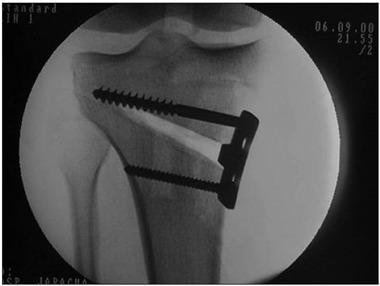
Cancellous screw
Cancellous screw
Deep, widely spaced threads

    /     /     /     /     /
    ↑ coarse, deep thread pitch
Features
- Larger, deeper threads
- Greater spacing between threads
- Often partially threaded
- Better grip in softer metaphyseal or epiphyseal bone
Usual locations
- Near the ends of long bones
- Femoral neck and head
- Tibial plateau
- Calcaneus
- Proximal humerus
- Malleoli around the ankle
- Some pelvic fractures
Partial-thread cancellous screw as a lag screw
Screw head      Smooth shaft         Threads grip far fragment
   [O]==============|====================///////
          Near fragment slides       Far fragment is pulled closer
- Medial malleolus fracture
- Lateral femoral-neck fracture fixation
- Tibial plateau articular fragments
- Some calcaneal and condylar fractures
Cortical vs cancellous screw
| Feature | Cortical screw | Cancellous screw |
|---|---|---|
| Bone type | Dense cortical bone | Softer spongy bone |
| Thread | Fine, shallow, close together | Coarse, deep, widely spaced |
| Common region | Shaft of long bone | End of long bone, near joint |
| Typical role | Plate fixation in shaft | Fixation or compression of metaphyseal/articular fragment |
| Common example | 3.5 mm cortical screw in radius shaft | 6.5 mm cancellous screw in femoral neck |
3. LCP: Locking Compression Plate
- a locking screw, or
- a conventional non-locking screw.
LCP combi-hole

 ┌───────────────────┐
 │ Compression  Locking │
 │   portion    threaded│
 │      ◁          ○    │
 └───────────────────┘
What it can do
- A compression plate for a simple fracture
- A neutralization plate to protect lag screws
- A bridge plate across a comminuted area
- A buttress plate to resist collapse or shear near a joint
- A fixed-angle implant in osteoporotic bone
Advantages
- Strong angular stability
- Helpful in weak bone
- Helpful when the fracture is near a joint
- Can be inserted with less contact against the bone in selected bridge-plating constructs
- Can accept a mixture of locking and non-locking screws
Limitation
4. DCP: Dynamic Compression Plate
DCP hole

      Oval hole with sloping side
       ___________
      /           \
     |    O        |  ← screw inserted eccentrically
      \______/----/
             ↑
     sloped shoulder produces sliding
Before tightening                After tightening

 Bone A   fracture   Bone B      Bone A|Bone B
 ======      gap      =====      ======||=====
 [plate]                     →   Compression across fracture
Main uses
- Simple transverse fractures
- Short-oblique fractures
- Diaphyseal or shaft fractures with good bone contact
- Radius and ulna shaft fractures
- Selected humeral and tibial shaft fractures
Limitations
- Needs good plate-to-bone contact
- Depends on adequate conventional screw grip in bone
- Less ideal when bone is severely osteoporotic or the fracture is highly comminuted
5. LCP vs DCP
| Feature | LCP | DCP |
|---|---|---|
| Full name | Locking Compression Plate | Dynamic Compression Plate |
| Screw type | Locking screws, non-locking screws, or both | Conventional non-locking screws |
| Locking interface | Screw head threads into plate | No screw-plate locking |
| Main stability | Fixed-angle construct | Plate pressed against bone by screws |
| Can produce compression? | Yes, if conventional screws are placed in compression mode | Yes, its primary function |
| Best for osteoporotic bone | Often useful | Less reliable |
| Best for short periarticular fragments | Often useful | Often less suitable |
| Best for simple shaft fracture needing compression | Can be used | A classic indication |
| Plate-bone contact | Can be less dependent on intimate contact | Requires close plate-bone contact |
Easy memory rule
- DCP: Dynamic fracture Compression by a conventional screw sliding in an oval plate hole.
- LCP: Locking screw head locks to the plate, creating fixed-angle stability.
- Cortical screw: fine-thread screw for the hard outer bone.
- Cancellous screw: coarse-thread screw for soft spongy bone.
Create a comparison table of LCP, DCP, and reconstruction plates
site:aofoundation.org LCP DCP reconstruction plate functions compression locking reconstruction plates
locking compression plate fracture fixation
| Feature | LCP: Locking Compression Plate | DCP: Dynamic Compression Plate | Reconstruction Plate |
|---|---|---|---|
| Main concept | A versatile plate that can use locking screws, conventional screws, or both | A conventional plate designed to create axial compression across a fracture | A highly bendable plate designed to match complex bone surfaces |
| Plate holes | Usually combi-holes: one part accepts a locking screw, another accepts a conventional screw in neutral or compression mode | Oval, sloped holes that permit neutral or eccentric conventional-screw placement | Usually oval or combi-holes, depending on the system; deep notches between holes allow contouring |
| Compatible screws | Locking screws, cortical screws, cancellous screws, and sometimes both locking and non-locking screws in the same construct | Mainly conventional non-locking cortical or cancellous screws | Usually conventional cortical/cancellous screws; modern reconstruction plates may also accept locking screws |
| How stability is obtained | Screw heads lock into plate holes, creating a fixed-angle plate-screw frame | Conventional screws pull the plate firmly against bone; stability relies on screw grip and plate-bone friction | Depends on the screw system used. Its major advantage is contouring rather than locking or compression alone |
| Can it compress a fracture? | Yes. Use conventional screws in the compression part of a combi-hole before locking screws are inserted | Yes. This is its classic function. Eccentric screw insertion makes the bone fragment move toward the fracture | Can provide compression if its holes and screw technique permit it, but it is mainly selected for contourability |
| Plate-to-bone contact | Does not need to be tightly compressed against bone for stability when locking screws are used | Requires close contact between plate and bone | Usually contoured closely to the bone because it is used on irregular surfaces |
| Best bone quality | Particularly useful in osteoporotic or weak bone | Best when bone quality and conventional screw purchase are adequate | Depends on screw type; commonly used where anatomy, rather than bone quality, drives implant choice |
| Best fracture pattern | Comminuted fractures, periarticular fractures, short fragments, osteoporotic fractures, bridge-plating constructs | Simple transverse or short-oblique fractures with good bone contact and a need for compression | Fractures of irregular or curved bones, especially where extensive bending is needed |
| Typical locations | Distal radius, proximal humerus, distal femur, proximal tibia, clavicle | Radius and ulna shafts, humeral shaft, selected tibial/femoral shaft fractures | Pelvis, acetabulum, clavicle, distal humerus, selected scapular and complex periarticular fractures |
| Main advantage | Fixed-angle stability and versatile screw options | Predictable fracture compression with a relatively simple conventional construct | Can be bent in multiple planes to fit difficult anatomy |
| Main limitation | More technique-sensitive and often more expensive; locking screws alone do not reduce a fracture or create compression | Less reliable in severe osteoporosis or very short periarticular fragments | Excessive bending can weaken the plate; it is not automatically a locking plate |
Simple visual memory guide
LCP
[ Combi-hole ]  = can take locking or non-locking screws
       ↓
Locking screw head threads into plate
Plate + screws act like one fixed-angle frame
DCP
[ Oval, sloped hole ]
       ↓
Conventional screw placed eccentrically
Tightening slides the screw head down the slope
Bone fragment moves toward fracture = compression
Reconstruction plate
|--o--|--o--|--o--|--o--|
  ^ deep notches between holes
  Allows bending in several planes
  Fits curved or irregular bone surfaces
Key distinctions
- LCP is not only a locking plate. It can act as a compression, neutralization, bridge, or buttress plate depending on the screw arrangement and fracture.
- DCP does not use locking screws. Its defining feature is the specially shaped hole that enables dynamic compression with a conventional screw.
- A reconstruction plate is defined by shape and bendability. It may be conventional or locking depending on the particular implant system.
- A reconstruction plate is often chosen for the pelvis, acetabulum, clavicle, and distal humerus because these bones have complex contours.
Show labeled diagrams of LCP, DCP, and reconstruction plate holes
labeled diagram LCP locking compression plate combi hole DCP dynamic compression plate hole reconstruction plate notched holes
AO Foundation plates form function LCP combi hole DCP reconstruction plate notches diagram
A medically accurate educational diagram comparing orthopedic plate holes, with three horizontal plates on a plain white background. Top: labeled Locking Compression Plate (LCP) with three enlarged combi-holes, each clearly divided into a threaded circular locking portion and an oblong dynamic compression portion. Middle: labeled Dynamic Compression Plate (DCP) with three enlarged oval dynamic-compression holes, including one cross-section inset showing the sloping shoulder and arrows indicating eccentric screw movement toward a fracture. Bottom: labeled Reconstruction Plate with scalloped deep notches between oval holes, with bending arrows in multiple planes. Add clear callout labels: locking threaded portion, compression portion, eccentric position, neutral position, deep contouring notch. Clean vector-style textbook schematic, black and dark blue lines, labels large and readable, no logos, no patient anatomy.
Labeled diagrams: LCP, DCP, and reconstruction plate holes
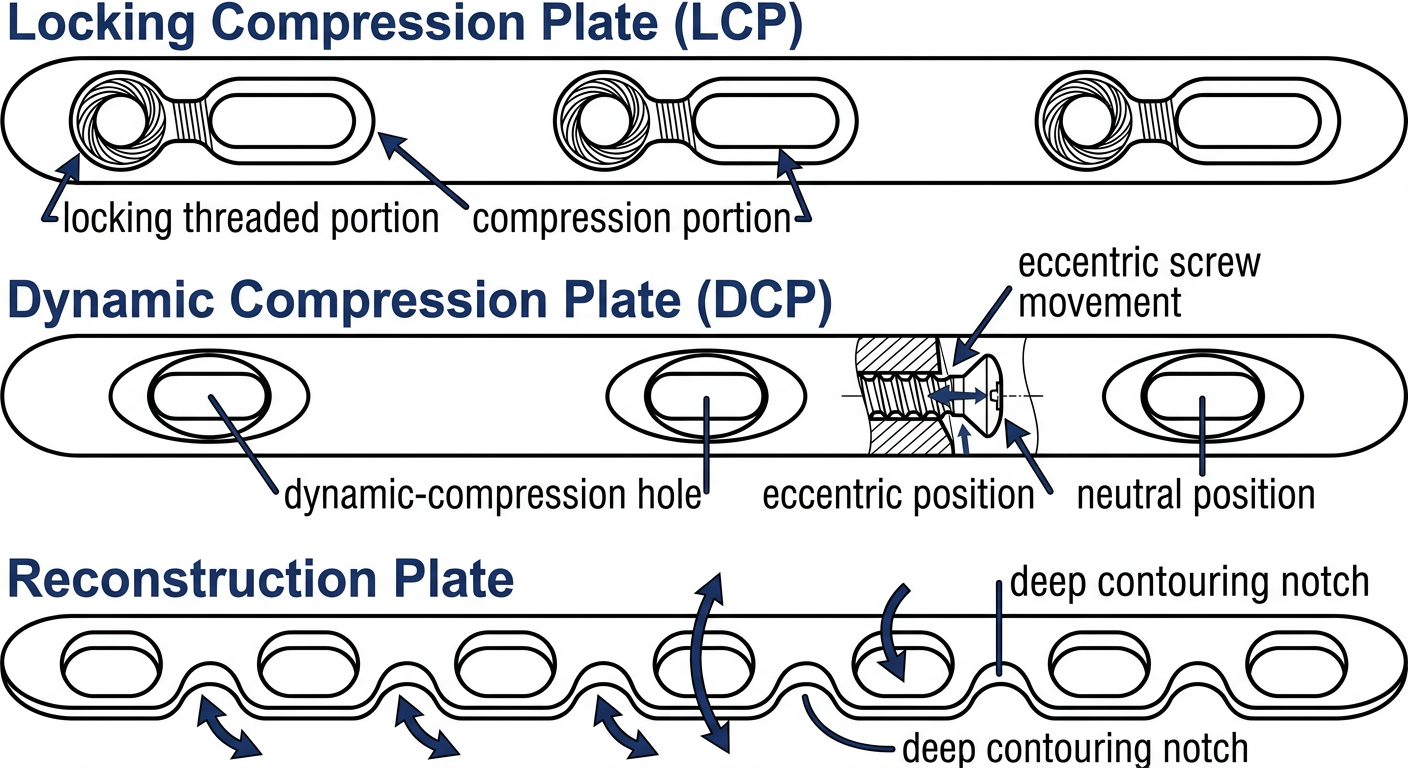
1. LCP: Locking Compression Plate
LCP combi-hole, top view

 ┌──────────────────────────────┐
 │  Compression part | Locking  │
 │      (oval)      | threaded │
 │        ◁         |    ○     │
 └──────────────────────────────┘
- Compression portion: accepts a conventional, non-locking screw. If drilled eccentrically, it can generate fracture compression.
- Locking threaded portion: accepts a locking screw. The screw head threads into the plate and creates fixed-angle stability.
2. DCP: Dynamic Compression Plate
DCP hole, top view

       Oval hole
     ┌───────────┐
     │  neutral  │
     │     ○     │
     │           │
     │ eccentric ●  → toward fracture
     └───────────┘
DCP hole, side section

    Screw head
       ↓
      (●)     slides down the sloping shoulder
  ─────╲________________ plate
        ╲
         ╲_____ moves bone fragment toward fracture
- Neutral position: secures plate to bone without producing axial compression.
- Eccentric position: as the screw is tightened, the head slides down the sloped portion and shifts the bone fragment toward the fracture, creating compression.
3. Reconstruction plate
Reconstruction plate, top view

  Deep notch     Deep notch     Deep notch
      ↓              ↓              ↓
 ──╲__/──(  )──╲__/──(  )──╲__/──(  )──
       oval hole      oval hole
- Along its length
- Side-to-side, called bending “on the flat”
- With contouring in multiple planes
One important detail
- Oval DCP-style holes, allowing conventional screw compression, or
- Combi-holes in newer systems, allowing both conventional and locking screws.
Create a labeled PDF of plate and screw types
AO Foundation plates form and function locking compression plate dynamic compression plate reconstruction plate
orthopedic plate screw fixation
~/
mkdir -p "/tmp/workspace/orthopaedic-implants-pdf/src" "/tmp/workspace/orthopaedic-implants-pdf/output" && python - <<'PY' from reportlab.pdfgen import canvas from reportlab.lib.pagesizes import A4 from reportlab.lib.colors import HexColor, black, white from reportlab.lib.units import mm from reportlab.pdfbase.pdfmetrics import stringWidth from reportlab.pdfbase.ttfonts import TTFont from reportlab.pdfbase import pdfmetrics from reportlab.lib import colors from reportlab.pdfbase.pdfmetrics import registerFont from reportlab.pdfbase.ttfonts import TTFont from reportlab.pdfbase.pdfmetrics import stringWidth from reportlab.lib.utils import simpleSplit from pathlib import Path out = Path('/tmp/workspace/orthopaedic-implants-pdf/output/Orthopaedic_Plate_and_Screw_Types.pdf') W,H=A4 c=canvas.Canvas(str(out),pagesize=A4) c.setTitle('Orthopaedic Plate and Screw Types') c.setAuthor('Orris') NAVY=HexColor('#163A5F'); BLUE=HexColor('#1F6EA8'); TEAL=HexColor('#208E8A'); LIGHT=HexColor('#EAF3F8'); GREY=HexColor('#5E6B75'); PALE=HexColor('#F7FAFC'); ORANGE=HexColor('#D87824'); RED=HexColor('#BA3A3A'); DARK=HexColor('#1C2630') def title(text, sub=''): c.setFillColor(NAVY); c.rect(0,H-32*mm,W,32*mm,stroke=0,fill=1) c.setFillColor(white); c.setFont('Helvetica-Bold',21); c.drawString(16*mm,H-18*mm,text) if sub: c.setFont('Helvetica',9.5); c.drawString(16*mm,H-25*mm,sub) def footer(page): c.setStrokeColor(HexColor('#D5E1EA'));c.line(14*mm,14*mm,W-14*mm,14*mm) c.setFillColor(GREY);c.setFont('Helvetica',7.5) c.drawString(14*mm,9*mm,'Educational schematic only - implant choice and application require orthopaedic training.') c.drawRightString(W-14*mm,9*mm,f'Page {page}') def wrap(text,x,y,width,font='Helvetica',size=9,leading=12,color=DARK): c.setFont(font,size);c.setFillColor(color) for line in simpleSplit(text,font,size,width): c.drawString(x,y,line); y-=leading return y def panel(x,y,w,h,heading): c.setFillColor(PALE);c.setStrokeColor(HexColor('#B8CBD9'));c.roundRect(x,y,w,h,4*mm,stroke=1,fill=1) c.setFillColor(NAVY);c.setFont('Helvetica-Bold',13);c.drawString(x+5*mm,y+h-9*mm,heading) def screw(x,y,length,kind,label,locking=False): # y baseline central, horizontal c.setStrokeColor(DARK); c.setFillColor(HexColor('#B9C5CE')) # head c.circle(x,y,5*mm,stroke=1,fill=1); c.setStrokeColor(DARK); c.line(x-2*mm,y,x+2*mm,y) start=x+5*mm; end=x+length c.setStrokeColor(DARK);c.setLineWidth(2.2);c.line(start,y,end,y) # threads c.setLineWidth(0.8) if kind=='cortical': spacing=3.2*mm; depth=1.5*mm; thread_start=start+1*mm elif kind=='cancellous': spacing=5.5*mm; depth=3*mm; thread_start=start+length*.32 else: spacing=3.5*mm; depth=1.7*mm; thread_start=start+1*mm px=thread_start while px<end-1*mm: c.line(px,y-depth,px+spacing*.55,y+depth); px+=spacing if locking: c.setStrokeColor(ORANGE);c.setLineWidth(1.2) for a in [-3,-1,1,3]: c.arc(x-5*mm+a*mm,y-5*mm+a*0.25*mm,x+5*mm+a*mm,y+5*mm+a*0.25*mm,70,40) c.setFillColor(NAVY);c.setFont('Helvetica-Bold',9);c.drawString(x,y-9*mm,label) def page1(): title('Orthopaedic Plate and Screw Types','Labeled teaching diagrams: LCP, DCP, reconstruction plates, and common screw designs') c.setFillColor(DARK); c.setFont('Helvetica-Bold',11);c.drawString(16*mm,H-42*mm,'How to use this handout') wrap('Plate names describe the plate design and function. Screw names may describe either the screw-to-plate interface (locking or non-locking) or the thread design for the bone being gripped (cortical or cancellous).',16*mm,H-48*mm,W-32*mm,size=9.3) # two axes c.setFillColor(LIGHT);c.roundRect(16*mm,H-79*mm,W-32*mm,20*mm,3*mm,stroke=0,fill=1) c.setFillColor(NAVY);c.setFont('Helvetica-Bold',10);c.drawString(21*mm,H-67*mm,'Two separate ways to classify screws') c.setFont('Helvetica',9);c.setFillColor(DARK) c.drawString(21*mm,H-73*mm,'1. Interface with plate: locking vs non-locking') c.drawString(105*mm,H-73*mm,'2. Bone thread: cortical vs cancellous') # panels panel(16*mm,H-157*mm,86*mm,68*mm,'Locking screw') panel(108*mm,H-157*mm,86*mm,68*mm,'Non-locking screw') # locking mini x=29*mm;y=H-112*mm c.setFillColor(HexColor('#C8DCEB'));c.roundRect(x,y,53*mm,8*mm,2*mm,stroke=1,fill=1) c.setFillColor(white);c.circle(x+37*mm,y+4*mm,3.7*mm,stroke=1,fill=1) c.setStrokeColor(ORANGE);c.setLineWidth(1.3);c.circle(x+37*mm,y+4*mm,3*mm,stroke=1,fill=0) c.setStrokeColor(DARK);c.setLineWidth(1.7);c.line(x+37*mm,y+4*mm,x+37*mm,y-18*mm) c.setFillColor(ORANGE);c.setFont('Helvetica-Bold',7.5);c.drawString(x+41*mm,y+8*mm,'threaded head locks') c.setFillColor(DARK);c.setFont('Helvetica',8.2);wrap('The screw head threads into the plate hole. Plate and screw form a fixed-angle construct; stability does not rely on tightly compressing the plate to bone.',21*mm,H-137*mm,75*mm,size=8.2,leading=10) # non locking x=121*mm;y=H-112*mm c.setFillColor(HexColor('#C8DCEB'));c.roundRect(x,y,53*mm,8*mm,2*mm,stroke=1,fill=1) c.setFillColor(white);c.circle(x+37*mm,y+4*mm,3.7*mm,stroke=1,fill=1) c.setStrokeColor(DARK);c.setLineWidth(1.7);c.line(x+37*mm,y+4*mm,x+37*mm,y-18*mm) c.setFillColor(RED);c.setFont('Helvetica-Bold',7.5);c.drawString(x+5*mm,y+11*mm,'head presses plate to bone') c.setFillColor(DARK);c.setFont('Helvetica',8.2);wrap('The head does not thread into the plate. Tightening pulls the plate against the bone. Stability depends on bone purchase and plate-to-bone friction.',113*mm,H-137*mm,75*mm,size=8.2,leading=10) # screw designs c.setFillColor(NAVY);c.setFont('Helvetica-Bold',13);c.drawString(16*mm,H-172*mm,'Thread design: cortical versus cancellous') c.setStrokeColor(HexColor('#B8CBD9'));c.roundRect(16*mm,H-254*mm,W-32*mm,72*mm,4*mm,stroke=1,fill=0) screw(31*mm,H-202*mm,60*mm,'cortical','Cortical screw') c.setFillColor(DARK);wrap('Fine, closely spaced threads. Used primarily in dense cortical bone, especially the shaft (diaphysis) of long bones and for many plate screws.',25*mm,H-218*mm,70*mm,size=8.3,leading=10) screw(119*mm,H-202*mm,60*mm,'cancellous','Cancellous screw') c.setFillColor(DARK);wrap('Deep, widely spaced threads. Used in softer trabecular bone near bone ends (metaphysis/epiphysis), e.g., femoral neck, tibial plateau, malleoli.',113*mm,H-218*mm,70*mm,size=8.3,leading=10) c.setFillColor(ORANGE);c.setFont('Helvetica-Bold',9);c.drawString(22*mm,H-246*mm,'Memory aid: cortex = fine thread; cancellous bone = coarse/deep thread.') footer(1);c.showPage() def plate_body(x,y,w,h,kind): c.setFillColor(HexColor('#C8DCEB'));c.setStrokeColor(NAVY);c.setLineWidth(1);c.roundRect(x,y,w,h,2*mm,stroke=1,fill=1) centers=[x+w*.2,x+w*.5,x+w*.8] for cx in centers: if kind=='LCP': # combi hole, left dynamic ellipse and right threaded circle c.setFillColor(white);c.ellipse(cx-7*mm,y+h/2-3.5*mm,cx+1*mm,y+h/2+3.5*mm,stroke=1,fill=1) c.circle(cx+5*mm,y+h/2,3.7*mm,stroke=1,fill=1) c.setStrokeColor(ORANGE);c.setLineWidth(.75);c.circle(cx+5*mm,y+h/2,2.6*mm,stroke=1,fill=0) elif kind=='DCP': c.setFillColor(white);c.ellipse(cx-7*mm,y+h/2-4*mm,cx+7*mm,y+h/2+4*mm,stroke=1,fill=1) c.setStrokeColor(GREY);c.setLineWidth(.7);c.line(cx+2*mm,y+h/2-3*mm,cx+5*mm,y+h/2+3*mm) else: # reconstruct scallop top/bottom plus holes c.setFillColor(white);c.ellipse(cx-6*mm,y+h/2-3.5*mm,cx+6*mm,y+h/2+3.5*mm,stroke=1,fill=1) if kind=='RECON': c.setStrokeColor(white);c.setLineWidth(2.6) for cx in [x+w*.35,x+w*.65]: c.arc(cx-5*mm,y+h-2*mm,cx+5*mm,y+h+5*mm,180,180) c.arc(cx-5*mm,y-5*mm,cx+5*mm,y+2*mm,0,180) def page2(): title('Plate Types and Hole Design','The plate hole determines whether compression, locking fixation, or both can be used') # LCP panel(16*mm,H-103*mm,W-32*mm,58*mm,'1. LCP: Locking Compression Plate') plate_body(27*mm,H-77*mm,82*mm,11*mm,'LCP') c.setFillColor(ORANGE);c.setFont('Helvetica-Bold',8);c.drawString(28*mm,H-88*mm,'Orange ring = threaded locking portion') c.setFillColor(BLUE);c.drawString(28*mm,H-94*mm,'White oval = dynamic compression portion for conventional screw') wrap('A combi-hole can accept either a locking screw or a conventional non-locking screw. It can function in compression, neutralization, buttress, or bridge mode. Especially useful for short periarticular fragments and osteoporotic bone.',118*mm,H-70*mm,65*mm,size=8.4,leading=10) # DCP panel(16*mm,H-169*mm,W-32*mm,58*mm,'2. DCP: Dynamic Compression Plate') plate_body(27*mm,H-143*mm,82*mm,11*mm,'DCP') c.setFillColor(RED);c.setFont('Helvetica-Bold',8);c.drawString(28*mm,H-154*mm,'Oval hole with sloping shoulder') c.setFillColor(DARK);c.setFont('Helvetica',8);c.drawString(28*mm,H-160*mm,'No threaded locking hole: uses conventional screws.') wrap('A conventional screw placed eccentrically slides down the sloped portion of the hole as it is tightened. This shifts the bone fragment toward the fracture and creates axial compression. Classic use: simple shaft fractures with good bone contact.',118*mm,H-136*mm,65*mm,size=8.4,leading=10) # reconstruction panel(16*mm,H-235*mm,W-32*mm,58*mm,'3. Reconstruction plate') plate_body(27*mm,H-209*mm,82*mm,11*mm,'RECON') c.setFillColor(TEAL);c.setFont('Helvetica-Bold',8);c.drawString(28*mm,H-220*mm,'Scalloped deep notches between holes') c.setFillColor(DARK);c.setFont('Helvetica',8);c.drawString(28*mm,H-226*mm,'Allows contouring in several planes.') wrap('A reconstruction plate is defined mainly by its high contourability, not by one fixed hole system. It is useful on complex curved anatomy such as the pelvis, acetabulum, clavicle, and distal humerus. It may have oval holes or combi-holes depending on the system.',118*mm,H-202*mm,65*mm,size=8.4,leading=10) # recap table c.setFillColor(NAVY);c.setFont('Helvetica-Bold',11);c.drawString(16*mm,H-248*mm,'Quick comparison') x=16*mm;y=H-285*mm; widths=[38*mm,48*mm,48*mm,48*mm]; hh=8*mm headers=['Feature','LCP','DCP','Reconstruction'] c.setFillColor(NAVY) xx=x for wd,tx in zip(widths,headers): c.rect(xx,y,wd,hh,stroke=1,fill=1);c.setFillColor(white);c.setFont('Helvetica-Bold',7.5);c.drawCentredString(xx+wd/2,y+2.5*mm,tx);c.setFillColor(NAVY);xx+=wd rows=[('Key hole','Combi-hole','Sloped oval hole','Oval or combi-hole'),('Primary strength','Fixed-angle option','Dynamic compression','Multi-plane contouring'),('Usual screw','Locking or conventional','Conventional','System-dependent')] for r,row in enumerate(rows): yy=y-(r+1)*9*mm;xx=x for wd,tx in zip(widths,row): c.setFillColor(white);c.setStrokeColor(HexColor('#B8CBD9'));c.rect(xx,yy,wd,9*mm,stroke=1,fill=1) c.setFillColor(DARK);c.setFont('Helvetica',7.2); lines=simpleSplit(tx,'Helvetica',7.2,wd-3*mm) for j,line in enumerate(lines):c.drawCentredString(xx+wd/2,yy+5.2*mm-j*2.6*mm,line) xx+=wd footer(2);c.showPage() def page3(): title('Common Plate and Screw Types','Illustrated revision summary') c.setFillColor(NAVY);c.setFont('Helvetica-Bold',13);c.drawString(16*mm,H-44*mm,'Common plates') items=[ ('Locking compression plate (LCP)','Combi-holes. Locking screws provide fixed-angle stability. Common near joints and in osteoporotic bone.'), ('Dynamic compression plate (DCP)','Sloped oval holes. Eccentric conventional screws generate compression across a simple fracture.'), ('Reconstruction plate','Deep side notches. Very contourable for irregular anatomy, e.g., pelvis, acetabulum, clavicle, distal humerus.'), ('Buttress plate','Supports a fragment against shear or collapse, often near a joint such as tibial plateau or distal radius.'), ('Bridge plate','Spans a comminuted zone while preserving fracture biology; commonly used with relative stability.'), ] y=H-53*mm for name,desc in items: c.setFillColor(LIGHT);c.roundRect(16*mm,y-11*mm,W-32*mm,13*mm,2*mm,stroke=0,fill=1) c.setFillColor(NAVY);c.setFont('Helvetica-Bold',9);c.drawString(20*mm,y-3*mm,name) c.setFillColor(DARK);c.setFont('Helvetica',8.2);c.drawString(70*mm,y-3*mm,desc) y-=15*mm c.setFillColor(NAVY);c.setFont('Helvetica-Bold',13);c.drawString(16*mm,H-136*mm,'Common screws') screw(26*mm,H-153*mm,54*mm,'generic','Locking screw',locking=True) wrap('Threaded head locks into an LCP hole. Provides angular stability.',20*mm,H-166*mm,70*mm,size=8.2,leading=9.5) screw(111*mm,H-153*mm,54*mm,'generic','Non-locking screw') wrap('Head presses plate to bone. Used in conventional plating and compression.',105*mm,H-166*mm,70*mm,size=8.2,leading=9.5) screw(26*mm,H-197*mm,54*mm,'cortical','Cortical screw') wrap('Fine threads for dense cortical bone, commonly in long-bone shafts.',20*mm,H-210*mm,70*mm,size=8.2,leading=9.5) screw(111*mm,H-197*mm,54*mm,'cancellous','Cancellous screw') wrap('Coarse deep threads for trabecular bone, commonly near bone ends.',105*mm,H-210*mm,70*mm,size=8.2,leading=9.5) c.setFillColor(HexColor('#FFF3E7'));c.setStrokeColor(ORANGE);c.roundRect(16*mm,H-253*mm,W-32*mm,27*mm,3*mm,stroke=1,fill=1) c.setFillColor(ORANGE);c.setFont('Helvetica-Bold',10);c.drawString(21*mm,H-237*mm,'High-yield distinction') wrap('Locking versus non-locking describes the screw-to-plate interface. Cortical versus cancellous describes the thread design and bone purchase. These descriptions can overlap: a screw can be both a cortical screw and a locking screw.',21*mm,H-244*mm,W-42*mm,size=8.8,leading=10) c.setFillColor(GREY);c.setFont('Helvetica',7.3) c.drawString(16*mm,23*mm,'Sources: Campbell’s Operative Orthopaedics, 15th ed., sections on screw fixation and biomaterials; AO Foundation, Plates: Form and Function.') footer(3);c.showPage() page1();page2();page3();c.save() print(out) PY python - <<'PY' from pypdf import PdfReader p='/tmp/workspace/orthopaedic-implants-pdf/output/Orthopaedic_Plate_and_Screw_Types.pdf' r=PdfReader(p) print('pages',len(r.pages),'size',__import__('os').path.getsize(p)) print(r.pages[0].extract_text()[:350]) PY
Orthopaedic Plate and Screw Types
PDF Document · PDF
Add labeled diagrams of cortical, cancellous, locking, and lag screws
~/orthopaedic-implants-pdf/
orthopedic screw fixation
AO Foundation cortical cancellous locking lag screw fixation principles
~/orthopaedic-implants-pdf/src
~/orthopaedic-implants-pdf/output
python - <<'PY' from reportlab.pdfgen import canvas from reportlab.lib.pagesizes import A4 from reportlab.lib.units import mm from reportlab.lib.colors import HexColor, white from reportlab.lib.utils import simpleSplit from pathlib import Path from pypdf import PdfReader, PdfWriter base=Path('/tmp/workspace/orthopaedic-implants-pdf/output/Orthopaedic_Plate_and_Screw_Types.pdf') supp=Path('/tmp/workspace/orthopaedic-implants-pdf/src/screw_diagrams_supplement.pdf') final=Path('/tmp/workspace/orthopaedic-implants-pdf/output/Orthopaedic_Plate_and_Screw_Types_Expanded.pdf') W,H=A4 NAVY=HexColor('#163A5F'); BLUE=HexColor('#1F6EA8'); TEAL=HexColor('#208E8A'); LIGHT=HexColor('#EAF3F8'); GREY=HexColor('#5E6B75'); PALE=HexColor('#F7FAFC'); ORANGE=HexColor('#D87824'); RED=HexColor('#BA3A3A'); DARK=HexColor('#1C2630'); BONE=HexColor('#F5E7C9') c=canvas.Canvas(str(supp),pagesize=A4) c.setTitle('Orthopaedic Screw Types - Labeled Diagrams') def wrap(text,x,y,w,size=8.1,leading=9.6,bold=False): c.setFillColor(DARK);c.setFont('Helvetica-Bold' if bold else 'Helvetica',size) for line in simpleSplit(text,'Helvetica-Bold' if bold else 'Helvetica',size,w): c.drawString(x,y,line); y-=leading return y def panel(x,y,w,h,title,color=BLUE): c.setFillColor(PALE);c.setStrokeColor(HexColor('#B8CBD9'));c.roundRect(x,y,w,h,3*mm,stroke=1,fill=1) c.setFillColor(color);c.setFont('Helvetica-Bold',11);c.drawString(x+4*mm,y+h-7*mm,title) def threaded_screw(x,y,length,mode,label,head_lock=False): # horizontal screw, y center c.setStrokeColor(DARK);c.setFillColor(HexColor('#B9C5CE'));c.setLineWidth(0.9) c.circle(x,y,4.5*mm,stroke=1,fill=1) c.line(x-2*mm,y,x+2*mm,y); c.line(x,y-2*mm,x,y+2*mm) shaftstart=x+4.5*mm; end=x+length c.setStrokeColor(DARK);c.setLineWidth(2.4);c.line(shaftstart,y,end,y) if mode=='cortical': st=shaftstart+1*mm; spacing=3.1*mm; depth=1.6*mm elif mode=='cancellous': st=shaftstart+1*mm; spacing=5.2*mm; depth=3.1*mm elif mode=='lag': st=shaftstart+length*0.42; spacing=4.5*mm; depth=2.4*mm elif mode=='locking': st=shaftstart+1*mm; spacing=3.2*mm; depth=1.6*mm p=st;c.setLineWidth(.8) while p<end-1.8*mm: c.line(p,y-depth,p+spacing*.6,y+depth);p+=spacing if head_lock: c.setStrokeColor(ORANGE);c.setLineWidth(0.8) for k in [-2.3,-.8,.8,2.3]: c.arc(x-4*mm+k*mm,y-4*mm,x+4*mm+k*mm,y+4*mm,50,70) c.setFillColor(NAVY);c.setFont('Helvetica-Bold',8.8);c.drawString(x,y-8*mm,label) def bone_blocks(x,y,w,h,gap=2*mm): c.setFillColor(BONE);c.setStrokeColor(HexColor('#9B7D52')) c.rect(x,y,w/2-gap/2,h,stroke=1,fill=1);c.rect(x+w/2+gap/2,y,w/2-gap/2,h,stroke=1,fill=1) c.setFillColor(RED);c.setFont('Helvetica-Bold',7);c.drawCentredString(x+w/2,y+h+2.5*mm,'fracture line') # title c.setFillColor(NAVY);c.rect(0,H-32*mm,W,32*mm,stroke=0,fill=1) c.setFillColor(white);c.setFont('Helvetica-Bold',20);c.drawString(16*mm,H-18*mm,'Labeled Orthopaedic Screw Diagrams') c.setFont('Helvetica',9.5);c.drawString(16*mm,H-25*mm,'Cortical, cancellous, locking, and lag screws: design, function, and common use') # panels 2x2 left=14*mm; right=108*mm; ytop=H-112*mm; bw=88*mm; bh=67*mm panel(left,ytop,bw,bh,'1. Cortical screw',BLUE) threaded_screw(left+14*mm,ytop+43*mm,59*mm,'cortical','Fine, closely spaced threads') c.setFillColor(RED);c.setFont('Helvetica-Bold',7.5);c.drawString(left+13*mm,ytop+32*mm,'Designed for dense cortical bone') wrap('Usually fully threaded. The fine thread pitch is suited to the hard outer cortex, especially in long-bone shafts and for conventional plate fixation.',left+5*mm,ytop+24*mm,bw-10*mm) panel(right,ytop,bw,bh,'2. Cancellous screw',TEAL) threaded_screw(right+14*mm,ytop+43*mm,59*mm,'cancellous','Deep, widely spaced threads') c.setFillColor(TEAL);c.setFont('Helvetica-Bold',7.5);c.drawString(right+13*mm,ytop+32*mm,'Designed for softer trabecular bone') wrap('The deeper, coarser threads improve grip in cancellous bone near the ends of long bones, e.g., femoral neck, tibial plateau, and malleoli.',right+5*mm,ytop+24*mm,bw-10*mm) y2=H-186*mm panel(left,y2,bw,bh,'3. Locking screw',ORANGE) # plate and locking head depiction c.setFillColor(HexColor('#C8DCEB'));c.setStrokeColor(NAVY);c.roundRect(left+14*mm,y2+45*mm,61*mm,8*mm,2*mm,stroke=1,fill=1) c.setFillColor(white);c.circle(left+46*mm,y2+49*mm,4*mm,stroke=1,fill=1) c.setStrokeColor(ORANGE);c.setLineWidth(1);c.circle(left+46*mm,y2+49*mm,3*mm,stroke=1,fill=0) threaded_screw(left+46*mm,y2+49*mm,0,'locking','',head_lock=True) # redraw lower body screw from plate down as vertical conceptual c.setStrokeColor(DARK);c.setLineWidth(2.2);c.line(left+46*mm,y2+45*mm,left+46*mm,y2+28*mm) c.setStrokeColor(DARK);c.setLineWidth(.8) for yy in range(int(y2+30*mm),int(y2+44*mm),int(3*mm)): c.line(left+43.8*mm,yy,left+48.2*mm,yy+2*mm) c.setFillColor(ORANGE);c.setFont('Helvetica-Bold',7.5);c.drawString(left+14*mm,y2+35*mm,'Threaded head locks into threaded plate hole') wrap('Produces a fixed-angle plate-screw construct. The plate does not need to be pressed tightly against bone for stability. Useful in osteoporotic bone and short periarticular fragments.',left+5*mm,y2+24*mm,bw-10*mm) panel(right,y2,bw,bh,'4. Lag screw',RED) bone_blocks(right+9*mm,y2+33*mm,67*mm,13*mm) threaded_screw(right+11*mm,y2+39.5*mm,62*mm,'lag','',head_lock=False) c.setFillColor(RED);c.setFont('Helvetica-Bold',7.2);c.drawString(right+9*mm,y2+26*mm,'Smooth near segment glides; threads grip far segment') wrap('A lag screw is a function, not a separate thread type. Tightening draws the far fragment toward the near fragment and compresses the fracture. Ideally placed perpendicular to the fracture plane.',right+5*mm,y2+18*mm,bw-10*mm) # comparison bar c.setFillColor(NAVY);c.setFont('Helvetica-Bold',12);c.drawString(14*mm,H-199*mm,'Quick comparison') headers=['Screw','Main defining feature','Typical role'] rows=[['Cortical','Fine, close threads','Dense cortical shaft bone'],['Cancellous','Deep, coarse threads','Trabecular bone near a joint'],['Locking','Threaded head engages plate','Fixed-angle plate construct'],['Lag','Near fragment glides, far fragment grips','Interfragmentary compression']] x=14*mm;y=H-207*mm;widths=[37*mm,67*mm,79*mm] for i,h in enumerate(headers): c.setFillColor(NAVY);c.rect(x,y,widths[i],8*mm,stroke=1,fill=1);c.setFillColor(white);c.setFont('Helvetica-Bold',7.6);c.drawCentredString(x+widths[i]/2,y+2.7*mm,h);x+=widths[i] for rowi,row in enumerate(rows): x=14*mm;yy=y-(rowi+1)*8.5*mm for i,txt in enumerate(row): c.setFillColor(white);c.setStrokeColor(HexColor('#B8CBD9'));c.rect(x,yy,widths[i],8.5*mm,stroke=1,fill=1) c.setFillColor(DARK);c.setFont('Helvetica',7.5);c.drawCentredString(x+widths[i]/2,yy+2.8*mm,txt);x+=widths[i] # bottom note c.setFillColor(HexColor('#FFF3E7'));c.setStrokeColor(ORANGE);c.roundRect(14*mm,20*mm,W-28*mm,19*mm,3*mm,stroke=1,fill=1) c.setFillColor(ORANGE);c.setFont('Helvetica-Bold',8.8);c.drawString(19*mm,33*mm,'Important distinction') wrap('Cortical/cancellous refers to thread design and bone purchase. Locking/non-locking refers to the screw-to-plate interface. A lag screw describes how compression is achieved. A single screw may have more than one of these descriptors.',19*mm,28*mm,W-38*mm,size=8.1,leading=9) c.setFillColor(GREY);c.setFont('Helvetica',7);c.drawString(14*mm,11*mm,'Educational schematic only. Source concepts: Campbell’s Operative Orthopaedics, 15th ed.; AO Surgery Reference, Lag Screw Principles.') c.save() writer=PdfWriter() for p in PdfReader(str(base)).pages: writer.add_page(p) for p in PdfReader(str(supp)).pages: writer.add_page(p) with open(final,'wb') as f: writer.write(f) print(final) PY python - <<'PY' from pypdf import PdfReader from pathlib import Path p=Path('/tmp/workspace/orthopaedic-implants-pdf/output/Orthopaedic_Plate_and_Screw_Types_Expanded.pdf') r=PdfReader(str(p)) print('pages=',len(r.pages),'bytes=',p.stat().st_size) print(r.pages[-1].extract_text()[:800]) PY
- Cortical screw
- Cancellous screw
- Locking screw
- Lag screw, including fracture-compression mechanism
Orthopaedic Plate and Screw Types Expanded
PDF Document · PDF