
Bk amputation
Reading File
Now let me search for below-knee (BK) amputation content in parallel.
Finding Sources
Finding Sources
Searching PubMed
"transtibial amputation" OR "below-knee amputation"
Good results. Now let me read the most comprehensive sources in parallel - Campbell's (most current, 2026), Fischer's Mastery, and Mulholland & Greenfield.
Reading File
Reading File
Reading File
Now let me read more from Campbell's for the operative technique and rehabilitation, plus Fischer's for the skew flap technique.
Reading File
Reading File
Reading File
Let me now get the rehabilitation, complications, and postoperative sections from Campbell's and Current Surgical Therapy.
Reading File
Reading File
I now have comprehensive information from multiple authoritative textbooks. Let me also get the Mulholland criteria tables for BKA vs AKA, and fetch a key surgical diagram.
Reading File
Loading Image
I now have comprehensive information from multiple authoritative sources. Here is the full structured answer:
Below-Knee (Transtibial) Amputation
Definition & Overview
A below-knee amputation (BKA), formally termed transtibial amputation, is surgical removal of the lower limb at a level between the knee joint and the ankle. It preserves the knee joint, which is the single most important factor in functional rehabilitation - patients with an intact knee consume far less energy ambulating with a prosthesis than those with above-knee (transfemoral) amputation.
Indications
The leading causes are complications of diabetes mellitus and peripheral arterial disease (together accounting for the majority of cases). Other indications include:
- Severe trauma or crush injury
- Malignancy (soft tissue or bone sarcoma)
- Severe infection / necrotizing fasciitis / gas gangrene
- Congenital limb deficiency
- Chronic non-healing wounds unresponsive to revascularization
Guillotine (open) amputation is reserved for emergency situations - rapidly spreading infection, gas gangrene - where the goal is rapid life-saving debridement; formal closure follows days later once infection is controlled.
Choosing BKA vs. AKA
| Factor | Favors BKA | Favors AKA |
|---|---|---|
| Circulation | Adequate perfusion at BKA level | Ischemia extends too proximally |
| Knee function | Intact, functional knee | Fixed flexion contracture |
| Infection / gangrene | Confined below knee | Spreads above proposed BKA level |
| Stump length | At least 8.8 cm of tibia preservable | Inadequate residual tibia |
| Functional goals | Patient ambulatory candidate | Non-ambulatory, high comorbidities |
A short BKA (even to the level of the tibial tuberosity) is functionally superior to an AKA. Minimum usable tibial length is approximately 8.8 cm; below this the fibula should be entirely removed to allow the short stump to fit a prosthetic socket.
Level of Amputation
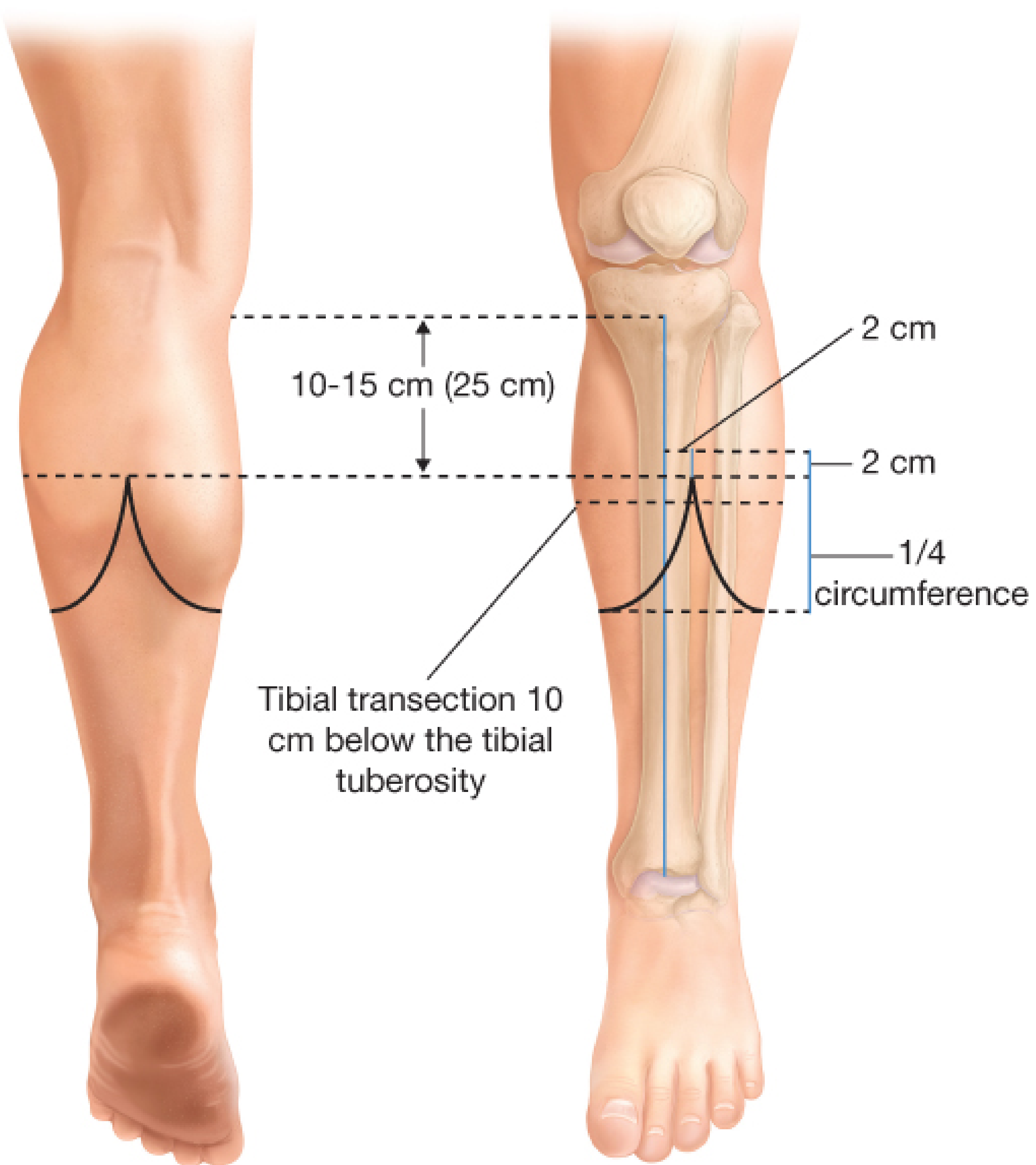
- Ideal tibial length: 12.5 to 17.5 cm from the medial knee joint line (rule of thumb: 2.5 cm per 30 cm of body height)
- Standard level: tibia transected ~10 cm below the tibial tuberosity
- Fibula: cut 1-2 cm shorter than the tibia
- Distal third of the leg is suboptimal - poor vascularity, slower healing, limited soft tissue
- In ischemic limbs, amputation is customarily at a higher level (10-12.5 cm distal to the joint line)
Surgical Techniques
1. Long Posterior Flap (Burgess Technique) - Most Common
This is the preferred technique, especially in vascular disease, because the gastrocnemius and soleus are supplied by sural arteries arising proximal to the knee - making the posterior flap reliable even with distal arterial occlusion.
Skin marking:
- Anterior incision: 1 cm distal to the proposed tibial transection level, with a length equal to two-thirds of the leg circumference at that level
- Medial and lateral longitudinal limbs: each one-third of the circumference (~9-12 cm)
- The posterior flap must be generous - excess is trimmed at closure
Key steps:
- Anterior compartment muscles divided at skin incision level
- Anterior tibial neurovascular bundle - identified and suture-ligated
- Tibia cleared of periosteum; transected with oscillating/Gigli saw; anterior cortex beveled at 45° to prevent pressure necrosis
- Fibula cleared and transected 2 cm proximal to tibial cut
- Posterior tibial and peroneal neurovascular bundles - suture-ligated
- Nerves (posterior tibial, common peroneal, deep peroneal, sural) - gently retracted distally, sharply divided, allowed to retract proximally to prevent neuroma formation
- Posterior flap rotated anteriorly; muscle debulked as needed
- Deep posterior musculature secured over tibial end (myodesis to periosteum)
- Gastrocnemius fascia approximated to anterior fascia - absorbable suture
- Skin closed with interrupted nylon or staples
2. Skew Flap (Robinson/Jain Technique)
Used when posterior flap viability is questionable:
- A fishmouth incision is made at 10-25 cm below the joint line (2-2.5 cm lateral to tibial crest as the flap junction point)
- Creates anterolateral and posteromedial flaps of equal quarter-circumference length
- The posterior gastrocnemius-soleus complex is brought anteriorly and secured to anterior periosteum
- The suture line lies off the tibial crest - reducing pressure from prosthetic socket
3. Equal Anterior and Posterior Flaps (Classic)
Used when gangrene or wounds preclude posterior flap; each flap length = one-half the anteroposterior diameter of the leg.
4. Ertl (Osteomyoplastic) Amputation
- A bone bridge is created between tibia and fibula using a fibular autograft strut
- Notches cut in both bones; strut secured with heavy sutures
- Advantages: more stable end-bearing construct, decreased tibiofibular joint instability, better load transfer
Ischemic limb modifications:
- Tourniquet traditionally avoided (though recent RCTs show it may be safe)
- Tension myodesis and osteomyoplasty contraindicated in ischemic limbs - compresses remaining blood supply
- Skew or posterior flaps favored over anterior flaps
Neurovascular Management
| Structure | Action |
|---|---|
| Anterior tibial vessels | Suture-ligate proximal to bone cut |
| Posterior tibial vessels | Suture-ligate |
| Peroneal vessels | Suture-ligate |
| Posterior tibial nerve | Retract distally under tension → divide sharply → allow to retract proximally |
| Common peroneal nerve | Identified deep to peroneus longus; divided proximal to where superficial peroneal branches |
| Deep peroneal nerve | Divided with anterior compartment muscles |
| Sural nerve | Divided in posterior subcutaneous plane |
| Great/lesser saphenous veins | Ligated during skin incision |
Nerves are handled with gentle traction + sharp division + proximal retraction - this minimizes painful neuroma formation.
Postoperative Management
- Rigid dressing or posterior splint - prevents knee flexion contracture (major complication)
- Closed-suction drain - optional, at surgeon's discretion to prevent hematoma
- Skin closure kept for at least 3 weeks until healed
- Stump shrinker applied after wound healing to shape residual limb for prosthetic fitting
- Early prosthetic fitting: 5 to 21 days postoperatively if residual limb can transfer load and patient has adequate physiologic reserve
- Formal inpatient rehabilitation is brief; most prosthetic training is outpatient
Rehabilitation
- Requires functional quadriceps - stumps lacking quadriceps function are not useful for prosthetic ambulation
- Physiatrist + physical therapist guide progression: rigid dressing → temporary prosthesis → permanent prosthesis (process takes several months)
- Endoskeletal (pylon) prosthetic designs preferred - easier to modify
- Goals: return to prior occupation, hobbies, education (with social work + vocational counseling support)
- Rehabilitation in nonischemic limbs is far more aggressive and successful due to younger, healthier population
Complications
| Complication | Details |
|---|---|
| Wound breakdown / infection | Most common local complications; can lead to conversion to AKA |
| Knee flexion contracture | Prevented by posterior splint; if established, makes prosthetic use impossible |
| Neuroma | Painful; prevented by proper nerve handling |
| Phantom limb pain | Requires multimodal pain management |
| Residual limb edema | Managed with stump shrinker, compressive wrapping |
| Hematoma | Consider closed drain; risk of infection and wound dehiscence |
| Tibiofibular joint instability | Addressed by Ertl procedure or retention of fibular head |
| Prosthetic socket skin breakdown | Higher risk in elderly with newer longer-stump prosthetic components |
Key Points Summary
- BKA preserves the knee joint and dramatically reduces the energy cost of ambulation compared to AKA
- The long posterior flap (Burgess) is the standard technique for vascular patients
- Ideal tibial length: 12.5-17.5 cm; minimum functional length ~8.8 cm
- Fibula cut 2 cm proximal to tibia; anterior tibial cortex beveled at 45°
- All nerves divided under traction and allowed to retract - prevents neuroma
- Tension myodesis is contraindicated in ischemic limbs
- Knee flexion contracture and wound breakdown are the two major preventable complications
Sources: Campbell's Operative Orthopaedics 15th Ed 2026, p. 879-881; Fischer's Mastery of Surgery 8th Ed, p. 6635-6660; Mulholland and Greenfield's Surgery 7th Ed, p. 5001-5003; Miller's Review of Orthopaedics 9th Ed; Current Surgical Therapy 14th Ed
This is a shared conversation. Sign in to Orris to start your own chat.