
Syphilis
Reading File
Now I'll search the medical library for comprehensive syphilis coverage, running parallel queries.
Finding Sources
Searching PubMed
syphilis diagnosis treatment
Good. Now I'll read the most comprehensive syphilis sections in parallel - dermatology (best for skin stages), Rosen's Emergency Medicine (clinical management), and Swanson's (exam-oriented overview).
Reading File
Reading File
Reading File
I have good foundational content. Now let me read more from Andrews' Dermatology (clinical stages, rash details) and get the treatment/neurosyphilis section from Rosen's, plus fetch the clinical images.
Reading File
Reading File
Loading Image
Loading Image
I now have comprehensive content from multiple authoritative sources. Let me compile the full response.
Syphilis
A systemic sexually transmitted infection caused by the spirochete Treponema pallidum subspecies pallidum. It is the third most common STI in the United States (after chlamydia and gonorrhea) and remains a major global health problem with an estimated 12 million new infections annually worldwide.
Microbiology
T. pallidum is a delicate, spiral, actively motile spirochete measuring 5-20 µm in length with 4-14 spirals. Its motility shows three characteristic movements: axial projection, rotation on its long axis, and lateral bending. It cannot be cultured in vitro because it has only about one-quarter of the genes of most bacteria and lacks significant metabolic capacity. It is visualized by darkfield microscopy or fluorescent antibody techniques from fresh lesion exudate (darkfield is unreliable for oral lesions due to commensal oral treponemes).
The organism disseminates rapidly - reaching the bloodstream within hours of inoculation and the brain within 18 hours. It persists in tissues for decades despite the immune response, partly because it expresses very few surface antigens (~1% as many as E. coli) and rapidly evolves antigenically distinct subpopulations.
Stages of Disease
Primary Syphilis
- Incubation: 10 to 90 days after exposure
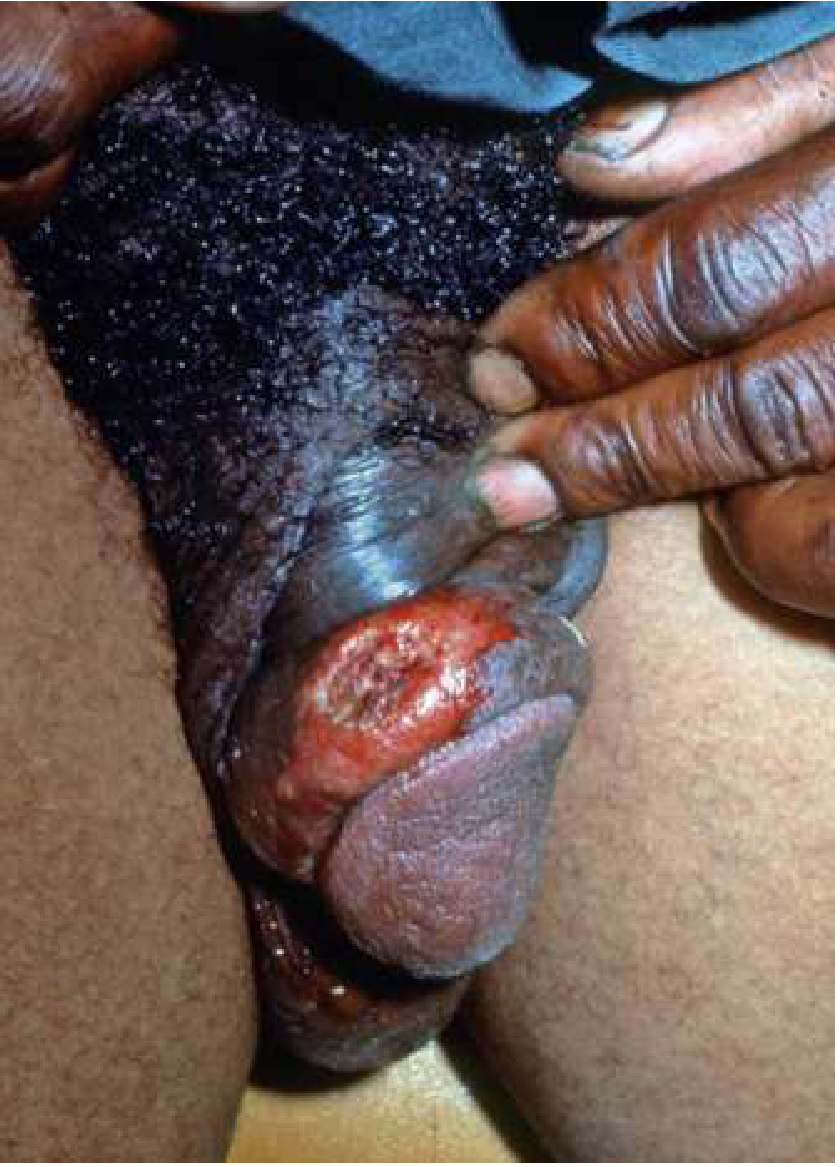
- Chancre: the hallmark - begins as a papule that evolves into a painless ulcer ~1 cm diameter with a clean base and raised, indurated borders
- Located at the site of inoculation (genitalia, anus, mouth, cervix)
- May be single or multiple; typically painless unless secondarily infected
- Accompanied by painless regional lymphadenopathy
- Lasts 3-12 weeks, then heals spontaneously
- Many patients do not recall having a chancre
Primary Syphilis - Chancre:
Secondary Syphilis
- Appears 6 weeks to 6 months after the initial exposure (roughly 6+ weeks after primary)
- Reflects hematogenous dissemination; the most florid, contagious stage
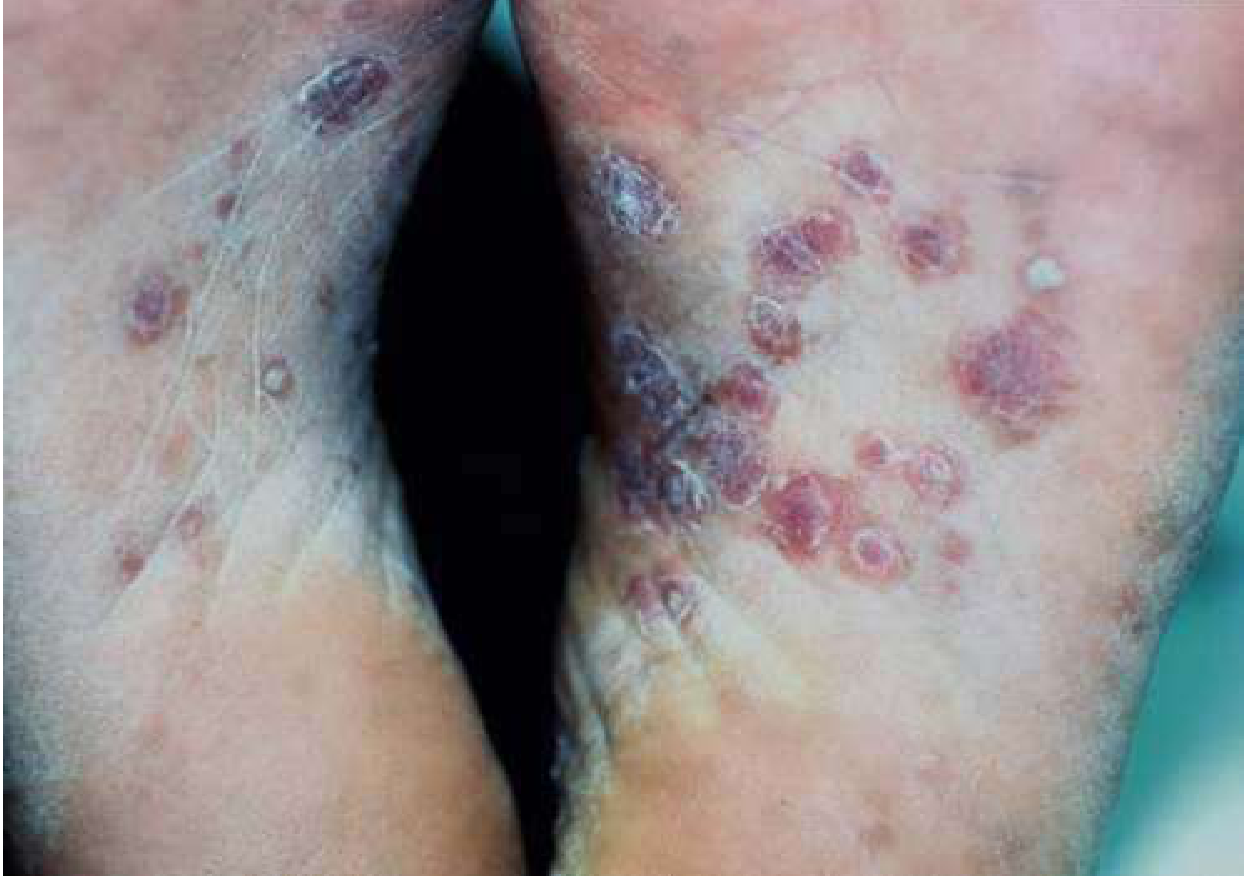
- Skin: erythematous/pink macules and papules with a symmetric generalized distribution - classic involvement of palms and soles (pigmented macules/papules)
- Any maculopapular rash = secondary syphilis until proven otherwise
- Condyloma lata: moist, flat, verrucous lesions in the anogenital region - highly infectious
- Generalized lymphadenopathy and malaise
- Other findings: alopecia ("moth-eaten"), mucous patches, hepatitis, uveitis, meningitis, periostitis, nephropathy
- Lesions heal spontaneously in 2-6 weeks
Secondary Syphilis - Rash on palms/soles:
Latent Syphilis
- Serologic evidence of infection with no clinical manifestations
- Early latent: acquired within the preceding year
- Late latent: >1 year duration (or unknown duration)
- Patients in early latent remain potentially infectious (relapses to secondary stage can occur)
Tertiary Syphilis
Occurs in ~30% of untreated patients, months to years after secondary syphilis. Three forms:
| Form | Features |
|---|---|
| Gummatous syphilis | Granulomatous lesions (gummas) in skin, bone, viscera; destructive but responsive to treatment |
| Cardiovascular syphilis | Aortitis (ascending aorta) - aortic regurgitation, aortic aneurysm (tree-bark appearance), coronary ostial stenosis |
| Neurosyphilis | Meningovascular (stroke-like), general paresis (dementia, personality change), tabes dorsalis (posterior column degeneration - lightning pains, ataxia, Argyll Robertson pupils, loss of deep tendon reflexes) |
Note: Neurosyphilis can occur at any stage, not only tertiary.
Congenital Syphilis
- T. pallidum crosses the placenta; risk is highest in early maternal syphilis
- Early: rhinitis ("snuffles"), maculopapular rash, hepatosplenomegaly, osteochondritis
- Late: Hutchinson's teeth (notched incisors), interstitial keratitis, "saddle nose," saber shins, 8th nerve deafness, Clutton joints
Diagnosis
Serology (most practical)
Two-tier testing:
-
Nontreponemal tests (screen, monitor response):
- VDRL (Venereal Disease Research Laboratory)
- RPR (Rapid Plasma Reagin)
- Positive in ~75% of primary syphilis (may be negative very early); nearly always positive in secondary syphilis
- Titers fall with treatment - used to confirm cure (expect fourfold reduction at 6-12 months)
- False positives occur (SLE, pregnancy, viral infections, TB)
-
Treponemal-specific tests (confirm, not for monitoring):
- FTA-ABS (Fluorescent Treponemal Antibody Absorption) - most sensitive/specific
- TPHA (T. pallidum Hemagglutination Assay)
- Remain reactive for life even after successful treatment
-
Darkfield microscopy of lesion exudate - definitive for primary/secondary lesions (not oral)
-
CSF analysis for neurosyphilis: CSF-VDRL, pleocytosis, elevated protein
Treatment
| Stage | First-line | Alternative (penicillin allergy) |
|---|---|---|
| Primary, secondary, early latent | Benzathine penicillin G 2.4 million units IM, single dose | Doxycycline 100 mg PO BID × 14 days; or azithromycin |
| Late latent / tertiary (non-neurological) | Benzathine penicillin G 2.4 million units IM × 3 doses at weekly intervals (total 7.2 million units) | Doxycycline 100 mg PO BID × 28 days |
| Neurosyphilis | Aqueous crystalline penicillin G 3-4 million units IV q4h × 10-14 days | Procaine penicillin G + probenecid |
| Pregnancy | Penicillin regimen appropriate to stage - doxycycline NOT used in pregnancy |
- Follow-up: Nontreponemal titers at 6 and 12 months - expect a fourfold (two-dilution) decrease to confirm adequate treatment
- Penicillin-allergic pregnant women should be desensitized to penicillin and treated with it
Jarisch-Herxheimer Reaction
An acute febrile reaction within 24 hours of initiating treatment for syphilis (any stage). Features include fever, rigors, headache, myalgia, and transient worsening of skin lesions. Caused by massive release of treponemal antigens. Managed with antipyretics; do not stop antibiotic therapy. Can cause preterm labor in pregnant patients - warn them in advance.
Key Points for Exams
- Painless ulcer (chancre) with indurated edges = primary syphilis
- Rash on palms and soles = think secondary syphilis
- "The great imitator" - secondary syphilis can mimic almost any dermatologic or systemic disease
- Argyll Robertson pupil ("prostitute's pupil" - accommodates but does not react to light) = neurosyphilis
- Treponemal tests stay positive for life; nontreponemal tests (VDRL/RPR) are used to monitor treatment response
- Congenital syphilis screening: all pregnant women should be tested at first prenatal visit
Sources: Andrews' Diseases of the Skin, p. 4720-4732 | Rosen's Emergency Medicine, p. 2402-2404 | Swanson's Family Medicine Review, p. 446
Recent evidence note: A 2026 systematic review (PMID 41983122) examined the immunopathology of "serofast" syphilis (persistent reactive nontreponemal tests despite treatment), an evolving clinical challenge. A 2024 meta-analysis (PMID 38661311) reviewed treatment alternatives for neurosyphilis - no major changes to first-line penicillin recommendations, but confirms alternative regimens have variable efficacy.
This is a shared conversation. Sign in to Orris to start your own chat.