
I can see small papular lesions on the dorsum of both hands, scattered across the skin surface. Let me look into this more carefully.
Searching sources...
Reading File
Searching the Web
small scattered papules dorsum of hands differential diagnosis
Finding Sources
Finding Sources
Finding Sources
Finding Sources
Reading File
Reading File
This is a very good match. Let me fetch the clinical image of lichen nitidus on hands for comparison.
Loading Image
Finding Sources
The textbook image is strikingly similar to the patient's photos. Here is my full assessment:
Clinical Impression: Likely Lichen Nitidus (possibly the Actinic Variant)
Important disclaimer: This is an educational image analysis only - not a medical diagnosis. A dermatologist must examine the patient in person.
What I See in the Photos
Both hands show:
- Multiple tiny (1-2 mm), discrete, skin-colored/slightly hypopigmented papules scattered across the dorsum
- Bilateral and roughly symmetric distribution
- No obvious vesicles, crusting, or burrows
- The papules appear flat-topped and shiny in the closer view
- No significant scaling or erythema surrounding them
Most Likely Diagnosis: Lichen Nitidus
The appearance is a strong match. Here is what the dermatology textbooks say:
Lichen nitidus is a chronic inflammatory skin condition characterized by:
- Minute, shiny, flat-topped, pale, discrete, uniform papules, rarely larger than 1-2 mm
- In darker-skinned individuals, papules tend to be hypopigmented (exactly as seen here)
- Favorite locations: dorsal hands/forearms, flexor wrists, chest, abdomen, genitalia
- Pruritus is usually minimal or absent
- Primarily affects children and young adults
- A Koebner phenomenon (linear arrays along scratch lines) is common
Actinic Lichen Nitidus - a particularly relevant variant here: Textbooks specifically note this variant occurs in dark-skinned patients from the Indian subcontinent and Middle East, with lesions limited to sun-exposed areas of the dorsal hands, brachio-radial area, and posterior neck - matching this presentation closely. It is also known as "pinpoint papular polymorphic light eruption" (PMLE).
(Andrews' Diseases of the Skin, p. 268; Dermatology 2-Volume Set 5e, p. 245)
Textbook Reference Image
The image below, from Andrews' Diseases of the Skin, shows lichen nitidus with the Koebner phenomenon - note the tiny, discrete papules resembling what is seen on these hands:
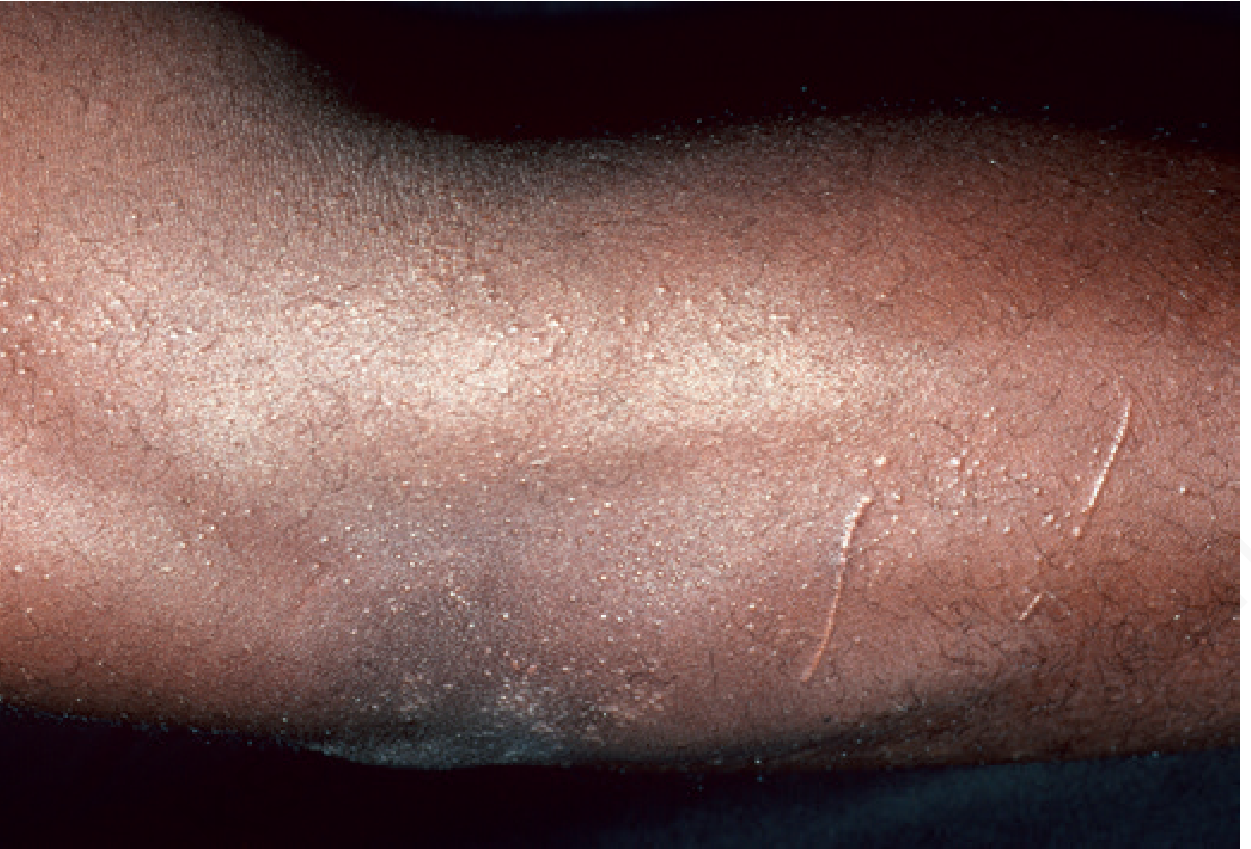
Differential Diagnoses to Consider
| Condition | Key distinguishing features |
|---|---|
| Lichen nitidus (top pick) | Tiny skin-colored/hypopigmented papules, dorsal hands, minimal itch, dark skin phototype |
| Flat warts (Verruca plana) | Slightly larger (2-4 mm), skin-colored or pink papules, often linear grouping due to scratching |
| Scabies | Intensely pruritic, burrows in web spaces, nodules, worse at night - usually affects web spaces more prominently |
| Lichen planus | Larger violaceous papules, wickham striae, more pruritic, oral involvement common |
| Keratosis pilaris | Follicular, rough texture, usually over proximal limbs more than dorsal hands |
| Actinic (photo) eruption / PMLE | Itchy, related to sun exposure, resolves after sun avoidance |
What to Do Next
- See a dermatologist - confirmation requires clinical examination (dermoscopy can be very helpful here)
- A skin biopsy is often diagnostic for lichen nitidus - the histology shows a characteristic "ball and claw" granulomatous infiltrate confined to 1-3 dermal papillae
- Ask about: any itching, duration of lesions, family history, sun exposure history, and whether lesions appear/worsen in summer (pointing to actinic variant)
Treatment (if lichen nitidus is confirmed): Often resolves spontaneously. For the actinic variant - sun protection is first-line, with or without topical corticosteroids; hydroxychloroquine has been used in resistant cases.
Treatment ?
Lichen nitidus often resolves on its own without treatment. When symptoms are present or lesions persist, topical corticosteroids are first-line, with options like tacrolimus, antihistamines for itch, and phototherapy for widespread cases.
Searching sources...
Finding Sources
Searching PubMed
lichen nitidus treatment
Reading File
Reading File
Reading Article
PMID: 39882979
Here is a full treatment guide for Lichen Nitidus, drawn from Fitzpatrick's Dermatology and the Dermatology 2-Volume Set 5e, supplemented by a 2025 review (PMID 39882979):
Treatment of Lichen Nitidus
Step 1 - First Ask: Does it Need Treatment?
Most cases do not. Lichen nitidus is often asymptomatic and self-limiting - the majority of patients experience spontaneous clearing within one to several years. Treatment is only warranted when:
- Significant pruritus is present
- The disease is generalized
- Lesions are in cosmetically sensitive areas
- The patient is bothered enough to seek therapy
Step 2 - Topical Therapy (First-Line for Most)
| Agent | Role | Notes |
|---|---|---|
| Mid- to high-potency topical corticosteroids | First-line for body lesions | e.g. mometasone, betamethasone |
| Tacrolimus ointment 0.1% | First-line for face/skin folds; second-line for body | Especially useful in children; avoids steroid side effects |
| Pimecrolimus cream | Alternative calcineurin inhibitor | Anecdotal reports of effectiveness |
For the actinic variant (sun-exposed dorsal hands, as seen in this case): Sun protection (SPF 50+ sunscreen, protective clothing) is the primary intervention, combined with topical corticosteroids or tacrolimus.
Step 3 - Systemic Therapy for Pruritus
- Oral antihistamines - first-line for itch
- Sedating: diphenhydramine, hydroxyzine
- Non-sedating: cetirizine, loratadine, fexofenadine
- Hydroxychloroquine has been used in actinic LN cases successfully
Step 4 - For Generalized or Refractory Disease
| Treatment | Evidence |
|---|---|
| Narrowband UVB (NB-UVB) | Preferred phototherapy - safer and effective for widespread disease |
| PUVA | Effective for generalized and palmar disease; largely replaced by NB-UVB |
| Short course oral prednisone (0.3 mg/kg) | Hasten resolution of extensive/symptomatic disease; best combined with topicals |
| Low-dose cyclosporine | Reserved for severe/atypical cases |
| Acitretin | For hyperkeratotic palmar variant |
| Itraconazole | Anecdotal - reported in 6 cases alongside lichen planus |
Step 5 - Future/Experimental Options
For severe, refractory cases based on mechanism:
- TNF-α inhibitors (significant granuloma formation)
- Methotrexate, mycophenolate mofetil, azathioprine
- JAK inhibitors (marked lichenoid infiltrate)
Practical Summary for This Case
Given the bilateral dorsal hand distribution in a darker-skinned individual - consistent with actinic lichen nitidus:
- Sun protection - daily broad-spectrum SPF 50+, protective gloves/clothing during peak sun hours
- Mild-to-mid potency topical steroid (e.g. desonide or mometasone) applied once daily for 2-4 weeks
- If inadequate response: switch to tacrolimus 0.1% ointment
- Reassurance - condition is benign and typically resolves over months to years without scarring
A confirmed diagnosis by a dermatologist (with possible biopsy) should precede treatment. Self-treatment without diagnosis is not recommended.
(Fitzpatrick's Dermatology, p. 4104-4111; Dermatology 2-Volume Set 5e, p. 245; Palaniappan & Karthikeyan, Clin Exp Dermatol 2025, PMID 39882979)
This is a shared conversation. Sign in to Orris to start your own chat.