
Write a short note on cirrhosis with hypertension
Reading File
Now let me search the medical library for relevant content on cirrhosis and portal hypertension in parallel.
Finding Sources
Finding Sources
Searching Images
cirrhosis portal hypertension pathophysiology diagram
Good results. Now let me read the most relevant sections from Harrison's and Schwartz's Surgery for comprehensive content.
Reading File
Reading File
Reading File
I have rich content from Harrison's, Schwartz's Surgery, and Washington Manual. Let me also quickly read more from Harrison's on varices and ascites management, and get the cirrhosis histology image.
Reading File
Loading Image
I now have comprehensive content from multiple authoritative sources. Let me compose the short note.
Cirrhosis with Portal Hypertension
Definition
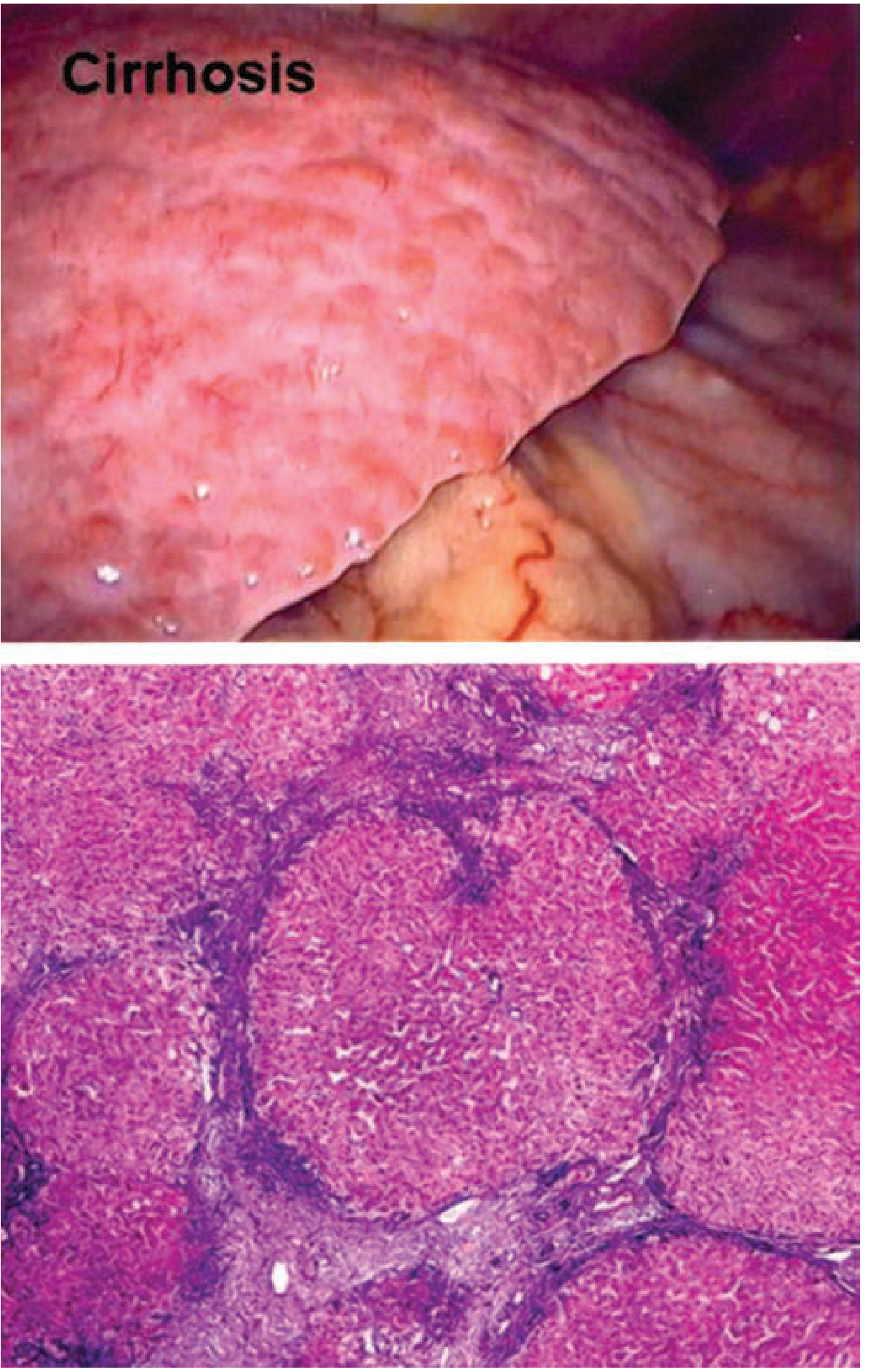
Cirrhosis is the end-stage consequence of sustained chronic liver injury, characterized by diffuse hepatic fibrosis, fibrous septa that subdivide the parenchyma into regenerative hepatocellular nodules, and distortion of the normal lobular architecture. It represents the final pathway of almost all chronic liver diseases.
Portal hypertension (PH) is defined as elevation of the hepatic venous pressure gradient (HVPG) to >5 mmHg. It is the single most important complication of cirrhosis and the driver of most of its life-threatening sequelae.
Etiology of Cirrhosis
Common causes include:
- Chronic alcohol use (most common in Western countries)
- Chronic viral hepatitis B and C
- Non-alcoholic fatty liver disease / metabolic-associated steatohepatitis (MASH)
- Autoimmune hepatitis
- Cholestatic diseases (primary biliary cholangitis, primary sclerosing cholangitis)
- Hereditary hemochromatosis, Wilson's disease, alpha-1 antitrypsin deficiency
Morphology
Cirrhosis is classified morphologically as:
- Micronodular - regular thick septa, small uniform nodules (<3 mm); typical of alcoholic liver disease
- Macronodular - nodules and septa of varying size (>3 mm); typical of viral hepatitis
- Mixed - features of both
On imaging, the cirrhotic liver typically shows right lobe atrophy, caudate lobe hypertrophy, nodular surface contour, dilated portal vein, splenomegaly, and gastroesophageal varices.
Pathophysiology of Portal Hypertension in Cirrhosis
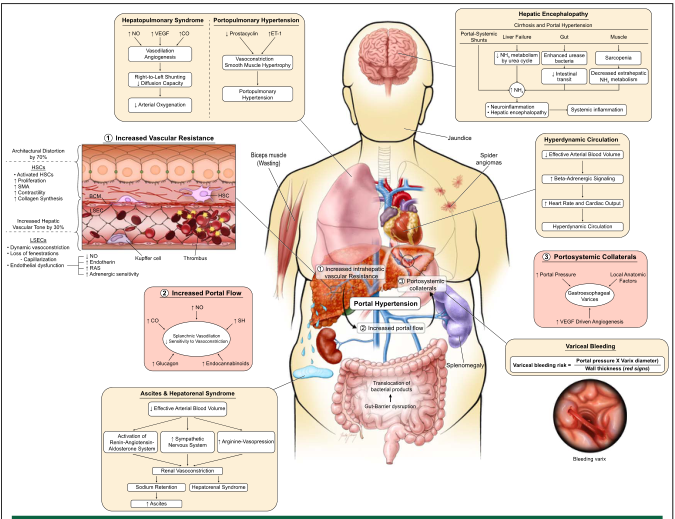
Portal hypertension in cirrhosis arises from two simultaneous hemodynamic disturbances:
- Increased intrahepatic vascular resistance - due to fibrosis, regenerative nodules, and microthrombi distorting the sinusoidal architecture
- Increased splanchnic blood flow - secondary to splanchnic vasodilation driven by nitric oxide and other vasodilators
In advanced disease, neurohumoral activation (renin-angiotensin-aldosterone system, sympathetic nervous system) causes sodium and water retention, expanded plasma volume, and a hyperdynamic circulatory state that further raises portal pressure.
Clinically significant portal hypertension (CSPH) is defined as HVPG ≥10 mmHg and marks the threshold at which decompensation (variceal bleeding, ascites, encephalopathy) becomes a substantial risk.
Classification of Causes of Portal Hypertension
| Category | Examples |
|---|---|
| Prehepatic | Portal vein thrombosis, splenic vein thrombosis |
| Intrahepatic - presinusoidal | Schistosomiasis, congenital hepatic fibrosis |
| Intrahepatic - sinusoidal | Cirrhosis (all causes), alcoholic hepatitis |
| Intrahepatic - postsinusoidal | Hepatic sinusoidal obstruction (veno-occlusive disease) |
| Posthepatic | Budd-Chiari syndrome, constrictive pericarditis, right heart failure |
Intrahepatic causes account for >95% of all portal hypertension cases, with cirrhosis being overwhelmingly the most common in developed countries.
Clinical Features
The three primary complications of portal hypertension are:
1. Gastroesophageal Varices and Hemorrhage
- Approximately one-third of confirmed cirrhotics have varices at diagnosis
- 5-15% of cirrhotics per year develop new varices
- Variceal hemorrhage carries a 20-30% mortality rate per episode
- Risk of bleeding increases with Child-Pugh class, MELD score, HVPG, varix size, and endoscopic stigmata (red wale signs, cherry red spots)
2. Ascites
- Most common complication (>50% of patients over 10 years)
- Results from sinusoidal hypertension leading to hepatic lymph formation, sodium retention, and reduced oncotic pressure
- Serum-ascites albumin gradient (SAAG) ≥1.1 g/dL confirms portal hypertension-related ascites with 97% specificity
3. Splenomegaly and Hypersplenism
- Congestion of the spleen leads to thrombocytopenia, leukopenia, and anemia
- Thrombocytopenia is often the earliest laboratory clue to portal hypertension
Other Complications
- Hepatic encephalopathy - portosystemic shunting allows ammonia and toxins to bypass hepatic detoxification
- Spontaneous bacterial peritonitis (SBP) - infection of ascitic fluid, usually by gram-negative enteric organisms
- Hepatorenal syndrome (HRS) - functional renal failure due to profound splanchnic vasodilation and renal vasoconstriction
- Portopulmonary hypertension and hepatopulmonary syndrome
- Hepatocellular carcinoma (HCC) - cirrhosis is the leading risk factor
Diagnosis
- Laboratory: Thrombocytopenia, hypoalbuminemia, elevated bilirubin, coagulopathy (elevated PT/INR), anemia
- Imaging (ultrasound/CT/MRI): Nodular liver, splenomegaly, ascites, dilated portal vein, intra-abdominal collateral vessels
- Endoscopy: Upper GI endoscopy to identify varices
- HVPG measurement: Gold standard for quantifying portal hypertension (transjugular approach); uncommonly required when clinical diagnosis is clear
- Liver biopsy: Confirms diagnosis and etiology; shows bridging fibrosis and regenerative nodules
Management
Variceal Bleeding
- Acute bleeding: Vasoactive agents (terlipressin, octreotide), band ligation (endoscopic variceal ligation, EVL), balloon tamponade as a bridge, TIPS (transjugular intrahepatic portosystemic shunt)
- Primary prophylaxis: Non-selective beta-blockers (propranolol, nadolol, carvedilol) or EVL to prevent first bleed
- Secondary prophylaxis: Combination of beta-blockers + EVL
Ascites
- Sodium restriction (<2 g/day) and diuretics (spironolactone ± furosemide)
- Large-volume paracentesis with albumin replacement for refractory ascites
- TIPS for refractory cases
Encephalopathy
- Lactulose (reduce ammonia production), rifaximin (non-absorbable antibiotic)
SBP
- Cefotaxime or other third-generation cephalosporins
- Prophylaxis with norfloxacin or trimethoprim-sulfamethoxazole in high-risk patients
Definitive Treatment
- Liver transplantation is the only curative option for end-stage disease; MELD score is used to prioritize allocation
Prognosis
Cirrhosis follows two stages:
- Compensated (HVPG 5-10 mmHg): Often asymptomatic for >10 years; annual mortality ~1-3%
- Decompensated (HVPG ≥10 mmHg, with variceal bleeding, ascites, or encephalopathy): Median survival <2 years without transplant; 5-year mortality ~50%
End-stage liver disease (ESLD) accounts for ~30,000 deaths per year in the United States, making it the most common non-neoplastic cause of death from hepatobiliary/digestive disease.
Sources: Harrison's Principles of Internal Medicine 22E (2025); Schwartz's Principles of Surgery 11th Ed.; Washington Manual of Medical Therapeutics
This is a shared conversation. Sign in to Orris to start your own chat.