
Anti helmenthick
Anthelmintics are drugs used to treat parasitic worm (helminth) infections. They work by various mechanisms - paralysis of worms, disruption of their metabolism, or damage to their tegument - and are classified by the type of worm they target (nematodes, cestodes, trematodes).
Searching sources...
Reading File
Finding Sources
Finding Sources
Good - I have strong sources. Let me read the core anthelmintic sections from Goodman & Gilman, Katzung, and Lippincott in parallel.
Reading File
Reading File
Reading File
I have excellent content. Let me now read more from Lippincott for individual drug details and fetch the classification diagram.
Reading File
Reading File
Loading Image
I now have rich content. Let me read more on the individual drug mechanisms and then compile the full answer.
Reading File
Reading File
I now have comprehensive content from multiple authoritative sources. Here is a full, well-organized answer on anthelmintic drugs.
Anthelmintic Drugs
Anthelmintic drugs target metabolic processes present in parasitic worms (helminths) that are either absent from, or structurally different in, the human host. Helminths fall into three main groups:
- Nematodes (roundworms) - intestinal (Ascaris, hookworms, pinworms, whipworms, Strongyloides) and tissue/filarial (Wuchereria, Onchocerca, Loa loa)
- Trematodes (flukes) - blood (Schistosoma), liver (Fasciola, Clonorchis), lung (Paragonimus)
- Cestodes (tapeworms) - Taenia solium/saginata, Diphyllobothrium, Echinococcus
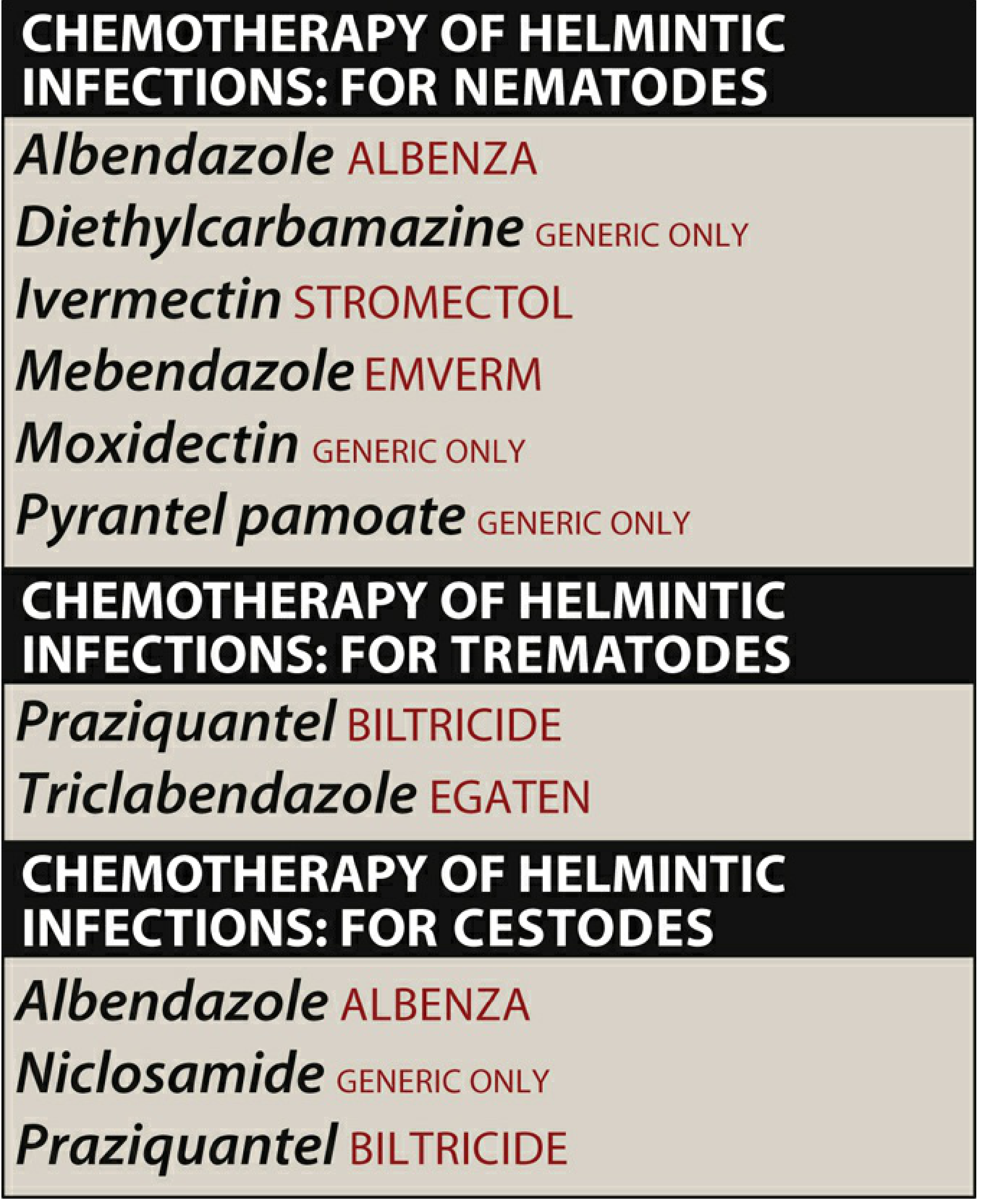
The classification of drugs by target organism is shown below:
I. Drugs for Nematodes (Roundworms)
1. Benzimidazoles - Mebendazole & Albendazole
These are the most widely used anthelmintics globally, including in WHO mass drug administration (MDA) programs.
Mechanism: Bind selectively to parasite beta-tubulin and inhibit microtubule polymerization. This blocks glucose uptake and disrupts the worm's cytoskeleton, ultimately causing death and expulsion in feces.
Mebendazole
- Indications: Whipworm (Trichuris), pinworm (Enterobius), hookworms (Necator, Ancylostoma), roundworm (Ascaris)
- Very poorly absorbed orally - acts locally in the gut
- ADRs: Abdominal pain, diarrhea; rare: convulsions in children <1 year; Stevens-Johnson syndrome with concurrent metronidazole
- Avoid in pregnancy (first trimester); may be used in 2nd/3rd trimester in MDA programs
Albendazole
- Broader spectrum - also used for hydatid disease (Echinococcus), cysticercosis, cutaneous larva migrans, visceral larva migrans, strongyloidiasis, trichinosis
- Undergoes rapid first-pass metabolism to the active metabolite albendazole sulfoxide; absorption is improved by a fatty meal
- Half-life ~8-12 hours; the sulfoxide penetrates cysts, CSF, and CNS well
- Preferred over praziquantel for neurocysticercosis (better CNS penetration, cheaper, not reduced by corticosteroids)
- ADRs (short courses): mild - GI upset, headache, dizziness. Long-term (hydatid disease): alopecia, elevated liver enzymes, pancytopenia - monitor LFTs and CBC
- Contraindicated in pregnancy; avoid in cirrhosis
Triclabendazole - a benzimidazole derivative specifically for fascioliasis (Fasciola hepatica, F. gigantica); inhibits tubulin function and protein synthesis. Considered the drug of choice for sheep/liver fluke infection.
2. Pyrantel Pamoate
- Indications: Pinworms, hookworms, Ascaris
- Mechanism: Depolarizing neuromuscular blocking agent - causes release of acetylcholine and inhibits cholinesterase, resulting in spastic paralysis and expulsion of the worm
- Poorly absorbed - acts locally in the intestine only; not effective against tissue infections
- A second dose is needed for pinworm (does not kill eggs)
- ADRs: Mild - nausea, vomiting, diarrhea
3. Ivermectin
- Indications: Drug of choice for strongyloidiasis (Strongyloides stercoralis), onchocerciasis (river blindness), cutaneous larva migrans. Also used for lymphatic filariasis (in combination), scabies, and head lice
- Mechanism: Binds glutamate-gated chloride channel receptors in invertebrate nerve/muscle cells → enhanced chloride influx → hyperpolarization → flaccid paralysis and death of the worm. Does not cross the human blood-brain barrier at therapeutic doses
- Note: In onchocerciasis, ivermectin kills microfilaria but not adult worms, so it is not curative; repeated dosing is needed
- Mazzotti reaction: Killing microfilaria can trigger fever, headache, dizziness, hypotension - severity correlates with parasite load; treat with antihistamines or steroids
- Avoid in pregnancy
4. Diethylcarbamazine (DEC)
- Indications: Lymphatic filariasis (Wuchereria bancrofti, Brugia spp.), loiasis (Loa loa)
- Used in MDA programs combined with albendazole (with or without ivermectin) for lymphatic filariasis
- Mechanism: Immobilizes microfilaria and enhances their clearance by the host immune system
5. Moxidectin
- A macrocyclic lactone (related to ivermectin) approved for onchocerciasis; generic only in the US
- Longer half-life than ivermectin
II. Drugs for Trematodes (Flukes)
Praziquantel
- Drug of choice for virtually all trematode and most cestode infections
- Indications: All Schistosoma species, liver flukes (Clonorchis, Opisthorchis), lung fluke (Paragonimus), intestinal flukes, tapeworms (Taenia, Diphyllobothrium, Hymenolepis)
- Mechanism: Increases permeability of the parasite cell membrane to calcium → tetanic contracture → paralysis and tegument disruption
- Rapidly absorbed orally; take with food; extensively metabolized; excreted renally
- ADRs: Dizziness, malaise, headache, GI upset (often from dying worms)
- Drug interactions: Strong CYP3A4 inducers (phenytoin, rifampin, carbamazepine) reduce praziquantel levels - co-administration is contraindicated
- Contraindicated in ocular cysticercosis (destruction of organisms in the eye can cause irreversible damage)
- Exception: Fascioliasis does NOT respond well to praziquantel - use triclabendazole
III. Drugs for Cestodes (Tapeworms)
| Drug | Use |
|---|---|
| Praziquantel | Taenia saginata, T. solium, Diphyllobothrium, Hymenolepis nana |
| Albendazole | Neurocysticercosis (preferred), hydatid disease (Echinococcus) |
| Niclosamide | Alternative for taeniasis, diphyllobothriasis (not available in the US) |
Niclosamide acts by inhibiting oxidative phosphorylation in tapeworm mitochondria, blocking ATP production. It is not absorbed and is well tolerated, but has been largely replaced by praziquantel.
IV. Drug of Choice Quick Reference (from Katzung, Table 53-1)
| Organism | Drug of Choice | Alternative |
|---|---|---|
| Ascaris lumbricoides | Albendazole or pyrantel pamoate or mebendazole | Ivermectin |
| Trichuris trichiura | Mebendazole or albendazole | Ivermectin |
| Hookworms | Albendazole or mebendazole or pyrantel pamoate | - |
| Strongyloides stercoralis | Ivermectin | Albendazole |
| Enterobius (pinworm) | Mebendazole or pyrantel pamoate | Albendazole |
| Trichinella spiralis | Mebendazole or albendazole + corticosteroids | - |
| Wuchereria bancrofti (LF) | DEC + albendazole | Ivermectin + albendazole |
| Onchocerca volvulus | Ivermectin | - |
| Schistosoma spp. | Praziquantel | - |
| Fasciola hepatica | Triclabendazole | Bithionol |
| Paragonimus westermani | Praziquantel | Bithionol |
| Clonorchis / Opisthorchis | Praziquantel | Albendazole |
| Taenia spp. | Praziquantel or niclosamide | Mebendazole |
| Cysticercosis | Albendazole | Praziquantel |
| Echinococcus (hydatid) | Albendazole | Surgery |
V. Pregnancy & Special Notes
Drugs to avoid in pregnancy: Albendazole, mebendazole (1st trimester), ivermectin, triclabendazole. In MDA programs, albendazole or mebendazole may be used in the 2nd/3rd trimester under WHO guidance.
Immunocompromised patients (e.g., HTLV-1 infection, chronic corticosteroids): Risk of hyperinfection syndrome with Strongyloides - these patients must be screened and treated with ivermectin before immunosuppression whenever possible.
Sources: Lippincott Illustrated Reviews Pharmacology, Ch. 36 | Katzung's Basic and Clinical Pharmacology 16e, Ch. 53 | Goodman & Gilman's Pharmacological Basis of Therapeutics, Ch. 68
This is a shared conversation. Sign in to Orris to start your own chat.