
Lachmann test
The Lachmann test is a clinical examination maneuver used to assess the integrity of the anterior cruciate ligament (ACL) of the knee. It is performed with the knee in about 20-30 degrees of flexion, stabilizing the femur with one hand while applying an anterior drawer force to the tibia with the other. A positive test shows increased anterior tibial translation with a soft or absent endpoint, indicating ACL rupture.
Searching sources...
Reading File
Searching the Web
Lachmann test ACL sensitivity specificity technique
Finding Sources
Finding Sources
Reading File
Reading File
Reading File
Loading Image
Here is a thorough breakdown of the Lachmann test:
Lachman Test
Purpose
The Lachman test is the most sensitive clinical test for diagnosing anterior cruciate ligament (ACL) rupture. It assesses the amount and quality of anterior tibial translation relative to the femur.
Why This Position (Biomechanical Rationale)
At 90 degrees of knee flexion (the position used in the anterior drawer test), the medial meniscus abuts the convex medial femoral condyle and creates a "doorstop" effect, impeding anterior tibial translation and potentially masking an ACL tear. At 15-30 degrees of flexion (the Lachman position), the femur's comparatively flat weight-bearing surface does not obstruct forward motion, allowing the ACL to be isolated and tested more accurately. - Campbell's Operative Orthopaedics, 15th Ed
Technique
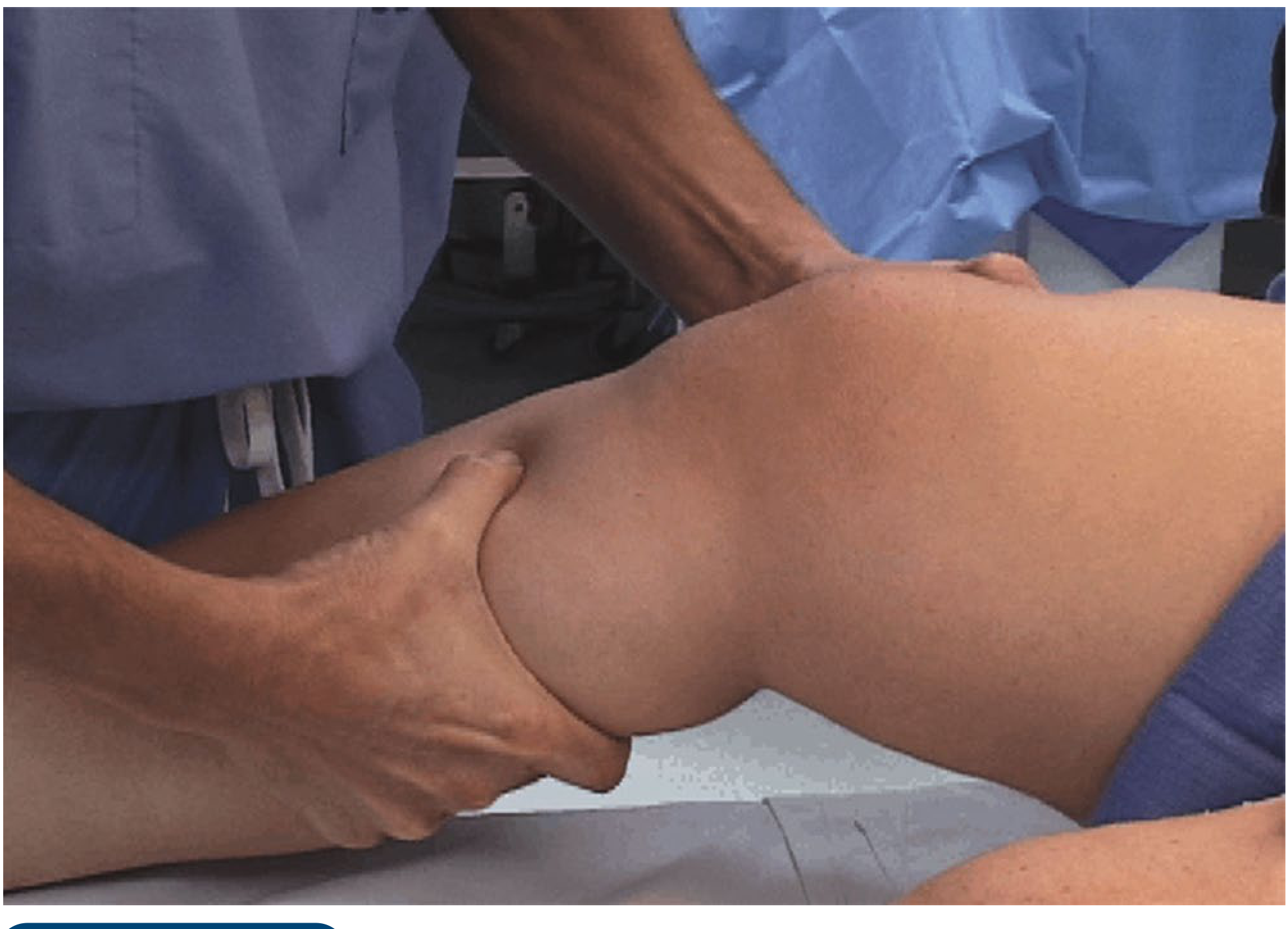
Patient position: Supine, involved extremity in slight external rotation
Steps:
- Flex the knee to 15-30 degrees
- One hand firmly stabilizes the distal femur
- The other hand grips the proximal tibia with the thumb resting on the anteromedial joint margin
- Apply a rapid, anteriorly-directed lifting force to the posterior proximal tibia
- Feel with the thumb for anterior translation of the tibia relative to the femur
Key tip: The hamstrings must be fully relaxed - any tension will prevent anterior tibial translation and falsely suppress the test. Palpate the posterior thigh to verify relaxation before applying force. The tibia should be rapidly accelerated anteriorly so the ACL snaps tight like a short rope - the examiner feels for the hard endpoint rather than just looking for excursion.
Interpreting the Result
| Finding | Interpretation |
|---|---|
| Firm, hard endpoint | Normal ACL |
| Soft or absent endpoint | ACL rupture (positive test) |
| Anterior sag silhouette disappears | Further sign of ACL tear |
Grading by translation (compared to contralateral knee):
| Grade | Translation |
|---|---|
| Grade 1 | 1-5 mm |
| Grade 2 | 6-10 mm |
| Grade 3 | >10 mm |
Each grade is further sub-classified:
- A = firm/hard endpoint
- B = soft endpoint
So a "Grade 1B" means 1-5 mm of translation with a soft endpoint, which still suggests ACL injury despite minimal excursion. - Campbell's Operative Orthopaedics, 15th Ed, p. 2649
Important Caveat
The test may be negative in chronic ACL ruptures because the ACL stump can scar and adhere to the PCL, creating a false endpoint. Always correlate with history and imaging. - Bailey and Love's Short Practice of Surgery, 28th Ed, p. 514
Comparison With Other ACL Tests
| Test | Knee Position | Notes |
|---|---|---|
| Lachman test | 15-30° flexion | Most sensitive; best for acute injuries |
| Anterior Drawer test | 90° flexion | Less sensitive due to meniscal doorstop effect |
| Pivot Shift test | Near full extension | Tests anterolateral rotatory instability; high specificity but low sensitivity in acute setting |
The Lachman test has been shown in systematic reviews and meta-analyses to have the highest diagnostic accuracy among manual knee examinations for ACL tears. The positive likelihood ratio ranges from approximately 2.19-9.67 and the negative likelihood ratio from 0.13-0.31.
Clinical Pearls
- A displacement of only 5 mm can be hard to see visually in a large knee - feel for the endpoint, do not just look
- If the patient is in pain or guarding, the test will be less reliable; consider examination under anesthesia
- Always compare to the contralateral knee as a baseline
- The prone Lachman test is an alternative when supine examination is difficult, though it should not be used as the sole diagnostic test
This is a shared conversation. Sign in to Orris to start your own chat.