
Types of electric current
Electric current comes in two main types: Direct Current (DC) and Alternating Current (AC). In DC, electrons flow in one direction only (like from a battery). In AC, the flow direction reverses periodically at a set frequency (like household electricity at 50/60 Hz). There are also sub-classifications based on waveform shape within AC.
Searching sources...
Searching the Web
types of electric current AC DC explained
Here is a full breakdown of the types of electric current:
Types of Electric Current
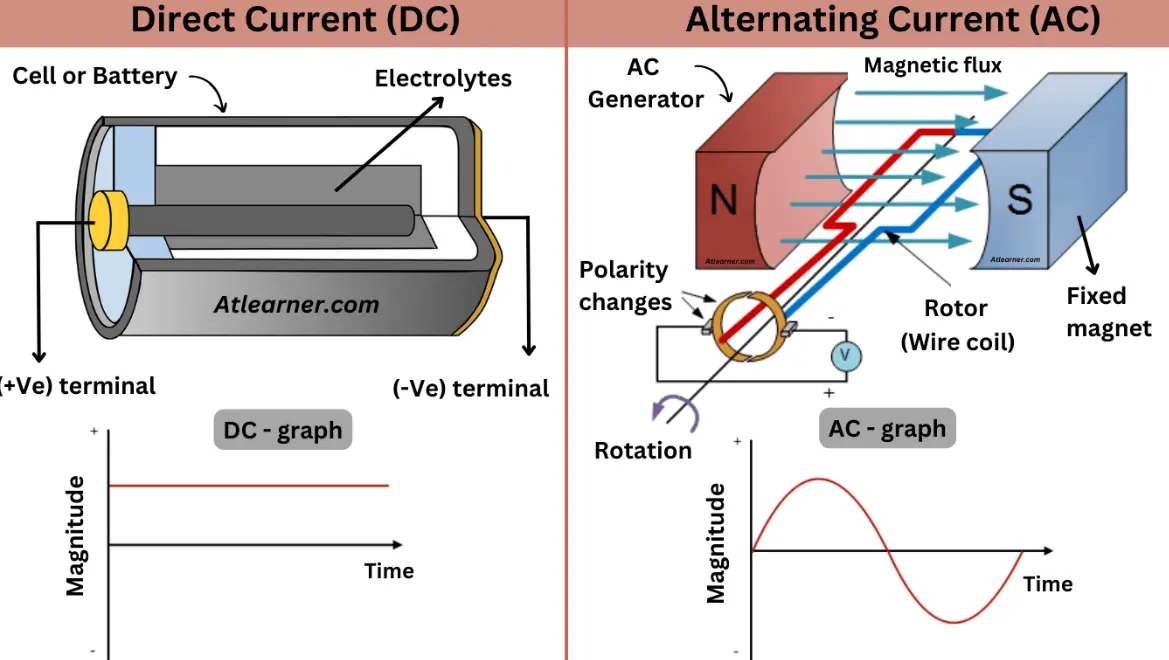
1. Direct Current (DC)
DC is a flow of electric charge in one direction only, with a constant or near-constant magnitude.
Characteristics:
- Unidirectional flow
- Voltage and current do not reverse polarity
- Can be steady (perfectly flat) or slightly varying (ripple DC)
Sub-types of DC:
| Sub-type | Description |
|---|---|
| Steady/Pure DC | Perfectly constant magnitude over time (ideal) |
| Pulsating DC | Magnitude varies but never reverses direction (e.g., output of a rectifier) |
| Varying DC | Magnitude changes over time but stays in one direction |
Sources: Batteries, solar cells, fuel cells, DC generators, rectifiers
Uses: Mobile phones, laptops, electric vehicles, LED lighting, electroplating
2. Alternating Current (AC)
AC is a current whose magnitude changes continuously and direction reverses periodically. It follows a waveform (most commonly sinusoidal).
Characteristics:
- Bidirectional flow (reverses at a set frequency)
- Described by frequency (Hz), amplitude, and phase
- Easy to step up/down with transformers - ideal for long-distance transmission
Sub-types of AC by waveform:
| Waveform | Description |
|---|---|
| Sinusoidal (Sine wave) | Smooth, continuous wave - the standard household supply (50 Hz or 60 Hz) |
| Square wave | Abrupt alternation between two levels - common in digital electronics |
| Triangular wave | Linear rise and fall - used in signal processing and testing |
| Sawtooth wave | Ramps up then drops sharply (or vice versa) - used in oscilloscopes and audio synthesis |
Sources: AC generators (alternators), power plants, inverters
Uses: Household power, industrial motors, transformers, HVAC systems
3. Varying Current (sometimes listed separately)
Some classifications include a third category: varying current, where magnitude changes with time but direction does NOT reverse. This is essentially a sub-type of DC and sits between pure DC and AC.
Quick Comparison: AC vs. DC
| Feature | DC | AC |
|---|---|---|
| Direction | One-way | Reverses periodically |
| Frequency | 0 Hz | 50 Hz or 60 Hz (typical) |
| Waveform | Flat line | Sine wave (typically) |
| Transmission | Inefficient over long distances | Efficient over long distances |
| Storage | Can be stored (batteries) | Cannot be directly stored |
| Conversion | DC to AC via inverter | AC to DC via rectifier |
| Typical use | Electronics, batteries | Power grids, homes, motors |
Key Formulas
- Current (I): I = Q / t (charge per unit time, measured in Amperes)
- AC Frequency (f): f = 1 / T (cycles per second, in Hertz)
- RMS Voltage for Sine AC: V_rms = V_peak / √2
In summary, the two fundamental types are DC (steady, one-direction flow) and AC (oscillating, reversing flow). AC dominates power grids because transformers can efficiently change its voltage; DC dominates electronics and portable devices because most components require a stable, unidirectional supply.
This is a shared conversation. Sign in to Orris to start your own chat.