
Post partum sterilization
postpartum sterilization tubal ligation
Postpartum Sterilization
Definition
Timing Options
- Immediately during cesarean section - performed after delivery and uterine repair; adds only a slight prolongation of operating time and poses no additional significant risk
- Delayed 8-48 hours after vaginal delivery - allows elective fasting, equilibration of fluid shifts (especially if blood loss was a concern), and observation of the newborn
- Deferred (interval procedure) - performed 6+ weeks postpartum; interval tubal ligation as early as 6 weeks after delivery is equally effective
Importantly, PTL remains an elective procedure. Never assume that a patient who underwent emergency cesarean section (especially for fetal concern) still wishes to proceed with sterilization - consent must be reconfirmed.
Contraindications to PTL
- Maternal fever
- Pregnancy-related hypertension (preeclampsia/eclampsia)
- Uncontrolled diabetes mellitus
- Excessive blood loss during delivery
- Concern over viability or health of the newborn
Surgical Approach: Minilaparotomy
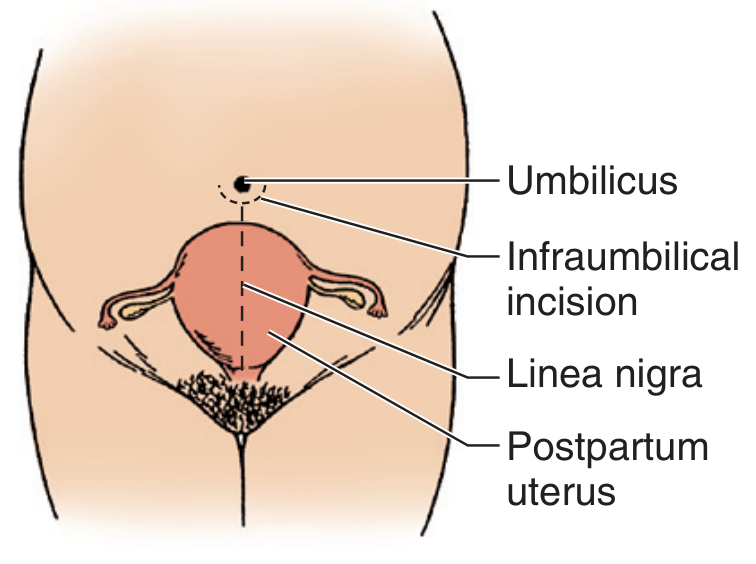
Technique Steps
- Drain the bladder by voiding immediately before surgery or by straight catheterization
- Incision: Curved infraumbilical incision (4-5 cm), placed close to or within the umbilical crater - the enlarged postpartum uterus brings the tubes up to this level
- Entry: Blunt dissection with Kelly clamps to enter the peritoneal cavity; uterus is gently pushed to one side to rotate adnexal structures into view
- Tube identification: Babcock clamps are used to identify the fallopian tube, which is characteristically swollen and engorged in the postpartum state. Each tube must be followed to its fimbriated end and the ovary identified to confirm correct structure
- Caution with mesosalpinx: Vessels within the mesosalpinx are hugely dilated postpartum - extremely gentle traction is required to avoid profuse bleeding
- Tubal occlusion: Perform as for interval sterilization (see below). If the tube cannot be delivered through the incision, clips may be applied in situ
- Closure: Layered closure, ensuring definitive fascial closure
Tubal Occlusion Techniques
| Technique | Description | Notes |
|---|---|---|
| Modified Pomeroy (most common for PTL) | Loop of tube ligated at base with absorbable suture, then excised | Favored for fragile postpartum mesosalpinx; quick and hemostatic |
| Parkland (Partial salpingectomy) | Midportion of tube ligated with two separate absorbable sutures, then excised | Also called "separate sutures technique" |
| Irving method | Midportion excised; proximal stump buried into uterine wall | Extremely low failure rate; more technically demanding |
| Uchida method | Saline-epinephrine injected submucosally; mucosal segment excised; proximal stump buried | >20,000 cases with no reported pregnancies |
| Clips (Hulka, Filshie) | Mechanical occlusion | Used when tube cannot be delivered; Filshie clip has largely supplanted Hulka clip |
| Silastic band (Falope ring) | Ischemic necrosis of a loop | More reversible than electrocautery |
| Bipolar electrocoagulation | 3 cm of tube coagulated at midsthymic portion | Requires generator delivering ≥25 W into 100 Ω; if fragment cannot be confirmed, coagulation may be incomplete |
Anesthesia for Postpartum Sterilization
If Epidural was Used for Labor
- The epidural catheter can be left in place for up to 48 hours
- Allow an elective fasting period before proceeding
- A T4-T5 sensory level is usually needed for a pain-free experience; lower levels (T10) may fail to prevent visceral traction pain
If No Prior Anesthesia (Vaginal Delivery without Block)
- Spinal is often preferred over epidural for speed, density, and reliability
- Bupivacaine 8-12 mg or lidocaine 60-75 mg
- Postdural puncture headache risk is ~1% with 25-gauge pencil-point needle
- Epidural: lidocaine 1.5-2% or chloroprocaine 3%, 15-30 mL
- Note: regional anesthetic dose requirements return to normal within 24-36 hours after delivery
- Rapid-sequence induction + endotracheal intubation
- Premedication: H2 blocker (ranitidine), sodium citrate, or metoclopramide
- Extubate only when awake with intact airway reflexes
- Succinylcholine duration is modestly prolonged (reduced plasma cholinesterase persists postpartum)
- Rocuronium duration is also prolonged; atracurium/cisatracurium are not affected
- Avoid excessive volatile agents (risk of uterine relaxation and postpartum hemorrhage)
- Breastfeeding can resume immediately postanesthesia (the old "pump and dump" advice is outdated)
Complications and Failure
- Complication rate for postpartum minilaparotomy: approaches that of interval sterilization, generally < 3%
- Average tubal sterilization failure rate: ~1 in 250 at 1 year
- Postpartum and postabortion sterilization is slightly less effective than interval sterilization
- Ectopic pregnancy risk: postpartum partial salpingectomy and unipolar coagulation have the lowest rates of ectopic pregnancy after sterilization failure (Berek & Novak)
Reversal and Regret
- 1-2% of women seek reversal after sterilization
- Of these, only 30-70% are candidates for reversal surgery (range depends on original method)
- Pregnancy occurs in approximately 50% of those who undergo reversal
- Reversal is most successful when < 3 cm of tube was damaged or removed, and when the isthmic portion was preserved (non-electrocautery techniques are most reversible)
Risk Factors for Regret (Counsel Before Proceeding)
- Marital disharmony at the time of sterilization (remarriage is the reason in 90% of reversal requests)
- Age < 30 years at time of sterilization
- Sterilization chosen due to financial, health, or emotional difficulties
- Regret may be slightly more prevalent after postpartum sterilization specifically
vs. Interval Sterilization
| Feature | Postpartum (PTL) | Interval (6+ weeks later) |
|---|---|---|
| Technical ease | Easier (enlarged uterus) | Standard difficulty |
| Access | Infraumbilical minilaparotomy | Suprapubic minilaparotomy or laparoscopy |
| Anesthesia risk | Slightly higher (aspiration) | Lower |
| Efficacy | Slightly lower | Slightly higher |
| Laparoscopy safety | Less safe (engorged vasculature) | Preferred route |
- Pfenninger and Fowler's Procedures for Primary Care, 3rd ed. - Chapter 152
- Berek & Novak's Gynecology - Chapter 14
- Morgan and Mikhail's Clinical Anesthesiology, 7th ed. - Chapter on Obstetric Anesthesia
Create a summary document on postpartum sterilization for patient counseling
ls -la /home/daytona/workspace/ && ls /home/daytona/skills/docx/
mkdir -p /home/daytona/workspace/postpartum-sterilization && node --version && npm list -g docx 2>/dev/null | head -5
~/postpartum-sterilization/create_doc.js
const {
  Document, Packer, Paragraph, TextRun, Table, TableRow, TableCell,
  HeadingLevel, AlignmentType, BorderStyle, WidthType, ShadingType,
  VerticalAlign, PageNumber, Header, Footer, TabStopType, TabStopPosition,
  UnderlineType
} = require('docx');
const fs = require('fs');

// ── Colour palette ──────────────────────────────────────────────────────────
const TEAL       = "1A6B72";   // dark teal – headings / accents
const TEAL_LIGHT = "E8F5F6";   // very light teal – shaded rows / callouts
const ORANGE     = "D95F02";   // warm orange – important warnings
const GREY_TEXT  = "444444";
const WHITE      = "FFFFFF";

// ── Helper: plain paragraph ─────────────────────────────────────────────────
const p = (text, opts = {}) => new Paragraph({
  spacing: { after: 120 },
  children: [new TextRun({
    text,
    size: opts.size || 22,
    color: opts.color || GREY_TEXT,
    bold: opts.bold || false,
    italics: opts.italic || false,
    font: "Calibri",
  })],
  alignment: opts.align || AlignmentType.LEFT,
});

// ── Helper: bullet ───────────────────────────────────────────────────────────
const bullet = (text, bold_prefix = "") => new Paragraph({
  bullet: { level: 0 },
  spacing: { after: 80 },
  children: [
    ...(bold_prefix ? [new TextRun({ text: bold_prefix + " ", bold: true, size: 22, color: GREY_TEXT, font: "Calibri" })] : []),
    new TextRun({ text, size: 22, color: GREY_TEXT, font: "Calibri" }),
  ],
});

// ── Helper: section heading (H2 style) ──────────────────────────────────────
const sectionHeading = (text) => new Paragraph({
  spacing: { before: 280, after: 120 },
  border: { bottom: { style: BorderStyle.SINGLE, size: 6, color: TEAL, space: 4 } },
  children: [new TextRun({
    text: text.toUpperCase(),
    bold: true,
    size: 26,
    color: TEAL,
    font: "Calibri",
    allCaps: true,
  })],
});

// ── Helper: callout box (shaded paragraph) ──────────────────────────────────
const callout = (text, color = TEAL_LIGHT, textColor = TEAL) => new Paragraph({
  spacing: { before: 160, after: 160 },
  indent: { left: 360, right: 360 },
  shading: { type: ShadingType.CLEAR, fill: color },
  children: [new TextRun({ text, size: 22, color: textColor, bold: true, font: "Calibri" })],
});

// ── Helper: table cell ──────────────────────────────────────────────────────
const cell = (text, opts = {}) => new TableCell({
  width: opts.width ? { size: opts.width, type: WidthType.PERCENTAGE } : undefined,
  verticalAlign: VerticalAlign.CENTER,
  shading: opts.shade ? { type: ShadingType.CLEAR, fill: opts.shade } : undefined,
  margins: { top: 80, bottom: 80, left: 120, right: 120 },
  children: [new Paragraph({
    alignment: AlignmentType.LEFT,
    children: [new TextRun({
      text,
      size: opts.size || 20,
      bold: opts.bold || false,
      color: opts.color || GREY_TEXT,
      font: "Calibri",
    })],
  })],
});

// ── Table helper ─────────────────────────────────────────────────────────────
const makeTable = (rows, colWidths) => new Table({
  width: { size: 100, type: WidthType.PERCENTAGE },
  rows: rows.map((rowData, ri) =>
    new TableRow({
      children: rowData.map((cellText, ci) =>
        cell(cellText, {
          width: colWidths ? colWidths[ci] : undefined,
          bold: ri === 0,
          shade: ri === 0 ? TEAL : (ri % 2 === 0 ? "F5F5F5" : WHITE),
          color: ri === 0 ? WHITE : GREY_TEXT,
          size: ri === 0 ? 20 : 20,
        })
      ),
    })
  ),
});

// ═══════════════════════════════════════════════════════════════════════════
// DOCUMENT
// ═══════════════════════════════════════════════════════════════════════════
const doc = new Document({
  styles: {
    default: {
      document: {
        run: { font: "Calibri", size: 22 },
      },
    },
  },
  sections: [{
    properties: {
      page: {
        margin: { top: 900, bottom: 900, left: 1080, right: 1080 },
      },
    },
    headers: {
      default: new Header({
        children: [
          new Paragraph({
            alignment: AlignmentType.CENTER,
            spacing: { after: 0 },
            shading: { type: ShadingType.CLEAR, fill: TEAL },
            children: [
              new TextRun({
                text: "  POSTPARTUM STERILIZATION  |  Patient Counseling Guide",
                bold: true, size: 20, color: WHITE, font: "Calibri",
              }),
            ],
          }),
        ],
      }),
    },
    footers: {
      default: new Footer({
        children: [
          new Paragraph({
            alignment: AlignmentType.CENTER,
            spacing: { after: 0 },
            children: [
              new TextRun({ text: "This document is for informational purposes only and does not replace individualized medical advice.  |  Page ", size: 18, color: "888888", font: "Calibri" }),
              new TextRun({ children: [PageNumber.CURRENT], size: 18, color: "888888", font: "Calibri" }),
            ],
          }),
        ],
      }),
    },

    children: [

      // ── TITLE BLOCK ──────────────────────────────────────────────────────
      new Paragraph({
        spacing: { before: 200, after: 60 },
        alignment: AlignmentType.CENTER,
        children: [new TextRun({ text: "Postpartum Sterilization", bold: true, size: 52, color: TEAL, font: "Calibri" })],
      }),
      new Paragraph({
        spacing: { after: 60 },
        alignment: AlignmentType.CENTER,
        children: [new TextRun({ text: "Patient Counseling & Information Guide", size: 28, color: ORANGE, font: "Calibri", italics: true })],
      }),
      new Paragraph({
        spacing: { after: 320 },
        alignment: AlignmentType.CENTER,
        children: [new TextRun({ text: "Prepared by your healthcare team  |  Please read carefully and ask any questions before signing consent", size: 20, color: "888888", font: "Calibri" })],
      }),

      // ── WHAT IS IT ───────────────────────────────────────────────────────
      sectionHeading("What is Postpartum Sterilization?"),
      p("Postpartum sterilization (also called postpartum tubal ligation or PTL) is a surgical procedure to permanently prevent future pregnancies. It is performed within 72 hours of giving birth. During the procedure, the fallopian tubes are tied, cut, or occluded so that eggs can no longer meet sperm."),
      p("It is one of the most effective forms of contraception available, but it is intended to be permanent. Only consider this procedure if you are certain that you do not want more children."),

      callout("⚠  Important: This is an elective, permanent procedure. It should never be performed in an emergency or under pressure. You may change your mind at any time before the surgery begins.", "FFF3E0", ORANGE),

      // ── TIMING ───────────────────────────────────────────────────────────
      sectionHeading("When Can it Be Done?"),
      p("There are three time windows for postpartum sterilization:"),
      bullet("During cesarean section (C-section) — performed immediately after delivery and uterine repair. It adds only a few extra minutes to the surgery.", "1."),
      bullet("Within 48 hours after vaginal delivery — performed the day after birth, once you have rested and fasted. This is the most common approach after vaginal delivery.", "2."),
      bullet("Interval procedure (6+ weeks after delivery) — if postpartum sterilization is not possible or you change your mind, sterilization at 6 weeks is equally effective.", "3."),
      p("The immediate postpartum period is technically easier for the surgeon because the uterus is still enlarged and the fallopian tubes are high in the abdomen, making them easier to reach through a small incision."),

      // ── CONTRAINDICATIONS ────────────────────────────────────────────────
      sectionHeading("When the Procedure Cannot Be Done Right Away"),
      p("Your doctor may delay or cancel the procedure if any of the following are present at the time of delivery:"),
      bullet("Fever or active infection"),
      bullet("Pregnancy-related high blood pressure (preeclampsia/eclampsia)"),
      bullet("Uncontrolled diabetes"),
      bullet("Excessive blood loss during delivery"),
      bullet("Concern about the health or survival of your newborn"),
      p("If your procedure is postponed, you can have interval sterilization 6 weeks after delivery, which is just as effective."),

      // ── HOW IT IS DONE ───────────────────────────────────────────────────
      sectionHeading("How is the Procedure Performed?"),
      p("In the postpartum period, sterilization is most safely done through a minilaparotomy — a small incision (about 3-4 cm) made just below the belly button. This approach is preferred because laparoscopy (using a camera inserted through the abdomen) carries higher risks in the immediate postpartum period due to engorged blood vessels."),

      new Paragraph({
        spacing: { after: 100, before: 160 },
        children: [new TextRun({ text: "Step-by-Step Overview:", bold: true, size: 22, color: TEAL, font: "Calibri" })],
      }),
      bullet("You will be given regional (spinal or epidural) or general anesthesia."),
      bullet("A small incision is made just below the belly button."),
      bullet("Each fallopian tube is identified, then tied, cut, clipped, or a small segment is removed."),
      bullet("The incision is closed in layers. The whole procedure usually takes 20-30 minutes."),
      bullet("You will be monitored for a few hours afterward before discharge or transfer to the postnatal ward."),

      new Paragraph({ spacing: { after: 100, before: 160 }, children: [new TextRun({ text: "Common Techniques Used:", bold: true, size: 22, color: TEAL, font: "Calibri" })] }),
      p("Different methods exist to block the tubes. Your surgeon will choose the most appropriate one. The most commonly used in the postpartum period is the Modified Pomeroy technique:"),

      makeTable([
        ["Technique", "How It Works", "Notes"],
        ["Modified Pomeroy", "A loop of tube is tied at its base and the loop is cut away", "Most common postpartum method; simple and effective"],
        ["Parkland (Partial Salpingectomy)", "A segment of tube is tied with two sutures and removed", "Very reliable; also commonly used"],
        ["Irving Method", "Tube segment removed; cut end buried in the uterine wall", "Extremely low failure rate; more involved"],
        ["Uchida Method", "Tube segment excised; cut end buried under tissue", "Near-zero failure rate in large series"],
        ["Clip (e.g., Filshie clip)", "A titanium clip is applied to clamp the tube shut", "Less tissue removed; more reversible"],
      ], [35, 40, 25]),

      new Paragraph({ spacing: { after: 0 } }),

      // ── EFFECTIVENESS ────────────────────────────────────────────────────
      sectionHeading("How Effective is it?"),
      p("Tubal sterilization is among the most effective contraceptive methods available:"),
      bullet("Overall failure rate: approximately 1 in 250 women in the first year"),
      bullet("Postpartum sterilization is very effective but slightly less so than interval sterilization"),
      bullet("Methods that remove more tube (Irving, Uchida) have the lowest failure rates"),
      callout("Even if sterilization fails, there is a risk that the resulting pregnancy could be an ectopic pregnancy (in the fallopian tube). If you miss a period or have unusual pain after sterilization, contact your doctor immediately.", TEAL_LIGHT, TEAL),

      // ── ANESTHESIA ───────────────────────────────────────────────────────
      sectionHeading("Anesthesia Options"),
      p("The type of anesthesia depends on your delivery method and individual circumstances:"),
      bullet("If you had an epidural during labor: the same epidural catheter may be used for the sterilization procedure (performed the following morning after a fasting period)."),
      bullet("If you did not have an epidural: a spinal or epidural anesthetic will be placed. Regional anesthesia is generally preferred after delivery because it is safer in terms of reducing the risk of vomiting and aspiration."),
      bullet("General anesthesia (going to sleep fully): may occasionally be used, especially if regional anesthesia is not possible. Special precautions are taken because the stomach may still contain fluid after delivery."),
      p("Your anesthesiologist will discuss the best option with you and answer your questions before surgery."),

      // ── RISKS AND COMPLICATIONS ──────────────────────────────────────────
      sectionHeading("Risks and Complications"),
      p("Postpartum minilaparotomy is a safe procedure with an overall complication rate of less than 3%. Possible risks include:"),

      makeTable([
        ["Complication", "How Common", "Details"],
        ["Infection", "Uncommon", "Wound or pelvic infection; treated with antibiotics"],
        ["Bleeding", "Uncommon", "Vessels in the area are engorged postpartum; gentle technique is essential"],
        ["Anesthesia reactions", "Rare", "Your anesthesiologist will monitor you throughout"],
        ["Failure (pregnancy after)", "~1 in 250 per year", "If pregnancy occurs, ectopic pregnancy must be excluded"],
        ["Ectopic pregnancy", "Rare", "If sterilization fails, the pregnancy may be in the tube — a medical emergency"],
        ["Injury to nearby organs", "Very rare", "Bowel or bladder injury; very uncommon with minilaparotomy"],
      ], [35, 20, 45]),

      new Paragraph({ spacing: { after: 0 } }),

      // ── PERMANENCE & REGRET ──────────────────────────────────────────────
      sectionHeading("Permanence and the Possibility of Regret"),
      callout("Sterilization should be considered PERMANENT. While reversal surgery is possible, it is not guaranteed to restore fertility.", "FFF3E0", ORANGE),
      p("About 1-2% of women who are sterilized later request a reversal. Key facts about reversal:"),
      bullet("Only 30-70% of women who want reversal are even suitable candidates (depends on the original technique used)"),
      bullet("Even among those who undergo reversal surgery, pregnancy occurs in only about 50%"),
      bullet("Reversal is most successful when less than 3 cm of tube was removed, and when no electrocautery (burning) was used"),
      bullet("The most reversible methods are clips and bands; the least reversible involve burning or removing long segments of tube"),

      new Paragraph({ spacing: { after: 100, before: 160 }, children: [new TextRun({ text: "Who is at Higher Risk of Regretting Sterilization?", bold: true, size: 22, color: TEAL, font: "Calibri" })] }),
      p("Regret does not mean you will be denied the procedure, but your doctor will discuss these factors with you:"),
      bullet("Being under 30 years of age at the time of sterilization"),
      bullet("Relationship problems or divorce (remarriage is the reason in 90% of reversal requests)"),
      bullet("Choosing sterilization mainly due to financial, health, or emotional difficulties (not a permanent reason)"),
      bullet("Having the procedure done in the immediate postpartum period — when emotions and circumstances are heightened — carries a slightly higher risk of regret"),

      // ── ALTERNATIVES ─────────────────────────────────────────────────────
      sectionHeading("Alternatives to Sterilization"),
      p("If you are uncertain, highly effective reversible contraceptive options are available:"),

      makeTable([
        ["Method", "Effectiveness", "Duration"],
        ["Copper IUD (e.g., Paragard)", ">99%", "Up to 10-12 years; immediately reversible"],
        ["Hormonal IUD (e.g., Mirena)", ">99%", "3-8 years depending on device; reversible"],
        ["Implant (Nexplanon)", ">99%", "Up to 3 years; reversible"],
        ["Injectable (Depo-Provera)", "~94-99%", "Every 3 months; fertility may take up to 1 year to return"],
        ["Male vasectomy", ">99%", "Permanent; simpler procedure with lower complication rate than female sterilization"],
      ], [35, 25, 40]),

      new Paragraph({ spacing: { after: 0 } }),
      p("Long-acting reversible contraceptives (LARCs) like IUDs and implants are as effective as sterilization but can be removed if you change your mind. Please discuss these options with your doctor."),

      // ── RECOVERY ─────────────────────────────────────────────────────────
      sectionHeading("Recovery After the Procedure"),
      bullet("Most women return to the postnatal ward within a few hours of the procedure"),
      bullet("Mild abdominal discomfort is expected for a few days and is managed with standard pain relief"),
      bullet("Normal postpartum activity restrictions apply — avoid heavy lifting for 1-2 weeks"),
      bullet("Your surgical wound should be kept clean and dry; watch for signs of infection (redness, discharge, fever)"),
      bullet("A follow-up appointment is typically scheduled 2 weeks after the procedure to review the histology (tissue sample) from the removed tube segment"),
      bullet("Breastfeeding can continue normally — sterilization does not affect breast milk production"),

      // ── QUESTIONS ────────────────────────────────────────────────────────
      sectionHeading("Questions to Ask Your Doctor"),
      bullet("Which technique will you use, and why is it recommended for me?"),
      bullet("What type of anesthesia will I receive?"),
      bullet("What are the specific risks given my health history?"),
      bullet("What happens if I decide I do not want the procedure before the surgery starts?"),
      bullet("What are my options if I am not a candidate for postpartum sterilization?"),
      bullet("What signs of complications should I watch for at home?"),

      // ── CONSENT REMINDER ─────────────────────────────────────────────────
      callout("You have the right to change your mind at any time before the surgery — even if you have already signed a consent form. Let your nurse or doctor know immediately if you wish to cancel.", "FFF3E0", ORANGE),

      // ── SIGNATURE BLOCK ──────────────────────────────────────────────────
      sectionHeading("Acknowledgment"),
      p("I confirm that I have read this information, my questions have been answered, and I understand that postpartum sterilization is intended to be a permanent procedure."),

      new Paragraph({ spacing: { before: 400, after: 0 } }),
      makeTable([
        ["Patient Name:", "Date of Birth:", "Date:"],
        ["", "", ""],
        ["Signature:", "Witness:", "Doctor/Midwife:"],
        ["", "", ""],
      ], [34, 33, 33]),

      new Paragraph({ spacing: { after: 200 } }),

    ],
  }],
});

// ── Write file ───────────────────────────────────────────────────────────────
Packer.toBuffer(doc).then((buffer) => {
  fs.writeFileSync('/home/daytona/workspace/postpartum-sterilization/Postpartum_Sterilization_Patient_Counseling.docx', buffer);
  console.log('Document written successfully.');
}).catch(err => {
  console.error('Error:', err);
  process.exit(1);
});
cd /home/daytona/workspace/postpartum-sterilization && node create_doc.js
python3 /home/daytona/skills/docx/scripts/office/validate.py /home/daytona/workspace/postpartum-sterilization/Postpartum_Sterilization_Patient_Counseling.docx
cd /home/daytona/workspace/postpartum-sterilization && python3 -c " import zipfile, sys try: with zipfile.ZipFile('Postpartum_Sterilization_Patient_Counseling.docx', 'r') as z: names = z.namelist() print('Valid ZIP/DOCX. Files inside:') for n in names: print(' ', n) except Exception as e: print('Error:', e) sys.exit(1) " && ls -lh Postpartum_Sterilization_Patient_Counseling.docx
Postpartum Sterilization Patient Counseling
Word Document · DOCX
| Section | What's Inside |
|---|---|
| Title block | Document title, subtitle, and introductory note |
| What is Postpartum Sterilization? | Plain-language definition and permanence warning |
| When Can it Be Done? | Three timing options (C-section, within 48h, 6-week interval) |
| When It Cannot Be Done | Contraindications in bullet form |
| How is it Performed? | Step-by-step overview + techniques table (Pomeroy, Parkland, Irving, Uchida, clips) |
| Effectiveness | Failure rates; ectopic pregnancy callout |
| Anesthesia Options | Epidural/spinal/general with plain-language explanation |
| Risks & Complications | Formatted table with frequency and details |
| Permanence & Regret | Reversal success rates, risk factors for regret |
| Alternatives | IUD, implant, injectable, vasectomy comparison table |
| Recovery | Post-procedure care instructions |
| Questions to Ask | Checklist of key questions for the patient |
| Consent Warning | Right to withdraw consent callout |
| Acknowledgment / Signature Block | Patient name, DOB, date, signature, witness, doctor fields |